Field Shower System
ProductOverview
Field shower systems are portable emergency decontamination stations deployed during hazmat incidents, chemical/biological training exercises, and disaster response operations. They provide warm water showers to remove toxic chemicals, radioactive particles, or biological contaminants from personnel skin and clothing.
Typical deployment scenarios:
- Chemical spill response: Industrial accident; workers exposed to corrosive or toxic gases or liquids.
- Biological contamination drills: Military or first responder training exercises simulating anthrax, smallpox, or plague exposure.
- Radiological incidents: Nuclear facility accident; personnel require decontamination before medical assessment.
- Military field operations: Chemical weapons training or post-combat contamination removal.
A standard system supports 2–4 personnel simultaneously and can decontaminate 50–100 people within 1–2 hours depending on contamination severity. Warm water (~45 °C) is critical because it:
- Promotes skin cleansing: Warm water opens pores, allowing soap to penetrate and remove contaminants.
- Prevents hypothermia: Cold-water decontamination in winter climates can induce dangerous heat loss.
- Reduces stress: Warm water is psychologically comforting during high-stress decontamination events.
System Design & Principles
Water Heating
The water heater receives cold water (10–20 °C ambient) and raises it to 45 °C for shower delivery. Two heating methods:
- Propane burner (most common): Propane burner at 100 kW thermal input. Modulating burner control adjusts flame intensity based on demand (cold water throughput and target temperature).
- Electric immersion heater: 50 kW electric element (requires 480 VAC three-phase). Less portable but no fuel logistics.
Heat balance: 40 L/min cold water (20 °C) heated to 45 °C requires:
Q = ṁ × c × ΔT = (40 L/min × 1 kg/L) × 4.18 kJ/kg·°C × (45−20)°C = 4,180 kJ/min = 70 kW
Adding 20% margin for losses yields ~85 kW heater sizing (100 kW provides headroom).
The thermostatic mixing valve maintains outlet temperature at 45 ±3 °C by:
- Measuring outlet temperature with a bimetallic or liquid-filled sensor.
- Modulating a three-way bypass valve to blend hot and cold water streams.
- If burner overshoots 48 °C, excess hot water bypasses to return tank.
Water Pressurization & Distribution
The pump module draws water from the cold supply tank, pressurizes to 3 bar, and delivers to the heater inlet. Centrifugal pump specifications:
- Flow: 30–40 L/min @ 3 bar (supplies 4 shower heads at 8 L/min each)
- Power: 1.5 kW electric or diesel-equivalent
- Durability: Cast iron body, sealed shaft bearings rated for portable field use
After heating, hot water flows through insulated piping to the distribution manifold, which splits flow to individual shower stalls via isolation valves.
Decontamination Effectiveness
Warm water + mild soap removes:
- Chemical agents: Sulfur mustard, sarin nerve agents, blister agents, all are lipophilic compounds that dissolve in soap-water mixture. Typical contact time: 10 minutes for 99% removal.
- Biological agents: Bacteria and viruses adhere to skin via protein/lipid interactions. Soap disrupts lipid membranes; mechanical scrubbing (recommended) achieves >99.9% removal.
- Radioactive particles: Alpha and beta emitters (contaminated dust) are mechanically removed by water spray and scrubbing; gamma radiation dose is not reduced by decontamination but contaminating particles are.
Standard decontamination protocol:
- Remove outer clothing (leave contaminated suits in designated area).
- Shower with warm soapy water, paying special attention to hands, face, hair, armpits, and groin (areas where contaminants concentrate).
- Dry with clean towels (provided station).
- Final inspection: Monitor with survey meter (for radiological incidents) to verify decontamination adequacy; repeat if needed.
Total time per person: 15–20 minutes (including drying).
Operational Deployment
Setup Workflow
- Site selection: Choose elevated, well-draining area to prevent runoff ponding. Identify location for sump tank (downgrade from shower stalls).
- Trailer/container placement: Position main equipment unit (generator, heater, pump) upwind to minimize noise/exhaust exposure to decontamination personnel.
- Water supply connection: Connect supply hose from fire hydrant, water truck, or nearby pond to cold-water tank inlet. Prime tanks until full.
- Power-up: Start diesel generator or connect to grid. Verify 480 VAC at distribution panel.
- Heater startup: Ignite propane burner; open pump throttle. Water begins circulating through heater.
- Temperature setpoint: Adjust thermostatic valve to target 45 °C. Monitor outlet temperature via system thermometer.
- Flow check: Open individual shower head isolation valves; verify steady spray pattern from all heads.
- Personnel briefing: Explain decontamination procedure, shower location, and clean clothing area.
Total setup time: 30–45 minutes from vehicle arrival.
Active Decontamination
- Station capacity: 2–4 persons per shower cycle, rotating through in 15–20 minute intervals.
- Operator: One staff member supervises, monitors water temperature, refills tanks as needed, documents who was contaminated.
- Sump management: Drainage manifold routes all shower runoff to sump tank. Once sump reaches capacity (~1000 L), operator calls vacuum truck to pump out contaminated water.
Shutdown & Decontamination of Equipment
- Final flush: Run clean water through entire system for 10 minutes to purge any residual contaminants.
- Tank drain: Open drain plug on both hot and cold tanks; allow gravity drain.
- Hose flush: Disconnect supply and discharge hoses; flush with clean water if contamination is suspected.
- Sump pumping: Vacuum truck removes sump tank contents; sump is triple-rinsed with clean water.
- Power-down: Shut down generator or disconnect grid power. Allow heater to cool (20–30 minutes before transport).
Maintenance & Field Servicing
Pre-Deployment Checklist
Before each deployment:
- Heater test-run: Start burner, confirm temperature control to 45 °C.
- Pump operation: Run pump solo (no shower heads open) for 5 minutes; verify steady operation, no cavitation noise.
- Hose inspection: Visual check for cracks, kinks, or separation at fittings.
- Generator fuel: Verify diesel tank is full; generator runs for 8 hours on full tank.
- Isolation valves: Verify all shower head isolations open/close smoothly (winterization may freeze valves).
Preventive Maintenance (Post-Deployment)
After each use:
- Tank drain & rinse: Empty hot and cold tanks; rinse interiors with clean water using internal hose nozzle (if equipped).
- Pump lubrication: Check pump drain plug for evidence of water in oil; if present, change pump oil.
- Heater inspection: Inspect burner nozzle for carbon buildup; clean with soft brush if needed.
- Hose storage: Coil hoses in shaded area; avoid kinking. Long-term UV exposure degrades rubber.
Annual Service
- Full system cleaning: Flush entire system with dilute acid (citric or acetic) to remove mineral deposits.
- Thermostatic valve calibration: Test outlet temperature across range of inlet temperatures (5–35 °C); recalibrate if deviation >3 °C.
- Pump seal inspection: Replace pump seals if leakage exceeds a few drops/hour.
- Generator servicing: Oil change, filter replacement, fuel system inspection per manufacturer schedule.
Annual service cost: $2,000–3,000.
Safety Considerations
Hot Water Hazards
- Scalding risk: Water at 45 °C poses burn risk if contact exceeds ~60 seconds. Thermostatic valve prevents overshoot; additional pressure relief (3 bar setpoint) prevents any supersaturation.
- Low-flow protection: If shower heads are blocked or flow drops below 20 L/min, heater inlet temperature can spike. Limit thermostat to 50 °C maximum to prevent accidental scalding.
Environmental Discharge
Contaminated shower water (especially from chemical decontamination drills) may contain:
- Residual chemical agents (broken down but not completely neutralized)
- Biological agent cultures (in training scenarios)
- Heavy metals (from certain industrial contamination)
Discharge to public sewers or waterways is restricted or prohibited depending on jurisdiction and contaminant type. Standard practice:
- Collect all runoff in sump tank.
- Test sample before discharge (pH, chemical composition, biological markers).
- If contamination exceeds public utility limits, arrange specialized hazmat waste disposal.
Operator Exposure
Operators standing near hot water and steam may experience:
- Heat stress (prolonged exposure to 45 °C radiating surfaces)
- Inhalation of propane exhaust (if burner is poorly ventilated)
- Chemical vapors (if decontaminating personnel have volatile chemical residue)
Mitigation:
- Locate generator and heater unit downwind of shower stalls.
- Provide operators with supplied-air respirator if volatile contamination is suspected.
- Rotate personnel every 2 hours to prevent heat exhaustion.
Standards & Regulatory
- OSHA 1910.120: Hazardous waste decontamination procedures (emergency response).
- NFPA 471: Recommended practice for responding to hazardous material incidents.
- EPA 40 CFR 264.114: Decontamination standards for hazardous waste operations.
- DOD TM 3-11.3: Chemical and biological decontamination (U.S. military standard).
Performance Metrics
- Deployment time: 30–45 minutes from vehicle arrival to operational showers.
- Personnel throughput: 50–100 people per 2-hour operation session.
- Decontamination effectiveness: >99.9% removal of biological agents, >99% removal of chemical agents (lipophilic compounds).
- System reliability: 99%+ uptime during field deployment (mean time between failures >2000 hours).
Economics
A complete field shower system (equipment, trailer, generator, installation, spares) costs $150,000–250,000. Operating costs (fuel, supplies, maintenance) run ~$10,000/year. For large hazmat response teams or military units that deploy multiple times annually, ownership is justified over rental. Alternatively, rental systems are available at $5,000–8,000 per deployment (3–5 day mobilization period).
Field Shower System parts and their functions
8 top-level parts · 79 parts in total · full bill of materials below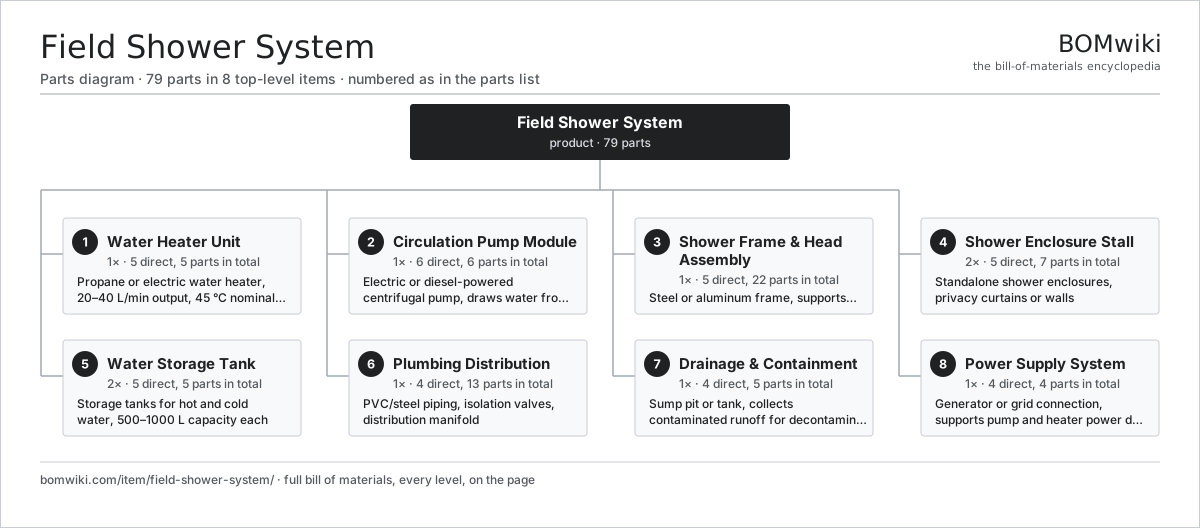
| # | Part | Qty | What it does |
|---|---|---|---|
| 1 | Water Heater Unit 5 parts | 1× | Propane or electric water heater, 20–40 L/min output, 45 °C nominal temperature |
| 2 | Circulation Pump Module 6 parts | 1× | Electric or diesel-powered centrifugal pump, draws water from supply tank and pressuizes |
| 3 | Shower Frame & Head Assembly 5 parts | 1× | Steel or aluminum frame, supports shower heads and enclosure |
| 4 | Shower Enclosure Stall 5 parts | 2× | Standalone shower enclosures, privacy curtains or walls |
| 5 | Water Storage Tank 5 parts | 2× | Storage tanks for hot and cold water, 500–1000 L capacity each |
| 6 | Plumbing Distribution 4 parts | 1× | PVC/steel piping, isolation valves, distribution manifold |
| 7 | Drainage & Containment 4 parts | 1× | Sump pit or tank, collects contaminated runoff for decontamination |
| 8 | Power Supply System 4 parts | 1× | Generator or grid connection, supports pump and heater power draw |
3D model
No 3D model yet. Have a CAD file of this? Add a 3D model. STL renders right on this page; STEP, FreeCAD, and OpenSCAD sources are welcome too (openly licensed, like all 3D models on BOMwiki).
Build & assembly graph
expand / collapse · shared sub-assemblies converge · links to related products · est. labourTap an assembly to expand/collapse · tap a part to open it · use “Open page” for any node · drag to pan, scroll to zoom.
Bill of materials for Field Shower System
8 top-level lines · 46 rows shown · 79 parts total · indented to 3 levels| # | Item / sub-assembly | Part no. | Qty/assy | Ext. qty | Parts | Type |
|---|---|---|---|---|---|---|
| 1 | Water Heater Unit 5 parts | field-shower-system-water-heater | 1× | 1 | 5 | assembly |
| 1.1 | Propane Burner | field-shower-system-burner-assembly | 1× | 1 | · | part |
| 1.2 | Plate Heat Exchanger | field-shower-system-heat-exchanger | 1× | 1 | · | part |
| 1.3 | Thermostatic Mixing Valve | field-shower-system-thermostatic-mixing-valve | 1× | 1 | · | part |
| 1.4 | Pressure Relief Valve | field-shower-system-pressure-relief-valve | 1× | 1 | · | part |
| 1.5 | Insulated Housing | field-shower-system-insulated-housing | 1× | 1 | · | part |
| 2 | Circulation Pump Module 6 parts | field-shower-system-pump-module | 1× | 1 | 6 | assembly |
| 2.1 | Centrifugal Water Pump | field-shower-system-centrifugal-pump | 1× | 1 | · | part |
| 2.2 | Pump Drive Motor | field-shower-system-pump-motor | 1× | 1 | · | part |
| 2.3 | Suction Strainer | field-shower-system-pump-strainer | 1× | 1 | · | part |
| 2.4 | Suction Hose Assembly | field-shower-system-suction-hose | 1× | 1 | · | part |
| 2.5 | Discharge Hose | field-shower-system-discharge-hose | 1× | 1 | · | part |
| 2.6 | Check Valve | field-shower-system-check-valve | 1× | 1 | · | part |
| 3 | Shower Frame & Head Assembly 5 parts | field-shower-system-shower-frame-assembly | 1× | 1 | 22 | assembly |
| 3.1 | Structural Beam | field-shower-system-frame-beam | 4× | 4 | · | part |
| 3.2 | Wide-Spray Shower Head | field-shower-system-shower-head | 4× | 4 | · | part |
| 3.3 | Lateral Distribution Pipe | field-shower-system-lateral-pipe | 2× | 2 | · | part |
| 3.4 | Shower Head Isolation Valve | field-shower-system-isolation-valve | 4× | 4 | · | part |
| 3.5 | Quick-Connect Coupling | field-shower-system-frame-connector | 8× | 8 | · | part |
| 4 | Shower Enclosure Stall 5 parts | field-shower-system-shower-stalls | 2× | 2 | 7 | assembly |
| 4.1 | Stall Frame | field-shower-system-stall-frame | 1× | 2 | · | part |
| 4.2 | Privacy Curtain | field-shower-system-privacy-curtain | 2× | 4 | · | part |
| 4.3 | Curtain Suspension Rod | field-shower-system-curtain-rod | 2× | 4 | · | part |
| 4.4 | Drainage Floor Pan | field-shower-system-drainage-pan | 1× | 2 | · | part |
| 4.5 | Non-Slip Floor Mat | field-shower-system-stall-flooring | 1× | 2 | · | part |
| 5 | Water Storage Tank 5 parts | field-shower-system-water-tanks | 2× | 2 | 5 | assembly |
| 5.1 | HDPE Tank Body | field-shower-system-tank-body | 1× | 2 | · | part |
| 5.2 | Tank Lockable Lid | field-shower-system-tank-lid | 1× | 2 | · | part |
| 5.3 | Supply Hose | field-shower-system-filler-hose | 1× | 2 | · | part |
| 5.4 | Bottom Drain Valve | field-shower-system-drain-plug | 1× | 2 | · | part |
| 5.5 | Tank Elevation Frame | field-shower-system-tank-support-frame | 1× | 2 | · | part |
| 6 | Plumbing Distribution 4 parts | field-shower-system-plumbing-distribution | 1× | 1 | 13 | assembly |
| 6.1 | Distribution Manifold | field-shower-system-distribution-manifold | 1× | 1 | · | part |
| 6.2 | Insulated Steel Pipe | field-shower-system-insulated-pipe-sections | 4× | 4 | · | part |
| 6.3 | Isolation Gate Valve | field-shower-system-gate-valves | 6× | 6 | · | part |
| 6.4 | Pressure Gauge | field-shower-system-pressure-gauge | 2× | 2 | · | part |
| 7 | Drainage & Containment 4 parts | field-shower-system-drainage-system | 1× | 1 | 5 | assembly |
| 7.1 | Sump Tank | field-shower-system-sump-tank | 1× | 1 | · | part |
| 7.2 | Floor Drain Grate | field-shower-system-floor-drains | 2× | 2 | · | part |
| 7.3 | Sediment Filter Bag | field-shower-system-sediment-filter | 1× | 1 | · | part |
| 7.4 | Pump-Out Quick Coupler | field-shower-system-pump-out-port | 1× | 1 | · | part |
| 8 | Power Supply System 4 parts | field-shower-system-power-supply | 1× | 1 | 4 | assembly |
| 8.1 | Diesel Generator | field-shower-system-portable-generator | 1× | 1 | · | part |
| 8.2 | Transfer Switch | field-shower-system-transfer-switch | 1× | 1 | · | part |
| 8.3 | Power Panel | field-shower-system-power-distribution-panel | 1× | 1 | · | part |
| 8.4 | Propane Tank | field-shower-system-fuel-tank | 1× | 1 | · | part |
Something wrong in this list? Report a problem with this BOM.
Sourcing: possible vendors
Browse the supplier directory → Prices, MOQ, and lead times are algorithmic estimates, not quotes, and not claims about these companies. Company mappings are curated by keyword; est. price band $200–$100M. How estimates work| Vendor | HQ | Specialty | MOQ | Lead time |
|---|---|---|---|---|
| smithsdetection.com ↗ | London, GB | Security screening | made to order | 24–52 wks |
|
🇺🇸Leidos
leidos.com ↗
|
Reston, US | Security & screening | made to order | 24–52 wks |
|
🇺🇸Rapiscan
rapiscansystems.com ↗
|
Torrance, US | X-ray screening | made to order | 24–52 wks |
|
🇫🇷Thales
thalesgroup.com ↗
|
Paris, FR | Defense electronics | made to order | 24–52 wks |
| baesystems.com ↗ | London, GB | Defense | made to order | 24–52 wks |
1,507-word article