Fire Damper
ProductOverview
Fire-resistance-rated walls and floors only work if every penetration through them is protected, and HVAC ducts are the biggest penetrations in most buildings. A fire damper sits in the duct at the plane of the barrier and restores the wall's rating when fire arrives: a Fusible Link melts at 72 °C, a spring-driven steel curtain slams shut in under a second, and the opening that was a duct becomes, functionally, more wall. Unlike a smoke damper it has no actuator and no wiring; it is a purely mechanical device that has changed little since the mid-20th century because it rarely needs to.
The curtain type described here is the dominant style for rectangular ducts. Its Blade Curtain of interlocking blades folds into a pocket at the top of the Damper Frame, completely out of the airstream on "type B" models, so the damper adds almost no pressure drop in normal service.
How it works
In the open state the blade stack is folded accordion-fashion in the head pocket, restrained by the Release Latch. The latch is held by the Fusible Link, two metal halves joined by a eutectic solder that loses strength sharply at its rated temperature. The standard 72 °C (165 °F) rating sits far enough above normal supply-air temperatures to avoid nuisance trips while still responding early in a fire; 100 °C links serve heating systems with hot supply air.
When the link parts, the Closure Spring Pack takes over. Type 301 stainless Closure Springs are constant-force ribbon coils, chosen because their pull is nearly flat across the whole stroke and independent of mounting orientation, the same damper closes upward, downward, or sideways. The Bottom Bar leads the cascade, the Curtain Blades unfold and interlock at their hooked edges, the blade ends run down the Blade Tracks, and Blade Locks snap behind the stack so pressure pulses from the fire cannot bounce it open. Dynamic-rated dampers must demonstrate closure against 10.2 m/s (2,000 fpm) of moving air at 1 kPa, fans in modern smoke-control sequences often keep running, and a damper that only closes in still air is no longer acceptable for those systems.
Installation: the part that fails inspections
A fire damper is listed as a system, not a loose product, and most field failures are installation failures. The damper mounts inside a steel Mounting Sleeve that passes through the barrier. The duct connects to the sleeve through Breakaway Joints, deliberately weak slip joints, so that when an unprotected duct run softens and collapses in the fire, it tears away at the joint and leaves the damper seated in the wall rather than ripping it out. Retaining Angles on both faces of the barrier hold the sleeve while still permitting the expansion clearance the listing demands, roughly 3 mm per 300 mm of damper dimension: a steel frame heated to 500 °C grows several millimetres, and a damper installed tight will bow and jam its own curtain. The Perimeter Seal around the sleeve is treated exactly as the listing says, sometimes packed, sometimes mandatorily left open, a detail that regularly surprises installers used to caulking every gap.
Every damper also needs a service opening. The Access Provision provision, an insulated Access Door within reach of the curtain, marked with a Identification Label, exists because NFPA 80 requires each damper to be drop-tested one year after installation and every four years thereafter (six in hospitals). The Test Tab lets the inspector release and reset the curtain without sacrificing a link. Industry surveys of first-time inspections routinely find 15–20 % of dampers failed closed, blocked by ductwork debris, painted links, or missing clearance, which is why the inspection regime is unforgiving.
Ratings and variants
UL 555 assigns 1.5-hour dampers to barriers rated up to 2 hours and 3-hour dampers to barriers above that. Larger openings use multiple damper sections ganged in a common sleeve, each section capped near 900 × 900 mm. Round ducts use curtain dampers with round transitions or single-blade/multi-blade types. Where smoke control matters, combination fire/smoke dampers replace the fusible link with a 141 °C-rated heat-responsive device plus an electric actuator, picking up UL 555S leakage classes, but the plain curtain damper remains the workhorse wherever the requirement is fire containment alone. European practice under EN 15650 uses tested single-blade dampers with thermal release at 72 °C and EI classifications matched to the wall.
Fire Damper parts and their functions
6 top-level parts · 50 parts in total · full bill of materials below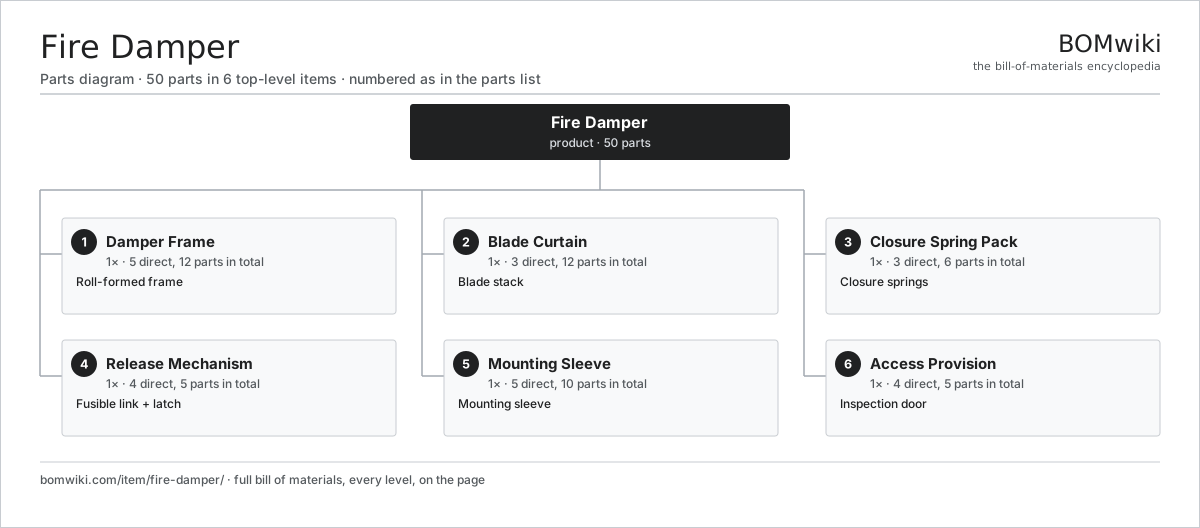
| # | Part | Qty | What it does |
|---|---|---|---|
| 1 | Damper Frame 5 parts | 1× | Roll-formed frame |
| 2 | Blade Curtain 3 parts | 1× | Blade stack |
| 3 | Closure Spring Pack 3 parts | 1× | Closure springs |
| 4 | Release Mechanism 4 parts | 1× | Fusible link + latch |
| 5 | Mounting Sleeve 5 parts | 1× | Mounting sleeve |
| 6 | Access Provision 4 parts | 1× | Inspection door |
3D model
No 3D model yet. Have a CAD file of this? Add a 3D model. STL renders right on this page; STEP, FreeCAD, and OpenSCAD sources are welcome too (openly licensed, like all 3D models on BOMwiki).
Build & assembly graph
expand / collapse · shared sub-assemblies converge · links to related products · est. labourTap an assembly to expand/collapse · tap a part to open it · use “Open page” for any node · drag to pan, scroll to zoom.
Bill of materials for Fire Damper
6 top-level lines · 30 rows shown · 50 parts total · indented to 3 levels| # | Item / sub-assembly | Part no. | Qty/assy | Ext. qty | Parts | Type |
|---|---|---|---|---|---|---|
| 1 | Damper Frame 5 parts | fire-damper-frame | 1× | 1 | 12 | assembly |
| 1.1 | Frame Channel | fire-damper-frame-channel | 4× | 4 | · | part |
| 1.2 | Corner Gusset | fire-damper-corner-gusset | 4× | 4 | · | part |
| 1.3 | Blade Track | fire-damper-blade-track | 2× | 2 | · | part |
| 1.4 | Blade Stop | fire-damper-blade-stop | 1× | 1 | · | part |
| 1.5 | Fastener Set | fastener-set | 1× | 1 | · | part |
| 2 | Blade Curtain 3 parts | fire-damper-curtain | 1× | 1 | 12 | assembly |
| 2.1 | Curtain Blade | fire-damper-blade | 9× | 9 | · | part |
| 2.2 | Bottom Bar | fire-damper-bottom-bar | 1× | 1 | · | part |
| 2.3 | Blade Lock | fire-damper-blade-lock | 2× | 2 | · | part |
| 3 | Closure Spring Pack 3 parts | fire-damper-spring-pack | 1× | 1 | 6 | assembly |
| 3.1 | Closure Spring | fire-damper-closure-spring | 2× | 2 | · | part |
| 3.2 | Spring Drum | fire-damper-spring-drum | 2× | 2 | · | part |
| 3.3 | Spring Bracket | fire-damper-spring-bracket | 2× | 2 | · | part |
| 4 | Release Mechanism 4 parts | fire-damper-release | 1× | 1 | 5 | assembly |
| 4.1 | Fusible Link | fire-damper-fusible-link | 1× | 1 | · | part |
| 4.2 | Link Hook | fire-damper-link-hook | 2× | 2 | · | part |
| 4.3 | Release Latch | fire-damper-release-latch | 1× | 1 | · | part |
| 4.4 | Test Tab | fire-damper-test-tab | 1× | 1 | · | part |
| 5 | Mounting Sleeve 5 parts | fire-damper-sleeve | 1× | 1 | 10 | assembly |
| 5.1 | Sheet Metal Panel | sheet-panel | 2× | 2 | · | part |
| 5.2 | Breakaway Joint | fire-damper-breakaway-joint | 2× | 2 | · | part |
| 5.3 | Retaining Angle | fire-damper-retaining-angle | 4× | 4 | · | part |
| 5.4 | Perimeter Seal | fire-damper-perimeter-seal | 1× | 1 | · | part |
| 5.5 | Fastener Set | fastener-set | 1× | 1 | · | part |
| 6 | Access Provision 4 parts | fire-damper-access | 1× | 1 | 5 | assembly |
| 6.1 | Access Door | fire-damper-access-door | 1× | 1 | · | part |
| 6.2 | Door Gasket | fire-damper-door-gasket | 1× | 1 | · | part |
| 6.3 | Door Latch | fire-damper-door-latch | 2× | 2 | · | part |
| 6.4 | Identification Label | fire-damper-id-label | 1× | 1 | · | part |
Something wrong in this list? Report a problem with this BOM.
Related products
same domain, ranked by shared parts Access Control Panel
52 parts · shares 1 with this page
Access Control Panel
52 parts · shares 1 with this page
 Air Dancer
46 parts · shares 1 with this page
Automatic Smoke Vent
60 parts · shares 1 with this page
Air Dancer
46 parts · shares 1 with this page
Automatic Smoke Vent
60 parts · shares 1 with this page
 Automatic Swing Door Operator
43 parts · shares 1 with this page
Automatic Swing Door Operator
43 parts · shares 1 with this page
 Crowd Barrier
113 parts · shares 1 with this page
Electric Strike
23 parts · shares 1 with this page
Crowd Barrier
113 parts · shares 1 with this page
Electric Strike
23 parts · shares 1 with this page
Sourcing: possible vendors
Browse the supplier directory → Prices, MOQ, and lead times are algorithmic estimates, not quotes, and not claims about these companies. Company mappings are curated by keyword; est. price band $50–$10k. How estimates work| Vendor | HQ | Specialty | MOQ | Lead time |
|---|---|---|---|---|
| assaabloy.com ↗ | Stockholm, SE | Locks & access | 1,000 units | 8–12 wks |
|
🇺🇸Allegion
allegion.com ↗
|
Dublin, US | Security products (Schlage) | 1,000 units | 8–12 wks |
| dormakaba.com ↗ | Rümlang, CH | Access & door systems | 1,000 units | 8–12 wks |
| honeywell.com ↗ | Charlotte, US | Building & safety tech | 1,000 units | 8–12 wks |
| hikvision.com ↗ | Hangzhou, CN | Surveillance & security | 1,000 units | 8–12 wks |
791-word article