Fireplace Insert
ProductOverview
A fireplace insert is a factory-built wood stove that fits entirely within the masonry or steel box of an existing fireplace. Rather than replacing the fireplace with a standalone unit or living with poor efficiency of an open fire, a homeowner can retrofit an insert into the existing opening. The insert serves two roles: it acts as the primary heating surface (via radiant heat from its steel exterior) and a secondary air circulation device (via a Convection Blower System that draws room air around the hot firebox and ejects it back into the room).
The benefit of retrofitting over new construction is financial: masonry fireplaces are expensive to build (~$5,000–10,000 materials + labor), whereas a quality insert runs $1,500–4,000 installed and can be added to an existing fireplace in a single day. The insert also provides a cleaner aesthetic, the fireplace opening and hearth remain unchanged, with only the Door Assembly and visible Surround Panel Kit visible from the room.
Traditional open fireplaces are dramatically inefficient (10–15% of wood energy heats the house; 85–90% escapes up the chimney) because hot exhaust gases and warm room air are constantly pulled up the flue to replace cold intake air. An insert Insert Firebox is sealed on three sides and the back, forcing all combustion air through a controlled Baffle Plate path. The Convection Blower System then recirculates room air that would normally be drawn up the chimney, improving net heating efficiency to 60–80%.
How it works
The insert is a steel box approximately 20–35 cm deep that is positioned in the fireplace opening, with its Flue Connection Adapter connecting to the existing chimney flue collar. The existing fireplace opening is filled around the insert edges with Surround Panel Kit and trim, creating a seal against the masonry. A non-combustible hearth pad typically covers the fireplace floor and extends 18 inches in front of the insert door.
Wood is loaded and burned in the Insert Firebox exactly as in a standalone stove: kindling is placed on the Firewood Grate, the Door Assembly is closed and latched, and room air is drawn in through primary intake ports below the grate. As wood heats and volatile gases rise, they encounter the Baffle Plate, which deflects gases toward the rear and then upward, slowing their path and allowing maximum contact with the hot steel walls of the Insert Firebox. This residence time in the combustion zone allows secondary reaction of unburned hydrocarbons.
Hot flue gases exit the top of the Insert Firebox and enter the Flue Connection Adapter, which channels them into the existing masonry chimney flue. The insert relies on natural draft from the chimney height, there is no induced-draft fan, as is typical in modern stoves, so the chimney must be unobstructed and have adequate height (typically 12–15 feet minimum).
The Convection Blower System is a separate motor and fan assembly mounted on the outside of the insert box or integrated into the cabinet. The blower draws room air through intake grilles at the base of the insert (or from the fireplace hearth), circulates it around the hot Insert Firebox exterior, and ejects warm air through discharge outlets (typically along the sides and top of the insert opening). A simple thermostat or manual speed control allows the operator to increase convection air flow as the insert heats up, or a variable-speed motor may adjust automatically based on surface temperature.
Ash falls from the coals through the Firewood Grate into a removable Ash Pan beneath the insert. This pan is typically pulled out and emptied every few burns or as needed. A thin ash bed on the grate itself actually improves heat retention and draft characteristics.
The Door Assembly consists of a Door Frame that holds a large Door Glass panel, allowing the user to view flames while the insert is operating. The Door Gasket Seal seals the perimeter of the glass and frame to the insert body, preventing air leakage around the door. A Door Latch mechanically holds the door tightly closed during operation.
Installation and clearances
Proper installation requires careful attention to clearances. The insert itself generates extreme heat, the exterior Insert Firebox walls can reach 250°C+. If the insert is positioned against uninsulated wood framing or brick in the fireplace throat area, the surrounding structure can overheat and risk fire. Most manufacturer specifications require a minimum 2–3 inch air gap behind and above the insert for convection cooling, and this is maintained by mounting brackets that hold the insert away from the back wall of the fireplace.
The Surround Panel Kit must be non-combustible or at minimum 3 inches away from the hot insert surface. Steel side trim kits are common and conduct some heat away from surrounding masonry, providing additional safety margin.
The chimney flue itself must be inspected and cleaned before insert installation. If the flue is obstructed or severely deteriorated (large cracks, loose mortar), creosote and smoke will back up into the room. Many jurisdictions now require a chimney liner (steel or ceramic tube) to be installed with an insert retrofit; the liner protects the masonry from thermal shock and acid condensation, and provides a seal that prevents room air from being drawn in through flue gaps.
Maintenance
Annual inspection of the insert includes:
- Professional chimney cleaning (typically every 1–2 years, depending on wood type and volume burned).
- Inspection of the Door Gasket Seal, ceramic rope gradually compacts and should be replaced every 3–5 years.
- Cleaning of the Convection Blower System motor and housing, as dust and ash can accumulate.
- Visual check of the Baffle Plate for warping or ash accumulation that blocks gas flow.
If the Convection Blower System develops a grinding noise or vibration, the motor bearings may be failing, this is a common wear item and typically replaced rather than repaired.
The insert's thermal mass (steel insert + masonry fireplace) acts as a heat battery, absorbing energy during burns and radiating it long after the fire dies down. This radiant heating continues for 4–6 hours after a burn, reducing heating costs compared to forced-air systems that shut down immediately.
Economic perspective
A retrofit insert saves 50–65% of the heating cost of an open fireplace (relative to total household heating) and approaches 30–40% savings versus an oil or gas furnace in jurisdictions where wood is inexpensive. However, the labor investment in wood handling (splitting, stacking, seasoning, loading) is substantial. A typical heating season requires 3–8 cords (12–32 m³) of split hardwood, which, if purchased ready-split and seasoned, costs $600–1,500 depending on region. If the homeowner splits and seasons their own wood from free or cheap trees, the effective cost per BTU can be competitive with fossil fuels; if purchasing quality seasoned firewood, wood and oil costs are similar in many climates.
The insert also improves the aesthetic and functional value of the fireplace itself: rather than an unusable architectural feature, the open fireplace becomes an active heating appliance that can be enjoyed visually during operation.
Fireplace Insert parts and their functions
8 top-level parts · 27 parts in total · full bill of materials below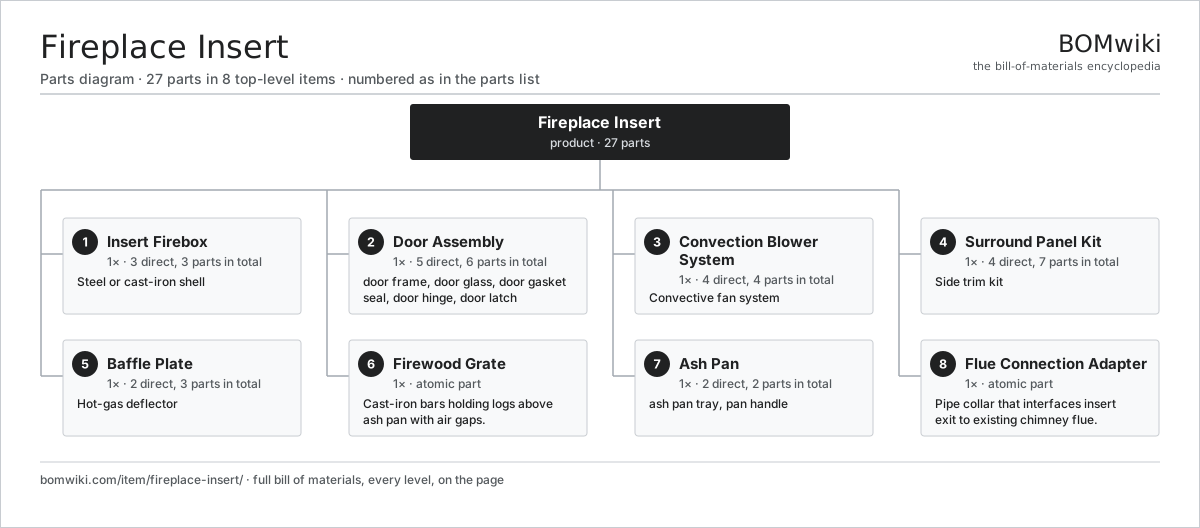
| # | Part | Qty | What it does |
|---|---|---|---|
| 1 | Insert Firebox 3 parts | 1× | Steel or cast-iron shell |
| 2 | Door Assembly 5 parts | 1× | Cast-iron frame with tempered glass panel and sealing gasket. |
| 3 | Convection Blower System 4 parts | 1× | Convective fan system |
| 4 | Surround Panel Kit 4 parts | 1× | Side trim kit |
| 5 | Baffle Plate 2 parts | 1× | Hot-gas deflector |
| 6 | Firewood Grate | 1× | Cast-iron bars holding logs above ash pan with air gaps. |
| 7 | Ash Pan 2 parts | 1× | Removable steel tray collecting ash below grate. |
| 8 | Flue Connection Adapter | 1× | Pipe collar that interfaces insert exit to existing chimney flue. |
3D model
No 3D model yet. Have a CAD file of this? Add a 3D model. STL renders right on this page; STEP, FreeCAD, and OpenSCAD sources are welcome too (openly licensed, like all 3D models on BOMwiki).
Build & assembly graph
expand / collapse · shared sub-assemblies converge · links to related products · est. labourTap an assembly to expand/collapse · tap a part to open it · use “Open page” for any node · drag to pan, scroll to zoom.
Bill of materials for Fireplace Insert
8 top-level lines · 28 rows shown · 27 parts total · indented to 3 levels| # | Item / sub-assembly | Part no. | Qty/assy | Ext. qty | Parts | Type |
|---|---|---|---|---|---|---|
| 1 | Insert Firebox 3 parts | fireplace-insert-firebox | 1× | 1 | 3 | assembly |
| 1.1 | Firebox Body | fireplace-insert-firebox-body | 1× | 1 | · | part |
| 1.2 | Refractory Liner | fireplace-insert-refractory-liner | 1× | 1 | · | part |
| 1.3 | Firebox Top | fireplace-insert-firebox-top | 1× | 1 | · | part |
| 2 | Door Assembly 5 parts | fireplace-insert-door-assembly | 1× | 1 | 6 | assembly |
| 2.1 | Door Frame | fireplace-insert-door-frame | 1× | 1 | · | part |
| 2.2 | Door Glass | fireplace-insert-door-glass | 1× | 1 | · | part |
| 2.3 | Door Gasket Seal | fireplace-insert-door-gasket | 1× | 1 | · | part |
| 2.4 | Door Hinge | fireplace-insert-door-hinge | 2× | 2 | · | part |
| 2.5 | Door Latch | fireplace-insert-door-latch | 1× | 1 | · | part |
| 3 | Convection Blower System 4 parts | fireplace-insert-blower | 1× | 1 | 4 | assembly |
| 3.1 | Blower Motor | blower-motor | 1× | 1 | · | part |
| 3.2 | Blower Impeller | fireplace-insert-blower-wheel | 1× | 1 | · | part |
| 3.3 | Blower Scroll | fireplace-insert-blower-housing | 1× | 1 | · | part |
| 3.4 | Blower Speed Control | fireplace-insert-blower-speed-control | 1× | 1 | · | part |
| 4 | Surround Panel Kit 4 parts | fireplace-insert-surround-panels | 1× | 1 | 7 | assembly |
| 4.1 | Left Surround Panel | fireplace-insert-surround-left | 1× | 1 | · | part |
| 4.2 | Right Surround Panel | fireplace-insert-surround-right | 1× | 1 | · | part |
| 4.3 | Top Surround Panel | fireplace-insert-surround-top | 1× | 1 | · | part |
| 4.4 | Surround Bracket | fireplace-insert-trim-bracket | 4× | 4 | · | part |
| 5 | Baffle Plate 2 parts | fireplace-insert-baffle | 1× | 1 | 3 | assembly |
| 5.1 | Baffle Plate | fireplace-insert-baffle-plate | 1× | 1 | · | part |
| 5.2 | Baffle Support | fireplace-insert-baffle-support | 2× | 2 | · | part |
| 6 | Firewood Grate | fireplace-insert-grate | 1× | 1 | · | part |
| 7 | Ash Pan 2 parts | fireplace-insert-ash-pan | 1× | 1 | 2 | assembly |
| 7.1 | Ash Pan Tray | fireplace-insert-ash-pan-tray | 1× | 1 | · | part |
| 7.2 | Pan Handle | fireplace-insert-ash-pan-handle | 1× | 1 | · | part |
| 8 | Flue Connection Adapter | fireplace-insert-flue-adaptor | 1× | 1 | · | part |
Something wrong in this list? Report a problem with this BOM.
Related products
same domain, ranked by shared parts Air Curtain
115 parts · shares 1 with this page
Air Curtain
115 parts · shares 1 with this page
 Ceiling Cassette AC
395 parts · shares 1 with this page
Ceiling Cassette AC
395 parts · shares 1 with this page
 Dehumidifier
217 parts · shares 1 with this page
Direct-Vent Wall Furnace
25 parts · shares 1 with this page
Dehumidifier
217 parts · shares 1 with this page
Direct-Vent Wall Furnace
25 parts · shares 1 with this page
 Electric Furnace
33 parts · shares 1 with this page
Electric Furnace
33 parts · shares 1 with this page
 Evaporative Cooler
101 parts · shares 1 with this page
Evaporative Cooler
101 parts · shares 1 with this page
Sourcing: possible vendors
Browse the supplier directory → Prices, MOQ, and lead times are algorithmic estimates, not quotes, and not claims about these companies. Company mappings are curated by keyword; est. price band $100–$20k. How estimates work| Vendor | HQ | Specialty | MOQ | Lead time |
|---|---|---|---|---|
|
🇺🇸Carrier
carrier.com ↗
|
Palm Beach Gardens, US | HVAC | 500 units | 8–14 wks |
| tranetechnologies.com ↗ | Davidson, US | HVAC | 500 units | 8–14 wks |
|
🇯🇵Daikin
daikin.com ↗
|
Osaka, JP | HVAC | 500 units | 8–14 wks |
|
🇺🇸Lennox
lennox.com ↗
|
Richardson, US | HVAC | 500 units | 8–14 wks |
| johnsoncontrols.com ↗ | Milwaukee, US | Building systems | 500 units | 8–14 wks |
1,223-word article