Fish Filleting Machine
ProductAlso known as: Fish Filleting Line
Overview
Fish filleting machines automatically separate fish fillets from whole carcasses using precision-controlled cutting blades. The machine positions whole fish (typically 200 g to 2.5 kg) onto a moving conveyor system with shaped pockets that hold the fish upright and advance it through the cutting zone. A reciprocating or rotary cutting blade (typically 200 mm long × 60 mm wide) moves at 20–40 strokes per second, following the fish's contours and separating the fillet from the rib cage and backbone in one or two passes. High-pressure water jets cool the blade and flush away bone fragments and scales.
The depth of cut is controlled by an adjustable micrometer stop, typically set to 0–3 mm. This shallow cut removes the fillet cleanly without cutting into the rib cage or leaving excess flesh on the bones. Lateral guides constrain the fish's position so the blade follows the natural seam between flesh and bone. After cutting, the separated fillet drops onto a secondary conveyor or collection tray; the remaining carcass continues to a disposal or further-processing area.
A typical mid-capacity machine processes 300–600 whole fish per hour, achieving 45–65% fillet yield (weight of fillets divided by initial fish weight). Seafood processors, fish farms, and retail groceries with in-house processing operations rely on these machines to convert commodity whole fish into higher-value fillets. Industrial facilities often deploy multiple units in tandem or use larger carousel systems with 4–8 cutting heads working on different fish simultaneously.
How It Works
Operators load whole, cleaned fish (viscera and scales already removed) into the conveyor pockets. The conveyor advances at 5–15 m/min, carrying each fish sequentially into the cutting zone. As the fish enters, it is positioned against a lateral guide rail and under the reciprocating blade.
The blade moves at 20–40 strokes per second (frequency set by the motor gearbox reduction ratio). With each stroke, the blade cuts through flesh and separates the fillet from the rib cage. The blade follows a path parallel to the backbone, guided by the fish's natural anatomy. A depth stop limits the blade's penetration to 0–3 mm below the skin surface, preventing the blade from cutting into the carcass beneath.
Simultaneously, high-pressure spray nozzles (typically 60 bar) direct water onto the blade and cutting zone. The water serves three purposes: (1) cooling the blade, preventing heat buildup and edge dulling, (2) flushing away bone dust, scales, and blood that would obscure the blade path, and (3) lubricating the blade, reducing drag and noise.
After the cut is complete (taking 2–5 seconds depending on fish size), the fillet either separates naturally from the carcass or is knocked loose by mechanical tapper or brush. The fillet drops onto a secondary conveyor bound for grading, skin-removal, or freezing. The partially deboned carcass continues in the conveyor for a second pass (if used) to recover a second fillet from the opposite side, or moves to a secondary processing area.
Design Considerations
Blade design and sharpness are critical. Fish fillets demand a very sharp blade edge; a dull blade crushes tissue rather than cutting cleanly, resulting in bruised flesh, rapid oxidation, and shortened shelf life. Most operations sharpen or replace blades daily or every 8–12 hours of use. Serrated blades (with fine teeth) cut more smoothly than straight edges and are increasingly standard on modern machines.
The blade's stroke length and frequency determine how cleanly the fillet separates. Too-shallow a stroke or too-slow a frequency leaves ragged, incomplete separation; too-long a stroke or too-high a frequency risks cutting through the fillet. Operators adjust blade speed via the variable-frequency drive to match the target fish species. Salmon fillets require different settings than cod, which require different settings than catfish.
Fish size variation is a constant challenge. The lateral guide rails and depth stop are calibrated for a specific size range (e.g., 300–800 g fish). If fish are significantly larger or smaller, the blade may miss the fillet seam or cut too deep. Many facilities pre-sort fish by size before filleting, feeding each size class to a dedicated machine with optimized settings. Mixed-size batches require manual adjustment of guide rails and depth stops between fish, slowing production.
The spray system must be robust. Salt water and fish blood are corrosive; stainless steel 304 or 316L is mandatory for all wetted parts. Spray nozzles clog frequently from scale and bone dust. Daily backflushing or nozzle cleaning is necessary to maintain spray pattern and cooling efficacy. Neglecting nozzle maintenance leads to blade overheating, accelerated dulling, and poor cut quality within hours.
Filet recovery rate (yield) depends on blade sharpness, depth setting, and operator skill in loading fish. Industry benchmarks are 45–55% yield for whole round fish (e.g., salmon, cod) and 60–70% for dressed fish (scales and viscera removed). Machines with poor blade maintenance or misadjusted guides achieve only 35–40% yield, representing significant product loss.
The gripper pockets or clips that hold the fish require periodic inspection. Broken or worn grippers allow fish to slip or rotate during cutting, resulting in misaligned fillets or blade collisions. Most clips are plastic or rubber and cost $ 5–20 each; replacement is quick (unbolt, slide out, slide in new gripper) but labor-intensive if many need replacement simultaneously.
Safety is important. The reciprocating blade moves at high frequency and can cause serious lacerations if an operator's hand is in the path. Modern machines include guard enclosures and emergency-stop mushroom buttons. However, operators loading and unloading fish work close to the blade. Training and vigilance are essential.
Cleanup requires daily attention. Blood and fish tissue dry quickly inside the machine, creating a food-safety risk and promoting off-odors. The collection tray must be emptied after each shift, and all internal surfaces must be sprayed and rinsed with hot water (> 80°C) and food-grade sanitizer. Weekly deep cleaning includes disassembly of removable guards and gripper clips for soak-washing.
Fish Filleting Machine parts and their functions
7 top-level parts · 39 parts in total · full bill of materials below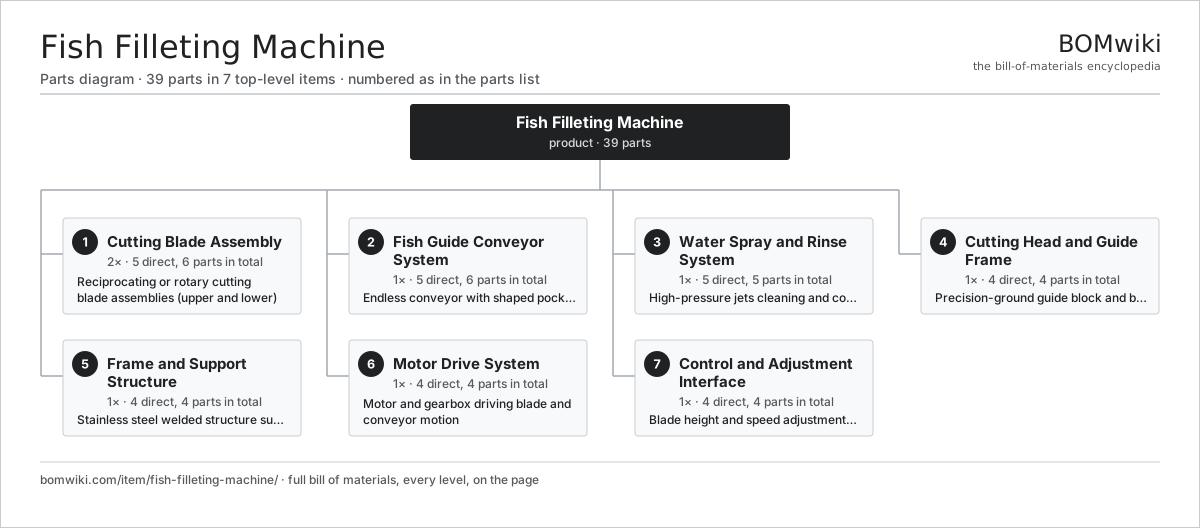
| # | Part | Qty | What it does |
|---|---|---|---|
| 1 | Cutting Blade Assembly 5 parts | 2× | Reciprocating or rotary cutting blade assemblies (upper and lower) |
| 2 | Fish Guide Conveyor System 5 parts | 1× | Endless conveyor with shaped pockets holding fish body |
| 3 | Water Spray and Rinse System 5 parts | 1× | High-pressure jets cleaning and cooling blades |
| 4 | Cutting Head and Guide Frame 4 parts | 1× | Precision-ground guide block and blade-adjustment mechanism |
| 5 | Frame and Support Structure 4 parts | 1× | Stainless steel welded structure supporting all subsystems |
| 6 | Motor Drive System 4 parts | 1× | Motor and gearbox driving blade and conveyor motion |
| 7 | Control and Adjustment Interface 4 parts | 1× | Blade height and speed adjustment, and conveyor timing |
3D model
No 3D model yet. Have a CAD file of this? Add a 3D model. STL renders right on this page; STEP, FreeCAD, and OpenSCAD sources are welcome too (openly licensed, like all 3D models on BOMwiki).
Build & assembly graph
expand / collapse · shared sub-assemblies converge · links to related products · est. labourTap an assembly to expand/collapse · tap a part to open it · use “Open page” for any node · drag to pan, scroll to zoom.
Bill of materials for Fish Filleting Machine
7 top-level lines · 38 rows shown · 39 parts total · indented to 3 levels| # | Item / sub-assembly | Part no. | Qty/assy | Ext. qty | Parts | Type |
|---|---|---|---|---|---|---|
| 1 | Cutting Blade Assembly 5 parts | fish-filleting-machine-blade-cartridge | 2× | 2 | 6 | assembly |
| 1.1 | Cutting Blade | fish-filleting-machine-blade-body | 1× | 2 | · | part |
| 1.2 | Blade Holder Cartridge | fish-filleting-machine-blade-holder | 1× | 2 | · | part |
| 1.3 | Blade Bearing | fish-filleting-machine-blade-bearing | 2× | 4 | · | part |
| 1.4 | Blade Depth Adjustment | fish-filleting-machine-blade-adjustment-screw | 1× | 2 | · | part |
| 1.5 | Fastener Set | fastener-set | 1× | 2 | · | part |
| 2 | Fish Guide Conveyor System 5 parts | fish-filleting-machine-fish-guide-conveyor | 1× | 1 | 6 | assembly |
| 2.1 | Conveyor Chain | fish-filleting-machine-conveyor-chain | 1× | 1 | · | part |
| 2.2 | Fish Gripper Set | fish-filleting-machine-fish-gripper-set | 1× | 1 | · | part |
| 2.3 | Conveyor Sprocket | fish-filleting-machine-conveyor-sprockets | 2× | 2 | · | part |
| 2.4 | Chain Tensioner | fish-filleting-machine-conveyor-tensioner | 1× | 1 | · | part |
| 2.5 | Fastener Set | fastener-set | 1× | 1 | · | part |
| 3 | Water Spray and Rinse System 5 parts | fish-filleting-machine-water-spray-system | 1× | 1 | 5 | assembly |
| 3.1 | Spray Pump | fish-filleting-machine-spray-pump | 1× | 1 | · | part |
| 3.2 | Spray Motor | fish-filleting-machine-spray-motor | 1× | 1 | · | part |
| 3.3 | Spray Manifold | fish-filleting-machine-spray-manifold | 1× | 1 | · | part |
| 3.4 | Spray Nozzle Array | fish-filleting-machine-spray-nozzles | 1× | 1 | · | part |
| 3.5 | Connector | connector | 1× | 1 | · | part |
| 4 | Cutting Head and Guide Frame 4 parts | fish-filleting-machine-cutting-head-frame | 1× | 1 | 4 | assembly |
| 4.1 | Cutting Head Block | fish-filleting-machine-cutting-head-block | 1× | 1 | · | part |
| 4.2 | Lateral Guide Rail | fish-filleting-machine-lateral-guide-rail | 1× | 1 | · | part |
| 4.3 | Depth Stop Mechanism | fish-filleting-machine-depth-stop | 1× | 1 | · | part |
| 4.4 | Fastener Set | fastener-set | 1× | 1 | · | part |
| 5 | Frame and Support Structure 4 parts | fish-filleting-machine-support-frame | 1× | 1 | 4 | assembly |
| 5.1 | Main Frame | fish-filleting-machine-main-frame | 1× | 1 | · | part |
| 5.2 | Sheet Metal Panel | sheet-panel | 1× | 1 | · | part |
| 5.3 | Waste Collection Tray | fish-filleting-machine-waste-tray | 1× | 1 | · | part |
| 5.4 | Fastener Set | fastener-set | 1× | 1 | · | part |
| 6 | Motor Drive System 4 parts | fish-filleting-machine-motor-drive | 1× | 1 | 4 | assembly |
| 6.1 | Blower Motor | blower-motor | 1× | 1 | · | part |
| 6.2 | Drive Gearbox | fish-filleting-machine-drive-gearbox | 1× | 1 | · | part |
| 6.3 | Crank-Slider Linkage | fish-filleting-machine-crank-linkage | 1× | 1 | · | part |
| 6.4 | Fastener Set | fastener-set | 1× | 1 | · | part |
| 7 | Control and Adjustment Interface 4 parts | fish-filleting-machine-controls | 1× | 1 | 4 | assembly |
| 7.1 | Depth Adjustment Knob | fish-filleting-machine-depth-adjustment-knob | 1× | 1 | · | part |
| 7.2 | Width Adjustment Knob | fish-filleting-machine-width-adjustment-knob | 1× | 1 | · | part |
| 7.3 | Speed Controller | fish-filleting-machine-speed-controller | 1× | 1 | · | part |
| 7.4 | Fastener Set | fastener-set | 1× | 1 | · | part |
Something wrong in this list? Report a problem with this BOM.
Sourcing: possible vendors
Browse the supplier directory → Prices, MOQ, and lead times are algorithmic estimates, not quotes, and not claims about these companies. Company mappings are curated by keyword; est. price band $1k–$500k. How estimates work| Vendor | HQ | Specialty | MOQ | Lead time |
|---|---|---|---|---|
| gea.com ↗ | Düsseldorf, DE | Process technology | 20 units | 12–20 wks |
| buhlergroup.com ↗ | Uzwil, CH | Food & materials processing | 20 units | 12–20 wks |
| tetrapak.com ↗ | Pully, CH | Food packaging & processing | 20 units | 12–20 wks |
| jbtc.com ↗ | Chicago, US | Food processing equipment | 20 units | 12–20 wks |
| alfalaval.com ↗ | Lund, SE | Heat transfer & separation | 20 units | 12–20 wks |
1,130-word article