Fishing Rod
ProductOverview
A fishing rod is a flexible lever composed of a carbon-fiber blank, guide rings, reel seat, and grip that transforms arm movement into precise casting and retrieves fish against resistance. The blank's taper stores and releases energy; the guides minimize friction; the reel seat positions the reel for leverage; and the grip provides comfort and control. Modern rods split into upper and lower sections with ferrule joints for portability, allowing sections to be nested for transport and separated for cleaning and repair.
Blank Assembly and Taper
The blank is the structural core, a hollow tapered tube of carbon fibers embedded in epoxy resin. Manufacturers lay up unidirectional carbon in the stress-bearing hoop direction and woven fabric in the circumferential direction to resist torsion and bending. The taper is the progressive reduction in outer diameter from the butt to the tip, typically from 1.2 inches at the base to 0.125 inches at the very tip. This taper determines the rod's action, how it flexes under load. A fast-action blank has a taper concentrated near the tip, storing energy in the upper section and keeping the lower sections stiff. A slow-action blank has a gentler, more even taper, distributing the bend along the entire length.
The blank wall thickness ranges from 3.5 mm at the butt to 0.8 mm at the tip. Thicker walls add weight but increase durability; thinner walls reduce weight but require better carbon fiber alignment to prevent buckling. The hollow core reduces weight by 40–50% compared to a solid blank of equivalent stiffness.
Guide System
Guide rings channel the fishing line along the rod and reduce friction during casting and retrieval. The largest guide sits closest to the reel (the stripping guide), typically 25 mm in inner diameter, and each successive guide shrinks in size as it moves toward the tip, ending with a 6 mm tip guide. This graduated sizing optimizes line velocity and reduces tangles.
Guides are mounted in feet, which are small brackets affixed to the blank with thread wraps and epoxy. Thread wraps begin 0.5 inches below each guide foot and spiral tightly around the blank, then saturated with epoxy resin that hardens into a rigid bond. The wrap pattern is typically tight and evenly spaced, taking 5–10 inches of thread per guide foot.
Modern rods use ceramic ring inserts (alumina or zirconia oxide) or aluminum oxide liners. Ceramic resists corrosion and heat and smooths line passage, reducing friction losses to 3–5%. The rings are press-fit into aluminum frames and can be replaced if damaged.
Reel Seat and Grip
The reel seat is a machined aluminum tube, anodized for corrosion resistance, with internal threads that accept two locking rings. A reel's foot slides into the barrel, and the angler tightens the upper and lower rings to clamp the reel immovably. The clamping force is typically 150–200 pounds-force, sufficient to prevent rotation during a hard fight.
The grip is the handle below the reel seat. Traditional grips use cork, which wicks sweat and provides natural friction. Modern alternatives include EVA foam or Hypalon, which resist mildew and salt corrosion. The grip core is glued to the blank and wrapped in cork sheets. A butt cap, usually rubber or phenolic, provides a blunt end for the angler's palm during fighting.
Ferrules and Sections
Most fishing rods longer than 7 feet split into two sections joined by ferrules. The ferrule is a tapered joint: the male ferrule, a tapered tube glued to the butt end of the tip section, inserts into the female ferrule, a socket reamed into the upper blank. When properly fitted, the joint is tight enough to withstand full casting load yet separates easily by hand for cleaning or transport.
Ferrule tolerances are tight: the taper angle is typically 1.5 degrees, and the fit tolerance is ±0.002 inches. Too loose, and the joint flexes and creaks; too tight, and it seizes during use. A wax-based lubricant applied to the male ferrule eases insertion and prevents sticking.
Hardware and Finish
Hardware includes the fasteners and metal fittings: stainless steel screws securing the reel seat to the blank, guide foot lugs, and a retention pin or spring clip preventing the reel from sliding backward. All hardware is either stainless steel or nickel plated to resist corrosion.
The finish is a protective layer of thread wraps and clear epoxy resin. Guides and ferrules are wrapped with thin nylon thread saturated in two-part epoxy, hardened into a rigid, corrosion-proof shield. A final coat of clear epoxy covers the entire blank, providing UV protection and gloss. Cure time is 24 hours at 20–25°C.
Performance and Standards
A fishing rod's performance is described by its power (light, medium, heavy), action (fast, medium, slow), and line weight rating (8–50 pound test). A medium-action, 7-foot rod casting a 0.017-inch diameter line and landing a 8-pound fish distributes the load across the bend, reducing stress on any single point. Peak bending stress during a strike is typically 40–60 MPa, well below the 300+ MPa tensile strength of carbon fiber.
Weight is a critical metric: lightweight rods reduce angler fatigue on all-day trips. Modern materials and manufacturing keep total weight to 4–8 ounces for a 7-foot rod, a 40% reduction from fiberglass equivalents of the same length.
Fishing Rod parts and their functions
7 top-level parts · 29 parts in total · full bill of materials below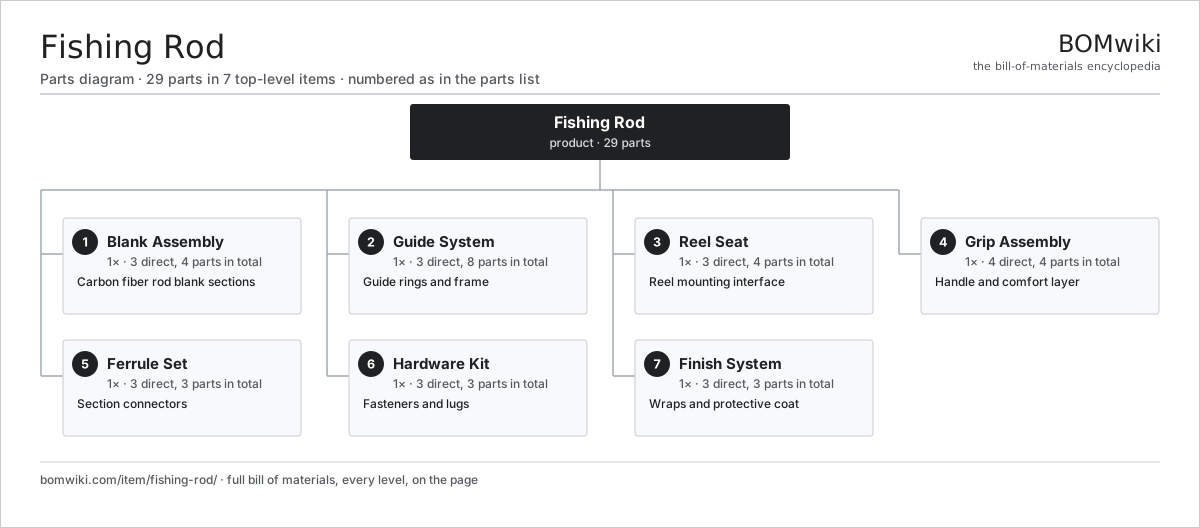
| # | Part | Qty | What it does |
|---|---|---|---|
| 1 | Blank Assembly 3 parts | 1× | Carbon fiber rod blank sections |
| 2 | Guide System 3 parts | 1× | Guide rings and frame |
| 3 | Reel Seat 3 parts | 1× | Reel mounting interface |
| 4 | Grip Assembly 4 parts | 1× | Handle and comfort layer |
| 5 | Ferrule Set 3 parts | 1× | Section connectors |
| 6 | Hardware Kit 3 parts | 1× | Fasteners and lugs |
| 7 | Finish System 3 parts | 1× | Wraps and protective coat |
3D model
No 3D model yet. Have a CAD file of this? Add a 3D model. STL renders right on this page; STEP, FreeCAD, and OpenSCAD sources are welcome too (openly licensed, like all 3D models on BOMwiki).
Build & assembly graph
expand / collapse · shared sub-assemblies converge · links to related products · est. labourTap an assembly to expand/collapse · tap a part to open it · use “Open page” for any node · drag to pan, scroll to zoom.
Bill of materials for Fishing Rod
7 top-level lines · 29 rows shown · 29 parts total · indented to 3 levels| # | Item / sub-assembly | Part no. | Qty/assy | Ext. qty | Parts | Type |
|---|---|---|---|---|---|---|
| 1 | Blank Assembly 3 parts | fishing-rod-blank-assembly | 1× | 1 | 4 | assembly |
| 1.1 | Carbon Blank Tube | fishing-rod-blank-tube | 2× | 2 | · | part |
| 1.2 | Taper Profile | fishing-rod-blank-taper | 1× | 1 | · | part |
| 1.3 | SMD Passive (R/C/L) | smd-passives | 1× | 1 | · | part |
| 2 | Guide System 3 parts | fishing-rod-guide-system | 1× | 1 | 8 | assembly |
| 2.1 | Guide Frame | fishing-rod-guide-frame | 1× | 1 | · | part |
| 2.2 | Guide Rings | fishing-rod-guide-rings | 6× | 6 | · | part |
| 2.3 | Guide Feet | fishing-rod-guide-feet | 1× | 1 | · | part |
| 3 | Reel Seat 3 parts | fishing-rod-reel-seat | 1× | 1 | 4 | assembly |
| 3.1 | Reel Seat Housing | fishing-rod-reel-seat-housing | 1× | 1 | · | part |
| 3.2 | Locking Ring | fishing-rod-reel-seat-clamp | 2× | 2 | · | part |
| 3.3 | Grip Insert | fishing-rod-reel-seat-insert | 1× | 1 | · | part |
| 4 | Grip Assembly 4 parts | fishing-rod-grip-assembly | 1× | 1 | 4 | assembly |
| 4.1 | Grip Core | fishing-rod-grip-core | 1× | 1 | · | part |
| 4.2 | Cork Wrap | fishing-rod-grip-wrap | 1× | 1 | · | part |
| 4.3 | Grip Tape | fishing-rod-grip-tape | 1× | 1 | · | part |
| 4.4 | End Cap | fishing-rod-grip-end-cap | 1× | 1 | · | part |
| 5 | Ferrule Set 3 parts | fishing-rod-ferrule-set | 1× | 1 | 3 | assembly |
| 5.1 | Male Ferrule | fishing-rod-ferrule-male | 1× | 1 | · | part |
| 5.2 | Female Ferrule | fishing-rod-ferrule-female | 1× | 1 | · | part |
| 5.3 | Ferrule Lubricant | fishing-rod-ferrule-lubricant | 1× | 1 | · | part |
| 6 | Hardware Kit 3 parts | fishing-rod-hardware | 1× | 1 | 3 | assembly |
| 6.1 | Fastener Set | fastener-set | 1× | 1 | · | part |
| 6.2 | Lug Set | fishing-rod-lug-set | 1× | 1 | · | part |
| 6.3 | Rod Lock Pin | fishing-rod-rod-lock | 1× | 1 | · | part |
| 7 | Finish System 3 parts | fishing-rod-finish-system | 1× | 1 | 3 | assembly |
| 7.1 | Wrap Thread | fishing-rod-wrap-thread | 1× | 1 | · | part |
| 7.2 | Finish Resin | fishing-rod-finish-resin | 1× | 1 | · | part |
| 7.3 | Curing Agent | fishing-rod-curing-agent | 1× | 1 | · | part |
Something wrong in this list? Report a problem with this BOM.
Related products
same domain, ranked by shared parts Avalanche Transceiver
35 parts · shares 2 with this page
Avalanche Transceiver
35 parts · shares 2 with this page
 Electric Fillet Knife
35 parts · shares 2 with this page
LED Headlamp
33 parts · shares 2 with this page
Electric Fillet Knife
35 parts · shares 2 with this page
LED Headlamp
33 parts · shares 2 with this page
 Portable Power Station
94 parts · shares 2 with this page
Portable Power Station
94 parts · shares 2 with this page
 Rechargeable Camp Lantern
58 parts · shares 2 with this page
Avalanche Probe
29 parts · shares 1 with this page
Rechargeable Camp Lantern
58 parts · shares 2 with this page
Avalanche Probe
29 parts · shares 1 with this page
Sourcing: possible vendors
Browse the supplier directory → Prices, MOQ, and lead times are algorithmic estimates, not quotes, and not claims about these companies. Company mappings are curated by keyword; est. price band $20–$2k. How estimates work| Vendor | HQ | Specialty | MOQ | Lead time |
|---|---|---|---|---|
|
🇺🇸Coleman
coleman.com ↗
|
Chicago, US | Camping gear | 1,000 units | 6–10 wks |
| thenorthface.com ↗ | Denver, US | Outdoor apparel & gear | 1,000 units | 6–10 wks |
|
🇺🇸YETI
yeti.com ↗
|
Austin, US | Coolers & drinkware | 1,000 units | 6–10 wks |
| decathlon.com ↗ | Villeneuve-d'Ascq, FR | Sporting goods | 1,000 units | 6–10 wks |
|
🇺🇸Garmin
garmin.com ↗
|
Olathe, US | GPS & wearables | 1,000 units | 6–10 wks |
934-word article