Flake Ice Machine
ProductOverview
Flake ice machines produce soft, uniform ice flakes (5–10 mm thick, 10–30 mm long) used extensively in food processing for rapid cooling and product preservation. Fresh fish, seafood, meat, and produce are packed directly with flake ice for transport and storage; the soft flakes conform to product shape without bruising, unlike hard crushed or block ice. The machine consists of a rotating stainless-steel drum with internal refrigerant passages, a hermetic refrigeration circuit, a water spray system freezing water on the drum surface, and a spring-loaded scraper blade continuously removing the frozen layer and ejecting it as flakes.
Typical production rates range from 300 to 1000 kg of flake ice per day, depending on ambient temperature, water supply temperature, and machine size. Fishing fleets, seafood processors, meat plants, and produce distributors operate flake ice machines continuously during operating hours to meet cooling demands. The machines are typically sized for the facility's peak cooling load; a 500 kg/day machine might run 12–16 hours daily to accumulate sufficient ice inventory.
How It Works
Water is continuously sprayed onto the rotating drum via the spray nozzles. Inside the drum, a refrigerant circuit circulates cold refrigerant (typically R404A or R290, at -10 to -15°C), freezing the thin water layer on the outer drum surface. As the drum rotates at 30–50 rpm, the spring-loaded scraper blade continuously contacts the frozen surface, breaking the ice layer into small flakes (5–10 mm). The flakes are ejected by centrifugal force or scraped into a chute, falling into the insulated storage bin.
The refrigeration circuit is a standard vapor-compression cycle: the hermetic compressor draws low-pressure vapor from the evaporator (drum), compresses it to high pressure, and discharges it to the condenser (air or water cooled). The condenser rejects heat to the environment, cooling and condensing the refrigerant to liquid. Liquid refrigerant flows through the thermal expansion valve, which meters refrigerant into the drum evaporator at low pressure, where it evaporates, absorbing latent heat from the water and ice on the drum surface. This completes the cycle.
The storage bin is heavily insulated (typically 100 mm polyurethane foam) to minimize ice melt. A full-bin switch automatically shuts down the compressor when ice reaches bin capacity, preventing overflow and reducing energy consumption during low-demand periods.
Design Considerations
The refrigerant distribution inside the drum is critical. Most designs use a long spiral tube or multiple parallel passages to maximize contact area and heat-transfer efficiency. The incoming liquid refrigerant must be distributed evenly across the drum width; uneven distribution results in localized ice formation, creating thick patches that are harder to scrape and reducing overall ice production. The refrigerant outlet is typically a gas (vapor) line that exits the drum and returns to the compressor.
The blade pressure must be carefully set. Too much pressure increases scraper blade wear and energy consumption, and risks damaging the drum surface; too little pressure allows ice to accumulate, forming chunks rather than flakes. Most machines use a spring-loaded holder with a fine-adjustment knob, allowing operators to tune blade pressure (typically 20–30 N preload). Blade wear is inevitable; hardened stainless steel 304 blades typically last 6–12 months before requiring replacement.
Water supply temperature affects ice production significantly. Cold water (< 10°C) freezes faster, increasing production rate; warm water (> 20°C) requires more refrigeration cycles, reducing output. Many seafood plants or remote ice-making facilities use seawater or well water, which can be cooler than municipal supply. Some industrial machines include a pre-cooling loop, passing incoming water through a secondary refrigerant circuit before spraying it onto the drum.
The compressor is the most expensive and failure-prone component. Hermetic scroll compressors are quieter and more reliable than reciprocating designs, but cost more. All compressors are sensitive to ''slugging'', liquid refrigerant entering the compressor instead of only vapor, which can cause catastrophic failure. Proper receiver tank sizing and expansion valve tuning prevent slugging.
The storage bin insulation is critical. Uninsulated bins lose ice rapidly in warm climates. Melt rate depends on ambient temperature, sun exposure, and bin ventilation. In direct sun, an uninsulated bin can melt 20–30% of its contents in 2–3 hours. Most commercial machines include a drain valve allowing operators to remove meltwater (which accumulates at the bin bottom) and maintain ice quality. Meltwater is often recirculated back to the machine to reduce freshwater consumption.
Energy consumption is substantial. A 2.2 kW compressor running 12 hours daily consumes ~26 kWh; over a month, this costs $ 10–30 depending on regional electricity rates. Modern machines aim for 1 kWh per 10–15 kg of ice produced. Compressor cycling (via the thermostat) during low-demand periods reduces energy waste.
Maintenance is routine but essential. The blade must be inspected monthly for wear; heavy scoring or dulling reduces ice quality and production rate. The drum bearings (especially the thrust bearing supporting the spinning load) can wear rapidly if the blade pressure is excessive. Every 1–2 years, refrigerant charge should be verified using a weighing scale; undercharge reduces cooling capacity, while overcharge increases compressor load and risks slugging.
Flake ice machines are water-intensive. A typical 500 kg/day machine circulates 50–100 L of water per hour, much of which is lost to evaporation and freeze-in-place as ice. In arid climates or water-scarce regions, ice makers are sometimes paired with seawater desalination or recirculating-cooling systems to reduce freshwater draw.
Flake Ice Machine parts and their functions
7 top-level parts · 38 parts in total · full bill of materials below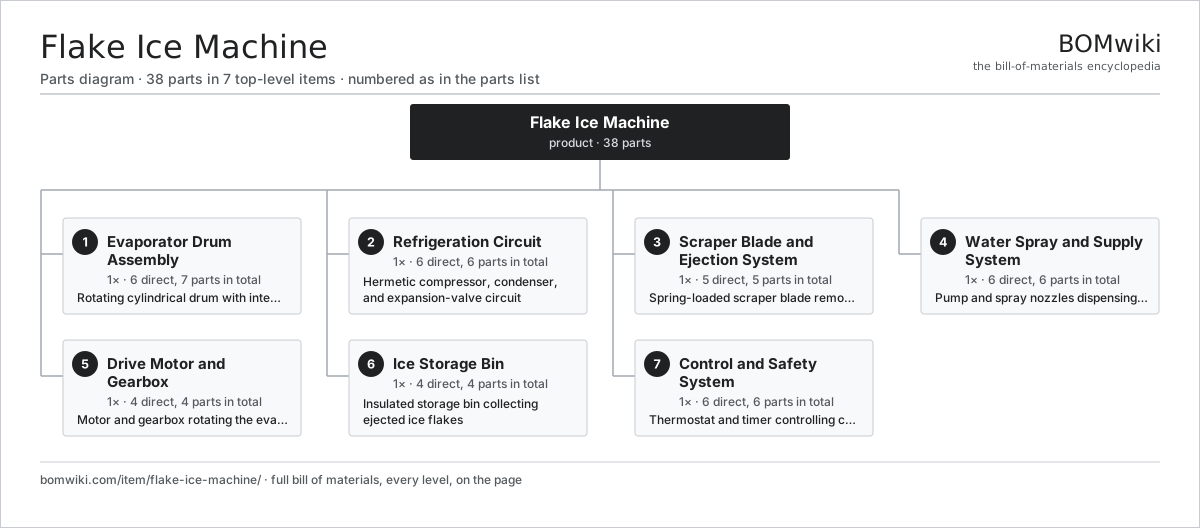
| # | Part | Qty | What it does |
|---|---|---|---|
| 1 | Evaporator Drum Assembly 6 parts | 1× | Rotating cylindrical drum with internal refrigerant channels |
| 2 | Refrigeration Circuit 6 parts | 1× | Hermetic compressor, condenser, and expansion-valve circuit |
| 3 | Scraper Blade and Ejection System 5 parts | 1× | Spring-loaded scraper blade removing ice from drum surface |
| 4 | Water Spray and Supply System 6 parts | 1× | Pump and spray nozzles dispensing water onto drum |
| 5 | Drive Motor and Gearbox 4 parts | 1× | Motor and gearbox rotating the evaporator drum |
| 6 | Ice Storage Bin 4 parts | 1× | Insulated storage bin collecting ejected ice flakes |
| 7 | Control and Safety System 6 parts | 1× | Thermostat and timer controlling compressor and drum rotation |
3D model
No 3D model yet. Have a CAD file of this? Add a 3D model. STL renders right on this page; STEP, FreeCAD, and OpenSCAD sources are welcome too (openly licensed, like all 3D models on BOMwiki).
Build & assembly graph
expand / collapse · shared sub-assemblies converge · links to related products · est. labourTap an assembly to expand/collapse · tap a part to open it · use “Open page” for any node · drag to pan, scroll to zoom.
Bill of materials for Flake Ice Machine
7 top-level lines · 44 rows shown · 38 parts total · indented to 3 levels| # | Item / sub-assembly | Part no. | Qty/assy | Ext. qty | Parts | Type |
|---|---|---|---|---|---|---|
| 1 | Evaporator Drum Assembly 6 parts | flake-ice-machine-evaporator-drum | 1× | 1 | 7 | assembly |
| 1.1 | Drum Shell | flake-ice-machine-drum-shell | 1× | 1 | · | part |
| 1.2 | Drum Shaft | flake-ice-machine-drum-shaft | 1× | 1 | · | part |
| 1.3 | Refrigerant Distribution Lines | flake-ice-machine-refrigerant-lines | 1× | 1 | · | part |
| 1.4 | Drum Bearing | flake-ice-machine-drum-bearing | 2× | 2 | · | part |
| 1.5 | Seal Kit | flake-ice-machine-seal-kit | 1× | 1 | · | part |
| 1.6 | Fastener Set | fastener-set | 1× | 1 | · | part |
| 2 | Refrigeration Circuit 6 parts | flake-ice-machine-refrigeration-unit | 1× | 1 | 6 | assembly |
| 2.1 | Refrigeration Compressor | flake-ice-machine-compressor | 1× | 1 | · | part |
| 2.2 | Condenser Unit | flake-ice-machine-condenser | 1× | 1 | · | part |
| 2.3 | Receiver Tank | flake-ice-machine-receiver-tank | 1× | 1 | · | part |
| 2.4 | Expansion Valve | flake-ice-machine-expansion-valve | 1× | 1 | · | part |
| 2.5 | Refrigerant Piping | flake-ice-machine-refrigerant-circuit-piping | 1× | 1 | · | part |
| 2.6 | Fastener Set | fastener-set | 1× | 1 | · | part |
| 3 | Scraper Blade and Ejection System 5 parts | flake-ice-machine-scraper-blade-system | 1× | 1 | 5 | assembly |
| 3.1 | Scraper Blade | flake-ice-machine-scraper-blade | 1× | 1 | · | part |
| 3.2 | Blade Holder | flake-ice-machine-blade-holder | 1× | 1 | · | part |
| 3.3 | Coil Spring | coil-spring | 1× | 1 | · | part |
| 3.4 | Blade Pressure Adjustment Knob | flake-ice-machine-adjustment-knob | 1× | 1 | · | part |
| 3.5 | Fastener Set | fastener-set | 1× | 1 | · | part |
| 4 | Water Spray and Supply System 6 parts | flake-ice-machine-water-distribution | 1× | 1 | 6 | assembly |
| 4.1 | Water Circulation Pump | flake-ice-machine-water-pump | 1× | 1 | · | part |
| 4.2 | Water Pump Motor | flake-ice-machine-pump-motor | 1× | 1 | · | part |
| 4.3 | Spray Nozzles | flake-ice-machine-spray-nozzles | 1× | 1 | · | part |
| 4.4 | Water Supply Hose | flake-ice-machine-water-supply-hose | 1× | 1 | · | part |
| 4.5 | Drain Line | flake-ice-machine-drain-line | 1× | 1 | · | part |
| 4.6 | Fastener Set | fastener-set | 1× | 1 | · | part |
| 5 | Drive Motor and Gearbox 4 parts | flake-ice-machine-drive-motor | 1× | 1 | 4 | assembly |
| 5.1 | Blower Motor | blower-motor | 1× | 1 | · | part |
| 5.2 | Worm Gearbox | flake-ice-machine-worm-gearbox | 1× | 1 | · | part |
| 5.3 | Motor Coupling | flake-ice-machine-motor-coupling | 1× | 1 | · | part |
| 5.4 | Fastener Set | fastener-set | 1× | 1 | · | part |
| 6 | Ice Storage Bin 4 parts | flake-ice-machine-collection-bin | 1× | 1 | 4 | assembly |
| 6.1 | Bin Body | flake-ice-machine-bin-body | 1× | 1 | · | part |
| 6.2 | Bin Drain Valve | flake-ice-machine-bin-drain-valve | 1× | 1 | · | part |
| 6.3 | Ice Level Switch | flake-ice-machine-ice-level-switch | 1× | 1 | · | part |
| 6.4 | Fastener Set | fastener-set | 1× | 1 | · | part |
| 7 | Control and Safety System 6 parts | flake-ice-machine-controls | 1× | 1 | 6 | assembly |
| 7.1 | Temperature Sensor | flake-ice-machine-temperature-sensor | 1× | 1 | · | part |
| 7.2 | Thermostat Controller | flake-ice-machine-thermostat-controller | 1× | 1 | · | part |
| 7.3 | Timer Module | flake-ice-machine-timer-module | 1× | 1 | · | part |
| 7.4 | Control Panel | flake-ice-machine-control-panel | 1× | 1 | · | part |
| 7.5 | Relay | relay | 1× | 1 | · | part |
| 7.6 | Fastener Set | fastener-set | 1× | 1 | · | part |
Something wrong in this list? Report a problem with this BOM.
Related products
same domain, ranked by shared parts Chocolate Enrober
470 parts · shares 1 with this page
Chocolate Moulding Line
223 parts · shares 1 with this page
Chocolate Enrober
470 parts · shares 1 with this page
Chocolate Moulding Line
223 parts · shares 1 with this page
Sourcing: possible vendors
Browse the supplier directory → Prices, MOQ, and lead times are algorithmic estimates, not quotes, and not claims about these companies. Company mappings are curated by keyword; est. price band $1k–$500k. How estimates work| Vendor | HQ | Specialty | MOQ | Lead time |
|---|---|---|---|---|
| gea.com ↗ | Düsseldorf, DE | Process technology | 20 units | 12–20 wks |
| buhlergroup.com ↗ | Uzwil, CH | Food & materials processing | 20 units | 12–20 wks |
| tetrapak.com ↗ | Pully, CH | Food packaging & processing | 20 units | 12–20 wks |
| jbtc.com ↗ | Chicago, US | Food processing equipment | 20 units | 12–20 wks |
| alfalaval.com ↗ | Lund, SE | Heat transfer & separation | 20 units | 12–20 wks |
1,065-word article