Flash Point Tester
ProductOverview
A flash-point tester measures the minimum temperature at which the vapors above a liquid fuel ignite momentarily when exposed to an open flame or spark. The apparatus heats a 50–100 mL liquid sample in a brass or copper test cup from ambient to 200°C, raising temperature at 5–10°C/min. At programmed temperature intervals (typically every 1°C), a test flame (Bunsen burner or electric spark) is brought down into the cup opening for 1–2 seconds. When the vapor ignites with an audible "pop" or visible flash, the thermometer temperature is recorded as the flash point.
Flash point is a critical property for fuel classification, storage safety, and transportation regulation. Gasoline flashes at -43°C (Reid vapor pressure), kerosene at +38°C, and mineral oils at >100°C. Regulatory agencies (NFPA, DOT, IATA) use flash point to classify liquids as flammable, combustible, or non-flammable, determining shipping, storage, and workplace requirements.
How it works
The Test Cup Assembly (brass or copper, 50–100 mL capacity) is mounted in a heating block supplied with electric power from a Cup Heater (1–2 kW immersion heater). A Heater Thermostat PID controller monitors the Thermometer (glass ASTM D1 or electronic PT100 RTD) and adjusts heater output to raise sample temperature at 5–10°C/min.
The Cup Lid Assembly (brass cap with sliding shutter) fits tightly over the cup, creating a semi-closed vapor space. As temperature rises, the sample volatilizes, and its vapor pressure increases. The lid''s shutter remains closed between tests, preventing flame entry and vapor escape.
The Igniter Arm (mechanical or solenoid-actuated) holds a test flame (Bunsen burner or spark) at a fixed height of 8–10 mm above the cup opening. At programmed temperature steps (e.g., every 1°C rise, or manually triggered), the operator or Igniter Solenoid (24 V solenoid on automated units) lowers the Flame Holder into the cup for 1–2 seconds.
When sample vapor concentration reaches a critical threshold (the lower explosive limit, LEL, typically 1–3% vapor by volume for hydrocarbons), the flame ignites the vapor with an audible "pop" and visible flash. The operator immediately notes the thermometer reading, which defines the flash point.
A Temperature and Timing Controller microcontroller (on automated systems) monitors the ADC Module input from an RTD RTD Temperature Probe and triggers the Igniter Solenoid igniter on a programmed schedule, logging the temperature at which ignition first occurs.
Test standards and variations
ASTM D92 (Cleveland Open-Cup) and ASTM D1310 (Tag Open-Cup) expose the liquid to an open atmosphere in the test cup, more closely simulating spillage hazards. The open-cup flash point is typically 2–5°C higher than closed-cup due to vapor loss through the opening.
ASTM D3278 (Tag Closed-Cup) and ASTM D56 (Pensky-Martens Closed-Cup) enclose the sample in a sealed cup with a controlled-opening shutter, reducing vapor escape and lowering flash point by 5–10°C. Closed-cup tests are more conservative and are preferred by regulatory agencies (e.g., DOT, IATA) for hazard classification.
The test pace varies by standard: manually operated units use visual flame detection (operator notes "pop" and reads thermometer). Automated systems employ a Spark Igniter Module spark igniter or Bunsen Burner Bunsen burner with optical or acoustic flame-detection sensors, reducing operator fatigue and improving repeatability (±2°C between replicates on the same apparatus).
Repeatability and vapor pressure
Flash point values are sensitive to sample composition, thermal mass of the test cup, and heater response time. Calibration using standard reference liquids (e.g., mineral oil with known flash point) is mandatory per ASTM E1. Cup design (size, material thickness, lid fit) affects heat transfer and vapor escape, so results can vary by ±3–5°C between different apparatus designs, hence the need for round-robin proficiency testing in multi-lab organizations.
Reid vapor pressure (RVP) and flash point correlate for petroleum fractions: gasoline RVP ~7–15 psi (flash point ~-43 to -20°C), kerosene RVP ~0.1–0.5 psi (flash point ~+38 to +100°C). For blended fuels or synthetic oils, flash point measurements help verify blend composition and detect contamination (water, light volatiles) that would lower flash point unexpectedly.
Safety and environmental procedures
Flash-point testing generates flammable vapors. Labs must operate testers in fume hoods or with local exhaust capture to prevent buildup of vapor clouds. The Igniter Source Bunsen burner or spark must be protected with a flash-back arrestor if using natural gas. Spent samples are disposed per hazardous-waste protocols depending on sample type (lab waste, industrial recycle, incineration).
Automated testers reduce operator exposure by enclosing the flame zone and using solenoid-triggered ignition. Many modern systems include flame-failure sensors that trigger emergency shutdown if the test flame extinguishes, preventing uncontrolled vapor accumulation.
Modern flash-point testers for routine QC integrate with lab LIMS, auto-recording sample ID, test standard, result, and timestamp. High-throughput labs (petroleum refineries, fuel distributors) run 5–10 samples per hour per apparatus, validating product batch compliance before release.
Flash Point Tester parts and their functions
7 top-level parts · 18 parts in total · full bill of materials below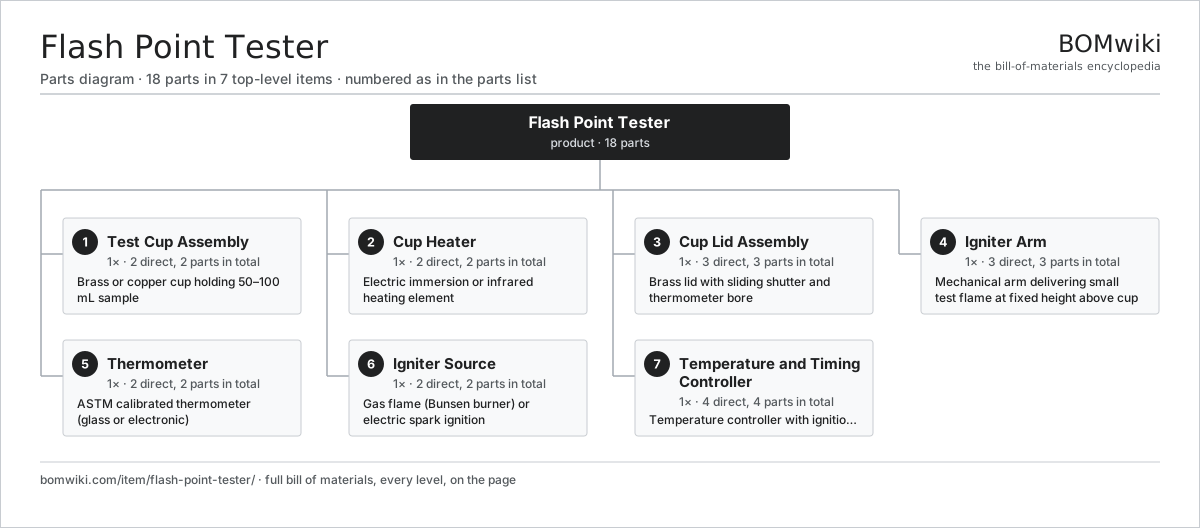
| # | Part | Qty | What it does |
|---|---|---|---|
| 1 | Test Cup Assembly 2 parts | 1× | Brass or copper cup holding 50–100 mL sample |
| 2 | Cup Heater 2 parts | 1× | Electric immersion or infrared heating element |
| 3 | Cup Lid Assembly 3 parts | 1× | Brass lid with sliding shutter and thermometer bore |
| 4 | Igniter Arm 3 parts | 1× | Mechanical arm delivering small test flame at fixed height above cup |
| 5 | Thermometer 2 parts | 1× | ASTM calibrated thermometer (glass or electronic) |
| 6 | Igniter Source 2 parts | 1× | Gas flame (Bunsen burner) or electric spark ignition |
| 7 | Temperature and Timing Controller 4 parts | 1× | Temperature controller with ignition timing and flame detection |
3D model
No 3D model yet. Have a CAD file of this? Add a 3D model. STL renders right on this page; STEP, FreeCAD, and OpenSCAD sources are welcome too (openly licensed, like all 3D models on BOMwiki).
Build & assembly graph
expand / collapse · shared sub-assemblies converge · links to related products · est. labourTap an assembly to expand/collapse · tap a part to open it · use “Open page” for any node · drag to pan, scroll to zoom.
Bill of materials for Flash Point Tester
7 top-level lines · 25 rows shown · 18 parts total · indented to 3 levels| # | Item / sub-assembly | Part no. | Qty/assy | Ext. qty | Parts | Type |
|---|---|---|---|---|---|---|
| 1 | Test Cup Assembly 2 parts | flash-point-tester-test-cup | 1× | 1 | 2 | assembly |
| 1.1 | Cup Body | flash-point-tester-cup-body | 1× | 1 | · | part |
| 1.2 | Cup Base Plate | flash-point-tester-cup-base | 1× | 1 | · | part |
| 2 | Cup Heater 2 parts | flash-point-tester-cup-heater | 1× | 1 | 2 | assembly |
| 2.1 | Heating Element | heating-element | 1× | 1 | · | part |
| 2.2 | Heater Thermostat | flash-point-tester-heater-thermostat | 1× | 1 | · | part |
| 3 | Cup Lid Assembly 3 parts | flash-point-tester-cup-lid | 1× | 1 | 3 | assembly |
| 3.1 | Lid Body | flash-point-tester-lid-body | 1× | 1 | · | part |
| 3.2 | Sliding Shutter | flash-point-tester-lid-shutter | 1× | 1 | · | part |
| 3.3 | Thermometer Bore | flash-point-tester-thermometer-bore | 1× | 1 | · | part |
| 4 | Igniter Arm 3 parts | flash-point-tester-igniter-arm | 1× | 1 | 3 | assembly |
| 4.1 | Igniter Arm Linkage | flash-point-tester-arm-linkage | 1× | 1 | · | part |
| 4.2 | Flame Holder | flash-point-tester-flame-holder | 1× | 1 | · | part |
| 4.3 | Igniter Solenoid | flash-point-tester-arm-solenoid | 1× | 1 | · | part |
| 5 | Thermometer 2 parts | flash-point-tester-thermometer-probe | 1× | 1 | 2 | assembly |
| 5.1 | Glass Thermometer | flash-point-tester-glass-thermometer | 1× | 1 | · | part |
| 5.2 | RTD Temperature Probe | flash-point-tester-rtd-probe | 1× | 1 | · | part |
| 6 | Igniter Source 2 parts | flash-point-tester-igniter-source | 1× | 1 | 2 | assembly |
| 6.1 | Bunsen Burner | flash-point-tester-bunsen-burner | 1× | 1 | · | part |
| 6.2 | Spark Igniter Module | flash-point-tester-spark-plug | 1× | 1 | · | part |
| 7 | Temperature and Timing Controller 4 parts | flash-point-tester-controller | 1× | 1 | 4 | assembly |
| 7.1 | Microcontroller | mcu | 1× | 1 | · | part |
| 7.2 | ADC Module | flash-point-tester-adc | 1× | 1 | · | part |
| 7.3 | Relay Output Module | flash-point-tester-relay-module | 1× | 1 | · | part |
| 7.4 | LCD Panel | lcd-panel | 1× | 1 | · | part |
Something wrong in this list? Report a problem with this BOM.
Related products
same domain, ranked by shared parts Atomic Absorption Spectrometer
648 parts · shares 2 with this page
Autoclave Sterilizer
282 parts · shares 2 with this page
Benchtop Bioreactor
487 parts · shares 2 with this page
Atomic Absorption Spectrometer
648 parts · shares 2 with this page
Autoclave Sterilizer
282 parts · shares 2 with this page
Benchtop Bioreactor
487 parts · shares 2 with this page
 Climate Test Chamber
64 parts · shares 2 with this page
Dissolution Tester
370 parts · shares 2 with this page
Freeze Dryer
317 parts · shares 2 with this page
Climate Test Chamber
64 parts · shares 2 with this page
Dissolution Tester
370 parts · shares 2 with this page
Freeze Dryer
317 parts · shares 2 with this page
Sourcing: possible vendors
Browse the supplier directory → Prices, MOQ, and lead times are algorithmic estimates, not quotes, and not claims about these companies. Company mappings are curated by keyword; est. price band $1k–$500k. How estimates work| Vendor | HQ | Specialty | MOQ | Lead time |
|---|---|---|---|---|
| thermofisher.com ↗ | Waltham, US | Lab instruments | 100 units | 10–18 wks |
|
🇺🇸Agilent
agilent.com ↗
|
Santa Clara, US | Analytical instruments | 100 units | 10–18 wks |
|
🇺🇸Bruker
bruker.com ↗
|
Billerica, US | Scientific instruments | 100 units | 10–18 wks |
|
🇯🇵Shimadzu
shimadzu.com ↗
|
Kyoto, JP | Analytical instruments | 100 units | 10–18 wks |
|
🇺🇸Waters
waters.com ↗
|
Milford, US | Chromatography & MS | 100 units | 10–18 wks |
883-word article