Flip Clock
ProductOverview
A flip clock shows the time as printed digits on hinged plastic leaves, split flaps, that fall under gravity once a minute with an audible snap. The format was industrialized by Solari di Udine in the 1950s for railway and airport departure boards and shrank to the bedside clock that defined the look of the 1960s–70s; the mechanism in both is the same.
The clock is four subsystems in a row: the Drive Motor turns continuously, the Gear Train reduces that rotation to drum speed, the Display Drums carry the printed flaps, and the Flap Mechanism decides the exact instant each flap is allowed to fall. The Housing and Power & Controls complete the product.
The split-flap principle
Each digit position is a stack of leaves hinged around a drum. A single Display Flap carries the bottom half of one digit printed on its front and the top half of the next digit on its back, so any displayed number is formed by two adjacent flaps: one hanging down in front (lower half) and one standing up behind (upper half). The flaps hinge on pins in the radial slots of a Drum Hub.
The drum rotates slowly and continuously, but the display must change instantaneously. That is the job of the Detent Finger: the leading upper flap rides against this thin sprung finger while the drum turns beneath it. When the drum has rotated one flap pitch (6° on a 60-flap minute drum), the flap's hinge pin cams it past the finger tip, the Finger Spring lets go, and the flap falls freely through 180° onto the Flap Stop, the snap that gives the clock its sound. One flap is released per pitch, never more, because the next flap is already captured by the finger before the first clears it.
Drums and indexing
The Minute Drum carries 60 flaps (00–59) and makes exactly one revolution per hour. The Hour Drum beside it carries 24 flaps and must not creep continuously, an hour digit half-rotated between 7 and 8 is unreadable, so it is indexed: a Geneva-style Transfer Pinion engages once per minute-drum revolution, as the 59 flap falls, and snaps the hour drum forward one full position. Both drums share the Drum Shaft running in two Ball Bearings between the Side Plates.
Drive and timebase
The classic flip clock has no oscillator of its own. Its Synchronous Stator, a shaded-pole lamination stack with one Copper Winding, spins the multi-pole Synchronous Rotor in exact lockstep with the 50 or 60 Hz mains, the electricity grid is the timebase. Grid operators historically steered accumulated cycle count toward true time, so a synchronous clock is exact over weeks even if individual days wander a second or two. Because a synchronous motor will happily start in either direction, a Starter Pawl ratchet kicks back any backward start. The stamped pole fingers of the Motor Can shape the field; the whole motor draws 1–2 W and runs warm to the touch for decades.
The Reduction Stack and an intermediate Helical Gear Pair take the rotor's few hundred RPM down to the Drum Gear's one revolution per hour, an overall reduction in the tens of thousands. Modern reissues replace the mains motor with a 1.5 V quartz stepper movement driving the same train, trading the grid timebase for ±20 ppm crystal accuracy and battery power.
Setting and housing
Split-flap displays only go forward. The rear Set Wheel spins the drums ahead through the Slip Clutch, which lets the user overrun the train without back-driving the motor; setting the clock five minutes back means going forward 23 hours 55 minutes. Alarm versions add a Alarm Module, a cam on the hour drum closing a contact for a buzzer or, in the famous clock-radio variants, switching on the radio.
The Case Shell is a two-part ABS moulding around 170 × 90 × 80 mm, with the curved acrylic Front Window in front, a matte Display Mask hiding the drum edges, and a Stand tilting the face toward the viewer. Mains models wire the Power Cord straight to the motor Connector through a short Wire Bundle; there is no electronics board at all in the original design. Typical failures are hardened gear lubricant and cracked flap hinge pins; replacement flap sets and motor cleaning keep fifty-year-old units running.
Flip Clock parts and their functions
6 top-level parts · 119 parts in total · full bill of materials below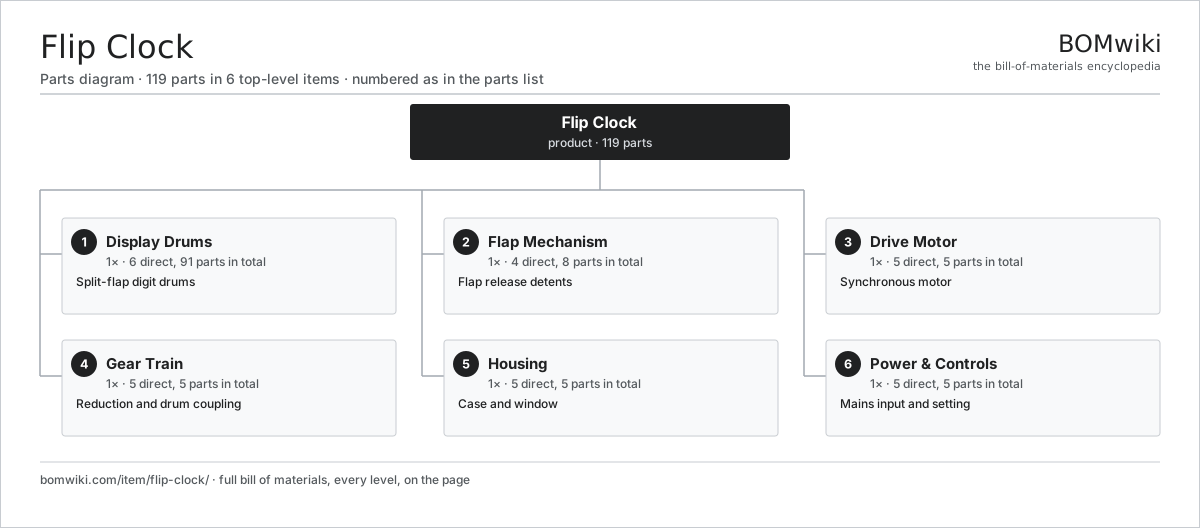
| # | Part | Qty | What it does |
|---|---|---|---|
| 1 | Display Drums 6 parts | 1× | Split-flap digit drums |
| 2 | Flap Mechanism 4 parts | 1× | Flap release detents |
| 3 | Drive Motor 5 parts | 1× | Synchronous motor |
| 4 | Gear Train 5 parts | 1× | Reduction and drum coupling |
| 5 | Housing 5 parts | 1× | Case and window |
| 6 | Power & Controls 5 parts | 1× | Mains input and setting |
3D model
No 3D model yet. Have a CAD file of this? Add a 3D model. STL renders right on this page; STEP, FreeCAD, and OpenSCAD sources are welcome too (openly licensed, like all 3D models on BOMwiki).
Build & assembly graph
expand / collapse · shared sub-assemblies converge · links to related products · est. labourTap an assembly to expand/collapse · tap a part to open it · use “Open page” for any node · drag to pan, scroll to zoom.
Bill of materials for Flip Clock
6 top-level lines · 36 rows shown · 119 parts total · indented to 3 levels| # | Item / sub-assembly | Part no. | Qty/assy | Ext. qty | Parts | Type |
|---|---|---|---|---|---|---|
| 1 | Display Drums 6 parts | flip-clock-display-drums | 1× | 1 | 91 | assembly |
| 1.1 | Minute Drum | flip-clock-minute-drum | 1× | 1 | · | part |
| 1.2 | Hour Drum | flip-clock-hour-drum | 1× | 1 | · | part |
| 1.3 | Display Flap | flip-clock-flap | 84× | 84 | · | part |
| 1.4 | Drum Hub | flip-clock-drum-hub | 2× | 2 | · | part |
| 1.5 | Drum Shaft | flip-clock-drum-shaft | 1× | 1 | · | part |
| 1.6 | Ball Bearing | ball-bearing | 2× | 2 | · | part |
| 2 | Flap Mechanism 4 parts | flip-clock-flap-mechanism | 1× | 1 | 8 | assembly |
| 2.1 | Detent Finger | flip-clock-detent-finger | 2× | 2 | · | part |
| 2.2 | Finger Spring | flip-clock-finger-spring | 2× | 2 | · | part |
| 2.3 | Flap Stop | flip-clock-flap-stop | 2× | 2 | · | part |
| 2.4 | Side Plate | flip-clock-side-plate | 2× | 2 | · | part |
| 3 | Drive Motor 5 parts | flip-clock-drive-motor | 1× | 1 | 5 | assembly |
| 3.1 | Synchronous Stator | flip-clock-sync-stator | 1× | 1 | · | part |
| 3.2 | Copper Winding | copper-winding | 1× | 1 | · | part |
| 3.3 | Synchronous Rotor | flip-clock-sync-rotor | 1× | 1 | · | part |
| 3.4 | Motor Can | flip-clock-motor-can | 1× | 1 | · | part |
| 3.5 | Starter Pawl | flip-clock-starter-pawl | 1× | 1 | · | part |
| 4 | Gear Train 5 parts | flip-clock-gear-train | 1× | 1 | 5 | assembly |
| 4.1 | Reduction Stack | flip-clock-reduction-stack | 1× | 1 | · | part |
| 4.2 | Drum Gear | flip-clock-drum-gear | 1× | 1 | · | part |
| 4.3 | Transfer Pinion | flip-clock-transfer-pinion | 1× | 1 | · | part |
| 4.4 | Helical Gear Pair | gear-pair | 1× | 1 | · | part |
| 4.5 | Slip Clutch | flip-clock-slip-clutch | 1× | 1 | · | part |
| 5 | Housing 5 parts | flip-clock-housing | 1× | 1 | 5 | assembly |
| 5.1 | Case Shell | flip-clock-shell | 1× | 1 | · | part |
| 5.2 | Front Window | flip-clock-window | 1× | 1 | · | part |
| 5.3 | Display Mask | flip-clock-mask | 1× | 1 | · | part |
| 5.4 | Stand | flip-clock-stand | 1× | 1 | · | part |
| 5.5 | Fastener Set | fastener-set | 1× | 1 | · | part |
| 6 | Power & Controls 5 parts | flip-clock-power-controls | 1× | 1 | 5 | assembly |
| 6.1 | Power Cord | flip-clock-power-cord | 1× | 1 | · | part |
| 6.2 | Set Wheel | flip-clock-set-wheel | 1× | 1 | · | part |
| 6.3 | Alarm Module | flip-clock-alarm-module | 1× | 1 | · | part |
| 6.4 | Wire Bundle | wire-bundle | 1× | 1 | · | part |
| 6.5 | Connector | connector | 1× | 1 | · | part |
Something wrong in this list? Report a problem with this BOM.
Related products
same domain, ranked by shared parts Railway Station Clock
43 parts · shares 4 with this page
Railway Station Clock
43 parts · shares 4 with this page
 World Time Clock
30 parts · shares 4 with this page
World Time Clock
30 parts · shares 4 with this page
 Watch Winder
39 parts · shares 4 with this page
Watch Winder
39 parts · shares 4 with this page
 Analog Alarm Clock
38 parts · shares 2 with this page
Analog Alarm Clock
38 parts · shares 2 with this page
 Radio-Controlled Atomic Clock
130 parts · shares 3 with this page
Radio-Controlled Atomic Clock
130 parts · shares 3 with this page
 Marine Chronometer
46 parts · shares 2 with this page
Marine Chronometer
46 parts · shares 2 with this page
Sourcing: possible vendors
Browse the supplier directory → Prices, MOQ, and lead times are algorithmic estimates, not quotes, and not claims about these companies. Company mappings are curated by keyword; est. price band $20–$50k. How estimates work| Vendor | HQ | Specialty | MOQ | Lead time |
|---|---|---|---|---|
|
🇯🇵Seiko
seikowatches.com ↗
|
Tokyo, JP | Watches | 500 units | 8–14 wks |
|
🇯🇵Citizen
citizenwatch-global.com ↗
|
Tokyo, JP | Watches | 500 units | 8–14 wks |
|
🇯🇵Casio
casio.com ↗
|
Tokyo, JP | Watches & electronics | 500 units | 8–14 wks |
| swatchgroup.com ↗ | Biel, CH | Watches (Omega, Tissot) | 500 units | 8–14 wks |
| titancompany.in ↗ | Bengaluru, IN | Watches & timepieces | 500 units | 8–14 wks |
794-word article