Float Valve
ProductOverview
A float valve (ballcock, ball-float valve) is the simplest self-acting level control in fluid handling: a hollow ball floats on the liquid surface, and as the level rises the ball's buoyancy, multiplied through a lever, presses a washer onto a seat and shuts off the inflow. No power, no sensor, no actuator, the water level is both the measured variable and the source of closing force. The device fills cold-water storage tanks, cattle troughs, cooling-tower basins, break tanks, and toilet cisterns, with industrial versions to DN100 controlling tank farms and process vessels. BS 1212 has standardised the domestic patterns since 1953; WRAS approval governs potable-water materials.
How it works
Mains water enters through the Inlet Shank, a threaded spigot long enough to pass through the tank wall, into the Valve Body waterway and up against the Valve Seat. The flow path is closed by the Piston Assembly: a brass Piston whose nose carries a renewable EPDM Seat Washer in a Washer Retainer cup.
The mechanics are a force chain from water surface to seat. The hollow Float Ball, soldered copper or moulded polypropylene, 110–300 mm diameter, rises with the level. Archimedes does the rest: a 150 mm ball half-submerged develops roughly 12 N of net buoyancy. That force acts through the Float Arm onto the long arm of the Lever, pivoting on the stainless Pivot Pin; with a lever ratio around 10:1, the short arm drives the piston through the Link Pin with on the order of 100 N. The valve modulates rather than snapping shut, as the level approaches setpoint the washer progressively throttles the seat, so filling slows smoothly to a stop.
Closing force has to beat inlet pressure acting on the seat orifice, which is why seats are interchangeable: a high-pressure Valve Seat has a small bore (more force margin, less flow), a low-pressure seat a large one. The equilibrium pattern sidesteps the trade-off altogether. A Balance Port drilled through the piston admits inlet pressure to a chamber behind the Piston Seal, so hydraulic force on the front of the piston is cancelled by the same pressure on its back. The float then only works against friction and the water to be displaced, letting a modest ball close a DN50 valve against 16 bar, and, usefully, making the shutoff level independent of supply-pressure fluctuations.
Level setting and service
Shutoff level is set at the Float Arm Assembly. Traditional practice bent the brass arm; current designs provide an Arm Adjuster, a screw or swivel clamp locked by the Arm Locknut, so the angle changes without deforming the rod. Deep tanks use a Drop Link so the ball rides well below the valve and the full tank depth becomes usable. The ball threads onto the arm against the Float Locknut, with the load spread by the moulded Float Insert.
Mounting is equally plain: the shank passes through a hole in the tank wall and is clamped by two Backnut nuts over Wall Washer plates, sealed by an EPDM Sealing Washer. Servicing means shutting the supply, unscrewing the End Cap against its Body Gasket, and sliding out the piston, the seat washer is the one consumable, hardening after years of chlorinated water, and costs pennies.
Failure modes and codes
The dominant failures are a perished Seat Washer (valve dribbles, tank overflows through the warning pipe), a punctured Float Ball (ball sinks, valve never closes), and wire-drawing erosion of the seat from prolonged near-closed throttling at high pressure. Water regulations therefore require every float-valve-fed tank to have an overflow/warning pipe sized larger than the inlet, and an air gap between valve outlet and overflow level to prevent backflow contamination of the mains, under UK regulations a Type AG or AF air gap depending on fluid category. Anti-vibration and delayed-action variants close the valve over a narrower band to stop the slow dribble-fill that wastes pressure and causes water hammer in long supply pipes.
For larger duties the same principle scales up through pilot operation: a small float valve serves as the pilot controlling a diaphragm main valve, giving full-bore filling of reservoirs with the same drip-tight, powerless shutoff.
Float Valve parts and their functions
7 top-level parts · 30 parts in total · full bill of materials below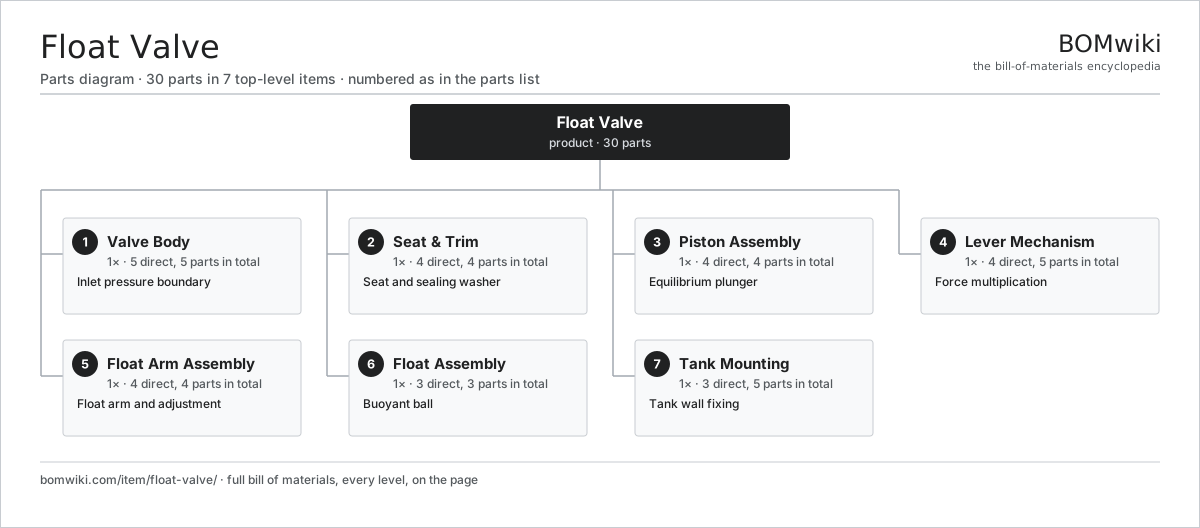
| # | Part | Qty | What it does |
|---|---|---|---|
| 1 | Valve Body 5 parts | 1× | Inlet pressure boundary |
| 2 | Seat & Trim 4 parts | 1× | Seat and sealing washer |
| 3 | Piston Assembly 4 parts | 1× | Equilibrium plunger |
| 4 | Lever Mechanism 4 parts | 1× | Force multiplication |
| 5 | Float Arm Assembly 4 parts | 1× | Float arm and adjustment |
| 6 | Float Assembly 3 parts | 1× | Buoyant ball |
| 7 | Tank Mounting 3 parts | 1× | Tank wall fixing |
3D model
No 3D model yet. Have a CAD file of this? Add a 3D model. STL renders right on this page; STEP, FreeCAD, and OpenSCAD sources are welcome too (openly licensed, like all 3D models on BOMwiki).
Build & assembly graph
expand / collapse · shared sub-assemblies converge · links to related products · est. labourTap an assembly to expand/collapse · tap a part to open it · use “Open page” for any node · drag to pan, scroll to zoom.
Bill of materials for Float Valve
7 top-level lines · 34 rows shown · 30 parts total · indented to 3 levels| # | Item / sub-assembly | Part no. | Qty/assy | Ext. qty | Parts | Type |
|---|---|---|---|---|---|---|
| 1 | Valve Body 5 parts | float-valve-body | 1× | 1 | 5 | assembly |
| 1.1 | Body Casting | float-valve-body-casting | 1× | 1 | · | part |
| 1.2 | Inlet Shank | float-valve-inlet-shank | 1× | 1 | · | part |
| 1.3 | End Cap | float-valve-end-cap | 1× | 1 | · | part |
| 1.4 | Body Gasket | float-valve-body-gasket | 1× | 1 | · | part |
| 1.5 | Fastener Set | fastener-set | 1× | 1 | · | part |
| 2 | Seat & Trim 4 parts | float-valve-seat-trim | 1× | 1 | 4 | assembly |
| 2.1 | Valve Seat | float-valve-seat | 1× | 1 | · | part |
| 2.2 | Seat Washer | float-valve-seat-washer | 1× | 1 | · | part |
| 2.3 | Washer Retainer | float-valve-washer-retainer | 1× | 1 | · | part |
| 2.4 | O-Ring Set | oring-set | 1× | 1 | · | part |
| 3 | Piston Assembly 4 parts | float-valve-piston-assembly | 1× | 1 | 4 | assembly |
| 3.1 | Piston | float-valve-piston | 1× | 1 | · | part |
| 3.2 | Piston Seal | float-valve-piston-seal | 1× | 1 | · | part |
| 3.3 | Balance Port | float-valve-balance-port | 1× | 1 | · | part |
| 3.4 | Piston Guide | float-valve-piston-guide | 1× | 1 | · | part |
| 4 | Lever Mechanism 4 parts | float-valve-lever-mechanism | 1× | 1 | 5 | assembly |
| 4.1 | Lever | float-valve-lever | 1× | 1 | · | part |
| 4.2 | Pivot Pin | float-valve-pivot-pin | 1× | 1 | · | part |
| 4.3 | Link Pin | float-valve-link-pin | 1× | 1 | · | part |
| 4.4 | Split Pin | float-valve-split-pin | 2× | 2 | · | part |
| 5 | Float Arm Assembly 4 parts | float-valve-arm-assembly | 1× | 1 | 4 | assembly |
| 5.1 | Float Arm | float-valve-float-arm | 1× | 1 | · | part |
| 5.2 | Arm Adjuster | float-valve-arm-adjuster | 1× | 1 | · | part |
| 5.3 | Arm Locknut | float-valve-arm-locknut | 1× | 1 | · | part |
| 5.4 | Drop Link | float-valve-drop-link | 1× | 1 | · | part |
| 6 | Float Assembly 3 parts | float-valve-float | 1× | 1 | 3 | assembly |
| 6.1 | Float Ball | float-valve-float-ball | 1× | 1 | · | part |
| 6.2 | Float Insert | float-valve-float-insert | 1× | 1 | · | part |
| 6.3 | Float Locknut | float-valve-float-locknut | 1× | 1 | · | part |
| 7 | Tank Mounting 3 parts | float-valve-mounting | 1× | 1 | 5 | assembly |
| 7.1 | Backnut | float-valve-backnut | 2× | 2 | · | part |
| 7.2 | Wall Washer | float-valve-wall-washer | 2× | 2 | · | part |
| 7.3 | Sealing Washer | float-valve-sealing-washer | 1× | 1 | · | part |
Something wrong in this list? Report a problem with this BOM.
Sourcing: possible vendors
Browse the supplier directory → Prices, MOQ, and lead times are algorithmic estimates, not quotes, and not claims about these companies. Company mappings are curated by keyword; est. price band $50–$50k. How estimates work| Vendor | HQ | Specialty | MOQ | Lead time |
|---|---|---|---|---|
|
🇩🇰Grundfos
grundfos.com ↗
|
Bjerringbro, DK | Pumps | 200 units | 6–12 wks |
|
🇺🇸Xylem
xylem.com ↗
|
Washington, US | Water technology | 200 units | 6–12 wks |
| flowserve.com ↗ | Irving, US | Pumps & valves | 200 units | 6–12 wks |
|
🇩🇪KSB
ksb.com ↗
|
Frankenthal, DE | Pumps & valves | 200 units | 6–12 wks |
| parker.com ↗ | Cleveland, US | Motion & fluid control | 200 units | 6–12 wks |
763-word article