Flushometer Valve
ProductOverview
A flushometer is a pressure-actuated valve that discharges a precise volume of water into a toilet or urinal bowl when a user presses a lever, foot pedal, or trigger button. Unlike tank-fed toilets, which rely on gravity drain-down, flushometers deliver a high-velocity jet directly from the building supply line, making a rapid, powerful flush. This design dominates commercial and institutional settings (offices, schools, airports, restaurants) because it handles high-frequency use, reduces water consumption per flush to 1.0–1.6 gallons, and simplifies plumbing in large facilities.
The core mechanism is ingeniously simple: a diaphragm (rubber disc) normally blocks the discharge, held closed by spring force and water pressure in a sealed chamber above it. When the user actuates the lever or sensor, a cartridge piston opens a small orifice in that chamber, allowing pressurized water to escape. This depressures the chamber, and supply pressure below the diaphragm pushes it open, unleashing a controlled burst of water. As the diaphragm chamber refills through a metering orifice (bleed screw), pressure rises again, closing the diaphragm within 1–8 seconds.
Valve Body and Diaphragm Mechanism
The Main Valve Body is a precision-cast brass or gunmetal housing containing the heart of the device: the Diaphragm Assembly and its Valve Seat. The diaphragm is a reinforced rubber disc 2–3 inches in diameter, resting on the ground seat below. In the closed position, supply pressure acts on the top (chamber side) and bottom (inlet side) of the diaphragm equally; the spring underneath biases the diaphragm closed.
When Actuation Assembly triggers the Cartridge Stem, a small orifice in the diaphragm chamber opens to atmosphere (or to a controlled bleed). The pressure above the diaphragm drops rapidly, creating a pressure differential: supply pressure below overcomes the spring, and the diaphragm lifts. Water rushes through the open seat from inlet to outlet at 15–35 GPM.
As the chamber refill orifice (the Bleed Screw) slowly lets pressure rebuild above the diaphragm, the pressure differential shrinks. After 1–8 seconds (depending on orifice size), the pressure equalizes, the spring reasserts, and the diaphragm seats again. This self-closing action is critical: users need not hold the lever down; a brief press delivers a complete flush.
Actuation and User Interface
Most commercial flushometers use a chrome-plated brass Actuation Element mounted on the side of the toilet or urinal. Pressing the lever downward actuates a Cartridge Stem, which forms the mechanical link. In newer installations, electronic Actuation Element (infrared or capacitive sensors) replace the manual lever, requiring no contact, a hygiene advantage in public restrooms. These sensors integrate a battery or plug-in power supply and a solenoid coil that replicates the mechanical piston action.
The Actuator Trim is a chrome or stainless steel trim ring that frames the lever or sensor and escutcheon plate, providing aesthetic finish and splash protection.
Water Supply and Inlet Filtration
The Water Inlet Assembly connects to the building cold-water line via 1/2 or 3/4 inch NPT threads. Sediment in municipal water supplies will quickly clog the diaphragm chamber and bleed orifice, so an internal Inlet Strainer (100–200 micron mesh) traps particles. This screen must be cleaned annually, a simple procedure requiring a hex wrench to access the strainer housing.
A Vacuum Breaker Assembly (anti-siphon device) is installed on the supply line upstream of the valve, typically in a separate VB Housing and VB Cartridge. This prevents contaminated bowl water from siphoning backward into the building supply if a sudden drop in line pressure occurs, a critical public health safeguard.
Discharge and Bowl Design
Water exits the Discharge Assembly through a 1 or 1.5 inch Outlet Connection into the bowl. The discharge is not a simple pipe; instead, a brass Discharge Spout mounted inside the bowl rim directs the jet through 4–6 small orifices at precise angles, creating a scouring action that cleans the bowl perimeter. A fine Outlet Strainer mesh breaks up the jet to prevent violent splashing.
Modern low-flow designs (1.0 GPF toilets per the EPA WaterSense standard) rely on refined spout geometry and higher inlet pressure (50–80 PSI) to deliver adequate scouring with less water. Poor spout design or low supply pressure (below 25 PSI) will result in incomplete flush and user dissatisfaction.
Flow and Duration Control
Two external Flow Control and Trim screws allow maintenance personnel to tune the valve in the field:
Flow Stop (Flow Stop): A needle valve restricting maximum discharge, typically set to 1.0–1.6 GPF for toilets or 0.125–0.5 GPF for urinals. Turning clockwise reduces flow.
Time Adjustment (Time Adjustment): The Bleed Screw orifice size (0.040–0.080 inches) tunes the flush duration, larger orifice = shorter flush (1–2 seconds, for urinals); smaller orifice = longer flush (4–8 seconds, for low-flow toilets requiring more scouring time).
Both adjustments are accessible under caps on the valve body and require only a hex wrench and a few minutes. Improper tuning is the source of most field complaints (weak flushes or continuous running).
Standards and Compliance
Flushometers are governed by ASME A112.14.2 (Backflow Prevention), which mandates the vacuum breaker, and by local water efficiency codes (many U.S. states follow the EPA WaterSense 1.28 GPF standard). The valve body and all wetted parts must be certified for potable water use and rated for the supply pressure and temperature range of the local water system (typically 40–140°F inlet, 25–80 PSI).
Installation Considerations
The Main Valve Body is wall-mounted behind the toilet or urinal, usually 36–48 inches above finished floor (AFF). Supply lines are 1/2 or 3/4 inch copper or PEX, fed from a main building supply branch. Discharge piping routes through the wall into the bowl. The Vacuum Breaker Assembly is installed on a tee in the supply line upstream, typically in a nearby cabinet or wall chase.
Installation labor is modest (2–4 hours); the main expense is cutting wall openings and running tubing. A flushometer unit costs $150–$400 depending on actuation type (manual lever is cheapest, electronic sensor ~$400).
Maintenance and Troubleshooting
Common issues and remedies:
- Weak or incomplete flush: Low inlet pressure (< 25 PSI) or Inlet Strainer clogged with sediment. Clean strainer and verify supply pressure with a gauge.
- Continuous running (valve won't close): Diaphragm torn or Bleed Screw orifice blocked by mineral deposits. Flush the valve with vinegar or replace the Diaphragm Assembly.
- No flush: Supply water shut off, or cartridge stuck. Check inlet shutoff and exercise the Cartridge Stem several times.
- Leaks at escutcheon: Worn Actuator Trim gasket. Replace gasket or trim ring.
Annual maintenance: clean the Inlet Strainer, check for corrosion on the Trim Ring, and verify adjustments have not drifted (mechanical vibration and thermal cycling can loosen set screws).
Flushometer Valve parts and their functions
8 top-level parts · 21 parts in total · full bill of materials below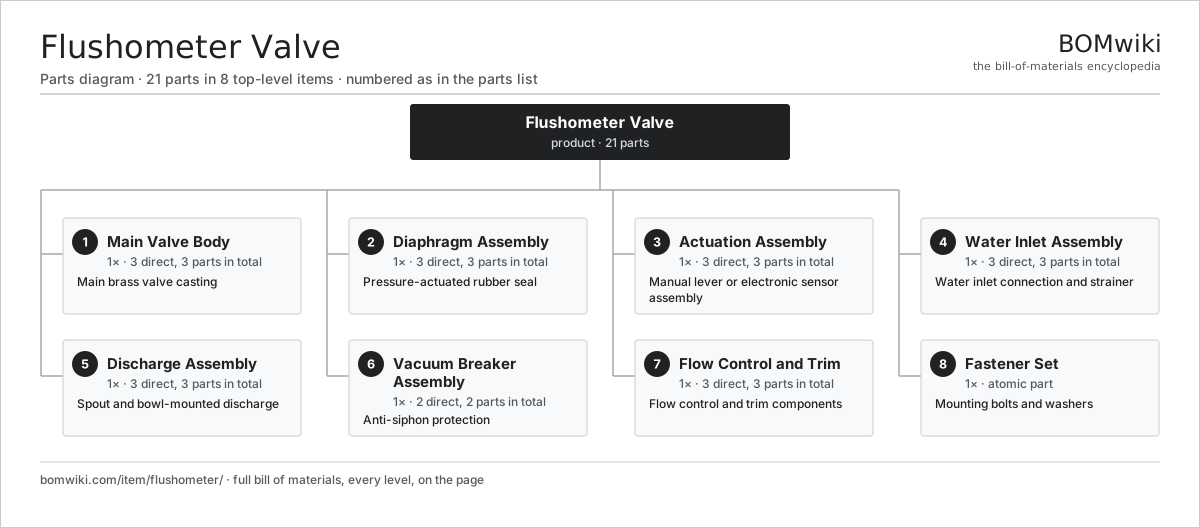
| # | Part | Qty | What it does |
|---|---|---|---|
| 1 | Main Valve Body 3 parts | 1× | Main brass valve casting |
| 2 | Diaphragm Assembly 3 parts | 1× | Pressure-actuated rubber seal |
| 3 | Actuation Assembly 3 parts | 1× | Manual lever or electronic sensor assembly |
| 4 | Water Inlet Assembly 3 parts | 1× | Water inlet connection and strainer |
| 5 | Discharge Assembly 3 parts | 1× | Spout and bowl-mounted discharge |
| 6 | Vacuum Breaker Assembly 2 parts | 1× | Anti-siphon protection |
| 7 | Flow Control and Trim 3 parts | 1× | Flow control and trim components |
| 8 | Fastener Set | 1× | Mounting bolts and washers |
3D model
No 3D model yet. Have a CAD file of this? Add a 3D model. STL renders right on this page; STEP, FreeCAD, and OpenSCAD sources are welcome too (openly licensed, like all 3D models on BOMwiki).
Build & assembly graph
expand / collapse · shared sub-assemblies converge · links to related products · est. labourTap an assembly to expand/collapse · tap a part to open it · use “Open page” for any node · drag to pan, scroll to zoom.
Bill of materials for Flushometer Valve
8 top-level lines · 28 rows shown · 21 parts total · indented to 3 levels| # | Item / sub-assembly | Part no. | Qty/assy | Ext. qty | Parts | Type |
|---|---|---|---|---|---|---|
| 1 | Main Valve Body 3 parts | flushometer-valve-body | 1× | 1 | 3 | assembly |
| 1.1 | Brass Casting | flushometer-body-casting | 1× | 1 | · | part |
| 1.2 | Valve Seat | flushometer-poppet-seat | 1× | 1 | · | part |
| 1.3 | Fastener Set | fastener-set | 1× | 1 | · | part |
| 2 | Diaphragm Assembly 3 parts | flushometer-diaphragm | 1× | 1 | 3 | assembly |
| 2.1 | Diaphragm Disc | flushometer-diaphragm-material | 1× | 1 | · | part |
| 2.2 | Return Spring | flushometer-diaphragm-spring | 1× | 1 | · | part |
| 2.3 | Bleed Screw | flushometer-bleed-screw | 1× | 1 | · | part |
| 3 | Actuation Assembly 3 parts | flushometer-actuation | 1× | 1 | 3 | assembly |
| 3.1 | Actuation Element | flushometer-lever-or-sensor | 1× | 1 | · | part |
| 3.2 | Cartridge Stem | flushometer-cartridge-stem | 1× | 1 | · | part |
| 3.3 | Actuator Trim | flushometer-actuator-housing | 1× | 1 | · | part |
| 4 | Water Inlet Assembly 3 parts | flushometer-supply-inlet | 1× | 1 | 3 | assembly |
| 4.1 | Inlet Connection | flushometer-inlet-port | 1× | 1 | · | part |
| 4.2 | Inlet Strainer | flushometer-inlet-strainer | 1× | 1 | · | part |
| 4.3 | Fastener Set | fastener-set | 1× | 1 | · | part |
| 5 | Discharge Assembly 3 parts | flushometer-discharge-outlet | 1× | 1 | 3 | assembly |
| 5.1 | Outlet Connection | flushometer-outlet-port | 1× | 1 | · | part |
| 5.2 | Discharge Spout | flushometer-spout | 1× | 1 | · | part |
| 5.3 | Outlet Strainer | flushometer-outlet-strainer | 1× | 1 | · | part |
| 6 | Vacuum Breaker Assembly 2 parts | flushometer-vacuum-breaker | 1× | 1 | 2 | assembly |
| 6.1 | VB Cartridge | flushometer-vb-cartridge | 1× | 1 | · | part |
| 6.2 | VB Housing | flushometer-vb-body | 1× | 1 | · | part |
| 7 | Flow Control and Trim 3 parts | flushometer-adjustment | 1× | 1 | 3 | assembly |
| 7.1 | Flow Stop | flushometer-flow-adjustment-screw | 1× | 1 | · | part |
| 7.2 | Time Adjustment | flushometer-time-adjustment-screw | 1× | 1 | · | part |
| 7.3 | Trim Ring | flushometer-trim-ring | 1× | 1 | · | part |
| 8 | Fastener Set | fastener-set | 1× | 1 | · | part |
Something wrong in this list? Report a problem with this BOM.
Sourcing: possible vendors
Browse the supplier directory → Prices, MOQ, and lead times are algorithmic estimates, not quotes, and not claims about these companies. Company mappings are curated by keyword; est. price band $20–$3k. How estimates work| Vendor | HQ | Specialty | MOQ | Lead time |
|---|---|---|---|---|
|
🇺🇸Kohler
kohler.com ↗
|
Kohler, US | Plumbing fixtures | 1,000 units | 6–12 wks |
|
🇯🇵TOTO
toto.com ↗
|
Kitakyushu, JP | Sanitaryware | 1,000 units | 6–12 wks |
|
🇯🇵LIXIL
lixil.com ↗
|
Tokyo, JP | Plumbing (Grohe, American Std) | 1,000 units | 6–12 wks |
|
🇺🇸Moen
moen.com ↗
|
North Olmsted, US | Faucets & fixtures | 1,000 units | 6–12 wks |
|
🇨🇭Geberit
geberit.com ↗
|
Rapperswil, CH | Sanitary systems | 1,000 units | 6–12 wks |
1,168-word article