Foam Pit System
ProductOverview
A foam pit system is a specialized training facility combining earth excavation, structural framing, and bulk foam filling to create a safe environment for gymnastics, parkour, diving, and acrobatic training. Participants jump or dive from elevated platforms into deep foam, where they land safely and practice flips, tricks, and body control without fear of injury.
The system is commonly used in gymnastics clubs, parkour training facilities, military training facilities, and theme parks. It allows athletes to learn aerial awareness and execute advanced techniques that would be dangerous to attempt on regular ground.
How it works
Pit Excavation and Foundation. The Pit Frame anchors the entire system at ground level or slightly above, defining the pit boundaries. The pit itself is excavated 8–12 feet deep (in some installations, dug into hillside or ground; in others, built as an above-ground frame structure with vertical walls). The bottom is lined with Drainage Base: a permeable geotextile separates native soil from a 12–18 inch gravel drainage layer, which percolates water away from the foam to prevent saturation and deterioration.
Foam Filling and Settlement. Foam Blocks (cross-linked polyethylene foam cubes, typically 2×2×2 feet) are stacked loosely to fill the pit to design depth, typically 10–14 feet. The foam is not glued together; individual blocks settle and compress slightly under participant loads. Initial compression is 10–15%; over the first month of use, the foam in the lower layers compresses and densifies slightly. The design accounts for this by filling initially to a depth 1–2 feet deeper than final target.
Load Path and Impact Absorption. When a participant lands on the foam, their kinetic energy is absorbed through progressive deformation of foam blocks. Blocks in contact with the participant compress at 20–40% strain, converting the impact energy into heat and block deformation. Deeper blocks experience lower stresses and minimal deformation, providing overall support. The distributed loading prevents the participant from hitting ground or frame structure.
Safety Netting and Containment. Safety Netting spans the pit opening, anchored via Net Cable to the pit frame corners. The netting is tensioned to remain taut (sag < 1 foot) and allows participants to jump through easily while preventing accidental falls over the pit edge. The mesh aperture (1–2 inches) prevents limbs from catching. If a participant lands on the netting, it flexes and distributes load across frame anchors.
Edge and Fall Protection. Edge Padding (6–12 inch thick foam) lines the pit rim, protecting against falls from the surrounding deck onto the frame structure. The padding is covered in durable vinyl to resist wear and water intrusion.
Access and Entry. The Entry Ramp provides graduated height: a lower ramp (5–8 feet) for beginners learning to land, and a higher platform (10–15 feet) for advanced participants practicing flips and aerials. Some pits feature multiple platforms at different heights, or adjustable springboards for launch assistance.
Foam Material and Longevity
Cross-linked polyethylene (PE) foam is chosen for its cell structure (closed-cell prevents water absorption) and recoverability (after compression, blocks rebound to 90%+ of original thickness within 24 hours). Some facilities use nitrile or polyurethane foam for enhanced durability, though cost is higher.
UV and thermal degradation gradually embrittle foam; outdoor pits lose performance within 2–3 years. Indoor pits last 5–7 years before central blocks require replacement due to compression set. Blocks in high-traffic areas (directly under common landing zones) degrade faster. Replacement is done progressively: worn blocks are removed and fresh foam inserted.
Maintenance and Hygiene
Foam pits require regular inspection and cleaning:
- Daily: Visual check for debris, damaged blocks, or loose netting.
- Weekly: Vacuum or blow out dust and fallen leaves from block surfaces.
- Monthly: Check netting for tears, replace worn edge padding, verify drainage is clear.
- Quarterly: Inspect frame bolts for corrosion and loosening; replace any significantly compressed foam blocks.
Because multiple participants use the foam, hygiene is important. Some facilities spray foam lightly with anti-microbial solution monthly and encourage users to wear clean athletic shoes.
Participant Technique and Safety
Before using a pit, participants are taught proper landing technique:
- Straight landing: Feet and legs together, knees bent to absorb impact.
- Controlled roll: After landing, participants roll backward to distribute impact across torso.
- Spatial awareness: Learning to orient body during flips and planning landing position.
Instructors observe sessions and spot participants during advanced maneuvers. The foam surface is forgiving, but back and neck injuries are still possible if a participant lands awkwardly (extreme arch, hyperflexion). Most pits restrict advanced diving and inversion training to supervised sessions.
Pit Management and Water Drainage
Properly designed Drainage Base is critical. In regions with high groundwater or heavy rainfall, poor drainage allows water to accumulate, saturating foam and causing freeze-thaw damage in winter. The drainage pipe conducts water to a sump or storm drain. In some installations, a small submersible pump may be required to prevent pooling.
Foam pits in wet climates sometimes add a mesh cover (loose netting or tarp) to keep rain off when not in active use, extending foam life significantly.
Foam Pit System parts and their functions
7 top-level parts · 311 parts in total · full bill of materials below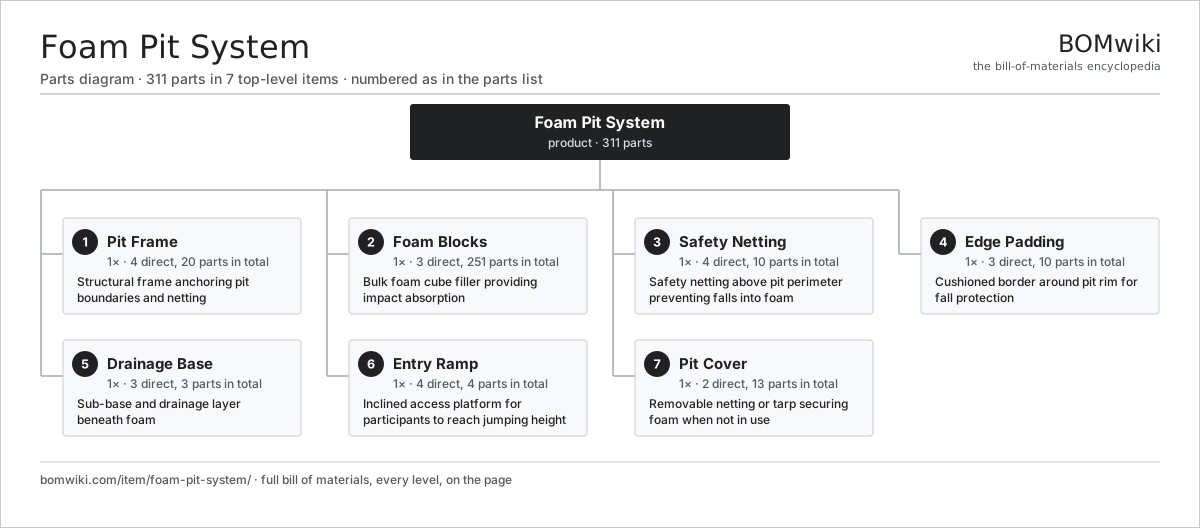
| # | Part | Qty | What it does |
|---|---|---|---|
| 1 | Pit Frame 4 parts | 1× | Structural frame anchoring pit boundaries and netting |
| 2 | Foam Blocks 3 parts | 1× | Bulk foam cube filler providing impact absorption |
| 3 | Safety Netting 4 parts | 1× | Safety netting above pit perimeter preventing falls into foam |
| 4 | Edge Padding 3 parts | 1× | Cushioned border around pit rim for fall protection |
| 5 | Drainage Base 3 parts | 1× | Sub-base and drainage layer beneath foam |
| 6 | Entry Ramp 4 parts | 1× | Inclined access platform for participants to reach jumping height |
| 7 | Pit Cover 2 parts | 1× | Removable netting or tarp securing foam when not in use |
3D model
No 3D model yet. Have a CAD file of this? Add a 3D model. STL renders right on this page; STEP, FreeCAD, and OpenSCAD sources are welcome too (openly licensed, like all 3D models on BOMwiki).
Build & assembly graph
expand / collapse · shared sub-assemblies converge · links to related products · est. labourTap an assembly to expand/collapse · tap a part to open it · use “Open page” for any node · drag to pan, scroll to zoom.
Bill of materials for Foam Pit System
7 top-level lines · 30 rows shown · 311 parts total · indented to 3 levels| # | Item / sub-assembly | Part no. | Qty/assy | Ext. qty | Parts | Type |
|---|---|---|---|---|---|---|
| 1 | Pit Frame 4 parts | foam-pit-system-pit-frame | 1× | 1 | 20 | assembly |
| 1.1 | Frame Beam | foam-pit-system-frame-beam | 4× | 4 | · | part |
| 1.2 | Frame Corner | foam-pit-system-frame-corner | 4× | 4 | · | part |
| 1.3 | Frame Brace | foam-pit-system-frame-brace | 4× | 4 | · | part |
| 1.4 | Fastener Set | fastener-set | 8× | 8 | · | part |
| 2 | Foam Blocks 3 parts | foam-pit-system-foam-blocks | 1× | 1 | 251 | assembly |
| 2.1 | Standard Foam Block | foam-pit-system-foam-block-standard | 200× | 200 | · | part |
| 2.2 | Half Foam Block | foam-pit-system-foam-block-half | 50× | 50 | · | part |
| 2.3 | Foam Compression Factor | foam-pit-system-foam-compression-factor | 1× | 1 | · | part |
| 3 | Safety Netting 4 parts | foam-pit-system-netting | 1× | 1 | 10 | assembly |
| 3.1 | Net Mesh | foam-pit-system-net-mesh | 1× | 1 | · | part |
| 3.2 | Net Frame Ring | foam-pit-system-net-frame-ring | 1× | 1 | · | part |
| 3.3 | Net Cable | foam-pit-system-net-cable | 4× | 4 | · | part |
| 3.4 | Net Tensioner | foam-pit-system-net-tensioner | 4× | 4 | · | part |
| 4 | Edge Padding 3 parts | foam-pit-system-edge-padding | 1× | 1 | 10 | assembly |
| 4.1 | Padding Foam | foam-pit-system-padding-foam | 1× | 1 | · | part |
| 4.2 | Padding Cover | foam-pit-system-padding-cover | 1× | 1 | · | part |
| 4.3 | Padding Mount | foam-pit-system-padding-mount | 8× | 8 | · | part |
| 5 | Drainage Base 3 parts | foam-pit-system-drainage-base | 1× | 1 | 3 | assembly |
| 5.1 | Base Liner | foam-pit-system-base-liner | 1× | 1 | · | part |
| 5.2 | Drainage Gravel | foam-pit-system-drainage-gravel | 1× | 1 | · | part |
| 5.3 | Drainage Pipe | foam-pit-system-drainage-pipe | 1× | 1 | · | part |
| 6 | Entry Ramp 4 parts | foam-pit-system-entry-ramp | 1× | 1 | 4 | assembly |
| 6.1 | Ramp Deck | foam-pit-system-ramp-deck | 1× | 1 | · | part |
| 6.2 | Ramp Frame | foam-pit-system-ramp-frame | 1× | 1 | · | part |
| 6.3 | Ramp Railing | foam-pit-system-ramp-railing | 1× | 1 | · | part |
| 6.4 | Ramp Step | foam-pit-system-ramp-step | 1× | 1 | · | part |
| 7 | Pit Cover 2 parts | foam-pit-system-pit-cover | 1× | 1 | 13 | assembly |
| 7.1 | Cover Net | foam-pit-system-cover-net | 1× | 1 | · | part |
| 7.2 | Cover Fastener | foam-pit-system-cover-fastener | 12× | 12 | · | part |
Something wrong in this list? Report a problem with this BOM.
Sourcing: possible vendors
Browse the supplier directory → Prices, MOQ, and lead times are algorithmic estimates, not quotes, and not claims about these companies. Company mappings are curated by keyword; est. price band $20–$3k. How estimates work| Vendor | HQ | Specialty | MOQ | Lead time |
|---|---|---|---|---|
|
🇩🇰LEGO
lego.com ↗
|
Billund, DK | Construction toys | 2,000 units | 6–10 wks |
|
🇺🇸Mattel
mattel.com ↗
|
El Segundo, US | Toys | 2,000 units | 6–10 wks |
|
🇺🇸Hasbro
hasbro.com ↗
|
Pawtucket, US | Toys & games | 2,000 units | 6–10 wks |
| bandainamco.co.jp ↗ | Tokyo, JP | Toys & amusement | 2,000 units | 6–10 wks |
| spinmaster.com ↗ | Toronto, CA | Toys | 2,000 units | 6–10 wks |
871-word article