Food Waste Collection Truck
ProductOverview
The food waste collection truck is a specialized refuse vehicle designed for hygienic, odour-controlled collection of organic waste streams from restaurants, food processing facilities, supermarkets, and increasingly from residential source-separated organic (brown bin) collection programs. The truck features a fully sealed stainless steel or epoxy-coated tank (8–12 m³) with an airtight lid, preventing odour emissions and leakage during transit.
Food waste differs fundamentally from general refuse: it decomposes rapidly, generating strong odours and liquid leachate (juice, oil, decomposition byproducts) within hours. Traditional open-body garbage trucks exposed surrounding communities to unacceptable smells and attracted rodents. Modern food waste collection trucks address these through sealed tanks, leachate extraction systems, active odour control, and on-board washdown capability.
The vehicles emerged in the 1990s in Northern Europe and Japan, driven by municipal composting programs and source-separation mandates. Today they are standard in advanced waste management markets (Germany, Netherlands, Scandinavia, Japan, South Korea). In North America, adoption is growing as more cities implement commercial organic waste diversion programs and meet zero-waste goals.
The combination of sealed tank, submersible leachate pump, carbon filtration, and enzyme-based odour neutralization creates a vehicle that can operate multiple times daily in dense residential neighbourhoods without neighbourhood complaints.
How it Works
The truck arrives at a residential area or commercial site where food waste bins (typically 120–240 L, brown-coloured and labelled) are staged at curbside or loading docks. The driver maneuvers to align the truck's compact lift mechanism (smaller than general refuse side-loaders) with the first bin.
The operator engages a hydraulic joystick controlling a short articulated boom (2–2.5 m reach) equipped with an open-bottom tipping bucket (stainless steel or epoxy-coated). The boom extends and the bucket lowers, gripping the bin's handles. The cylinder extends, lifting the bin 1.5 meters above the truck bed.
At peak height, the boom rotates inward. The bucket, now positioned above the sealed tank's top hatch, inverts (driven by a second cylinder), emptying the bin's organic contents into the tank interior. The rotation is quick (10–15 seconds) to minimize odour exposure. Once empty, the bucket retracts to its rest position, and the bin is lowered and released.
Falling food waste accumulates in the sealed tank. As material decomposes, liquid (leachate) pools at the bottom. A programmable logic controller (PLC) monitors tank fill level via a float switch or pressure transducer. When leachate accumulates to a threshold (typically 20–30% of tank volume), the PLC automatically triggers a submersible pump mounted inside the tank. The pump draws leachate through a strainer basket (pre-filtering solids) and a secondary cartridge filter (20–50 micron, polishing), then discharges into an external container or to a designated grease trap/treatment facility.
This leachate extraction is critical: without it, the tank would become waterlogged, reducing effective capacity and creating a septic environment. By extracting liquid continuously throughout the day, the truck can service 20–30 stops without capacity loss.
Odour control is layered: the sealed tank naturally confines volatile organic compounds (VOCs). A carbon-based filter on the tank's vent opening captures remaining emissions, and an optional enzyme-based neutralization system (automated or manual) dispenses an odour-fighting enzyme concentrate that decomposes odorous compounds. Some trucks recirculate enzyme mist via a low-pressure air pump; others rely on passive diffusion of liquid enzyme applied to the tank interior.
When the tank is full (or at shift end), the driver navigates to a materials recovery facility (MRF) or compost facility. Rather than tipping the truck (which would spray leachate and generate odour), the tank hatch is manually opened, and a facility worker (or automated discharge system) accesses the contents. Some trucks include a top-mounted discharge pump enabling remote offloading without worker entry.
At the end of the shift, the truck undergoes mandatory washdown: a high-pressure pump (80–150 bar, supplied by the truck's on-board fresh water tank of 200–300 L) sprays the exterior, tank, and hatch, removing residue and reducing odour carryover to the next shift. The operator uses a trigger gun on a 25 m hose to spray all surfaces, including under the truck bed where liquid inevitably drips.
Hydraulic power is modest: a 30 cc/rev pump supplies flow to the lift boom cylinders and (on some models) to the leachate pump motor control. A proportional directional valve meters flow, ensuring smooth, gentle bin handling and slow lift speeds to minimize spillage and splashing.
Safety features include:
- A pressure sensor on the lift circuit preventing over-tilt (dropping a bin from excessive height).
- An interlock preventing simultaneous lift and leachate pump operation (avoiding power conflicts).
- A level sensor shutting down leachate pumping if tank is empty (preventing air into pump).
- Manual or automatic enzyme dosing with safeguards preventing overdose.
- Odour alarm alerts if tank seal integrity is compromised (gas sensor optional on premium units).
Subsystems
The chassis is similar to compact side-loader vehicles: 6-cylinder diesel (150–200 kW), automatic transmission with retarder, and air-suspended axles rated for 24 tonne GVW. The frame is stainless or epoxy-coated to resist corrosion from leachate and washdown.
The sealed tank is the defining component: a 8–12 m³ stainless steel (304 or 316) or epoxy-coated mild steel cylinder with airtight hatch, integrated baffle, drain plug, and vent filter. All joints are gasket-sealed; no open areas permit odour escape.
The bin lift mechanism is a short, precision boom with tipping bucket. Unlike full-sized side-loader grippers, food waste lifts prioritize gentle handling and are ergonomically positioned for frequent city collection.
The leachate extraction system comprises a submersible pump, strainer basket, and cartridge filter. The PLC triggers the pump automatically based on tank level, discharging leachate to an external collection system.
The washdown system includes an on-board fresh water tank, high-pressure pump, and 25 m hose with spray gun. Essential for operator safety and odour reduction between shifts.
Odour control combines a carbon filter on the tank vent with optional enzyme-based neutralization. Carbon captures VOCs; enzyme chemically breaks down odorous compounds.
The hydraulic system is compact: a 30 cc/rev pump supplies the lift and optional leachate motor control. Load-sensing proportional controls ensure smooth operation.
The control interface includes a joystick for lift, a tank level display, a leachate pump switch, a washdown trigger, and a PLC managing automatic odour and leachate cycles.
Applications and Variants
Food waste collection is mandated in many EU jurisdictions (France, Germany, Netherlands, Italy) and spreading in North America (California, Ontario, Quebec). Applications include:
- Residential brown bins: Weekly or bi-weekly source-separated organic waste from households.
- Commercial/industrial: Daily collection from restaurants, supermarkets, food processing plants, and hotels.
- Institutional: Schools, hospitals, cafeterias generating high volumes of food waste.
- Market and slaughterhouse: Specialized food processing waste (blood, offal) requiring additional odour controls.
Variants include:
- Top-discharge models: Tank-mounted pump system enabling offloading from top (no tilting), reducing leachate splash.
- Dual-tank configuration: Two separate sealed compartments for different waste types (e.g., food waste and green waste) with independent packers and discharge gates.
- Refrigerated tanks: Optional active cooling (small compressor loop) for hot climates, slowing decomposition and odour generation.
- Enzyme auto-dosing: Programmable enzyme dispenser adjusting dosage based on fill level and time of day.
Leachate and Environmental Compliance
Food waste leachate (typically 5–10 L per tonne of waste) is highly polluted: high biochemical oxygen demand (BOD 10,000–50,000 mg/L), nitrogen (ammonia), oils, and grease. Discharge to municipal sewers requires pre-treatment: gravity settling, grease separation, and sometimes microbial digestion. Many trucks partner with receiving facilities offering leachate treatment; the driver either connects the discharge hose to the facility's grease trap or collects leachate in external containers for later treatment.
Environmental regulations (EU Waste Framework Directive 2008/98/EC, local water quality standards) mandate proper leachate handling. Trucks discharging leachate to the ground are illegal in most jurisdictions.
Odour Management and Operator Health
Food waste collection is labour-intensive and involves chronic odour exposure. Workers suffer higher rates of respiratory irritation, nausea, and stress-related illness compared to general refuse collectors. Sealed tanks, carbon filtration, and enzyme treatments significantly reduce but do not eliminate odours. Operator cabins with HEPA filtration and pressurization help; in some jurisdictions, food waste collection attracts premium pay.
Maintenance and Design Life
Stainless steel tanks resist corrosion but are expensive; epoxy-coated mild steel offers a cost-effective alternative but requires regular inspection for coating damage (replacement tube life: 8–12 years). Leachate pump seals are replaced every 2,000–3,000 operating hours. Carbon filter cartridges are changed every 6–12 months or when odour breakthrough occurs. Submersible pump impellers degrade faster due to solids and oils; replacement is every 3,000–5,000 hours.
A well-maintained food waste truck achieves 12–15 years in service, shorter than general refuse trucks due to the corrosive environment and leachate pump duty.
Industry Standards
Design follows ISO 4413 (hydraulic safety), EN 1501-1 (refuse vehicle construction), and local food handling and odour regulations. Leachate discharge permits require pre-treatment certification per local environmental standards. Tanks are pressure-tested to 1.5× rated capacity before delivery.
Food Waste Collection Truck parts and their functions
8 top-level parts · 95 parts in total · full bill of materials below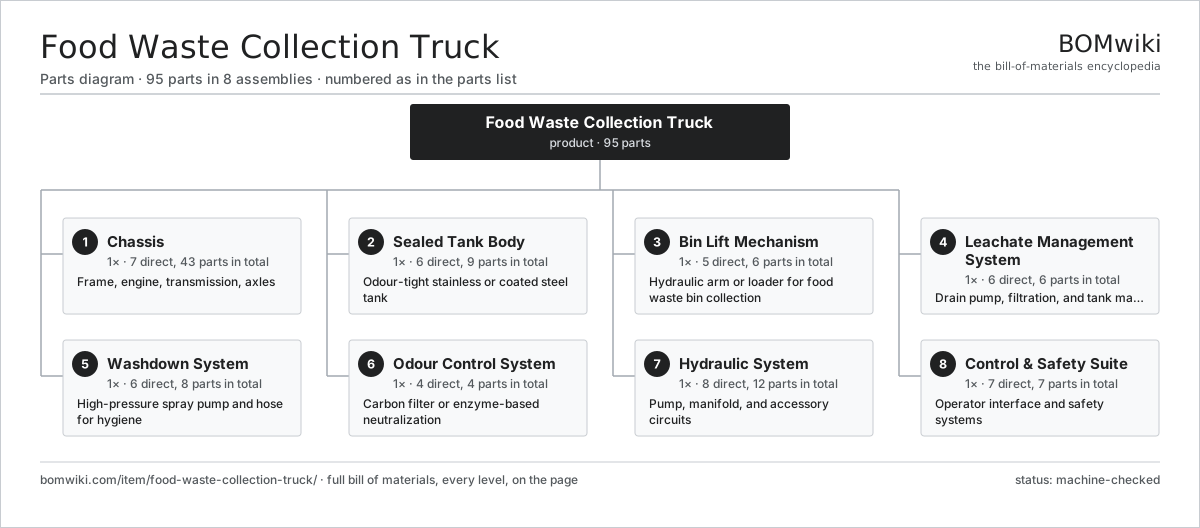
| # | Part | Qty | What it does |
|---|---|---|---|
| 1 | Chassis 7 parts | 1× | Frame, engine, transmission, axles |
| 2 | Sealed Tank Body 6 parts | 1× | Odour-tight stainless or coated steel tank |
| 3 | Bin Lift Mechanism 5 parts | 1× | Hydraulic arm or loader for food waste bin collection |
| 4 | Leachate Management System 6 parts | 1× | Drain pump, filtration, and tank management |
| 5 | Washdown System 6 parts | 1× | High-pressure spray pump and hose for hygiene |
| 6 | Odour Control System 4 parts | 1× | Carbon filter or enzyme-based neutralization |
| 7 | Hydraulic System 8 parts | 1× | Pump, manifold, and accessory circuits |
| 8 | Control & Safety Suite 7 parts | 1× | Operator interface and safety systems |
3D model
No 3D model yet. Have a CAD file of this? Add a 3D model — STL renders right on this page; STEP, FreeCAD, and OpenSCAD sources are welcome too (openly licensed, like all 3D models on BOMwiki).
Build & assembly graph
expand / collapse · shared sub-assemblies converge · links to related products · est. labourTap an assembly to expand/collapse · tap a part to open it · use “Open page” for any node · drag to pan, scroll to zoom.
Bill of materials for Food Waste Collection Truck
8 top-level lines · 62 rows shown · 95 parts total · indented to 3 levels| # | Item / sub-assembly | Part no. | Qty/assy | Ext. qty | Parts | Type |
|---|---|---|---|---|---|---|
| 1 | Chassis 7 parts | food-waste-collection-truck-chassis | 1× | 1 | 43 | assembly |
| 1.1 | Corrosion-Resistant Frame | food-waste-collection-truck-frame | 1× | 1 | · | part |
| 1.2 | Diesel Engine | food-waste-collection-truck-engine | 1× | 1 | · | part |
| 1.3 | Automatic Transmission | food-waste-collection-truck-transmission | 1× | 1 | · | part |
| 1.4 | Axles | food-waste-collection-truck-axles | 2× | 2 | · | part |
| 1.5 | Operator Cabin | food-waste-collection-truck-cab | 1× | 1 | · | part |
| 1.6 | Wheel Assembly 5 parts | wheel-assembly | 4× | 4 | 9 | assembly |
| 1.6.1 | Alloy Wheel | alloy-wheel | 1× | 4 | · | part |
| 1.6.2 | Tire | tire | 1× | 4 | · | part |
| 1.6.3 | TPMS Sensor | tpms-sensor | 1× | 4 | · | part |
| 1.6.4 | Lug Nut | lug-nut | 5× | 20 | · | part |
| 1.6.5 | Valve Stem | valve-stem | 1× | 4 | · | part |
| 1.7 | Fuel Tank | food-waste-collection-truck-fuel-tank | 1× | 1 | · | part |
| 2 | Sealed Tank Body 6 parts | food-waste-collection-truck-sealed-tank | 1× | 1 | 9 | assembly |
| 2.1 | Tank Shell | food-waste-collection-truck-tank-shell | 1× | 1 | · | part |
| 2.2 | Tank Hatch Cover | food-waste-collection-truck-tank-top-hatch | 1× | 1 | · | part |
| 2.3 | Drain Valve | food-waste-collection-truck-tank-drain-plug | 1× | 1 | · | part |
| 2.4 | Internal Baffle | food-waste-collection-truck-tank-internal-baffle | 1× | 1 | · | part |
| 2.5 | O-Ring Set | oring-set | 4× | 4 | · | part |
| 2.6 | Vent Filter | food-waste-collection-truck-ventilation-filter | 1× | 1 | · | part |
| 3 | Bin Lift Mechanism 5 parts | food-waste-collection-truck-bin-lift | 1× | 1 | 6 | assembly |
| 3.1 | Lift Boom | food-waste-collection-truck-lift-boom | 1× | 1 | · | part |
| 3.2 | Tipping Bucket | food-waste-collection-truck-lift-bucket | 1× | 1 | · | part |
| 3.3 | Lift Cylinders | food-waste-collection-truck-lift-cylinder | 2× | 2 | · | part |
| 3.4 | Lift Pivot Bearing | food-waste-collection-truck-lift-pivot | 1× | 1 | · | part |
| 3.5 | Pressure Sensor | pressure-sensor | 1× | 1 | · | part |
| 4 | Leachate Management System 6 parts | food-waste-collection-truck-leachate-system | 1× | 1 | 6 | assembly |
| 4.1 | Submersible Pump | food-waste-collection-truck-leachate-pump | 1× | 1 | · | part |
| 4.2 | Strainer Basket | food-waste-collection-truck-strainer-basket | 1× | 1 | · | part |
| 4.3 | Leachate Hose | food-waste-collection-truck-leachate-hose | 1× | 1 | · | part |
| 4.4 | Secondary Filter | food-waste-collection-truck-leachate-filter | 1× | 1 | · | part |
| 4.5 | Leachate Pump Motor | food-waste-collection-truck-pump-motor | 1× | 1 | · | part |
| 4.6 | Pressure Sensor | pressure-sensor | 1× | 1 | · | part |
| 5 | Washdown System 6 parts | food-waste-collection-truck-washdown-system | 1× | 1 | 8 | assembly |
| 5.1 | Washdown Pump | food-waste-collection-truck-washdown-pump | 1× | 1 | · | part |
| 5.2 | Fresh Water Tank | food-waste-collection-truck-fresh-water-tank | 1× | 1 | · | part |
| 5.3 | Pressure Hose | food-waste-collection-truck-washdown-hose | 1× | 1 | · | part |
| 5.4 | Spray Nozzles | food-waste-collection-truck-nozzle-set | 2× | 2 | · | part |
| 5.5 | Hose Reel | food-waste-collection-truck-hose-reel | 1× | 1 | · | part |
| 5.6 | Connector | connector | 2× | 2 | · | part |
| 6 | Odour Control System 4 parts | food-waste-collection-truck-odour-control | 1× | 1 | 4 | assembly |
| 6.1 | Carbon Filter Cartridge | food-waste-collection-truck-carbon-filter | 1× | 1 | · | part |
| 6.2 | Enzyme Dispenser | food-waste-collection-truck-enzyme-dispenser | 1× | 1 | · | part |
| 6.3 | Enzyme Solution Tank | food-waste-collection-truck-enzyme-tank | 1× | 1 | · | part |
| 6.4 | Air Circulation Pump | food-waste-collection-truck-air-pump | 1× | 1 | · | part |
| 7 | Hydraulic System 8 parts | food-waste-collection-truck-hydraulics | 1× | 1 | 12 | assembly |
| 7.1 | Hydraulic Pump | food-waste-collection-truck-hydraulic-pump | 1× | 1 | · | part |
| 7.2 | Valve Manifold | food-waste-collection-truck-valve-block | 1× | 1 | · | part |
| 7.3 | Hydraulic Filter | food-waste-collection-truck-filter | 1× | 1 | · | part |
| 7.4 | Gas Accumulator | food-waste-collection-truck-accumulator | 1× | 1 | · | part |
| 7.5 | Hydraulic Reservoir | food-waste-collection-truck-tank | 1× | 1 | · | part |
| 7.6 | Pressure Sensor | pressure-sensor | 2× | 2 | · | part |
| 7.7 | Wire Bundle | wire-bundle | 1× | 1 | · | part |
| 7.8 | Connector | connector | 4× | 4 | · | part |
| 8 | Control & Safety Suite 7 parts | food-waste-collection-truck-controls | 1× | 1 | 7 | assembly |
| 8.1 | Control Panel | food-waste-collection-truck-control-panel | 1× | 1 | · | part |
| 8.2 | Level Display | food-waste-collection-truck-liquid-level-display | 1× | 1 | · | part |
| 8.3 | Leachate Pump Switch | food-waste-collection-truck-leachate-pump-switch | 1× | 1 | · | part |
| 8.4 | Washdown Trigger Gun | food-waste-collection-truck-washdown-trigger | 1× | 1 | · | part |
| 8.5 | Interlock Relay | food-waste-collection-truck-safety-interlock | 1× | 1 | · | part |
| 8.6 | Backup Alarm | food-waste-collection-truck-audible-alarm | 1× | 1 | · | part |
| 8.7 | Microcontroller | mcu | 1× | 1 | · | part |
Related products
same domain, ranked by shared parts Coupe Car
1,617 parts · shares 8 with this page
Coupe Car
1,617 parts · shares 8 with this page
 Food Truck
197 parts · shares 8 with this page
Food Truck
197 parts · shares 8 with this page
 Front Loader Refuse Truck
131 parts · shares 8 with this page
Front Loader Refuse Truck
131 parts · shares 8 with this page
 Grapple Truck
146 parts · shares 8 with this page
Litter Vacuum Truck
101 parts · shares 8 with this page
Grapple Truck
146 parts · shares 8 with this page
Litter Vacuum Truck
101 parts · shares 8 with this page
 Medical Waste Truck
107 parts · shares 8 with this page
Medical Waste Truck
107 parts · shares 8 with this page
Sourcing: possible vendors
Prices, MOQ, and lead times are algorithmic estimates, not quotes, and not claims about these companies. Company mappings are curated by keyword; est. price band $8k–$90k. How estimates work| Vendor | HQ | Specialty | MOQ | Lead time |
|---|---|---|---|---|
|
🇯🇵Toyota
global.toyota ↗
|
Toyota City, JP | Automaker | made to order | 16–28 wks |
| volkswagen-group.com ↗ | Wolfsburg, DE | Automaker | made to order | 16–28 wks |
| gm.com ↗ | Detroit, US | Automaker | made to order | 16–28 wks |
| hyundai.com ↗ | Seoul, KR | Automaker | made to order | 16–28 wks |
|
🇨🇳BYD
byd.com ↗
|
Shenzhen, CN | EV & battery manufacturer | made to order | 16–28 wks |
1,589-word article