Football Helmet
ProductOverview
American football is a high-impact collision sport where players experience repeated head impacts exceeding 50 G (accelerations >500 m/s²). A football helmet is protective equipment designed to attenuate these impacts, reducing force transmission to the brain and skull. Modern helmets operate on a three-layer principle: the rigid polycarbonate shell spreads impact force over a large area; the multi-layer foam liner absorbs energy through controlled compression and material damping; the metal facemask protects facial bones.
The engineering challenge is balancing protection (maximize energy absorption) against wearability (minimize weight and heat buildup during play). A 900 g helmet seems light, but worn for 3 hours in a 35 °C afternoon game, the weight-induced neck strain and thermal stress are significant.
Impact Biomechanics & Head Injury Mechanisms
Concussion Physics
A concussion is a traumatic brain injury resulting from head acceleration exceeding approximately 75 G sustained for >5 milliseconds. When a 100 kg player running at 5 m/s collides head-first with another player or the ground, the head decelerates from 5 m/s to 0 m/s in approximately 10–20 milliseconds. Deceleration = change in velocity / time = 5 m/s / 0.015 s ≈ 333 m/s² ≈ 34 G, below the 75 G threshold for concussion.
However, if the collision is more severe (higher initial velocity, shorter deceleration time), or if the impact is rotational (glancing blow causing head rotation), the acceleration can exceed 75 G for sustained periods, causing neuronal shear injury and concussion.
The helmet liner cannot prevent all concussions, the brain still accelerates within the skull even with external head protection. However, the liner delays and reduces peak acceleration, extending the deceleration time from 10 ms to 20–30 ms, which can reduce peak G-forces by 30–50% and prevent marginal concussions from occurring.
Linear vs. Rotational Impacts
Most helmet design focuses on linear impacts (head struck directly, decelerating in a straight line). A ball directly to the forehead causes linear deceleration; the shell and liner work as designed.
Rotational impacts are more common in football and more dangerous for concussion. A glancing blow to the side of the helmet causes the head to rotate, creating angular acceleration. Even if linear acceleration is moderate (30 G), rotational acceleration can reach 50 rad/s² (equivalent to 5000 °/s²), causing severe shear forces in the brain. Modern helmets attempt to reduce rotational forces through:
- Smooth outer surface: Reduces friction between helmet and opponents' gear, minimizing rotational coupling
- Low-friction facemask coating: Prevents facemask engagement with other helmets
- Side-panel pad optimization: Distributes side impacts more uniformly
However, no helmet completely eliminates rotational injury risk; Rule enforcement (penalizing head-to-head contact) is more effective than helmet design for reducing rotational concussions.
Shell Design & Impact Absorption
The polycarbonate shell is injection-molded to 2.5–3.5 mm thickness, the thinnest practical thickness before loss of rigidity and difficulty achieving uniform cooling during injection molding.
Polycarbonate is chosen for its:
- Impact strength: Polycarbonate has superior impact resistance compared to other plastics (ABS, HDPE). At 20 °C, the impact strength is approximately 8–10 J/cm² (Izod test), compared to 2–3 J/cm² for ABS.
- Light weight: Density is 1.20 g/cm³ (vs. 1.05 g/cm³ for ABS), making it slightly heavier but the extra mass improves impact capacity.
- UV resistance: With proper coating, polycarbonate resists UV-induced yellowing and embrittlement better than other plastics.
- Rigidity: Modulus of elasticity ≈ 2.3 GPa, maintaining helmet shape under repeated impacts without permanent deformation.
The internal reinforcement ribs are critical: they prevent large-area flexing of the shell during impacts. Without ribs, a large flat area of shell flexes inward during impact, increasing local deformation and energy dissipation inefficiently. Ribs distribute flex load to the entire shell thickness, maintaining rigidity.
The paint finish (0.5–1.0 mm polyurethane or epoxy) serves two functions:
- UV protection: Blocks UV radiation that degrades polycarbonate, extending shell lifespan from 5 years (uncoated) to 8–10 years.
- Friction control: Matte or slightly textured paint reduces friction during tackle situations.
Multi-Layer Liner System
The helmet liner is the key innovation in modern helmet design. Three foam layers with different densities optimize impact absorption across the impact spectrum:
Layer 1: Outer Energy-Absorbing Foam
- Material: EPE (expanded polyethylene) or EPP (expanded polypropylene) foam
- Density: 0.8–1.0 g/cm³ (relatively high density for foam)
- Thickness: 20–25 mm
- Function: Primary impact absorber; compresses 40–50% under the 200 J impact required by NOCSAE standard
High-density foam is chosen for the outer layer to achieve high energy absorption per unit thickness. A low-density foam (0.3 g/cm³) would need to be much thicker (50–70 mm) to absorb the same energy, making the helmet uncomfortable and adding excessive weight.
Layer 2: Middle Damping Layer
- Material: Viscoelastic polyurethane foam (memory foam variant)
- Density: 0.6–0.8 g/cm³
- Thickness: 10–15 mm
- Function: Dissipates residual impact energy through material damping (the foam's internal friction converts kinetic energy to heat)
Viscoelastic foam has a property called tan(δ) (loss tangent), which measures internal damping. High tan(δ) materials are sticky and dissipate energy; low tan(δ) materials are bouncy. For helmets, a tan(δ) of 0.25–0.35 is optimal, enough damping to absorb energy without being so sticky that the foam "locks up" and becomes ineffective.
Layer 3: Inner Comfort Foam
- Material: Soft EVA or polyurethane foam
- Density: 0.3–0.5 g/cm³
- Thickness: 5–10 mm
- Function: Comfort and fit adjustment; minimal protective role
The inner foam contacts the player's head and must be soft (comfortable) and moisture-absorbing. It contributes little to impact protection but is essential for wearability over extended periods.
Impact Testing & NOCSAE Certification
The National Operating Committee on Standards for Athletic Equipment (NOCSAE) establishes the standard for football helmet impact performance. The NOCSAE test protocol:
Test procedure:
- Impact velocity: Helmet is struck at 80 m/s (equivalent to ~25 mph / 40 km/h, a severe tackle impact)
- Impact energy: 200 J (typical for a 90 kg player running at 5 m/s and stopping in 10 cm)
- Impact location: Front, back, side, and top of helmet (12–16 different test points)
- Acceptable result: Peak head acceleration <200 G, and liner compression <50 mm permanent deformation
A helmet meeting NOCSAE reduces peak acceleration to 100–180 G across most impact locations. Non-helmeted human skull can withstand approximately 100–150 G before fracture; helmeted impacts at 150 G can cause concussion but rarely cause skull fracture.
Facemask Engineering
The facemask is a secondary protective structure. Designed to:
Protect facial bones: Steel bars (5–8 mm diameter) prevent nose fractures, orbital socket fractures, and tooth loss from direct impacts.
Prevent finger/hand entanglement: Close mesh spacing (minimum 2 cm) prevents opponent hands from grabbing a face opening and distorting the helmet.
Allow visibility and ventilation: Sufficient open area for forward vision and airflow.
Facemask material selection:
- Chrome-molybdenum steel: Strength ~600 MPa (yield), weldable, cost-effective. Susceptible to rust if paint is chipped (requires maintenance).
- Carbon fiber composite: Strength ~600 MPa, lighter, corrosion-resistant. Cost 2–3× higher than steel.
The facemask padding (8–12 mm EVA foam) is essential for protecting the nose and cheek area from impacts. Without padding, a facemask strike can fracture facial bones despite the steel bars.
The quick-release clip is a safety feature: in emergency situations, medical personnel must be able to rapidly remove the helmet. A quick-release mechanism allows facemask removal in <30 seconds without removing the entire helmet, allowing cervical spine assessment.
Chinstrap Design & Helmet Displacement
The chinstrap system prevents helmet rotation and displacement during impacts. A loose chinstrap allows the helmet to shift relative to the head, changing impact angle and reducing protection effectiveness.
Chinstrap tension requirements:
The chinstrap must pull with approximately 15–20 lbf (65–90 N) force to keep the helmet in position during a 100 G impact. If tension is <10 lbf, the helmet will rotate 15–20° during impact, changing the impact angle and negating some protection.
However, excessive tension (>25 lbf) causes discomfort and breathing difficulty, potentially increasing heat stress and dehydration during play.
Most players adjust chinstrap tension based on comfort; medical research suggests that 20–40% of players wear helmets with sub-optimal chinstrap tension, reducing protection effectiveness by 10–20%.
Maintenance & Recertification
A football helmet has an 8–10 year lifespan before foam degradation becomes significant. However, after any significant impact (particularly if the player was concussed or lost consciousness), the helmet should be tested and potentially re-manufactured.
NOCSAE recommends:
- Post-injury testing: Within 2 weeks of any concussive impact, the helmet should be removed from play and tested (peak G-forces measured during a calibrated drop test). If peak G exceeds 200 G, the helmet is recertified.
- Annual inspection: Visual inspection for shell cracks, foam compression, or loose padding.
- Replacement schedule: After 8–10 years or 4–6 significant impacts, the helmet is replaced due to cumulative foam degradation.
Regular maintenance extends helmet life:
- Cleaning: Mild soap and water weekly; avoid abrasive scrubbing that damages paint.
- Chinstrap adjustment: Check weekly during season to ensure optimal tension.
- Visor cleaning: Clear visors are sometimes worn; clean with anti-fog solution.
- Storage: Store in cool, dry conditions; avoid direct sunlight which degrades paint.
Football Helmet parts and their functions
7 top-level parts · 23 parts in total · full bill of materials below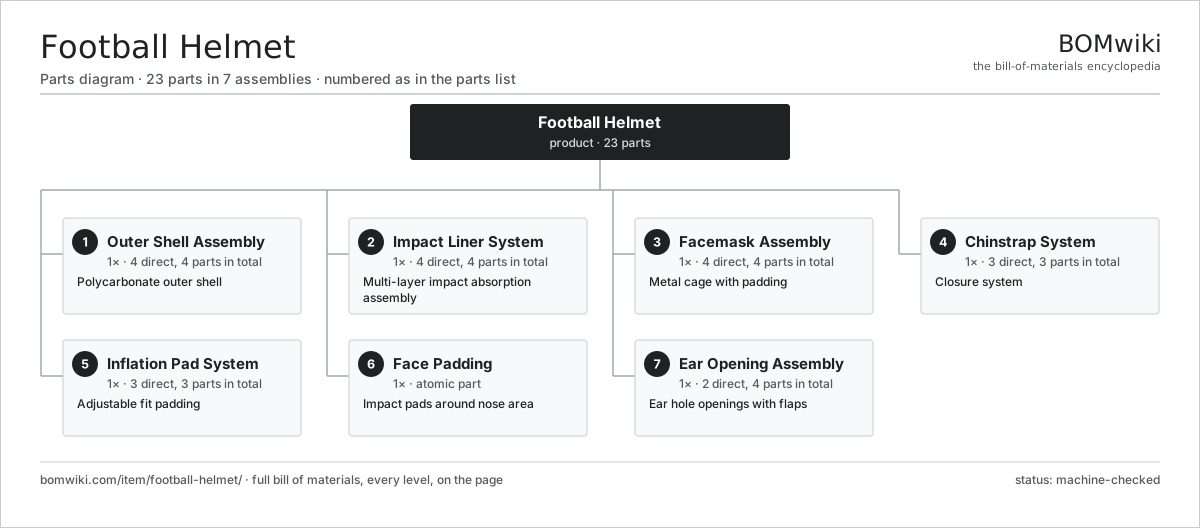
| # | Part | Qty | What it does |
|---|---|---|---|
| 1 | Outer Shell Assembly 4 parts | 1× | Polycarbonate outer shell |
| 2 | Impact Liner System 4 parts | 1× | Multi-layer impact absorption assembly |
| 3 | Facemask Assembly 4 parts | 1× | Metal cage with padding |
| 4 | Chinstrap System 3 parts | 1× | Closure system |
| 5 | Inflation Pad System 3 parts | 1× | Adjustable fit padding |
| 6 | Face Padding | 1× | Impact pads around nose area |
| 7 | Ear Opening Assembly 2 parts | 1× | Ear hole openings with flaps |
3D model
No 3D model yet. Have a CAD file of this? Add a 3D model — STL renders right on this page; STEP, FreeCAD, and OpenSCAD sources are welcome too (openly licensed, like all 3D models on BOMwiki).
Build & assembly graph
expand / collapse · shared sub-assemblies converge · links to related products · est. labourTap an assembly to expand/collapse · tap a part to open it · use “Open page” for any node · drag to pan, scroll to zoom.
Bill of materials for Football Helmet
7 top-level lines · 27 rows shown · 23 parts total · indented to 3 levels| # | Item / sub-assembly | Part no. | Qty/assy | Ext. qty | Parts | Type |
|---|---|---|---|---|---|---|
| 1 | Outer Shell Assembly 4 parts | football-helmet-shell | 1× | 1 | 4 | assembly |
| 1.1 | Polycarbonate Shell | football-helmet-pc-shell | 1× | 1 | · | part |
| 1.2 | Shell Reinforcement | football-helmet-shell-reinforcement | 1× | 1 | · | part |
| 1.3 | Paint Finish | football-helmet-paint-coating | 1× | 1 | · | part |
| 1.4 | Team Logo | football-helmet-logo-decal | 1× | 1 | · | part |
| 2 | Impact Liner System 4 parts | football-helmet-liner-system | 1× | 1 | 4 | assembly |
| 2.1 | Outer Absorber Foam | football-helmet-layer-1-outer | 1× | 1 | · | part |
| 2.2 | Middle Damping Layer | football-helmet-layer-2-middle | 1× | 1 | · | part |
| 2.3 | Inner Comfort Foam | football-helmet-layer-3-comfort | 1× | 1 | · | part |
| 2.4 | Liner Cover | football-helmet-liner-cover | 1× | 1 | · | part |
| 3 | Facemask Assembly 4 parts | football-helmet-facemask | 1× | 1 | 4 | assembly |
| 3.1 | Face Cage | football-helmet-facemask-bar | 1× | 1 | · | part |
| 3.2 | Face Padding | football-helmet-facemask-padding | 1× | 1 | · | part |
| 3.3 | Facemask Clip | football-helmet-facemask-connector | 1× | 1 | · | part |
| 3.4 | Chinstrap Loop | football-helmet-facemask-chinstrap-loop | 1× | 1 | · | part |
| 4 | Chinstrap System 3 parts | football-helmet-chinstrap | 1× | 1 | 3 | assembly |
| 4.1 | Chin Webbing | football-helmet-chinstrap-webbing | 1× | 1 | · | part |
| 4.2 | Chin Cup | football-helmet-chin-cup | 1× | 1 | · | part |
| 4.3 | Buckle System | football-helmet-buckle-system | 1× | 1 | · | part |
| 5 | Inflation Pad System 3 parts | football-helmet-inflation-pads | 1× | 1 | 3 | assembly |
| 5.1 | Air Bladder | football-helmet-pad-bladder | 1× | 1 | · | part |
| 5.2 | Pad Foam Covering | football-helmet-pad-foam | 1× | 1 | · | part |
| 5.3 | Pump Valve | football-helmet-pump-valve | 1× | 1 | · | part |
| 6 | Face Padding | football-helmet-facemask-padding | 1× | 1 | · | part |
| 7 | Ear Opening Assembly 2 parts | football-helmet-ear-cavity | 1× | 1 | 4 | assembly |
| 7.1 | Ear Opening | football-helmet-ear-hole | 2× | 2 | · | part |
| 7.2 | Ear Flap | football-helmet-ear-flap | 2× | 2 | · | part |
Sourcing: possible vendors
Prices, MOQ, and lead times are algorithmic estimates, not quotes, and not claims about these companies. Company mappings are curated by keyword; est. price band $20–$2k. How estimates work| Vendor | HQ | Specialty | MOQ | Lead time |
|---|---|---|---|---|
|
🇺🇸Coleman
coleman.com ↗
|
Chicago, US | Camping gear | 1,000 units | 6–10 wks |
| thenorthface.com ↗ | Denver, US | Outdoor apparel & gear | 1,000 units | 6–10 wks |
|
🇺🇸YETI
yeti.com ↗
|
Austin, US | Coolers & drinkware | 1,000 units | 6–10 wks |
| decathlon.com ↗ | Villeneuve-d'Ascq, FR | Sporting goods | 1,000 units | 6–10 wks |
|
🇺🇸Garmin
garmin.com ↗
|
Olathe, US | GPS & wearables | 1,000 units | 6–10 wks |
1,614-word article