Fountain Pen
ProductOverview
A fountain pen is a writing instrument that applies ink to paper through a split metal Nib Tines held over a paper edge. Unlike a ballpoint, the Nib Assembly does not roll; instead, the ink is pulled down a microchannel in the Nib Center Slit and delivered directly to the tip by capillary action through the Feed System. The result is a line that expresses the writer's pressure and speed, with variable width and depth. For many users, a fountain pen feels more natural and produces a more thoughtful mark than disposable ballpoints.
The pen body houses a Ink Reservoir holding 1–2 mL of water-soluble aniline dye ink. Refilling is either through a disposable Ink Reservoir cartridge or a Piston Rod converter that screws into an ink bottle. The barrel is typically brass or aluminum, finished in paint or chrome. The cap seals the nib with an air-tight grip, preventing the fountain-pen-wick-cotton from drying out.
Writing quality depends entirely on the nib. A well-tuned Nib Assembly glides smoothly across paper; a misaligned or damaged nib produces scratches or skipping. Maintenance is minimal: flush the Feed System with distilled water weekly if using different ink colors, and soak the Nib Tines for an hour if the pen has been capped for more than two weeks.
How it works
When you unscrew or slide off the fountain-pen-cap-cap-body, you expose the Nib Assembly. The Nib Tines split the ink stream: as you write, the Iridium Ball at the tip glides across the paper, and the width of the line is set by the gap between the Nib Tines.
Below the nib sits the Feed System, a plastic insert grooved with fine capillary channels. Ink from the Ink Reservoir wicks up through these Feed Channels by capillary action, traveling against gravity to reach the Nib Center Slit. A Breather Hole in the feed allows air to enter the Ink Reservoir as ink is consumed, preventing a vacuum from forming. Without this breather, the pen would write only until enough ink flows out to reduce pressure, then the line would cut off.
The Barrel Assembly is a hollow cylinder that holds the Ink Reservoir. A Section Ring threaded collar joins the barrel to the nib unit. Inside the barrel, the fountain-pen-follower-spring pushes the fountain-pen-lead-stack upward to keep it in contact with the feed; as ink is consumed, the spring extends to maintain pressure.
The Cap Assembly seals the nib with a rubber or plastic Cap Seal Cone on the inside. When capped, the cone grips the Section Ring and creates an air-tight seal, keeping the Feed System moist. If left uncapped, the Feed Channels dry out in minutes, and the pen will skip or write dry until soaked.
The Cap Clip allows the pen to be carried in a shirt pocket or clipped to a notebook without rolling off a desk.
Ink flow and line variation
The line width produced by a fountain pen depends on three factors: nib width (set at the manufacturer), writing angle (the tilt of the pen relative to the page), and pressure (how hard the writer presses down). A 1.5 mm broad nib held at a 45-degree angle produces thick horizontal strokes and thin vertical strokes, creating the characteristic calligraphic character of fountain pen writing. A 0.6 mm fine nib produces nearly uniform line width regardless of angle.
Ink flow is managed by the Feed System capillaries. In dry climates or with high-flow inks, some pens write too wet and leave marks or bleed through. In humid climates or with slow-drying inks, the same pen may skip. Adjusting flow is done by either selecting a different ink or, in some designs, bending the Feed Channels slightly to restrict or increase capillary draw.
Maintenance and longevity
A fountain pen with a quality Nib Assembly can last decades if cared for. The Iridium Ball gradually wears flat with use, but this is cosmetic and rarely affects performance. The Nib Tines can spring out of alignment if dropped on the tip; realignment requires a specialist nibmeister and a jeweler's loupe.
The Barrel Assembly and Cap Assembly are nearly indestructible if made of metal; plastic versions are lighter but more prone to stress cracks. The Cap Seal Cone rubber hardens and cracks after 10–15 years, causing leaks; replacement seals are available.
Cartridge refills are cheaper but wasteful; a Piston Rod converter is reusable and more economical for regular users. Inks range from fast-drying (ballpoint-like) to slow-drying (calligraphy inks that feather if you don't let them sit), so matching ink to pen and paper matters.
Fountain Pen parts and their functions
6 top-level parts · 16 parts in total · full bill of materials below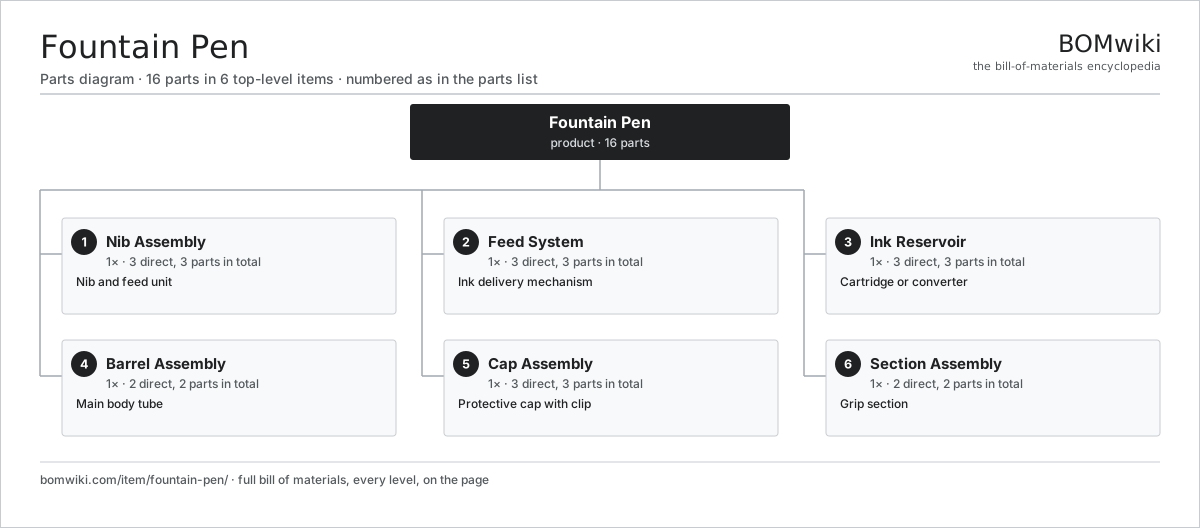
| # | Part | Qty | What it does |
|---|---|---|---|
| 1 | Nib Assembly 3 parts | 1× | Nib and feed unit |
| 2 | Feed System 3 parts | 1× | Ink delivery mechanism |
| 3 | Ink Reservoir 3 parts | 1× | Cartridge or converter |
| 4 | Barrel Assembly 2 parts | 1× | Main body tube |
| 5 | Cap Assembly 3 parts | 1× | Protective cap with clip |
| 6 | Section Assembly 2 parts | 1× | Grip section |
3D model
No 3D model yet. Have a CAD file of this? Add a 3D model. STL renders right on this page; STEP, FreeCAD, and OpenSCAD sources are welcome too (openly licensed, like all 3D models on BOMwiki).
Build & assembly graph
expand / collapse · shared sub-assemblies converge · links to related products · est. labourTap an assembly to expand/collapse · tap a part to open it · use “Open page” for any node · drag to pan, scroll to zoom.
Bill of materials for Fountain Pen
6 top-level lines · 22 rows shown · 16 parts total · indented to 3 levels| # | Item / sub-assembly | Part no. | Qty/assy | Ext. qty | Parts | Type |
|---|---|---|---|---|---|---|
| 1 | Nib Assembly 3 parts | fountain-pen-nib-assembly | 1× | 1 | 3 | assembly |
| 1.1 | Nib Tines | fountain-pen-nib-tines | 1× | 1 | · | part |
| 1.2 | Nib Center Slit | fountain-pen-nib-slit | 1× | 1 | · | part |
| 1.3 | Iridium Ball | fountain-pen-iridium-ball | 1× | 1 | · | part |
| 2 | Feed System 3 parts | fountain-pen-feed-system | 1× | 1 | 3 | assembly |
| 2.1 | Feed Body | fountain-pen-feed-body | 1× | 1 | · | part |
| 2.2 | Feed Channel | fountain-pen-feed-channel | 1× | 1 | · | part |
| 2.3 | Breather Hole | fountain-pen-breather-hole | 1× | 1 | · | part |
| 3 | Ink Reservoir 3 parts | fountain-pen-ink-reservoir | 1× | 1 | 3 | assembly |
| 3.1 | Reservoir Tube | fountain-pen-reservoir-tube | 1× | 1 | · | part |
| 3.2 | Reservoir Seal | fountain-pen-reservoir-seal | 1× | 1 | · | part |
| 3.3 | Piston Rod | fountain-pen-piston-rod | 1× | 1 | · | part |
| 4 | Barrel Assembly 2 parts | fountain-pen-barrel | 1× | 1 | 2 | assembly |
| 4.1 | Barrel Tube | fountain-pen-barrel-tube | 1× | 1 | · | part |
| 4.2 | Barrel Finish | fountain-pen-barrel-finish | 1× | 1 | · | part |
| 5 | Cap Assembly 3 parts | fountain-pen-cap | 1× | 1 | 3 | assembly |
| 5.1 | Cap Body | fountain-pen-cap-body | 1× | 1 | · | part |
| 5.2 | Cap Clip | fountain-pen-cap-clip | 1× | 1 | · | part |
| 5.3 | Cap Seal Cone | fountain-pen-cap-seal-cone | 1× | 1 | · | part |
| 6 | Section Assembly 2 parts | fountain-pen-section | 1× | 1 | 2 | assembly |
| 6.1 | Section Ring | fountain-pen-section-ring | 1× | 1 | · | part |
| 6.2 | Nib Unit Seat | fountain-pen-nib-unit-seat | 1× | 1 | · | part |
Something wrong in this list? Report a problem with this BOM.
Sourcing: possible vendors
Browse the supplier directory → Prices, MOQ, and lead times are algorithmic estimates, not quotes, and not claims about these companies. Company mappings are curated by keyword; est. price band $50–$15k. How estimates work| Vendor | HQ | Specialty | MOQ | Lead time |
|---|---|---|---|---|
|
🇯🇵Canon
canon.com ↗
|
Tokyo, JP | Imaging & optics | 500 units | 8–12 wks |
|
🇯🇵Ricoh
ricoh.com ↗
|
Tokyo, JP | Office imaging | 500 units | 8–12 wks |
|
🇺🇸Xerox
xerox.com ↗
|
Norwalk, US | Printers & copiers | 500 units | 8–12 wks |
|
🇯🇵Epson
epson.com ↗
|
Suwa, JP | Printers & projectors | 500 units | 8–12 wks |
|
🇯🇵Brother
brother.com ↗
|
Nagoya, JP | Printers & sewing | 500 units | 8–12 wks |
864-word article