Frame Warmer
ProductOverview
The frame warmer is a simple but essential tool in eyewear workshops and optical labs, softening plastic eyeglass frames to enable bending and fitting adjustments. Most modern eyeglass frames are made from thermoplastic materials (acetate, nylon, flexible polymers) that have softening temperatures in the 60–80 °C range. Operators use warmers to make incremental adjustments to frame fit, widening temples, bending nose pads, or correcting asymmetrical nose-pad height, without permanently damaging the frame material.
Unlike industrial heating ovens, frame warmers are benchtop-sized, reaching target temperature in 5–10 minutes, with precise temperature control to prevent overheating and material degradation. The glass-bead tray supports frames during heating, distributing heat uniformly while providing a non-slip surface.
How it works
Heating Mechanism and Temperature Management
The Heating Element (nichrome wire coil, 200–500 W) is positioned in the hot-air stream generated by the Blower Assembly (50–100 W fan). The blower draws air from the chamber, passes it over the heater, and recirculates the heated air back into the chamber via inlet ports. This convective circulation ensures uniform temperature throughout the chamber, preventing hot spots.
The Temperature Control System is a microcontroller-based PID thermostat reading the Temperature Probe (RTD or thermocouple) and switching the heater relay on/off to maintain the setpoint within ±2 °C. A Thermal Safety Cutout automatic safety cutoff prevents the chamber from exceeding 90 °C, protecting frame materials and operator safety.
Glass Bead Support System
The Glass Bead Support Tray is filled with 3–5 mm borosilicate glass beads (1–2 kg). These beads serve multiple purposes:
- Thermal mass: Glass has high heat capacity, helping stabilize chamber temperature and reducing heating time variability.
- Support stability: The bed of loose beads conforms to frame shape, supporting temples and nose bridge without pressure points.
- Air circulation: The permeable bead bed allows heated air to flow beneath frames, achieving efficient heat transfer.
- Gentleness: Glass beads won't scratch or mark acetate, nylon, or other frame materials, unlike direct metal contact.
Operators nest frames within the bead bed, ensuring even exposure on all sides.
Operational Workflow
Setup: Operator turns on the warmer and sets desired temperature (typically 65–75 °C for most plastics) using the Temperature Adjustment. The Display Panel shows current temperature; warm-up time is 5–10 minutes to reach setpoint.
Heating: Once the chamber stabilizes at target temperature, frames are placed in the glass-bead tray. A typical optical adjustment (widening a temple, bending a nose pad) requires 3–5 minutes of heating. Some operators use an optional Optional Timer Module to set an automatic shutdown timer (5–15 minutes), preventing unattended overheating.
Adjustment: Frames are removed using plastic tweezers or gloves and manually bent to the desired shape while still warm. Plastic remains pliable for 30–60 seconds after removal; if cooling occurs before adjustment is complete, the frame is reheated.
Cooling: Frames are allowed to cool on a bench (returning to ambient temperature fixes the adjusted shape) or briefly cooled in water to lock in the adjustment.
Material Properties and Temperature Considerations
Common Frame Materials and Softening Points
- Cellulose acetate: Softening point ~80 °C; most common eyewear plastic. Heating above 85 °C can cause discoloration or warping.
- Polycarbonate: Softening point ~150 °C; tougher than acetate, rarely requires heating. Not typically warmed in standard frame warmers.
- Nylon (polyamide): Softening point ~100 °C; flexible and durable. Can be warmed at 70–80 °C for minor adjustments.
- Flexible polymers (TR-90, Grilamid): Variable softening points 80–120 °C depending on polymer blend. Warm at lower end (60–70 °C) to preserve flexibility.
A frame-warmer setpoint of 65–75 °C is conservative for acetate and nylon, ensuring safe margins and preventing irreversible damage.
Heating Time and Heat Transfer
Heating time to reach thermal equilibrium depends on frame thickness and mass. A typical semi-rimless or full-rim plastic frame (2–5 gram total) reaches 70 °C in 3–5 minutes when placed in a 70 °C chamber. Heavier frames (titanium or thicker acetate, 10+ grams) may require 5–10 minutes.
The glass-bead contact accelerates heating compared to air alone; direct contact with beads provides conductive heat transfer in addition to convective warming from the air stream.
Practical Applications and Adjustments
Temple widening: If a frame feels tight around the temples, heating loosens the material, allowing the temples to be bent outward at the hinge. This is the most common adjustment.
Nose-pad height correction: Asymmetrical nose pads (one higher than the other) can be individually heated and bent down to equalize height.
Front-bridge bending: If the frame front is twisted or misaligned, heating allows subtle bending to restore symmetry.
Hinge tightening: Some heated frames can be adjusted at the hinge to increase or decrease resistance if the temple feels too loose or too tight.
These adjustments are typically performed by experienced opticians; improper heating or bending can crack the frame material, rendering it irreparable.
Safety and Maintenance
Operator safety: Although the chamber reaches only 70–80 °C (much cooler than industrial ovens), contact with hot glass beads or frames can cause minor burns. Operators use plastic tweezers or cloth gloves when handling heated frames. The optional timer prevents unattended heating, reducing risk of overheating or accidental ignition.
Ventilation: The frame warmer exhaust vents humid air; placement near a benchtop or light fume hood is recommended to prevent moisture accumulation in the workshop.
Cleaning: Glass beads are replaced if they become cloudy or discolored (typically every 1–2 years depending on usage). The tray is wiped clean monthly to remove dust and debris.
Power safety: A Power Cord Assembly with grounding ensures electrical safety. The heater should be plugged into a grounded outlet; a thermal cutout provides additional protection against runaway overheating.
Competitive Alternatives
Hot-air pen: Localized heating tool for small adjustments; less uniform but more precise for targeted bending.
Water bath: Immersing frames in hot (70 °C) water achieves similar softening; less precise temperature control but simpler operation.
Infrared lamp: Direct radiant heating without air circulation; risk of overheating one side if frames are not rotated frequently.
The glass-bead frame warmer remains the standard in optical labs because it offers uniform heating, repeatable results, simple operation, and inherent safety margins.
Frame Warmer parts and their functions
7 top-level parts · 36 parts in total · full bill of materials below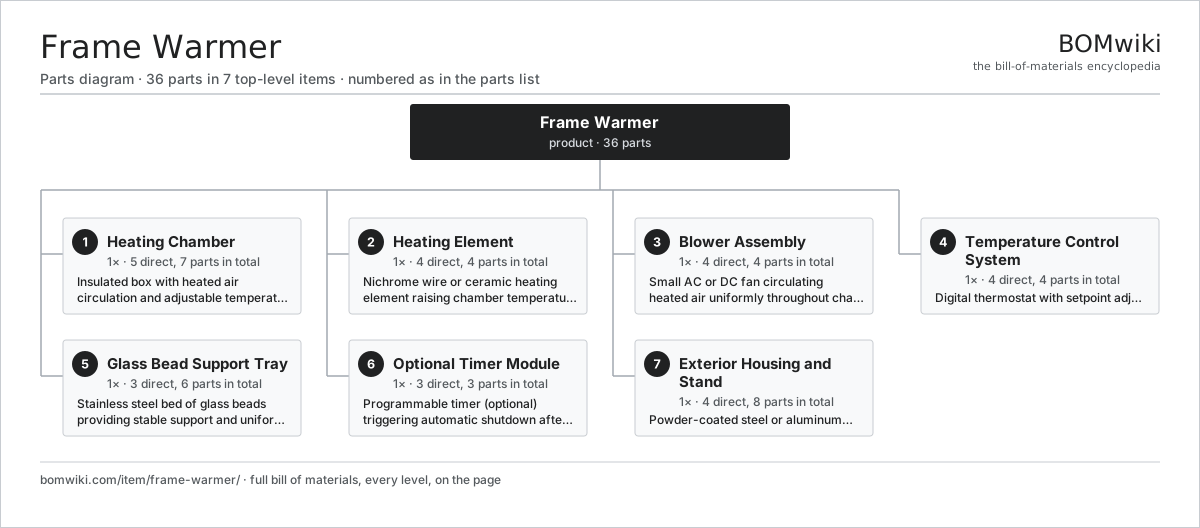
| # | Part | Qty | What it does |
|---|---|---|---|
| 1 | Heating Chamber 5 parts | 1× | Insulated box with heated air circulation and adjustable temperature control |
| 2 | Heating Element 4 parts | 1× | Nichrome wire or ceramic heating element raising chamber temperature to 60–80 °C |
| 3 | Blower Assembly 4 parts | 1× | Small AC or DC fan circulating heated air uniformly throughout chamber |
| 4 | Temperature Control System 4 parts | 1× | Digital thermostat with setpoint adjustment and thermal cutout safety |
| 5 | Glass Bead Support Tray 3 parts | 1× | Stainless steel bed of glass beads providing stable support and uniform heating |
| 6 | Optional Timer Module 3 parts | 1× | Programmable timer (optional) triggering automatic shutdown after preset duration |
| 7 | Exterior Housing and Stand 4 parts | 1× | Powder-coated steel or aluminum exterior with insulation and ventilation slots |
3D model
No 3D model yet. Have a CAD file of this? Add a 3D model. STL renders right on this page; STEP, FreeCAD, and OpenSCAD sources are welcome too (openly licensed, like all 3D models on BOMwiki).
Build & assembly graph
expand / collapse · shared sub-assemblies converge · links to related products · est. labourTap an assembly to expand/collapse · tap a part to open it · use “Open page” for any node · drag to pan, scroll to zoom.
Bill of materials for Frame Warmer
7 top-level lines · 34 rows shown · 36 parts total · indented to 3 levels| # | Item / sub-assembly | Part no. | Qty/assy | Ext. qty | Parts | Type |
|---|---|---|---|---|---|---|
| 1 | Heating Chamber 5 parts | frame-warmer-heating-chamber | 1× | 1 | 7 | assembly |
| 1.1 | Chamber Box | frame-warmer-chamber-body | 1× | 1 | · | part |
| 1.2 | Access Door | frame-warmer-chamber-door | 1× | 1 | · | part |
| 1.3 | Air Inlet Port | frame-warmer-air-inlet-ports | 2× | 2 | · | part |
| 1.4 | Air Outlet Vent | frame-warmer-air-outlet-vents | 2× | 2 | · | part |
| 1.5 | Temperature Probe | frame-warmer-temperature-sensor | 1× | 1 | · | part |
| 2 | Heating Element 4 parts | frame-warmer-heating-element | 1× | 1 | 4 | assembly |
| 2.1 | Nichrome Heating Coil | frame-warmer-heater-coil | 1× | 1 | · | part |
| 2.2 | Heater Sheath | frame-warmer-heater-housing | 1× | 1 | · | part |
| 2.3 | Heater Support | frame-warmer-heater-mounting | 1× | 1 | · | part |
| 2.4 | Heater Power Supply | frame-warmer-heater-supply | 1× | 1 | · | part |
| 3 | Blower Assembly 4 parts | frame-warmer-blower-motor | 1× | 1 | 4 | assembly |
| 3.1 | Blower Impeller | frame-warmer-blower-fan | 1× | 1 | · | part |
| 3.2 | Blower Motor | frame-warmer-blower-motor-unit | 1× | 1 | · | part |
| 3.3 | Blower Inlet | frame-warmer-blower-inlet-duct | 1× | 1 | · | part |
| 3.4 | Blower Outlet Duct | frame-warmer-blower-outlet-duct | 1× | 1 | · | part |
| 4 | Temperature Control System 4 parts | frame-warmer-temperature-control | 1× | 1 | 4 | assembly |
| 4.1 | Temperature Controller | frame-warmer-thermostat-controller | 1× | 1 | · | part |
| 4.2 | Display Panel | frame-warmer-control-display | 1× | 1 | · | part |
| 4.3 | Temperature Adjustment | frame-warmer-control-knob | 1× | 1 | · | part |
| 4.4 | Thermal Safety Cutout | frame-warmer-thermal-cutout | 1× | 1 | · | part |
| 5 | Glass Bead Support Tray 3 parts | frame-warmer-glass-bead-tray | 1× | 1 | 6 | assembly |
| 5.1 | Tray Base | frame-warmer-tray-base | 1× | 1 | · | part |
| 5.2 | Glass Beads | frame-warmer-glass-beads | 1× | 1 | · | part |
| 5.3 | Tray Support Legs | frame-warmer-tray-support-legs | 4× | 4 | · | part |
| 6 | Optional Timer Module 3 parts | frame-warmer-timer-module | 1× | 1 | 3 | assembly |
| 6.1 | Timer Control Logic | frame-warmer-timer-circuit | 1× | 1 | · | part |
| 6.2 | Timer Countdown Display | frame-warmer-timer-display | 1× | 1 | · | part |
| 6.3 | Timer Button Interface | frame-warmer-timer-control-button | 1× | 1 | · | part |
| 7 | Exterior Housing and Stand 4 parts | frame-warmer-housing | 1× | 1 | 8 | assembly |
| 7.1 | Outer Enclosure | frame-warmer-outer-body | 1× | 1 | · | part |
| 7.2 | Power Cord Assembly | frame-warmer-power-cord | 1× | 1 | · | part |
| 7.3 | Exhaust Vent | frame-warmer-ventilation-vents | 2× | 2 | · | part |
| 7.4 | Base Feet | frame-warmer-feet-bumpers | 4× | 4 | · | part |
Something wrong in this list? Report a problem with this BOM.
Sourcing: possible vendors
Browse the supplier directory → Prices, MOQ, and lead times are algorithmic estimates, not quotes, and not claims about these companies. Company mappings are curated by keyword; est. price band $100–$8k. How estimates work| Vendor | HQ | Specialty | MOQ | Lead time |
|---|---|---|---|---|
|
🇯🇵Canon
canon.com ↗
|
Tokyo, JP | Imaging & optics | 500 units | 10–16 wks |
|
🇯🇵Nikon
nikon.com ↗
|
Tokyo, JP | Imaging & optics | 500 units | 10–16 wks |
|
🇩🇪ZEISS
zeiss.com ↗
|
Oberkochen, DE | Optics & optoelectronics | 500 units | 10–16 wks |
| leica-camera.com ↗ | Wetzlar, DE | Cameras & optics | 500 units | 10–16 wks |
| flir.com ↗ | Wilsonville, US | Thermal imaging | 500 units | 10–16 wks |
1,059-word article