Frozen Beverage Machine
ProductOverview
A frozen beverage machine is a refrigerated dispenser that freezes a sweetened liquid to a slurpee-like consistency while continuously stirring it, then dispenses the semi-frozen mixture through a lever handle into a cup. Unlike soft-serve ice cream machines, which churn while freezing, a frozen beverage machine rotates a slow auger inside a still-freezing cylinder, breaking up ice crystals and creating a pourable slush rather than scoopable ice cream.
The equipment consists of 2–4 Cylinder Assembly, stainless-steel drums, one per flavor. Each cylinder is surrounded by an Evaporator Coil, a coil carrying the coldest refrigerant from the Compressor. The cylinder rotates at 10–50 RPM via a Cylinder Drive, and inside, a Auger Screw rotates in the opposite direction. As the liquid freezes on the walls of the cylinder, the auger scrapes it off and tumbles it back into the center, preventing solid ice from forming while maintaining the frozen texture.
A frozen-beverage-machine-mix-hopper sits above each cylinder, gravity-feeding syrup concentrate into the cylinder at a controlled rate. The concentration is preset (typically 1 part syrup to 4–5 parts water or other liquid) and can be adjusted with a needle valve.
The Dispensing Assembly at the front has 2–4 Dispense Handle, typically a lever or squeeze grip per flavor. Pulling the handle opens a Dispense Valve and the slush flows out through a Spout Nozzle into a cup.
How it works
When a machine is first turned on, the Compressor begins running continuously at full speed. Refrigerant is compressed and flows to the Condenser Coil, where heat is rejected to the air. The high-pressure, hot refrigerant then passes through an expansion valve, drops in pressure, and enters the Evaporator Coil coil, becoming very cold (-10 to -20 °F). The operator fills each Cylinder Body with pre-made flavored liquid or water, and the Hopper Valve is opened to allow syrup to drip in slowly.
The frozen-beverage-machine-circulation-fan inside the cabinet draws warm air from the environment, passes it over the Condenser Coil coil (which is now very hot because it's rejecting refrigerant heat), and exhausts the air back out. This cooling-cycle action runs continuously.
As the refrigerant circulates through the Evaporator Coil around the cylinder, the temperature inside the cylinder drops rapidly. The liquid inside begins to freeze. The Cylinder Bearing supports the rotating cylinder, and a motor drives it at low speed. As the cylinder rotates, the Auger Screw inside also rotates in the opposite direction, scraping ice from the cylinder walls and tumbling it back to the center.
After 30–45 minutes of running from cold, the cylinder reaches a quasi-equilibrium: the walls are continuously freezing, the auger is continuously scraping and breaking up ice crystals, and the liquid has the texture of wet snow or a soft slurpee. The syrup continues to drip from the Hopper Body into the cylinder via the Hopper Valve.
When a customer pulls a Dispense Handle, the Dispense Valve (usually a solenoid or manually-opened ball valve) opens, and the slush flows by gravity (or with a slight assist from pressure differentials in the system) down and out the Spout Nozzle. The Drip Tray below catches spills.
The Thermostat monitors the cylinder temperature continuously. If the liquid is freezing too fast or too slowly, the Compressor speed may be adjusted (in variable-capacity models) or the Expansion Valve opening is modulated to regulate refrigerant flow. The goal is a balance: cold enough that the texture is firm and frosty, not so cold that it becomes rock-hard and difficult to dispense.
Regular operation: as customers take cups of slush, the level in the cylinder drops. The Hopper Valve remains open, continuously feed more syrup-water mix into the cylinder, replenishing the volume and maintaining consistent flavor and texture. The auger keeps rotating to prevent ice buildup.
At end of shift, the Compressor is shut off. The cylinders thaw over the next few hours and are drained. Once a week, the augers and cylinders are removed and cleaned by hand.
Frozen beverage machines are iconic in cinemas, arcades, and theme parks. They are simple to operate, produce a product that is visually appealing and fun to consume, and the margins on the syrup concentrate are extremely high, a typical cost of goods is 10–15 % of the selling price. From an engineering perspective, the challenge is balancing freezing speed with consistent texture and preventing auger jam-up from over-freezing.
Frozen Beverage Machine parts and their functions
6 top-level parts · 45 parts in total · full bill of materials below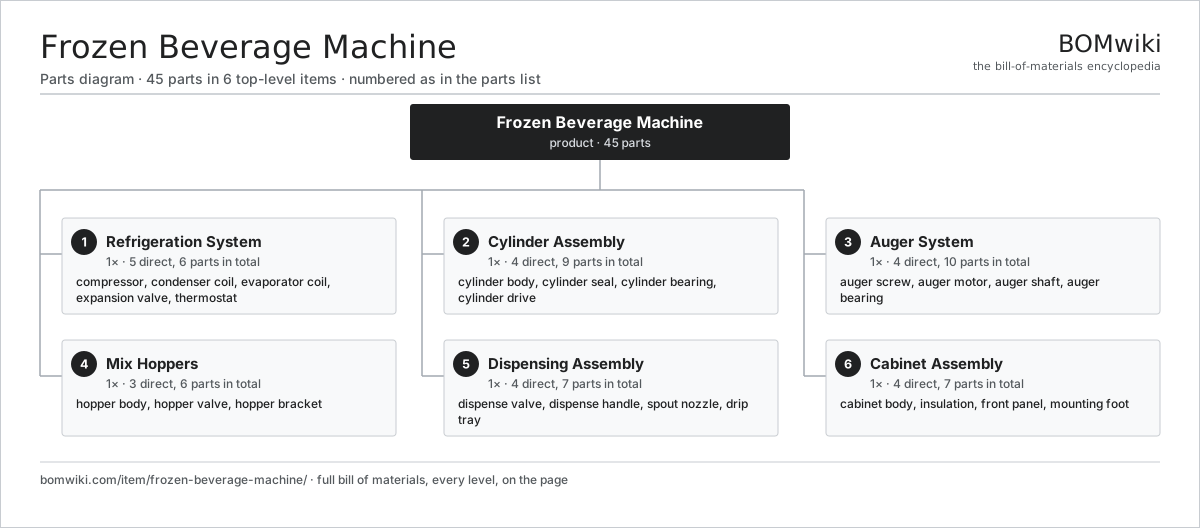
| # | Part | Qty | What it does |
|---|---|---|---|
| 1 | Refrigeration System 5 parts | 1× | Hermetic compressor and evaporator coils that chill the cylindrical chambers to freezing temperature. |
| 2 | Cylinder Assembly 4 parts | 1× | Rotating stainless-steel cylinders that hold the beverage mixture and expose it to evaporator coils for freezing. |
| 3 | Auger System 4 parts | 1× | Rotating screw inside each cylinder that breaks up and moves frozen slush toward the dispensing valve. |
| 4 | Mix Hoppers 3 parts | 1× | Gravity-fed hoppers above each cylinder that allow syrup or flavored concentrate to drip into the freezing chamber. |
| 5 | Dispensing Assembly 4 parts | 1× | Valve and handle system that dispenses the frozen slush from each cylinder into a cup. |
| 6 | Cabinet Assembly 4 parts | 1× | Insulated stainless-steel body that houses the refrigeration, cylinders, and controls. |
3D model
No 3D model yet. Have a CAD file of this? Add a 3D model. STL renders right on this page; STEP, FreeCAD, and OpenSCAD sources are welcome too (openly licensed, like all 3D models on BOMwiki).
Build & assembly graph
expand / collapse · shared sub-assemblies converge · links to related products · est. labourTap an assembly to expand/collapse · tap a part to open it · use “Open page” for any node · drag to pan, scroll to zoom.
Bill of materials for Frozen Beverage Machine
6 top-level lines · 30 rows shown · 45 parts total · indented to 3 levels| # | Item / sub-assembly | Part no. | Qty/assy | Ext. qty | Parts | Type |
|---|---|---|---|---|---|---|
| 1 | Refrigeration System 5 parts | frozen-beverage-machine-refrigeration-system | 1× | 1 | 6 | assembly |
| 1.1 | Compressor | frozen-beverage-machine-compressor | 1× | 1 | · | part |
| 1.2 | Condenser Coil | frozen-beverage-machine-condenser | 1× | 1 | · | part |
| 1.3 | Evaporator Coil | frozen-beverage-machine-evaporator | 2× | 2 | · | part |
| 1.4 | Expansion Valve | frozen-beverage-machine-expansion-valve | 1× | 1 | · | part |
| 1.5 | Thermostat | frozen-beverage-machine-thermostat | 1× | 1 | · | part |
| 2 | Cylinder Assembly 4 parts | frozen-beverage-machine-cylinder-assembly | 1× | 1 | 9 | assembly |
| 2.1 | Cylinder Body | frozen-beverage-machine-cylinder-body | 2× | 2 | · | part |
| 2.2 | Cylinder Seal | frozen-beverage-machine-cylinder-seal | 2× | 2 | · | part |
| 2.3 | Cylinder Bearing | frozen-beverage-machine-cylinder-bearing | 4× | 4 | · | part |
| 2.4 | Cylinder Drive | frozen-beverage-machine-cylinder-drive | 1× | 1 | · | part |
| 3 | Auger System 4 parts | frozen-beverage-machine-auger-system | 1× | 1 | 10 | assembly |
| 3.1 | Auger Screw | frozen-beverage-machine-auger-screw | 2× | 2 | · | part |
| 3.2 | Auger Motor | frozen-beverage-machine-auger-motor | 2× | 2 | · | part |
| 3.3 | Auger Shaft | frozen-beverage-machine-auger-shaft | 2× | 2 | · | part |
| 3.4 | Auger Bearing | frozen-beverage-machine-auger-bearing | 4× | 4 | · | part |
| 4 | Mix Hoppers 3 parts | frozen-beverage-machine-mix-hoppers | 1× | 1 | 6 | assembly |
| 4.1 | Hopper Body | frozen-beverage-machine-hopper-body | 2× | 2 | · | part |
| 4.2 | Hopper Valve | frozen-beverage-machine-hopper-valve | 2× | 2 | · | part |
| 4.3 | Hopper Bracket | frozen-beverage-machine-hopper-bracket | 2× | 2 | · | part |
| 5 | Dispensing Assembly 4 parts | frozen-beverage-machine-dispensing-assembly | 1× | 1 | 7 | assembly |
| 5.1 | Dispense Valve | frozen-beverage-machine-dispense-valve | 2× | 2 | · | part |
| 5.2 | Dispense Handle | frozen-beverage-machine-dispense-handle | 2× | 2 | · | part |
| 5.3 | Spout Nozzle | frozen-beverage-machine-spout | 2× | 2 | · | part |
| 5.4 | Drip Tray | frozen-beverage-machine-drip-tray | 1× | 1 | · | part |
| 6 | Cabinet Assembly 4 parts | frozen-beverage-machine-cabinet | 1× | 1 | 7 | assembly |
| 6.1 | Cabinet Body | frozen-beverage-machine-cabinet-body | 1× | 1 | · | part |
| 6.2 | Insulation | frozen-beverage-machine-cabinet-insulation | 1× | 1 | · | part |
| 6.3 | Front Panel | frozen-beverage-machine-front-panel | 1× | 1 | · | part |
| 6.4 | Mounting Foot | frozen-beverage-machine-mounting-feet | 4× | 4 | · | part |
Something wrong in this list? Report a problem with this BOM.
Sourcing: possible vendors
Browse the supplier directory → Prices, MOQ, and lead times are algorithmic estimates, not quotes, and not claims about these companies. Company mappings are curated by keyword; est. price band $1k–$500k. How estimates work| Vendor | HQ | Specialty | MOQ | Lead time |
|---|---|---|---|---|
| gea.com ↗ | Düsseldorf, DE | Process technology | 20 units | 12–20 wks |
| buhlergroup.com ↗ | Uzwil, CH | Food & materials processing | 20 units | 12–20 wks |
| tetrapak.com ↗ | Pully, CH | Food packaging & processing | 20 units | 12–20 wks |
| jbtc.com ↗ | Chicago, US | Food processing equipment | 20 units | 12–20 wks |
| alfalaval.com ↗ | Lund, SE | Heat transfer & separation | 20 units | 12–20 wks |
836-word article