Continuous Oil Filtration
ProductOverview
The Continuous Oil Filtration System is a standalone modular unit designed to extend the life of frying oil by removing food particles, meal fines, carbon fragments, and water droplets in real-time. Rather than shutting down a fryer periodically to change oil (every 1–2 days), this system continuously recirculates oil from the fryer tank through a high-capacity cartridge filter, heat exchanger, and sediment trap, allowing fryers to operate 5–7 days (40–60 hours) before oil change, a 3–5× extension of oil life.
This approach reduces oil consumption cost (primary ongoing expense in high-volume frying), extends equipment life (less thermal stress from repeated cold-oil start-ups), and improves product consistency (cleaner oil maintains stable frying temperature and color uniformity). The system is retrofittable to existing fryers and can serve multiple fryer tanks if sized appropriately.
How It Works
The Filtration Pump (2–3 kW gear pump) is connected via flexible hose to the fryer tank bottom (lowest point where sediment accumulates). When activated by a timer or manual control, the pump draws hot oil from the fryer at 15–30 L/min continuous flow. A Pump Strainer inlet screen (100 mesh) prevents large debris from entering the pump, protecting it from cavitation and wear.
The warm oil then passes through the Filter Housing, where a Filter Element pleated cartridge removes particles down to 10–25 microns nominal (depending on filter grade). High-capacity media allows 100+ liters of oil to pass before cartridge saturation. As the cartridge loads with debris, differential pressure across the element rises. A Filter Bypass poppet valve set to 1.5 bar opens if pressure differential exceeds safe limits, allowing oil to bypass the saturated cartridge rather than rupturing the media. A Filter Gauge differential pressure indicator mounted on the housing shows cartridge condition; operators replace the cartridge when gauge reads high (typically every 16–40 hours depending on food type and oil condition).
After filtration, the clean oil flows through the Heat Exchanger, a plate-frame cooler with oil and cooling fluid passages. If oil temperature has risen during recirculation and frying (adding ~5–10°C per cycle in high-throughput settings), the heat exchanger removes excess temperature to return oil to fryer at 170–180°C setpoint (no hotter). The Coolant Pump circulates cold water or glycol-water coolant from an external chiller or utility supply; a Coolant Control proportional three-way valve balances hot and cold coolant flows, maintaining outlet oil temperature within ±5°C of setpoint. If no external cooling is available, the heat exchanger can be sized for passive air cooling, relying on ambient air and circulation time to gradually reduce oil temperature.
Finally, oil enters the Sediment Trap, a gravity settling tank where the flow velocity drops abruptly. Heavy particles (fried meal, salt crystals, flour dust) fall out of suspension and accumulate in the conical bottom of the tank. Clean oil exits the top of the settling tank via a return line back to the fryer, completing the recirculation loop. Periodically (every 8–16 hours depending on food type), the Sediment Drain solenoid valve is opened, draining accumulated sediment sludge into a waste container; a Sight Glass level indicator helps operators identify when draining is necessary.
Control Logic and Automation
The Control PLC programmable logic controller manages the filtration cycle:
- On-demand or scheduled operation: A Control Timer can be set to run filtration automatically every 4–6 hours during production, or operators activate filtration manually via pushbutton.
- Pressure monitoring: The Pressure Switch differential pressure transmitter sends a 4–20 mA signal; if pressure exceeds 1.5 bar, an alarm alerts operators that the cartridge is saturated and requires replacement.
- Temperature feedback: An Temp Sensor RTD probe monitors oil outlet temperature; if oil remains too hot (> 185°C) after cooling, the PLC can signal the heat exchanger coolant pump to increase flow.
- Sediment level: A Level Sensor capacitive sensor in the sediment trap triggers a drain alarm when the tank is 80% full, reminding operators to empty waste.
The Control Panel stainless enclosure houses all electrical logic and solenoid drivers. A digital display shows real-time pressure, temperature, and sediment level; historical alarms are logged for maintenance trending.
Particle Removal Efficiency
The combination of cartridge filtration (10–25 micron) and gravity settling (removes particles > 50 micron) effectively removes:
- Meal particles: starch and protein fragments from breaded foods, typically 20–100 micron.
- Carbon fragments: polymerized fats and proteins from surface browning, typically 10–50 micron.
- Salt crystals: from salted product dust, typically 50–200 micron.
- Water droplets: condensed moisture forming during frying; coalescent cartridges (special pleated media with hydrophobic coating) separate water down to 5 micron droplet size.
Removal of these contaminants directly extends oil life. Water, in particular, accelerates oil oxidation and hydrolysis (free fatty acid generation). A dry oil cartridge (either using desiccant layers or coalescent media design) can reduce water content from 500 ppm (typical in batch-fried oil after 12–18 hours) to < 100 ppm.
Integration with Fryer Systems
The filtration system is retrofittable: flexible hose connections attach to the fryer tank, requiring no tank modification. For new facilities, the pump suction line can be manifolded to a shared drain at multiple fryer tanks, allowing one filtration system to serve 2–3 small fryers or 1 large fryer. The return line enters the tank above the oil level (to minimize splashing and aeriation), or via a dip tube submerged if gentle circulation is preferred.
Maintenance and Consumables
Cartridge replacement is the primary consumable. A high-capacity cartridge (100+ liters rated) typically lasts 16–40 operating hours depending on food type: breaded or heavy protein-load products (fish, chicken) clog cartridges faster than light snacks. Cost per cartridge is typically USD 20–80; calculating cartridge cost per liter of oil filtered helps quantify filtration ROI.
Heat exchanger maintenance involves annual cleaning (reversing flow direction briefly to dislodge scale buildup) and periodic gasket replacement if leakage occurs. Coolant (if water-based) should be treated with corrosion inhibitors and changed annually.
Pump and motor servicing includes annual oil level checks in gear pump reservoirs and belt tension inspection on external gear pump designs. Bearing lubrication intervals are typically 250–500 operating hours.
Economics and ROI
Oil cost is the dominant operating expense in continuous frying operations. A fryer consuming 200 kg/day at USD 3–5 per kg costs USD 600–1000/day in oil alone. Extending oil life from 2 days (requires daily oil change) to 5 days (via filtration) reduces oil consumption by 60%, saving USD 1200–2000/week on a single large fryer.
A filtration system costs USD 10k–25k installed (depending on capacity and heat exchanger type); annual operating costs (cartridges, energy, maintenance) are USD 3k–6k. A facility operating a single fryer breaks even in 2–4 months; multiple fryers amortize the investment faster.
Beyond cost, filtration maintains frying oil temperature stability (fewer cold-start cycles), improves product color consistency, and extends fryer heat exchanger life (less thermal cycling stress). These indirect benefits often justify filtration investment in high-value or specialty frying (gourmet chips, fresh-fried donuts) even if oil savings alone were marginal.
Temperature Management Considerations
Oil temperature control is critical for product quality and oil longevity. Without heat exchanger cooling, oil temperature creeps upward during heavy frying (up to 190–200°C peak). Excessive temperature (> 190°C) accelerates oil oxidation and smoke point reduction; product color darkens excessively.
The heat exchanger removes excess heat, maintaining isothermal operation: oil exits the filtration loop at ~170°C, the same as the fryer setpoint, ensuring no net temperature rise during recirculation. This is especially valuable in high-throughput snack lines (e.g., continuous chip fryers at 300 kg/h) where oil turnover is rapid and temperature control margins are tight.
In small-batch or intermittent frying (cinema poppers, donut shops), the heat exchanger can be passive (no external coolant), relying on extended residence time in the tank and ambient cooling to stabilize temperature, a lower-cost option suitable for < 50 kg/h production.
Continuous Oil Filtration parts and their functions
5 top-level parts · 25 parts in total · full bill of materials below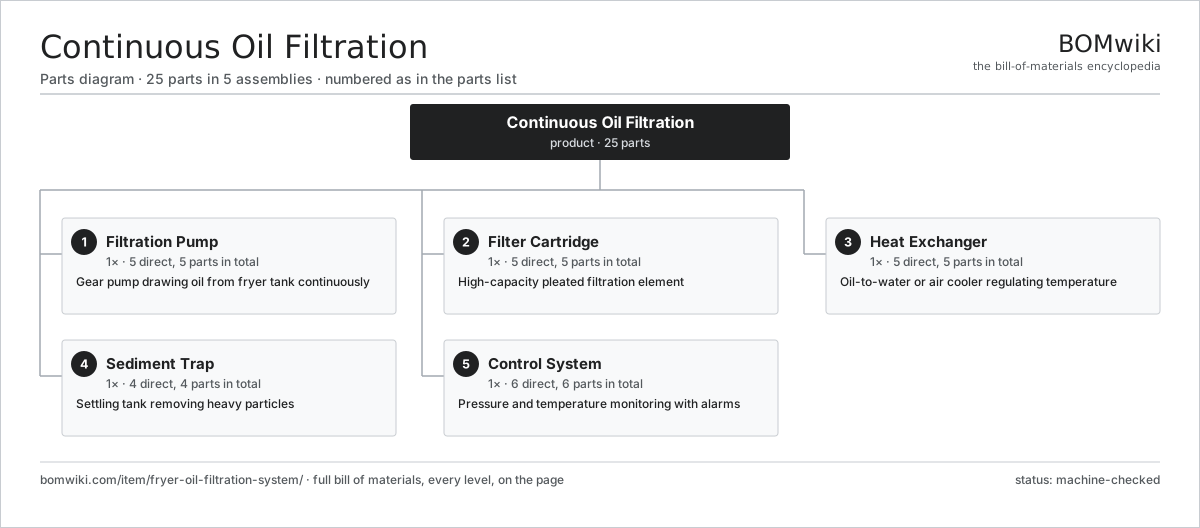
| # | Part | Qty | What it does |
|---|---|---|---|
| 1 | Filtration Pump 5 parts | 1× | Gear pump drawing oil from fryer tank continuously |
| 2 | Filter Cartridge 5 parts | 1× | High-capacity pleated filtration element |
| 3 | Heat Exchanger 5 parts | 1× | Oil-to-water or air cooler regulating temperature |
| 4 | Sediment Trap 4 parts | 1× | Settling tank removing heavy particles |
| 5 | Control System 6 parts | 1× | Pressure and temperature monitoring with alarms |
3D model
No 3D model yet. Have a CAD file of this? Add a 3D model — STL renders right on this page; STEP, FreeCAD, and OpenSCAD sources are welcome too (openly licensed, like all 3D models on BOMwiki).
Build & assembly graph
expand / collapse · shared sub-assemblies converge · links to related products · est. labourTap an assembly to expand/collapse · tap a part to open it · use “Open page” for any node · drag to pan, scroll to zoom.
Bill of materials for Continuous Oil Filtration
5 top-level lines · 30 rows shown · 25 parts total · indented to 3 levels| # | Item / sub-assembly | Part no. | Qty/assy | Ext. qty | Parts | Type |
|---|---|---|---|---|---|---|
| 1 | Filtration Pump 5 parts | fryer-oil-filtration-system-pump | 1× | 1 | 5 | assembly |
| 1.1 | Pump Motor | fryer-oil-filtration-system-pump-motor | 1× | 1 | · | part |
| 1.2 | Gear Pump | fryer-oil-filtration-system-pump-gear | 1× | 1 | · | part |
| 1.3 | Pump Strainer | fryer-oil-filtration-system-pump-strainer | 1× | 1 | · | part |
| 1.4 | Pump Relief | fryer-oil-filtration-system-pump-relief-valve | 1× | 1 | · | part |
| 1.5 | Motor Starter | fryer-oil-filtration-system-pump-motor-starter | 1× | 1 | · | part |
| 2 | Filter Cartridge 5 parts | fryer-oil-filtration-system-filter-cartridge | 1× | 1 | 5 | assembly |
| 2.1 | Filter Housing | fryer-oil-filtration-system-filter-housing | 1× | 1 | · | part |
| 2.2 | Filter Element | fryer-oil-filtration-system-filter-element | 1× | 1 | · | part |
| 2.3 | Filter Bypass | fryer-oil-filtration-system-filter-bypass-valve | 1× | 1 | · | part |
| 2.4 | Filter Drain | fryer-oil-filtration-system-filter-drain-valve | 1× | 1 | · | part |
| 2.5 | Filter Gauge | fryer-oil-filtration-system-filter-pressure-gauge | 1× | 1 | · | part |
| 3 | Heat Exchanger 5 parts | fryer-oil-filtration-system-heat-exchanger | 1× | 1 | 5 | assembly |
| 3.1 | Heat Exchanger Plates | fryer-oil-filtration-system-hx-plates | 1× | 1 | · | part |
| 3.2 | Heat Exchanger Frame | fryer-oil-filtration-system-hx-frame | 1× | 1 | · | part |
| 3.3 | Coolant Pump | fryer-oil-filtration-system-hx-coolant-pump | 1× | 1 | · | part |
| 3.4 | Coolant Control | fryer-oil-filtration-system-hx-coolant-temp-control | 1× | 1 | · | part |
| 3.5 | Gaskets | fryer-oil-filtration-system-hx-gaskets | 1× | 1 | · | part |
| 4 | Sediment Trap 4 parts | fryer-oil-filtration-system-sediment-trap | 1× | 1 | 4 | assembly |
| 4.1 | Sediment Vessel | fryer-oil-filtration-system-sediment-vessel | 1× | 1 | · | part |
| 4.2 | Sediment Drain | fryer-oil-filtration-system-sediment-drain-valve | 1× | 1 | · | part |
| 4.3 | Sight Glass | fryer-oil-filtration-system-sediment-sight-glass | 1× | 1 | · | part |
| 4.4 | Air Vent | fryer-oil-filtration-system-sediment-air-vent | 1× | 1 | · | part |
| 5 | Control System 6 parts | fryer-oil-filtration-system-control | 1× | 1 | 6 | assembly |
| 5.1 | Pressure Switch | fryer-oil-filtration-system-control-pressure-switch | 1× | 1 | · | part |
| 5.2 | Temp Sensor | fryer-oil-filtration-system-control-temperature-sensor | 1× | 1 | · | part |
| 5.3 | Level Sensor | fryer-oil-filtration-system-control-level-sensor | 1× | 1 | · | part |
| 5.4 | Control PLC | fryer-oil-filtration-system-control-plc | 1× | 1 | · | part |
| 5.5 | Control Panel | fryer-oil-filtration-system-control-panel | 1× | 1 | · | part |
| 5.6 | Control Timer | fryer-oil-filtration-system-control-timer | 1× | 1 | · | part |
Sourcing: possible vendors
Prices, MOQ, and lead times are algorithmic estimates, not quotes, and not claims about these companies. Company mappings are curated by keyword; est. price band $1k–$500k. How estimates work| Vendor | HQ | Specialty | MOQ | Lead time |
|---|---|---|---|---|
| gea.com ↗ | Düsseldorf, DE | Process technology | 20 units | 12–20 wks |
| buhlergroup.com ↗ | Uzwil, CH | Food & materials processing | 20 units | 12–20 wks |
| tetrapak.com ↗ | Pully, CH | Food packaging & processing | 20 units | 12–20 wks |
| jbtc.com ↗ | Chicago, US | Food processing equipment | 20 units | 12–20 wks |
| alfalaval.com ↗ | Lund, SE | Heat transfer & separation | 20 units | 12–20 wks |
1,429-word article