Cable Functional Trainer
ProductOverview
A cable functional trainer is a two-tower cable machine that allows exercise in all planes of motion (front-to-back, side-to-side, and rotational). Unlike a single-stack machine (which routes all cable load through one weight stack), a functional trainer has two independent Weight Stack Assembly assemblies, one per tower, allowing the user to load left and right sides differently or to use both pulleys simultaneously.
The key feature enabling functional training is the adjustable Adjustable Pulley Arm on each side. A user can move the pulley from knee height to overhead, creating exercise angles and positions that fixed machines cannot. Combined with a range of Cable Attachment Set accessories (handles, ropes, bars, ankle straps), a single functional trainer can replicate dozens of dumbbell or barbell exercises.
Weight stack and mechanical advantage
Each Weight Stack Assembly is a column of cast-iron Weight Plate discs, typically 2.5–5.0 kg each, stacked on a Weight Stack Rod center shaft. A user selects the desired load by inserting a Weight Selector Pin through a hole in the plates at the chosen weight level. The pin resets the load and locks it to the cable system via a mechanical linkage.
The Weight Stack Frame holds the stack to the tower. The stacks are independent: the left and right sides can be set to different weights, enabling asymmetric exercises (e.g., a single-arm row where one side is loaded heavier to challenge core stability). Typical weight ranges are 2.5–100 kg per side (light models) or 2.5–150 kg per side (heavy-duty gyms).
Cable system and pulley routing
The Steel Braided Cable is steel-braided, 3/16 inch (4.7 mm) diameter, with a tensile strength around 1000 kg, sufficient for any gym exercise load. Each cable runs from the top of the weight stack down to a Pulley Block Assembly held by the adjustable arm.
The cable path is:
- Anchor point at the top of the weight stack.
- Down and through the adjustable arm pulley (on the user's side).
- The cable can return to another pulley or directly to the user attachment.
The Pulley Block Assembly is a sealed-bearing block with a grooved wheel, minimizing friction and allowing smooth movement as the user pulls or pushes.
Cable routing guides (small Cable Routing Guide tubes or clips) keep the cable from fouling or catching on the frame as it moves through space during exercise. These guides are critical for safety and machine longevity.
Adjustable pulley arm and exercise angles
The Adjustable Pulley Arm is the innovation that defines a functional trainer. Each arm is a carriage that slides on an Arm Adjustment Rail, typically a 1.5-meter vertical rail. The user adjusts height by grasping the Arm Height Handle and sliding the arm up or down, then locking it in place with the Arm Lock Pin.
Height positions range from ~1 meter below shoulder height (good for low cable woodchops or cable kickbacks) to ~2 meters above head height (good for lat pulls or shoulder presses). This variability allows:
- Low pulley (below waist): cable rows, leg exercises, dead-bugs.
- Mid pulley (shoulder height): face pulls, chest presses, lateral raises.
- High pulley (above head): lat pulldowns, pullover-like movements, overhead pressing.
Some machines also allow the pulley arm to rotate 360° around the tower, so the user can pull from the front, side, or back of the machine. This multi-planar capability makes the cable trainer useful for rotational and transverse-plane exercises that dumbbells or barbells are awkward for.
Attachment versatility
The Cable Attachment Set includes multiple handle types:
- Single-hand Single-Hand Grip: D-shaped or ergonomic, for unilateral work. Two are typically provided (one per side).
- Rope Handle: a knotted rope ending in a ball connector, excellent for tricep extensions, face pulls, and rope climbs.
- Straight Bar Handle: a straight bar 20–30 cm wide, for bilateral movements like chest presses or lat pulldowns.
- Ankle Attachment Strap: an ankle cuff for leg exercises (leg presses, leg curls, leg kickbacks).
All attachments use a standard ball-end (1/4 inch) connector, allowing easy swapping. Most machines come with 6–8 standard attachments; specialty attachments (multi-grip bars, suspension trainers, medicine ball inserts) are optional purchases.
This modularity means hundreds of exercise variations are possible on a single machine by simply changing attachment, adjusting the arm height, and varying stance or position.
User experience and exercise categories
A typical functional trainer session includes:
- Pulling exercises: lat pulldowns (high pulley, bar handle), cable rows (mid pulley, single handle), face pulls (high pulley, rope).
- Pressing exercises: chest press (mid pulley, bar or single handle), overhead press (low or mid pulley, single handle or bar).
- Rotational exercises: woodchops (low to high pulley, single handle, rotating torso), cable chops (high to low pulley with rotation).
- Leg exercises: leg press (low pulley, bar handle, user in standing split-stance), leg curl (low pulley, ankle strap), glute kick-back (low pulley, ankle strap).
- Core work: anti-rotation holds, Pallof press (mid pulley, single handle, resisting rotation), dead-bug (high pulley, rope, in lying position).
The advantage of cables over free weights is that the force vector is constant (always in line with the cable) rather than vertical (like gravity on a barbell). This enables exercises and muscle activation patterns not easily replicated with dumbbells, making cable trainers valuable for strength and muscle development.
Mechanical advantages and load feel
The cable path creates mechanical advantage. If the cable goes directly from the weight stack to the user attachment, the mechanical advantage is 1:1 (the user pulls with the load you selected). If the cable is routed through a fixed redirect pulley on the machine, the mechanical advantage becomes 2:1 (the user pulls half the selected load, but the motion is half as far).
Most functional trainers use 1:1 routing, keeping the relationship simple. However, some machines include mechanical advantage options via different routing paths for specific exercises.
Durability and maintenance
The Steel Braided Cable is the primary wear item. A cable can last 5–10 years in moderate use but may fray or break in heavy commercial use after 2–3 years. Replacement requires unbolting the cable at both ends and routing a new cable through the system. Cable replacement is a skilled task typically done by gym service technicians.
The Pulley Block Assembly bearings should be sealed to minimize maintenance. In high-use gyms, it is common to occasionally lubricate pulley shafts with a light machine oil, but sealed bearings require minimal maintenance.
The Weight Plate casting can crack if mishandled or if the pin is removed carelessly, causing a plate to drop. This is rare. More common is rust if the plates are exposed to moisture; most gym plates are painted to resist rust, but chipped paint should be touched up to prevent surface rust.
The Arm Lock Pin and Arm Height Handle are high-use contact points. The pin should be checked periodically to ensure it holds position without slipping.
Advantages and limitations
The cable trainer excels at:
- Multi-planar and rotational movements.
- Unilateral training (one side at a time), which benefits core stability and addresses asymmetries.
- Exercise variety on a single machine.
- Smooth resistance throughout the range of motion (no sudden lockout).
Limitations:
- Load is limited by the weight stack (typically 100–150 kg per side), which is light for heavy strength training. A barbell deadlift at 200+ kg is not possible on a cable machine.
- The cable length limits the range of some motions. A very long cable pull-down is constrained by the arm height.
- The rope attachment is less stable than a barbell: a user attempting to bench press a heavy load on the cable would experience instability that a barbell bench press does not.
Cable trainers are ideally suited for general strength, hypertrophy, and conditioning training; they are less suitable for maximal strength or power development, where barbells and dumbbells are the standard.
Cable Functional Trainer parts and their functions
7 top-level parts · 95 parts in total · full bill of materials below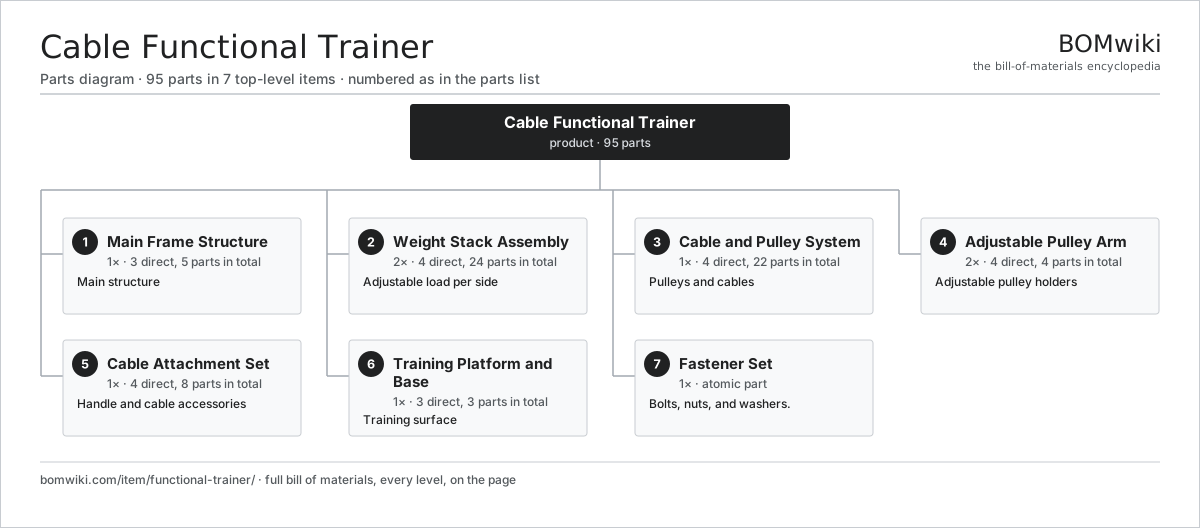
| # | Part | Qty | What it does |
|---|---|---|---|
| 1 | Main Frame Structure 3 parts | 1× | Main structure |
| 2 | Weight Stack Assembly 4 parts | 2× | Adjustable load per side |
| 3 | Cable and Pulley System 4 parts | 1× | Pulleys and cables |
| 4 | Adjustable Pulley Arm 4 parts | 2× | Adjustable pulley holders |
| 5 | Cable Attachment Set 4 parts | 1× | Handle and cable accessories |
| 6 | Training Platform and Base 3 parts | 1× | Training surface |
| 7 | Fastener Set | 1× | Bolts, nuts, and washers. |
3D model
No 3D model yet. Have a CAD file of this? Add a 3D model. STL renders right on this page; STEP, FreeCAD, and OpenSCAD sources are welcome too (openly licensed, like all 3D models on BOMwiki).
Build & assembly graph
expand / collapse · shared sub-assemblies converge · links to related products · est. labourTap an assembly to expand/collapse · tap a part to open it · use “Open page” for any node · drag to pan, scroll to zoom.
Bill of materials for Cable Functional Trainer
7 top-level lines · 29 rows shown · 95 parts total · indented to 3 levels| # | Item / sub-assembly | Part no. | Qty/assy | Ext. qty | Parts | Type |
|---|---|---|---|---|---|---|
| 1 | Main Frame Structure 3 parts | functional-trainer-frame | 1× | 1 | 5 | assembly |
| 1.1 | Vertical Tower | functional-trainer-frame-tower | 2× | 2 | · | part |
| 1.2 | Cross Connector Beam | functional-trainer-cross-connect | 2× | 2 | · | part |
| 1.3 | Base Stability Rail | functional-trainer-base-rail | 1× | 1 | · | part |
| 2 | Weight Stack Assembly 4 parts | functional-trainer-weight-stack | 2× | 2 | 24 | assembly |
| 2.1 | Weight Plate | functional-trainer-weight-plate | 20× | 40 | · | part |
| 2.2 | Weight Stack Rod | functional-trainer-weight-rod | 1× | 2 | · | part |
| 2.3 | Weight Stack Frame | functional-trainer-weight-frame | 1× | 2 | · | part |
| 2.4 | Weight Selector Pin | functional-trainer-pin-handle | 2× | 4 | · | part |
| 3 | Cable and Pulley System 4 parts | functional-trainer-cable-system | 1× | 1 | 22 | assembly |
| 3.1 | Steel Braided Cable | functional-trainer-cable | 4× | 4 | · | part |
| 3.2 | Pulley Block Assembly | functional-trainer-pulley-block | 4× | 4 | · | part |
| 3.3 | Cable End Fitting | functional-trainer-cable-end-fitting | 8× | 8 | · | part |
| 3.4 | Cable Routing Guide | functional-trainer-cable-guide | 6× | 6 | · | part |
| 4 | Adjustable Pulley Arm 4 parts | functional-trainer-pulley-arm | 2× | 2 | 4 | assembly |
| 4.1 | Arm Adjustment Rail | functional-trainer-arm-rail | 1× | 2 | · | part |
| 4.2 | Arm Carriage Block | functional-trainer-arm-carriage | 1× | 2 | · | part |
| 4.3 | Arm Lock Pin | functional-trainer-arm-lock-pin | 1× | 2 | · | part |
| 4.4 | Arm Height Handle | functional-trainer-arm-adjustment-handle | 1× | 2 | · | part |
| 5 | Cable Attachment Set 4 parts | functional-trainer-attachment-set | 1× | 1 | 8 | assembly |
| 5.1 | Single-Hand Grip | functional-trainer-single-grip-handle | 2× | 2 | · | part |
| 5.2 | Rope Handle | functional-trainer-rope-handle | 2× | 2 | · | part |
| 5.3 | Straight Bar Handle | functional-trainer-bar-handle | 2× | 2 | · | part |
| 5.4 | Ankle Attachment Strap | functional-trainer-ankle-strap | 2× | 2 | · | part |
| 6 | Training Platform and Base 3 parts | functional-trainer-base-platform | 1× | 1 | 3 | assembly |
| 6.1 | Platform Frame | functional-trainer-platform-frame | 1× | 1 | · | part |
| 6.2 | Platform Top Surface | functional-trainer-platform-surface | 1× | 1 | · | part |
| 6.3 | Foot Position Guide | functional-trainer-foot-position-marker | 1× | 1 | · | part |
| 7 | Fastener Set | fastener-set | 1× | 1 | · | part |
Something wrong in this list? Report a problem with this BOM.
Sourcing: possible vendors
Browse the supplier directory → Prices, MOQ, and lead times are algorithmic estimates, not quotes, and not claims about these companies. Company mappings are curated by keyword; est. price band $100–$10k. How estimates work| Vendor | HQ | Specialty | MOQ | Lead time |
|---|---|---|---|---|
| lifefitness.com ↗ | Rosemont, US | Fitness equipment | 200 units | 8–14 wks |
| technogym.com ↗ | Cesena, IT | Fitness equipment | 200 units | 8–14 wks |
|
🇺🇸Peloton
onepeloton.com ↗
|
New York, US | Connected fitness | 200 units | 8–14 wks |
| johnsonhealthtech.com ↗ | Taichung, TW | Fitness (Matrix) | 200 units | 8–14 wks |
|
🇺🇸Precor
precor.com ↗
|
Woodinville, US | Fitness equipment | 200 units | 8–14 wks |
1,371-word article