Automatic Game Feeder
ProductOverview
An automatic game feeder is a motorized hopper system that dispenses grain or pellets on a programmed schedule, attracting wildlife (deer, elk, hogs, turkeys) to specific locations for hunting or wildlife observation. The system consists of a large grain storage hopper (30–50 gallons), a digital or mechanical timer, a 12V electric motor driving a spinner plate or auger, and a battery pack with optional solar charging. Modern feeders operate autonomously for 7–14 days between manual refills, enabling hunters to monitor feeding patterns and game movement without daily site visits.
The primary advantage of automatic feeders is location control: instead of game animals being unpredictably distributed across large territories, feeders concentrate animals at specific spots, increasing encounter probability and enabling hunters to pattern behavior, identify individual animals, and make strategic harvest decisions. For land managers monitoring wildlife populations or researching habitat utilization, feeders provide consistent baseline data on species distribution and seasonal migration patterns.
How it Works
The Automatic Game Feeder operates on a simple cycle: at preset times (e.g., dawn and dusk), the Timer Control Module signals the Motor Drive to operate for 1–10 seconds. The motor drives the Spinner & Dispensing (a rotating disk with raised vanes or an auger screw), which scoops grain from the Hopper Storage and flings it outward in a 12–15 foot radius around the feeder base.
The Hopper Tank (30–50 gallon plastic or steel) sits atop the frame, 3–5 feet above ground. This height elevation serves multiple purposes: it prevents feral hogs and raccoons from tipping the feeder and accessing grain directly, it allows deer to walk underneath and reach feed, and it reduces ground moisture and mold growth in stored grain. The hopper bottom is sealed with a weatherproof gasket, preventing rain infiltration and keeping grain dry.
A removable top allows manual refilling via bucket or bag. Most commercial grain for wildlife (corn, sorghum, mixed pellets) weighs 50–70 lbs per 50-gallon bag, so refilling a 50-gallon hopper requires two bags (~100 lbs) every 7–10 days depending on animal traffic.
The Spinner & Dispensing is the core dispensing component. A rotating disk (12 inch diameter) with 4–8 raised vanes is mounted beneath the hopper outlet. When the motor spins the disk at 30–60 RPM, grain slides down the hopper chute onto the disk and is flung centrifugally outward, creating a dispersal pattern. The pattern radius depends on grain size: small pellets scatter 15–20 feet, while whole corn kernels (denser) scatter 12–15 feet.
The Motor Drive is a 12V brushless DC motor (typically 50–100 watts) coupled through a gearbox to reduce speed and increase torque. The gearbox reduction (10:1 to 50:1) ensures sufficient torque to spin a loaded disk against friction. The motor is housed in a sealed IP65 enclosure protecting internal components from rain and dust.
The Timer Control Module is a digital microcontroller-based module allowing users to program 1–8 feed times per 24-hour cycle. Most hunters program dawn and dusk feeds (2 cycles per day), matching natural grazing behavior of deer and elk. Some feeders allow independent set times: 6 a.m., 10 a.m., 2 p.m., 6 p.m., etc. A small LCD screen shows current time and next scheduled feed. Membrane buttons allow time and schedule entry.
The Power System consists of a 12V deep-cycle battery (20–50 Ah) providing 7–14 days of autonomy depending on feed frequency and motor run time. A typical 2-feed-per-day schedule with 5-second motor runs consumes ~2–3 watt-hours per day, extending battery life to 40–70 days before discharge. However, most hunters prefer weekly battery checks and refills (combining with grain refilling), ensuring reliability.
Optional solar modules (10–20 watt monocrystalline panels) mounted atop the feeder charge the battery during daylight, providing indefinite autonomy in clear conditions. A PWM regulator prevents overcharge, ensuring battery health. Solar-equipped feeders are popular for multi-month deployments (breeding season observation, drought feeding) where weekly access is difficult.
The Varmint Guard & Baffle is critical for selective feeding. A steel mesh or bar enclosure around the hopper allows deer to reach feed while excluding feral hogs, which are destructive and competing for food. Many guards feature a selective opening (e.g., 6 inch gap) sized for target species. Larger animals cannot access grain directly; smaller animals can. Some guards use weight-sensitive mechanisms: a pad under the spinner is set to support deer weight (300–500 lbs) but tips and closes when heavier hogs (400–600 lbs) approach.
Grain Selection & Wildlife Response
Grain choice influences which species are attracted. Whole corn is the most cost-effective ($.10–.15 per lb) and attracts deer, elk, bears, and hogs equally. Sorghum and milo (small seeds) are lighter and disperse further, attracting smaller birds (turkeys, quail) better. Pelleted feed (alfalfa or grain pellets) is expensive but minimizes waste and reduces competing species (hogs scatter and eat scattered grain more readily).
Game animals begin visiting feeders within 24–48 hours of first-time operation. Deer exhibit feeding behavior patterns: they visit feeders within 2–4 hours of dawn and 2–4 hours of dusk, the natural peak foraging periods. Elk feeders see heaviest use mid-morning and late afternoon. Hogs visit feeders at night or early morning, avoiding daylight.
Hunting Strategy & Population Management
Automatic feeders enable several hunting strategies:
Pattern Development: By deploying multiple feeders across a property or hunting unit, hunters identify game movement corridors and high-traffic zones. Feeders at natural water or mast (acorn) sources funnel animals predictably.
Quality Control: In trophy hunting contexts, sustained feeding over months allows hunters to identify and monitor individual animals (bucks with distinctive antler patterns, cow elk), enabling selective harvest targeting.
Herd Management: In areas with high hog populations or game overstocking, feeders concentrate animals, allowing land managers to implement selective harvest or population control culls.
Drought Feeding: During severe droughts, feeders prevent population crashes and maintain animal condition, supporting conservation goals.
Regulations & Ethics
Feeding regulations vary by jurisdiction. Many states restrict or ban wildlife feeders during certain seasons or require licenses. Whitetail feeding is banned in many Midwestern states due to chronic wasting disease (CWD) transmission risk, concentrating animals increases disease spread. Check local wildlife agency rules before deployment.
Ethical considerations include:
- Disease Transmission: Feeders concentrate animals, increasing parasite and pathogen spread (CWD, anthrax, brucellosis in elk).
- Predator Risk: Predators (lions, wolves) respond to high prey concentrations around feeders. Feeders can increase human-wildlife conflict.
- Natural Behavior Disruption: Artificial feeding disrupts natural migration and seasonal movement, potentially degrading habitat quality and animal fitness.
Conservation-focused feeders are used strategically: drought supplementation, reintroduction support for endangered species, or research data collection, not year-round entertainment feeding.
Maintenance & Seasonal Care
Feeders require regular inspection and maintenance:
- Weekly: Battery voltage check, grain level inspection, motor operation test.
- Monthly: Clean feed tube for bridging (grain clumping), check spinner for debris, inspect for rust or damage.
- Seasonal: Replace solar panel glass if scratched (reduces output), replace battery every 4–5 years, repaint if rust appears.
Grain storage management prevents mold: in humid climates, grain can mold if stored damp. Most feeders have drain holes or gaps allowing air circulation. In extreme humid conditions, food-grade anti-fungal additives mixed into grain extend shelf life.
Battery maintenance is critical. Deep-cycle lead-acid batteries (standard in feeders) should be kept charged; discharging below 50% capacity degrades lifespan. Lithium batteries (increasingly common) tolerate deeper discharge and last longer (1000+ cycles vs. 500 for lead-acid) but cost 2–3x more.
Winter storage: feeders in cold climates should have grain removed and batteries disconnected during off-season (November–June in many northern regions) to prevent freeze damage and reduce wildlife dependency in winter when natural forage is scarce.
Automatic Game Feeder parts and their functions
8 top-level parts · 36 parts in total · full bill of materials below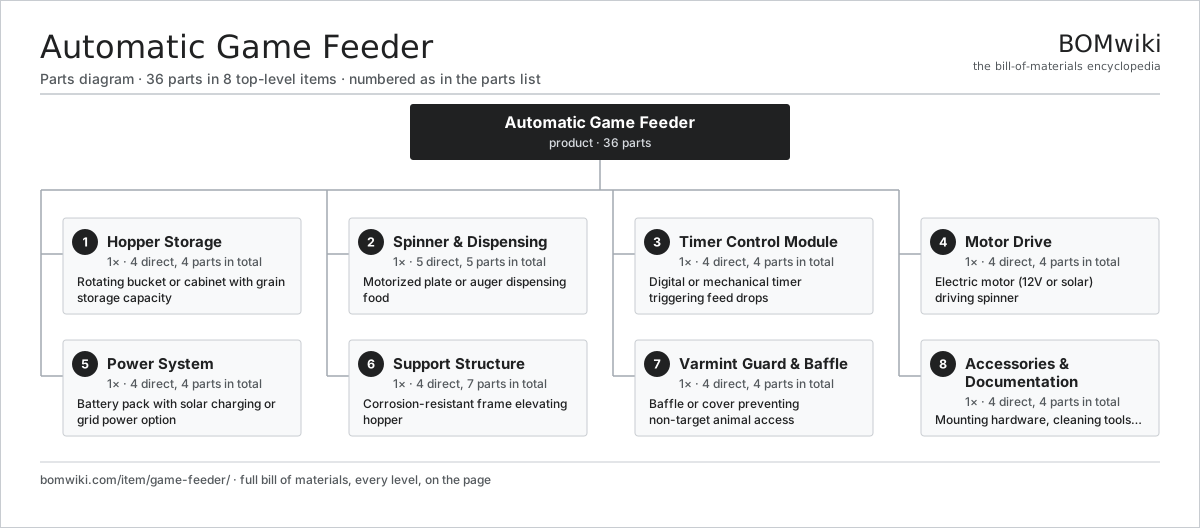
| # | Part | Qty | What it does |
|---|---|---|---|
| 1 | Hopper Storage 4 parts | 1× | Rotating bucket or cabinet with grain storage capacity |
| 2 | Spinner & Dispensing 5 parts | 1× | Motorized plate or auger dispensing food |
| 3 | Timer Control Module 4 parts | 1× | Digital or mechanical timer triggering feed drops |
| 4 | Motor Drive 4 parts | 1× | Electric motor (12V or solar) driving spinner |
| 5 | Power System 4 parts | 1× | Battery pack with solar charging or grid power option |
| 6 | Support Structure 4 parts | 1× | Corrosion-resistant frame elevating hopper |
| 7 | Varmint Guard & Baffle 4 parts | 1× | Baffle or cover preventing non-target animal access |
| 8 | Accessories & Documentation 4 parts | 1× | Mounting hardware, cleaning tools, instruction manual |
3D model
No 3D model yet. Have a CAD file of this? Add a 3D model. STL renders right on this page; STEP, FreeCAD, and OpenSCAD sources are welcome too (openly licensed, like all 3D models on BOMwiki).
Build & assembly graph
expand / collapse · shared sub-assemblies converge · links to related products · est. labourTap an assembly to expand/collapse · tap a part to open it · use “Open page” for any node · drag to pan, scroll to zoom.
Bill of materials for Automatic Game Feeder
8 top-level lines · 41 rows shown · 36 parts total · indented to 3 levels| # | Item / sub-assembly | Part no. | Qty/assy | Ext. qty | Parts | Type |
|---|---|---|---|---|---|---|
| 1 | Hopper Storage 4 parts | feeder-hopper-assembly | 1× | 1 | 4 | assembly |
| 1.1 | Hopper Tank | feeder-hopper-tank | 1× | 1 | · | part |
| 1.2 | Hopper Bottom | feeder-hopper-bottom | 1× | 1 | · | part |
| 1.3 | Hopper Seal | feeder-hopper-seal | 1× | 1 | · | part |
| 1.4 | Hopper Lid | feeder-hopper-lid | 1× | 1 | · | part |
| 2 | Spinner & Dispensing 5 parts | feeder-spinner-mechanism | 1× | 1 | 5 | assembly |
| 2.1 | Spinner Plate | feeder-spinner-plate | 1× | 1 | · | part |
| 2.2 | Auger Screw | feeder-auger-option | 1× | 1 | · | part |
| 2.3 | Spinner Shaft | feeder-spinner-shaft | 1× | 1 | · | part |
| 2.4 | Bearing Assembly | feeder-bearing-assembly | 1× | 1 | · | part |
| 2.5 | Motor Coupling | feeder-motor-coupling | 1× | 1 | · | part |
| 3 | Timer Control Module 4 parts | feeder-timer-control | 1× | 1 | 4 | assembly |
| 3.1 | Timer Circuit | feeder-timer-circuit | 1× | 1 | · | part |
| 3.2 | Timer Backup Battery | feeder-timer-battery | 1× | 1 | · | part |
| 3.3 | Timer Display | feeder-timer-display | 1× | 1 | · | part |
| 3.4 | Control Buttons | feeder-timer-buttons | 1× | 1 | · | part |
| 4 | Motor Drive 4 parts | feeder-motor-unit | 1× | 1 | 4 | assembly |
| 4.1 | DC Motor | feeder-motor-12v | 1× | 1 | · | part |
| 4.2 | Motor Gearbox | feeder-motor-gearbox | 1× | 1 | · | part |
| 4.3 | Motor Casing | feeder-motor-casing | 1× | 1 | · | part |
| 4.4 | Flywheel | feeder-motor-flywheel | 1× | 1 | · | part |
| 5 | Power System 4 parts | feeder-power-system | 1× | 1 | 4 | assembly |
| 5.1 | Battery Pack | feeder-battery-pack | 1× | 1 | · | part |
| 5.2 | Solar Panel | feeder-solar-panel | 1× | 1 | · | part |
| 5.3 | Charge Controller | feeder-charge-controller | 1× | 1 | · | part |
| 5.4 | Power Disconnect Switch | feeder-power-disconnect | 1× | 1 | · | part |
| 6 | Support Structure 4 parts | feeder-support-legs | 1× | 1 | 7 | assembly |
| 6.1 | Leg Post | feeder-leg-posts | 4× | 4 | · | part |
| 6.2 | Leg Bracing | feeder-leg-bracing | 1× | 1 | · | part |
| 6.3 | Ground Contact Feet | feeder-leg-feet | 1× | 1 | · | part |
| 6.4 | Hopper Mount Bracket | feeder-hopper-mounting | 1× | 1 | · | part |
| 7 | Varmint Guard & Baffle 4 parts | feeder-varmint-guard | 1× | 1 | 4 | assembly |
| 7.1 | Guard Cage | feeder-guard-cage | 1× | 1 | · | part |
| 7.2 | Guard Baffle | feeder-guard-baffle | 1× | 1 | · | part |
| 7.3 | Access Port | feeder-access-port | 1× | 1 | · | part |
| 7.4 | Guard Door Latch | feeder-guard-latch | 1× | 1 | · | part |
| 8 | Accessories & Documentation 4 parts | feeder-accessories | 1× | 1 | 4 | assembly |
| 8.1 | Fastener Kit | feeder-fastener-kit | 1× | 1 | · | part |
| 8.2 | Cleaning Brush | feeder-cleaning-brush | 1× | 1 | · | part |
| 8.3 | Instruction Manual | feeder-instruction-manual | 1× | 1 | · | part |
| 8.4 | Parts Diagram | feeder-parts-diagram | 1× | 1 | · | part |
Something wrong in this list? Report a problem with this BOM.
Sourcing: possible vendors
Browse the supplier directory → Prices, MOQ, and lead times are algorithmic estimates, not quotes, and not claims about these companies. Company mappings are curated by keyword; est. price band $20–$2k. How estimates work| Vendor | HQ | Specialty | MOQ | Lead time |
|---|---|---|---|---|
|
🇺🇸Coleman
coleman.com ↗
|
Chicago, US | Camping gear | 1,000 units | 6–10 wks |
| thenorthface.com ↗ | Denver, US | Outdoor apparel & gear | 1,000 units | 6–10 wks |
|
🇺🇸YETI
yeti.com ↗
|
Austin, US | Coolers & drinkware | 1,000 units | 6–10 wks |
| decathlon.com ↗ | Villeneuve-d'Ascq, FR | Sporting goods | 1,000 units | 6–10 wks |
|
🇺🇸Garmin
garmin.com ↗
|
Olathe, US | GPS & wearables | 1,000 units | 6–10 wks |
1,359-word article