Gamma Knife
ProductOverview
Gamma Knife is a stereotactic radiosurgery device that delivers a highly focused beam of gamma rays to intracranial lesions, typically tumors, arteriovenous malformations (AVMs), or trigeminal neuralgia. Unlike conventional external-beam radiotherapy that fractionates dose over weeks, stereotactic radiosurgery (SRS) delivers the full prescription dose in a single session, exploiting sharp dose falloff to spare surrounding brain tissue. The Gamma Knife uses 192 cobalt-60 sources arranged in a hemisphere, all focusing at a single point (the isocenter) 401 mm away.
The defining advantage is conformality: dose drops from 100% inside a 1 mm aperture to <5% just 5 mm away. This allows tumors <30 mm diameter to be treated with <1% dose to surrounding brain, a therapeutic window impossible with conventional linacs.
How it works
Source Array and Collimation
The Source Array contains 192 Co-60 capsules (370 TBq total, ~10 Ci), each 1 mm diameter. These sources decay at 1.4%/month (half-life 5.27 years), requiring periodic treatment-time adjustments. The sources are arranged in a tight hemisphere at the back of the Collimator Helmet, a 300 mm diameter lead structure.
Each Co-60 source emits gamma rays (primarily 1.17 and 1.33 MeV) in all directions. The Collimator Helmet is a solid lead hemisphere with 192 drilled channels (apertures), each precisely collimating the divergent radiation from its respective source. Gamma rays from all 192 sources converge at the focal point (isocenter), 401 mm from the helmet.
The Aperture Insert are removable tungsten or lead plugs that define the aperture diameter (1–18 mm). Smaller apertures create tighter dose distributions but deliver lower dose rate (fewer photons). Clinical practice often uses multiple "shots" (helmet positions) to cover larger targets.
Stereotactic Frame and Localization
The Patient Frame is a Leksell-type stereotactic frame, a horseshoe device mechanically clamped to the patient's skull via ear-canal posts and a nose-bridge contact. This frame is rigidly attached to the Collimator Helmet base during treatment, ensuring the brain target stays at the 401 mm focal point (isocenter).
Localization is achieved via imaging: the patient undergoes CT or MRI with the frame and gamma-knife-localizer-rods in place. The localizer rods appear as projections on CT/MRI images, establishing a 3D coordinate system. The neurosurgeon or physicist identifies the target (tumor, AVM, etc.) and measures its (x, y, z) coordinates relative to the frame origin. The Registration Software then computes required Treatment Couch positions and collimator selection for each shot.
Patient Positioning and Couch Alignment
The Treatment Couch is a motorized XYZ stage (typically stepper-motor-driven) on which the patient sits. The frame's baseplate clicks into engagement pins on the couch, repeating position to <1 mm. The Couch Controller receives a target list (x, y, z in frame coordinates) from the planning system and sequentially positions the couch, moving the patient (and frame) to align each target with the helmet isocenter.
For each position, the stereotactic frame's rigid kinematic interface ensures the brain target is at the 401 mm focal distance. The couch adjustments are purely for centering; the frame geometry is immobile.
Dose Delivery
The patient lies supine with the frame attached to the helmet, which is fixed to the treatment head. Gamma rays from all 192 sources traverse the patient skull and converge isocenter, delivering dose. Dwell time (typically 20–180 minutes) depends on target volume and prescribed dose.
The Control Console monitors treatment time, displays real-time dose accumulation (estimated from source activity decay), and allows the therapist to interrupt treatment via the Emergency Panel. A hardwired safety relay continuously verifies that the source is in the treatment head (not retracted to the vault safe position).
Safety Systems
The Safety System includes:
- Source retraction mechanism: on loss of power or emergency stop, a spring or compressed-air-driven system retracts the Co-60 source assembly back into the vault behind thick shielding.
- Door interlocks: the treatment-room door cannot close unless the source is in the safe (shielded) position; opening the door immediately triggers source retraction.
- Survey meter: before and after each patient, a Survey Meter confirms ambient dose rates are acceptable, detecting any source leak or malposition.
- Independent watchdog timer: hardware timer verifies software hasn't hung; if not reset every few seconds, power to the source-positioning solenoid is cut.
Clinical Advantages and Limitations
Advantages:
- Exceptional conformality (dose falloff 1–2 mm outside field edge).
- Single-session SRS (avoids weekday-commute burden on patients).
- No moving patient couch during treatment (unlike linac SRS, which rotates during arc delivery).
Limitations:
- Frame attachment invasive; not suitable for targets >30 mm (dose heterogeneity across large volumes).
- Expensive: Co-60 decay and replacement cost~$1–2 M per 5 years.
- Treatment time: 1–3 hours on day-of-treatment (including imaging, localization, positioning).
Dose Calculation and Planning
The planning system (often on the Control Console) computes 3D dose from the 192-source array geometry, collimator aperture, and treatment time. Modern algorithms account for tissue heterogeneity and allow dynamic dose painting via multiple shots and variable dwell times per position.
Gamma Knife parts and their functions
8 top-level parts · 419 parts in total · full bill of materials below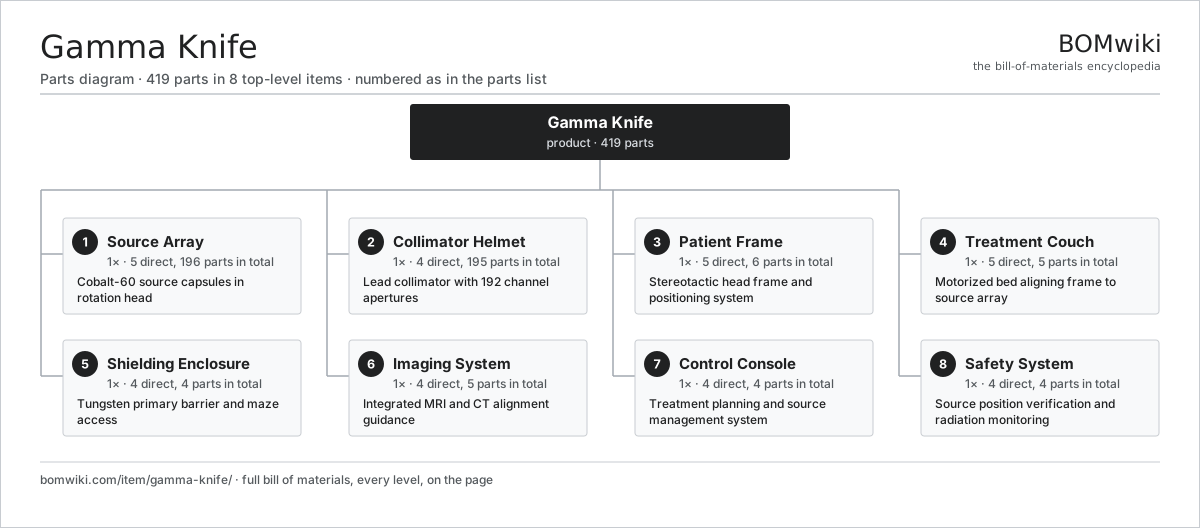
| # | Part | Qty | What it does |
|---|---|---|---|
| 1 | Source Array 5 parts | 1× | Cobalt-60 source capsules in rotation head |
| 2 | Collimator Helmet 4 parts | 1× | Lead collimator with 192 channel apertures |
| 3 | Patient Frame 5 parts | 1× | Stereotactic head frame and positioning system |
| 4 | Treatment Couch 5 parts | 1× | Motorized bed aligning frame to source array |
| 5 | Shielding Enclosure 4 parts | 1× | Tungsten primary barrier and maze access |
| 6 | Imaging System 4 parts | 1× | Integrated MRI and CT alignment guidance |
| 7 | Control Console 4 parts | 1× | Treatment planning and source management system |
| 8 | Safety System 4 parts | 1× | Source position verification and radiation monitoring |
3D model
No 3D model yet. Have a CAD file of this? Add a 3D model. STL renders right on this page; STEP, FreeCAD, and OpenSCAD sources are welcome too (openly licensed, like all 3D models on BOMwiki).
Build & assembly graph
expand / collapse · shared sub-assemblies converge · links to related products · est. labourTap an assembly to expand/collapse · tap a part to open it · use “Open page” for any node · drag to pan, scroll to zoom.
Bill of materials for Gamma Knife
8 top-level lines · 43 rows shown · 419 parts total · indented to 3 levels| # | Item / sub-assembly | Part no. | Qty/assy | Ext. qty | Parts | Type |
|---|---|---|---|---|---|---|
| 1 | Source Array 5 parts | gamma-knife-source-array | 1× | 1 | 196 | assembly |
| 1.1 | Co-60 Capsule | gamma-knife-source-capsules | 192× | 192 | · | part |
| 1.2 | Rotation Head | gamma-knife-rotation-head | 1× | 1 | · | part |
| 1.3 | Thermal Management | gamma-knife-thermal-management | 1× | 1 | · | part |
| 1.4 | Source Shielding | gamma-knife-source-shielding | 1× | 1 | · | part |
| 1.5 | Fastener Set | fastener-set | 1× | 1 | · | part |
| 2 | Collimator Helmet 4 parts | gamma-knife-collimator-helmet | 1× | 1 | 195 | assembly |
| 2.1 | Lead Shell | gamma-knife-helmet-lead-shell | 1× | 1 | · | part |
| 2.2 | Aperture Insert | gamma-knife-aperture-inserts | 192× | 192 | · | part |
| 2.3 | Helmet Frame | gamma-knife-helmet-frame | 1× | 1 | · | part |
| 2.4 | Fastener Set | fastener-set | 1× | 1 | · | part |
| 3 | Patient Frame 5 parts | gamma-knife-patient-frame | 1× | 1 | 6 | assembly |
| 3.1 | Frame Baseplate | gamma-knife-frame-baseplate | 1× | 1 | · | part |
| 3.2 | Ear Rods | gamma-knife-frame-ear-rods | 2× | 2 | · | part |
| 3.3 | Nose Piece | gamma-knife-frame-nose-piece | 1× | 1 | · | part |
| 3.4 | Localizer Rods | gamma-knife-frame-localizer-rods | 1× | 1 | · | part |
| 3.5 | Fastener Set | fastener-set | 1× | 1 | · | part |
| 4 | Treatment Couch 5 parts | gamma-knife-treatment-couch | 1× | 1 | 5 | assembly |
| 4.1 | Couch Carriage | gamma-knife-couch-carriage | 1× | 1 | · | part |
| 4.2 | Vertical Actuator | gamma-knife-couch-vertical-actuator | 1× | 1 | · | part |
| 4.3 | Engagement Pins | gamma-knife-couch-engagement-pins | 1× | 1 | · | part |
| 4.4 | Couch Controller | gamma-knife-couch-controller | 1× | 1 | · | part |
| 4.5 | Power Supply | power-supply | 1× | 1 | · | part |
| 5 | Shielding Enclosure 4 parts | gamma-knife-shielding-enclosure | 1× | 1 | 4 | assembly |
| 5.1 | Primary Barrier | gamma-knife-primary-barrier | 1× | 1 | · | part |
| 5.2 | Door Assembly | gamma-knife-door-assembly | 1× | 1 | · | part |
| 5.3 | Maze Corridor | gamma-knife-maze-corridor | 1× | 1 | · | part |
| 5.4 | Emergency Stop | gamma-knife-emergency-stop-plumbing | 1× | 1 | · | part |
| 6 | Imaging System 4 parts | gamma-knife-patient-imaging-system | 1× | 1 | 5 | assembly |
| 6.1 | Imaging MRI Unit | gamma-knife-imaging-mri-unit | 1× | 1 | · | part |
| 6.2 | Fiducial Frame | gamma-knife-fiducial-frame | 1× | 1 | · | part |
| 6.3 | Registration Software | gamma-knife-image-registration-software | 1× | 1 | · | part |
| 6.4 | Connector | connector | 2× | 2 | · | part |
| 7 | Control Console 4 parts | gamma-knife-control-console | 1× | 1 | 4 | assembly |
| 7.1 | Console Computer | gamma-knife-console-computer | 1× | 1 | · | part |
| 7.2 | Position Indicator | gamma-knife-source-position-indicator | 1× | 1 | · | part |
| 7.3 | Emergency Panel | gamma-knife-emergency-control-panel | 1× | 1 | · | part |
| 7.4 | Power Supply | power-supply | 1× | 1 | · | part |
| 8 | Safety System 4 parts | gamma-knife-safety-system | 1× | 1 | 4 | assembly |
| 8.1 | Survey Meter | gamma-knife-survey-meter | 1× | 1 | · | part |
| 8.2 | Decay Tracking | gamma-knife-source-decay-calculation | 1× | 1 | · | part |
| 8.3 | Interlocks | gamma-knife-interlocks-redundant | 1× | 1 | · | part |
| 8.4 | Power Supply | power-supply | 1× | 1 | · | part |
Something wrong in this list? Report a problem with this BOM.
Related products
same domain, ranked by shared parts Anesthesia Machine
562 parts · shares 1 with this page
Anesthesia Machine
562 parts · shares 1 with this page
 Apheresis Machine
199 parts · shares 1 with this page
Apheresis Machine
199 parts · shares 1 with this page
 Autorefractor
513 parts · shares 1 with this page
Autorefractor
513 parts · shares 1 with this page
 Blood Bank Refrigerator
79 parts · shares 1 with this page
Blood Gas Analyzer
386 parts · shares 1 with this page
Blood Bank Refrigerator
79 parts · shares 1 with this page
Blood Gas Analyzer
386 parts · shares 1 with this page
 Blood/Fluid Warmer
28 parts · shares 1 with this page
Blood/Fluid Warmer
28 parts · shares 1 with this page
Sourcing: possible vendors
Browse the supplier directory → Prices, MOQ, and lead times are algorithmic estimates, not quotes, and not claims about these companies. Company mappings are curated by keyword; est. price band $500–$3M. How estimates work| Vendor | HQ | Specialty | MOQ | Lead time |
|---|---|---|---|---|
| gehealthcare.com ↗ | Chicago, US | Medical imaging & devices | 100 units | 12–20 wks |
| siemens-healthineers.com ↗ | Erlangen, DE | Medical systems | 100 units | 12–20 wks |
|
🇳🇱Philips
philips.com ↗
|
Amsterdam, NL | Health technology | 100 units | 12–20 wks |
| medtronic.com ↗ | Minneapolis, US | Medical devices | 100 units | 12–20 wks |
|
🇨🇳Mindray
mindray.com ↗
|
Shenzhen, CN | Medical devices | 100 units | 12–20 wks |
879-word article