Garment Fusing Press
ProductOverview
A garment fusing press is a continuous-belt heat-and-pressure device that bonds interfacing fabric permanently to garment panels. The interfacing, a thermoplastic adhesive-coated nonwoven or woven base, is positioned face-down on the garment, then passed through the press under heat and pressure. The adhesive melts, wets into the garment fibers, and cools into a rigid bond that reinforces the panel, stabilizes seams, and adds body to lapels, collars, and waistbands. The fusing press is essential in tailoring and dress-shirt manufacturing, and is often the first process after pattern cutting.
The Main Frame is a sturdy steel structure. An endless Heated Belt Assembly is positioned above, heated to 100–200°C depending on the adhesive. A Pressure Roller is positioned below. The garment sandwich (interfacing + panel) travels between them on the Conveyor Belt System at adjustable speed, faster for light interfacings, slower for heavy or multi-ply fusing. The Temperature Control System maintains belt temperature with ±3–5°C precision via a PID loop; the Pressure Control System allows the operator to dial in the pressing force. Optional Steam / Humidity System adds humidity for moisture-dependent adhesives. The Main Motor Drive runs all belts synchronously.
How it works
The fusing adhesive is a thermoplastic resin, commonly polyamide or polyester, coated onto a nonwoven or thin-woven base. At room temperature, it is solid and inert. As temperature rises above its Tg (glass-transition temperature, typically 80–120°C depending on type), the adhesive softens and becomes tacky. At the press operating temperature (140–180°C), it is fully fluid and flows to wet both the interfacing base and the garment fibers.
When the operator places the interfacing on the garment and feeds it into the press, the combination passes under the heated Heated Belt Assembly. Heat transfers into the interfacing via conduction from the belt and radiation. Simultaneously, the Pressure Roller below applies uniform pressure, typically 1–2 MPa contact pressure, compressing the interfacing firmly into the garment weave. The combination of heat, moisture (if steam is enabled), and pressure causes the adhesive to flow and penetrate into the garment yarn structure, mechanically interlocking the interfacing to the garment. The dwell time, the time the sandwich spends between the heated belt and roller, determines penetration depth and bond strength. Typical dwell is 10–60 seconds, achieved by adjusting the Conveyor Belt System speed.
As the sandwich exits the press, the temperature drops. The adhesive cools and hardens within seconds, locking the interfacing in place. By the time the garment reaches the end of the machine, the bond is complete and the interfacing is permanently attached.
Control parameters and process windows
The fusing process has tight control windows. Temperature is the most critical parameter: too low and the adhesive does not flow, leaving a weak or spotty bond; too high and the adhesive over-wets, saturating the garment fibers and potentially weakening the weave. Different adhesive types have different optimal ranges, polyamide typically 140–160°C, polyester 160–180°C. Most modern machines have a setpoint dial or touchscreen where operators enter the interfacing type, and the controller ramps to the correct temperature.
Pressure must be sufficient to hold the interfacing down and compress it into the garment weave, but not so high that it crushes delicate fabrics or deforms the garment shape. Light synthetic blouses fuse at 0.5–1.0 MPa; heavy suiting at 1.5–2.0 MPa. The Pressure Gauge or digital readout tells the operator the current load; adjustment is via the Pressure Adjuster, usually a screw that preloads the spring stack supporting the Pressure Roller.
Conveyor speed determines dwell time. A slow speed (2–3 m/min) gives long contact time, ideal for heavy fabrics or thick interfacings; a fast speed (6–10 m/min) is used for lightweight synthetics that need less heat penetration. Speed is adjusted via the Conveyor Motor, often controlled by a VFD that allows stepless adjustment.
Steam and humidity
Some fusing adhesives are moisture-activated; they flow better and achieve stronger bonds when a small amount of steam is present. The Steam / Humidity System injects low-pressure steam into the press chamber. Steam raises humidity to 40–60% relative humidity, which plasticizes the adhesive and improves wetting. Polyamide adhesives benefit from steam; polyester adhesives are less sensitive. Too much steam causes condensation and spotty adhesive, so the Humidity Sensor provides feedback to limit steam injection.
Fabric and interfacing compatibility
Different interfacing weights and fiber types fuse at different temperatures and pressures. A woven interfacing (100% polyester or cotton-blend) is stiffer and requires higher temperature and longer dwell than a nonwoven of the same weight. Lightweight fusibles (0.5–1.0 oz/yard) fuse fully in 10–20 seconds; heavy ones (3–5 oz/yard) need 40–60 seconds. Operators must match the press recipe to the interfacing spec or risk weak bonds or fabric damage.
Natural-fiber garments (cotton, wool, linen) fuse well because the fibers are porous and allow good adhesive penetration. Synthetic garments (polyester, nylon) are less porous and require higher pressure and longer dwell time. Blended fabrics (polyester-cotton) are moderate. Delicate knits and stretch fabrics require careful pressure control to avoid distortion.
Maintenance and belt life
The Heated Belt is the most wear item. It is in constant contact with adhesive residue and hot garment surfaces, and gradually loses elasticity and surface quality. Typical belt life is 500–2000 running hours before replacement becomes necessary; lint and adhesive buildup must be cleaned regularly with soft brushes or compressed air to maintain heat transfer efficiency. The Heating Element Bank has similar life and is monitored for gradual power loss. Temperature sensors can drift over time and should be calibrated annually against a secondary standard to ensure recipe repeatability.
Garment Fusing Press parts and their functions
8 top-level parts · 93 parts in total · full bill of materials below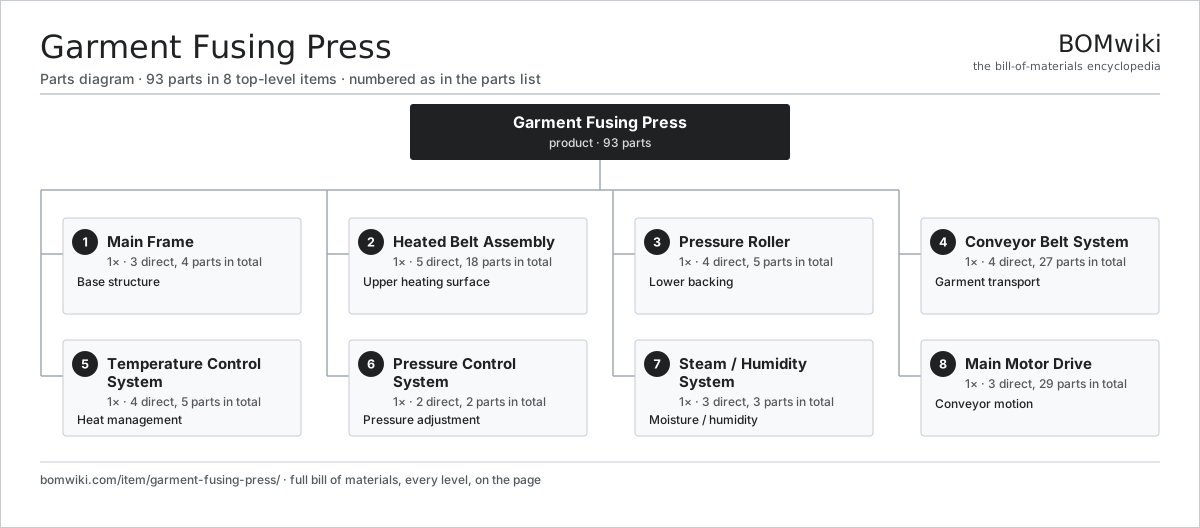
| # | Part | Qty | What it does |
|---|---|---|---|
| 1 | Main Frame 3 parts | 1× | Base structure |
| 2 | Heated Belt Assembly 5 parts | 1× | Upper heating surface |
| 3 | Pressure Roller 4 parts | 1× | Lower backing |
| 4 | Conveyor Belt System 4 parts | 1× | Garment transport |
| 5 | Temperature Control System 4 parts | 1× | Heat management |
| 6 | Pressure Control System 2 parts | 1× | Pressure adjustment |
| 7 | Steam / Humidity System 3 parts | 1× | Moisture / humidity |
| 8 | Main Motor Drive 3 parts | 1× | Conveyor motion |
3D model
No 3D model yet. Have a CAD file of this? Add a 3D model. STL renders right on this page; STEP, FreeCAD, and OpenSCAD sources are welcome too (openly licensed, like all 3D models on BOMwiki).
Build & assembly graph
expand / collapse · shared sub-assemblies converge · links to related products · est. labourTap an assembly to expand/collapse · tap a part to open it · use “Open page” for any node · drag to pan, scroll to zoom.
Bill of materials for Garment Fusing Press
8 top-level lines · 47 rows shown · 93 parts total · indented to 3 levels| # | Item / sub-assembly | Part no. | Qty/assy | Ext. qty | Parts | Type |
|---|---|---|---|---|---|---|
| 1 | Main Frame 3 parts | garment-fusing-press-frame | 1× | 1 | 4 | assembly |
| 1.1 | Base Plate | garment-fusing-press-base-plate | 1× | 1 | · | part |
| 1.2 | Upright Frame | garment-fusing-press-upright | 2× | 2 | · | part |
| 1.3 | Top Frame | garment-fusing-press-top-frame | 1× | 1 | · | part |
| 2 | Heated Belt Assembly 5 parts | garment-fusing-press-heated-belt-assembly | 1× | 1 | 18 | assembly |
| 2.1 | Heating Element Bank 2 parts | garment-fusing-press-heating-element | 1× | 1 | 10 | assembly |
| 2.1.1 | Heating Element | heating-element | 8× | 8 | · | part |
| 2.1.2 | Thermal Fuse | thermal-fuse | 2× | 2 | · | part |
| 2.2 | Heated Belt | garment-fusing-press-heated-belt | 1× | 1 | · | part |
| 2.3 | Belt Pulley | garment-fusing-press-belt-pulley | 2× | 2 | · | part |
| 2.4 | Temperature Sensor | garment-fusing-press-temperature-sensor | 1× | 1 | · | part |
| 2.5 | Ball Bearing | ball-bearing | 4× | 4 | · | part |
| 3 | Pressure Roller 4 parts | garment-fusing-press-pressure-roller | 1× | 1 | 5 | assembly |
| 3.1 | Roller Body | garment-fusing-press-roller-body | 1× | 1 | · | part |
| 3.2 | Roller Cover | garment-fusing-press-roller-cover | 1× | 1 | · | part |
| 3.3 | Ball Bearing | ball-bearing | 2× | 2 | · | part |
| 3.4 | Pressure Spring | garment-fusing-press-pressure-spring | 1× | 1 | · | part |
| 4 | Conveyor Belt System 4 parts | garment-fusing-press-conveyor-belt | 1× | 1 | 27 | assembly |
| 4.1 | Conveyor Belt | garment-fusing-press-conveyor | 1× | 1 | · | part |
| 4.2 | Conveyor Pulley | garment-fusing-press-conveyor-pulley | 2× | 2 | · | part |
| 4.3 | Conveyor Motor 3 parts | garment-fusing-press-conveyor-speed-motor | 1× | 1 | 23 | assembly |
| 4.3.1 | Stator Assembly 3 parts + deeper › | stator-assembly | 1× | 1 | 3 | assembly |
| 4.3.2 | Rotor Assembly 4 parts + deeper › | rotor-assembly | 1× | 1 | 19 | assembly |
| 4.3.3 | Helical Gear Pair | gear-pair | 1× | 1 | · | part |
| 4.4 | Encoder | encoder | 1× | 1 | · | part |
| 5 | Temperature Control System 4 parts | garment-fusing-press-temperature-control | 1× | 1 | 5 | assembly |
| 5.1 | Control Board | garment-fusing-press-control-board | 1× | 1 | · | part |
| 5.2 | Temperature Switch | garment-fusing-press-temperature-switch | 1× | 1 | · | part |
| 5.3 | Relay | relay | 2× | 2 | · | part |
| 5.4 | SCR Phase Controller | garment-fusing-press-scr-module | 1× | 1 | · | part |
| 6 | Pressure Control System 2 parts | garment-fusing-press-pressure-control | 1× | 1 | 2 | assembly |
| 6.1 | Pressure Adjuster | garment-fusing-press-pressure-adjuster | 1× | 1 | · | part |
| 6.2 | Pressure Gauge | garment-fusing-press-pressure-gauge | 1× | 1 | · | part |
| 7 | Steam / Humidity System 3 parts | garment-fusing-press-steam-system | 1× | 1 | 3 | assembly |
| 7.1 | Steam Generator | garment-fusing-press-steam-generator | 1× | 1 | · | part |
| 7.2 | Steam Valve | garment-fusing-press-steam-valve | 1× | 1 | · | part |
| 7.3 | Humidity Sensor | garment-fusing-press-humidity-sensor | 1× | 1 | · | part |
| 8 | Main Motor Drive 3 parts | garment-fusing-press-motor-drive | 1× | 1 | 29 | assembly |
| 8.1 | Main Motor 3 parts | garment-fusing-press-main-motor | 1× | 1 | 24 | assembly |
| 8.1.1 | Stator Assembly 3 parts + deeper › | stator-assembly | 1× | 1 | 3 | assembly |
| 8.1.2 | Rotor Assembly 4 parts + deeper › | rotor-assembly | 1× | 1 | 19 | assembly |
| 8.1.3 | Ball Bearing | ball-bearing | 2× | 2 | · | part |
| 8.2 | Drive Gearbox 3 parts | garment-fusing-press-drive-gearbox | 1× | 1 | 4 | assembly |
| 8.2.1 | Gearbox Housing | gearbox-housing | 1× | 1 | · | part |
| 8.2.2 | Helical Gear Pair | gear-pair | 1× | 1 | · | part |
| 8.2.3 | Ball Bearing | ball-bearing | 2× | 2 | · | part |
| 8.3 | Drive Belt | drive-belt | 1× | 1 | · | part |
Something wrong in this list? Report a problem with this BOM.
Related products
same domain, ranked by shared parts Industrial Steam Press
133 parts · shares 2 with this page
Industrial Garment Washer
204 parts · shares 2 with this page
Industrial Steam Press
133 parts · shares 2 with this page
Industrial Garment Washer
204 parts · shares 2 with this page
 Automatic Fabric Cutting Machine
1,695 parts · shares 2 with this page
Fabric Coating Machine
316 parts · shares 2 with this page
FDY Filament Spinning Line
679 parts · shares 2 with this page
Automatic Fabric Cutting Machine
1,695 parts · shares 2 with this page
Fabric Coating Machine
316 parts · shares 2 with this page
FDY Filament Spinning Line
679 parts · shares 2 with this page
 Meltblown Nonwoven Line
933 parts · shares 2 with this page
Meltblown Nonwoven Line
933 parts · shares 2 with this page
Sourcing: possible vendors
Browse the supplier directory → Prices, MOQ, and lead times are algorithmic estimates, not quotes, and not claims about these companies. Company mappings are curated by keyword; est. price band $10k–$1M. How estimates work| Vendor | HQ | Specialty | MOQ | Lead time |
|---|---|---|---|---|
|
🇨🇭Rieter
rieter.com ↗
|
Winterthur, CH | Spinning machinery | 10 units | 14–24 wks |
| truetzschler.com ↗ | Mönchengladbach, DE | Textile machinery | 10 units | 14–24 wks |
|
🇧🇪Picanol
picanol.be ↗
|
Ypres, BE | Weaving machines | 10 units | 14–24 wks |
| karlmayer.com ↗ | Obertshausen, DE | Warp knitting machines | 10 units | 14–24 wks |
|
🇨🇭Saurer
saurer.com ↗
|
Arbon, CH | Spinning & embroidery | 10 units | 14–24 wks |
1,016-word article