Protective Gas Mask
ProductOverview
A protective gas mask is an air-purifying respirator: it carries no air supply of its own, but forces every liter the wearer inhales through a filter that removes particles and toxic vapors. The design problem is therefore twofold, make a gas-tight seal against a moving, sweating human face, and make a filter that stops nerve agents and aerosolized pathogens while staying easy enough to breathe through that a soldier can run in it.
The Facepiece is the structural core, a molded bromobutyl rubber shell chosen because butyl rubbers have very low permeability to chemical-agent vapors; military specifications require the material to resist liquid mustard agent for at least 24 hours. Everything else mounts to it: the Visor Assembly in front of the eyes, the Filter Canister on a threaded port at the cheek, the Valve Assembly controlling airflow, the Voicemitter for speech, the Drinking System for hydration, and the Head Harness that holds the whole assembly against the face.
How it works
When the wearer inhales, the facepiece interior drops a few millibar below ambient. Outside air is pulled through the canister, where it first passes the HEPA Filter Layer, pleated glass-fiber paper rated P3, removing at least 99.97% of 0.3 µm aerosols, which covers biological agents, radioactive dust, and riot-control smokes. It then flows through the Activated Carbon Bed, roughly 150-200 g of activated carbon impregnated with copper, silver, zinc, and molybdenum compounds plus triethylenediamine (the ASZM-TEDA formulation). Plain carbon physisorbs large organic molecules such as mustard agent; the metal impregnants chemisorb small molecules, hydrogen cyanide, cyanogen chloride, arsine, that would otherwise pass straight through.
Cleaned air enters past the Inhalation Valve and is ducted by the Inner Nosecup across the inside of the lens before reaching the nose. This routing matters: the incoming air is dry, so sweeping it over the visor keeps it fog-free, and the nosecup also limits the dead space that would otherwise let exhaled CO2 accumulate and be re-breathed. On exhalation, both inhalation valve and canister are sealed off and breath exits through the Exhalation Valve, a soft silicone disc with a cracking pressure of only 2-3 mbar. That valve is the most safety-critical part in the mask, it must open thousands of times an hour and reseal perfectly every time, because a grain of sand under its seat is a direct leak path into the facepiece. The Valve Cover shields it from splash and icing.
Sealing and fit
Filtration is useless if air bypasses the filter at the face. The Reflex Edge Seal, a peripheral lip folded back on itself, flattens against the skin under the tension of the Head Harness, whose six elastic straps radiate from a crown pad and load the forehead, temple, and jaw zones independently. Fit is verified quantitatively: the wearer dons the mask, blocks the canister, and inhales; the facepiece must collapse and hold vacuum. Militaries require donning from the carrier and a verified seal in under nine seconds, which drives details like the Chin Pocket that indexes the chin so the mask seats identically every time. Facial hair under the seal line defeats the mask, which is why armies enforce shaving standards.
Vision, speech, and sustainment
The Panoramic Lens is a single curved polycarbonate panel giving about 90% of the natural visual field, a major advance over twin-eyepiece Cold War designs, which cost peripheral vision and rifle-sighting ability. A snap-on Protective Outsert takes abrasion, fragments, or laser energy in place of the bonded lens. Speech passes through the Speech Diaphragm, a stainless membrane about 0.05 mm thick that vibrates with the voice while staying gas-tight; a Communications Port lets a radio microphone clip directly over it. Because a mask may be worn for many hours, the Drinking System provides a bite tube and one-way Drink Check Valve coupling to a canteen adapter, so the wearer can drink without ever opening the seal.
Limits
An air-purifying mask protects only against agents its filter can capture and only at oxygen concentrations above about 19.5%, it does nothing in an oxygen-displaced space such as a fire or a confined tank, which requires self-contained breathing apparatus instead. Canister life depends on agent concentration and breathing rate; doctrine treats canisters as expendable, swapped after any confirmed exposure, and the Shipping Seals keep unopened spares viable for a decade or more in storage.
Protective Gas Mask parts and their functions
7 top-level parts · 41 parts in total · full bill of materials below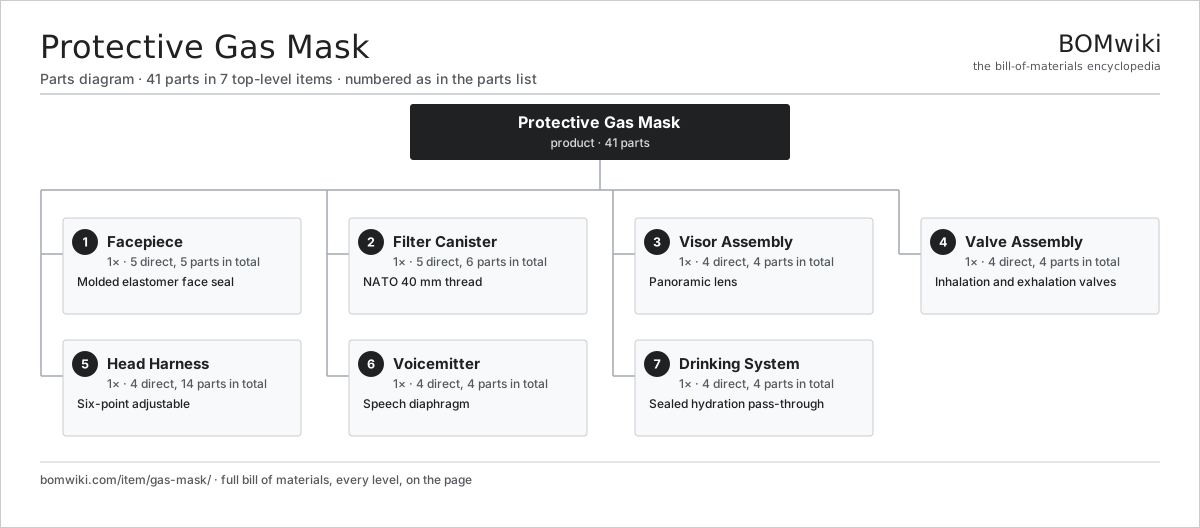
| # | Part | Qty | What it does |
|---|---|---|---|
| 1 | Facepiece 5 parts | 1× | Molded elastomer face seal |
| 2 | Filter Canister 5 parts | 1× | NATO 40 mm thread |
| 3 | Visor Assembly 4 parts | 1× | Panoramic lens |
| 4 | Valve Assembly 4 parts | 1× | Inhalation and exhalation valves |
| 5 | Head Harness 4 parts | 1× | Six-point adjustable |
| 6 | Voicemitter 4 parts | 1× | Speech diaphragm |
| 7 | Drinking System 4 parts | 1× | Sealed hydration pass-through |
3D model
No 3D model yet. Have a CAD file of this? Add a 3D model. STL renders right on this page; STEP, FreeCAD, and OpenSCAD sources are welcome too (openly licensed, like all 3D models on BOMwiki).
Build & assembly graph
expand / collapse · shared sub-assemblies converge · links to related products · est. labourTap an assembly to expand/collapse · tap a part to open it · use “Open page” for any node · drag to pan, scroll to zoom.
Bill of materials for Protective Gas Mask
7 top-level lines · 37 rows shown · 41 parts total · indented to 3 levels| # | Item / sub-assembly | Part no. | Qty/assy | Ext. qty | Parts | Type |
|---|---|---|---|---|---|---|
| 1 | Facepiece 5 parts | gas-mask-facepiece | 1× | 1 | 5 | assembly |
| 1.1 | Face Blank | gas-mask-face-blank | 1× | 1 | · | part |
| 1.2 | Reflex Edge Seal | gas-mask-reflex-seal | 1× | 1 | · | part |
| 1.3 | Inner Nosecup | gas-mask-nosecup | 1× | 1 | · | part |
| 1.4 | Chin Pocket | gas-mask-chin-pocket | 1× | 1 | · | part |
| 1.5 | Canister Port | gas-mask-canister-port | 1× | 1 | · | part |
| 2 | Filter Canister 5 parts | gas-mask-filter-canister | 1× | 1 | 6 | assembly |
| 2.1 | Canister Body | gas-mask-canister-body | 1× | 1 | · | part |
| 2.2 | HEPA Filter Layer | gas-mask-hepa-layer | 1× | 1 | · | part |
| 2.3 | Activated Carbon Bed | gas-mask-carbon-bed | 1× | 1 | · | part |
| 2.4 | Retaining Screens | gas-mask-canister-screens | 2× | 2 | · | part |
| 2.5 | Shipping Seals | gas-mask-canister-seals | 1× | 1 | · | part |
| 3 | Visor Assembly 4 parts | gas-mask-visor-assembly | 1× | 1 | 4 | assembly |
| 3.1 | Panoramic Lens | gas-mask-visor-lens | 1× | 1 | · | part |
| 3.2 | Visor Clamp Frame | gas-mask-visor-frame | 1× | 1 | · | part |
| 3.3 | Protective Outsert | gas-mask-outsert | 1× | 1 | · | part |
| 3.4 | Fastener Set | fastener-set | 1× | 1 | · | part |
| 4 | Valve Assembly 4 parts | gas-mask-valve-assembly | 1× | 1 | 4 | assembly |
| 4.1 | Inhalation Valve | gas-mask-inhalation-valve | 1× | 1 | · | part |
| 4.2 | Exhalation Valve | gas-mask-exhalation-valve | 1× | 1 | · | part |
| 4.3 | Valve Cover | gas-mask-valve-cover | 1× | 1 | · | part |
| 4.4 | O-Ring Set | oring-set | 1× | 1 | · | part |
| 5 | Head Harness 4 parts | gas-mask-head-harness | 1× | 1 | 14 | assembly |
| 5.1 | Crown Pad | gas-mask-harness-pad | 1× | 1 | · | part |
| 5.2 | Harness Strap | gas-mask-harness-strap | 6× | 6 | · | part |
| 5.3 | Quick-Release Buckle | gas-mask-strap-buckle | 6× | 6 | · | part |
| 5.4 | Carry Lanyard | gas-mask-neck-lanyard | 1× | 1 | · | part |
| 6 | Voicemitter 4 parts | gas-mask-voicemitter | 1× | 1 | 4 | assembly |
| 6.1 | Speech Diaphragm | gas-mask-speech-diaphragm | 1× | 1 | · | part |
| 6.2 | Voicemitter Housing | gas-mask-voicemitter-housing | 1× | 1 | · | part |
| 6.3 | Communications Port | gas-mask-comms-port | 1× | 1 | · | part |
| 6.4 | O-Ring Set | oring-set | 1× | 1 | · | part |
| 7 | Drinking System 4 parts | gas-mask-drinking-system | 1× | 1 | 4 | assembly |
| 7.1 | Internal Drink Tube | gas-mask-internal-tube | 1× | 1 | · | part |
| 7.2 | External Coupler | gas-mask-drink-coupler | 1× | 1 | · | part |
| 7.3 | Drink Check Valve | gas-mask-drink-valve | 1× | 1 | · | part |
| 7.4 | O-Ring Set | oring-set | 1× | 1 | · | part |
Something wrong in this list? Report a problem with this BOM.
Related products
same domain, ranked by shared parts Aircraft Carrier
3,103,110 parts · shares 1 with this page
Aircraft Carrier
3,103,110 parts · shares 1 with this page
 Amphibious Assault Vehicle
894 parts · shares 1 with this page
Amphibious Assault Vehicle
894 parts · shares 1 with this page
 Armored Bridge Layer
219 parts · shares 1 with this page
Armored Bridge Layer
219 parts · shares 1 with this page
 Armored Recovery Vehicle
728 parts · shares 1 with this page
Bomb Disposal Truck
233 parts · shares 1 with this page
Armored Recovery Vehicle
728 parts · shares 1 with this page
Bomb Disposal Truck
233 parts · shares 1 with this page
 CCTV Camera
288 parts · shares 1 with this page
CCTV Camera
288 parts · shares 1 with this page
Sourcing: possible vendors
Browse the supplier directory → Prices, MOQ, and lead times are algorithmic estimates, not quotes, and not claims about these companies. Company mappings are curated by keyword; est. price band $200–$100M. How estimates work| Vendor | HQ | Specialty | MOQ | Lead time |
|---|---|---|---|---|
| smithsdetection.com ↗ | London, GB | Security screening | made to order | 24–52 wks |
|
🇺🇸Leidos
leidos.com ↗
|
Reston, US | Security & screening | made to order | 24–52 wks |
|
🇺🇸Rapiscan
rapiscansystems.com ↗
|
Torrance, US | X-ray screening | made to order | 24–52 wks |
|
🇫🇷Thales
thalesgroup.com ↗
|
Paris, FR | Defense electronics | made to order | 24–52 wks |
| baesystems.com ↗ | London, GB | Defense | made to order | 24–52 wks |
784-word article