Gas Pool Heater
ProductOverview
A gas pool heater burns natural gas or propane to heat pool water via a Heat Exchanger Assembly, transferring combustion heat to circulating pool water at 75–85% thermal efficiency. Unlike electric immersion heaters (100% electric-to-water), gas heaters lose ~15–25% heat through the flue (exhaust vent), but operate at lower cost per BTU in regions with cheap natural gas.
Gas heaters are the standard for competitive pools, commercial facilities, and cold-climate residential pools. A typical 50k BTU/h residential heater warms a 20k gallon pool 2–4 °C per hour, reaching 30 °C setpoint in 3–6 hours from 15 °C cold fill.
Heat Exchanger
The Heat Exchanger Assembly is a tube-in-shell design: 7–10 mm copper tubing (called "tubes") coiled inside a steel or stainless outer shell, making 5–8 passes through the combustion chamber to maximize dwell time and heat transfer. Hot combustion gases flow around the outside of the tubes; cool pool water flows through the tubes' interior.
Heat transfer:
- Combustion gas temperature: 600–900 °C.
- Tube wall temperature: 80–120 °C.
- Pool water inlet: 20 °C, outlet: 35 °C (5–10 °C rise per pass).
The Internal Baffle Divider inside the shell directs gas flow across all tubing rows, preventing bypass. The Heat Transfer Tubing are chosen for corrosion resistance (pool water's chlorine and acidic pH attack bare steel).
Scaling and maintenance: Hard water (high calcium carbonate, >200 ppm) deposits scale on tube interior, reducing heat transfer and requiring chemical cleaning annually. Soft water (<100 ppm hardness) extends exchanger life 20+ years.
Burner & Ignition System
The Burner Assembly & Ignition tray holds the primary burning components:
- Pilot Burner & Safety Valve: Small standing pilot flame (always-on) with safety thermocouple generating electrical signal to unlock main gas valve.
- Main Burner Header Bar: Stainless steel bar with 20–40 holes ejecting gas jets into the combustion chamber.
- Spark Ignition Electrode: Spark electrode generating 10 kV ignition spark to light pilot on startup.
- Flame Detection Rod: Ionization rod detecting pilot flame presence; if flame lost, gas supply cuts off within <2 seconds (safety).
Ignition sequence:
- Controller energizes Spark Ignition Electrode, generating spark.
- Spark ignites pilot gas at Pilot Burner & Safety Valve.
- Pilot flame heats the Flame Detection Rod rod, generating microamp ionization current.
- Controller detects ionization signal, energizes Proportional Solenoid Valve, opening main gas valve.
- Main Main Burner Header Bar ignite from pilot, burner roars to life.
- If flame detected signal is lost (wind blows pilot out, gas supply interrupted), controller cuts solenoid power instantly, sealing gas supply (dual safety layer).
Proportional Gas Valve Control
The Proportional Solenoid Valve is a 240V AC electrically-modulated valve that can vary gas flow 0–100% continuously, unlike simple on/off solenoids. This enables the Thermostat & Safety Control microcontroller to maintain precise temperature:
- If pool is 5 °C below setpoint, solenoid opens to 100%, burner roars full-blast.
- At setpoint, solenoid throttles to 20%, pilot-light burning only.
- If overshooting, solenoid closes to 0%, burner extinguishes, cooling begins.
This proportional control is the hallmark of modern efficient gas heaters. Older "hi-lo" burners (on/off only) cycle roughly, overshooting setpoint and wasting gas.
Control & Thermostat
The Thermostat & Safety Control PCB includes:
- Microcontroller (embedded microcontroller) managing ignition sequence and proportional valve duty.
- Outlet Temperature Sensor (RTD probe, 0–100 °C range) in outlet water, reading actual temperature.
- High-Limit Safety Switch (setpoint 60–65 °C) emergency cutoff if water overheats (thermal overload protection).
- Temperature Setpoint Dial (user-adjustable resistor pot or digital encoder) setting target setpoint (typically 40–50 °C for pools, 35–40 °C for spas).
Operating logic: ''' current_temp = read_RTD_sensor() setpoint = read_thermostat_dial() error = setpoint - current_temp
if error > 3°C: proportional_solenoid_duty = 100% (full fire) elif error > 0.5°C: proportional_solenoid_duty = 50% (mid-fire) else: proportional_solenoid_duty = 10% (pilot light only)
if current_temp > 65°C: ignition_disable() (emergency high-limit) '''
Venting & Combustion Air
The Flue & Vent Stack is a vertical stainless steel or aluminum duct (3–4 inch diameter) extending 1–3 meters above the heater, with a Flue Rain Cap preventing water entry. Hot combustion exhaust (200–300 °C) exits via natural draft (buoyancy of hot gas) or forced draft (fan assist in some models).
Venting requirements:
- Vertical rise: minimum 1 meter above surrounding structures (roof peak, deck railing).
- Clearance: 3+ feet from windows, doors, air intakes (prevents flue gas re-entry into building).
- Insulation: Flue Insulation Wrap (fiberglass or ceramic wool) reduces flue surface temperature, improving draft and reducing radiant heating risk.
The Combustion Air Intake louver ensures adequate oxygen for combustion (natural gas requires 17.5 cubic feet air per cubic foot gas). Undersized intake starves the burner, causing poor ignition or incomplete combustion (carbon monoxide production).
Maintenance & Service
Weekly: Check heater is operating smoothly (no irregular sounds, flame burning smoothly visible through observation port if present).
Monthly:
- Read outlet temperature and compare to setpoint dial (if difference >2 °C, may indicate thermostat drift, requiring recalibration).
- Inspect flue for visible white or yellow deposits (scale buildup on heat exchanger, indicating hard water).
Annually:
- Professional combustion analysis (gas analyzer measures CO/O₂ to verify burner tuning).
- Scale removal if deposits visible: flush heat exchanger with dilute muriatic acid (HCl) or citric acid solution (requires isolation ball valves Inlet Ball Valve, Outlet Ball Valve) to access the hot side safely. Drain via Heater Drain Petcock.
- Test High-Limit Safety Switch activation (if available, manual test provides safety verification).
3–5 years:
- Replace Pilot Burner & Safety Valve (thermocouple degrades, causing ignition failures).
- Inspect copper tubes for pinhole leaks (corrosion). If leaking, heat exchanger must be replaced (~$1500–2500 cost).
Winterization (freeze-prone climates):
- Drain heater completely: close Inlet Ball Valve and Outlet Ball Valve, open Heater Drain Petcock on heater and Internal Bypass Assembly for 30+ minutes until no water drips.
- Alternatively: add pool antifreeze (RV-grade propylene glycol) to circulation water (adds cost but eliminates drain burden).
Efficiency & Operating Cost
A gas heater's thermal efficiency is typically 75–85%:
- 100 BTU heat output requires ~120 BTU gas input.
- 15–25% loss occurs via flue (hot exhaust exiting up vent pipe).
Operating cost comparison (example: heating 20k gallon pool from 15 to 30 °C):
- Gas heater (50k BTU/h): Requires 250k BTU input, costs $3–5 in gas ($0.012–0.015/BTU).
- Electric heater (7.5 kW): Requires 21.9 kWh input, costs $2.60–4 in electricity (~$0.12–0.15/kWh).
Gas becomes economical when natural gas cost is <$8–10 per million BTU. In regions with cheap gas (Texas, Louisiana: $5–7/MMBTU), gas heaters dominate. In regions with expensive gas or cheap electricity (Pacific Northwest, California with solar: $15–20/MMBTU), electric or heat pump heaters may be cheaper despite lower efficiency.
Bypass Valve & Flow Control
The Internal Bypass Assembly includes a check valve and optional 3-way diverter. If heater is "dead-headed" (zero circulation flow while running), the copper tubes can overheat locally, potentially cracking. A check valve on the heater inlet ensures minimum 10 GPM bypass flow even if system is isolated.
Some heaters include a gas-pool-heater-bypass-valve allowing partial flow diversion around the heater during high-demand heating. This prevents excessive outlet temperature rise when incoming water is cold and heater is at full fire.
Variants & Advanced Features
Heat Pump Heater: Compressor-driven heat pump extracting heat from air (COP 4–5 in mild climates, 2–3 in cold). Higher upfront cost (~$5000+), lower operating cost (30–50% cheaper than gas long-term), slower response (ramp-up slower than gas burst).
Combination Heater: Hybrid system with both gas and electric heating, gas for rapid temperature rise, electric for maintaining setpoint (lower cost than gas-only during partial-load hours).
Modulating Burner: Advanced burners with variable flame height (not just proportional valve), offering ultra-precise temperature control ±0.5 °C.
Smart Controls: WiFi-enabled Thermostat & Safety Control with scheduling, remote setpoint adjustment, consumption tracking, and predictive maintenance alerts.
Condensing Gas Heater: Captures latent heat from flue exhaust (95%+ efficiency), requires special corrosion-resistant materials and PVC venting (vs. metal flue). Higher cost ($4000+), significant operating savings in cold climates.
Gas Pool Heater parts and their functions
8 top-level parts · 45 parts in total · full bill of materials below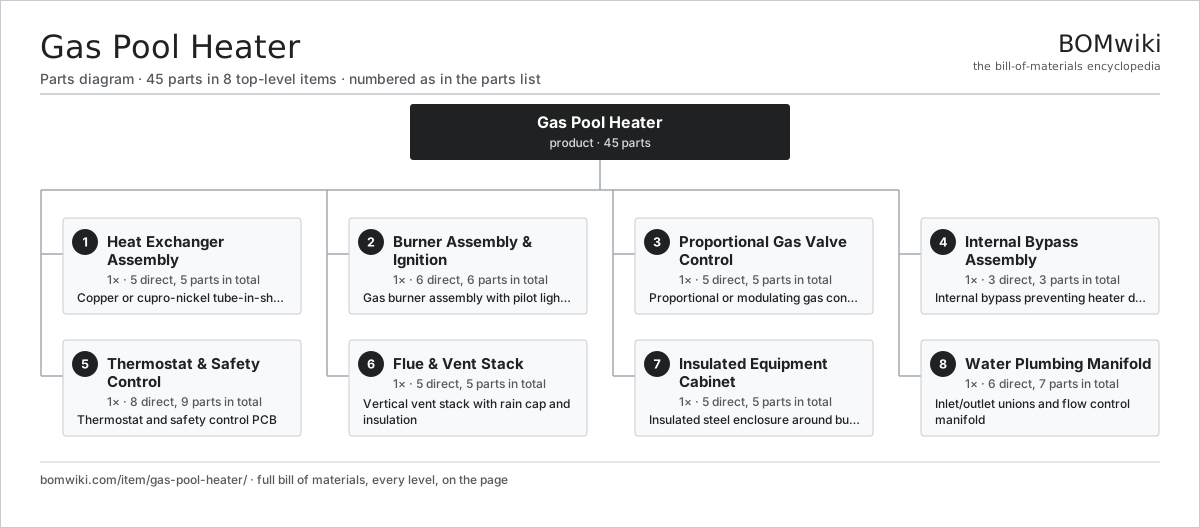
| # | Part | Qty | What it does |
|---|---|---|---|
| 1 | Heat Exchanger Assembly 5 parts | 1× | Copper or cupro-nickel tube-in-shell heat exchanger |
| 2 | Burner Assembly & Ignition 6 parts | 1× | Gas burner assembly with pilot light and main valve |
| 3 | Proportional Gas Valve Control 5 parts | 1× | Proportional or modulating gas control valve |
| 4 | Internal Bypass Assembly 3 parts | 1× | Internal bypass preventing heater dead-heading |
| 5 | Thermostat & Safety Control 8 parts | 1× | Thermostat and safety control PCB |
| 6 | Flue & Vent Stack 5 parts | 1× | Vertical vent stack with rain cap and insulation |
| 7 | Insulated Equipment Cabinet 5 parts | 1× | Insulated steel enclosure around burner and exchanger |
| 8 | Water Plumbing Manifold 6 parts | 1× | Inlet/outlet unions and flow control manifold |
3D model
No 3D model yet. Have a CAD file of this? Add a 3D model. STL renders right on this page; STEP, FreeCAD, and OpenSCAD sources are welcome too (openly licensed, like all 3D models on BOMwiki).
Build & assembly graph
expand / collapse · shared sub-assemblies converge · links to related products · est. labourTap an assembly to expand/collapse · tap a part to open it · use “Open page” for any node · drag to pan, scroll to zoom.
Bill of materials for Gas Pool Heater
8 top-level lines · 51 rows shown · 45 parts total · indented to 3 levels| # | Item / sub-assembly | Part no. | Qty/assy | Ext. qty | Parts | Type |
|---|---|---|---|---|---|---|
| 1 | Heat Exchanger Assembly 5 parts | gas-pool-heater-heat-exchanger | 1× | 1 | 5 | assembly |
| 1.1 | Heat Transfer Tubing | gas-pool-heater-copper-tubes | 1× | 1 | · | part |
| 1.2 | Exchanger Outer Shell | gas-pool-heater-exchanger-shell | 1× | 1 | · | part |
| 1.3 | Internal Baffle Divider | gas-pool-heater-baffle-plate | 1× | 1 | · | part |
| 1.4 | Exchanger Shell Gasket | gas-pool-heater-tank-gasket | 1× | 1 | · | part |
| 1.5 | Fastener Set | fastener-set | 1× | 1 | · | part |
| 2 | Burner Assembly & Ignition 6 parts | gas-pool-heater-burner | 1× | 1 | 6 | assembly |
| 2.1 | Burner Tray Assembly | gas-pool-heater-burner-tray | 1× | 1 | · | part |
| 2.2 | Pilot Burner & Safety Valve | gas-pool-heater-pilot-assembly | 1× | 1 | · | part |
| 2.3 | Main Burner Header Bar | gas-pool-heater-main-burner-ports | 1× | 1 | · | part |
| 2.4 | Spark Ignition Electrode | gas-pool-heater-ignition-electrode | 1× | 1 | · | part |
| 2.5 | Flame Detection Rod | gas-pool-heater-flame-sensor | 1× | 1 | · | part |
| 2.6 | Gas Manifold Block | gas-pool-heater-manifold-block | 1× | 1 | · | part |
| 3 | Proportional Gas Valve Control 5 parts | gas-pool-heater-gas-valve | 1× | 1 | 5 | assembly |
| 3.1 | Proportional Solenoid Valve | gas-pool-heater-proportional-solenoid | 1× | 1 | · | part |
| 3.2 | Gas Pressure Regulator | gas-pool-heater-regulator | 1× | 1 | · | part |
| 3.3 | Gas Pressure Safety Switch | gas-pool-heater-pressure-switch | 1× | 1 | · | part |
| 3.4 | Inline Gas Filter | gas-pool-heater-gas-filter | 1× | 1 | · | part |
| 3.5 | Connector | connector | 1× | 1 | · | part |
| 4 | Internal Bypass Assembly 3 parts | gas-pool-heater-bypass-circuit | 1× | 1 | 3 | assembly |
| 4.1 | Bypass Selector Valve | gas-pool-heater-bypass-ball-valve | 1× | 1 | · | part |
| 4.2 | Bypass Check Valve | gas-pool-heater-bypass-check-valve | 1× | 1 | · | part |
| 4.3 | Bypass Relief Valve | gas-pool-heater-bypass-relief | 1× | 1 | · | part |
| 5 | Thermostat & Safety Control 8 parts | gas-pool-heater-control-module | 1× | 1 | 9 | assembly |
| 5.1 | Control Logic PCB | gas-pool-heater-control-pcb | 1× | 1 | · | part |
| 5.2 | Outlet Temperature Sensor | gas-pool-heater-temperature-sensor | 1× | 1 | · | part |
| 5.3 | High-Limit Safety Switch | gas-pool-heater-high-limit-switch | 1× | 1 | · | part |
| 5.4 | Temperature Setpoint Dial | gas-pool-heater-thermostat-dial | 1× | 1 | · | part |
| 5.5 | PWM Driver Module | gas-pool-heater-pwm-module | 1× | 1 | · | part |
| 5.6 | Microcontroller | mcu | 1× | 1 | · | part |
| 5.7 | Relay | relay | 2× | 2 | · | part |
| 5.8 | Control Transformer | gas-pool-heater-transformer | 1× | 1 | · | part |
| 6 | Flue & Vent Stack 5 parts | gas-pool-heater-flue-assembly | 1× | 1 | 5 | assembly |
| 6.1 | Flue Vent Pipe | gas-pool-heater-flue-pipe | 1× | 1 | · | part |
| 6.2 | Flue Insulation Wrap | gas-pool-heater-flue-insulation | 1× | 1 | · | part |
| 6.3 | Flue Rain Cap | gas-pool-heater-rain-cap | 1× | 1 | · | part |
| 6.4 | Flue Mounting Bracket | gas-pool-heater-flue-support-bracket | 1× | 1 | · | part |
| 6.5 | Fastener Set | fastener-set | 1× | 1 | · | part |
| 7 | Insulated Equipment Cabinet 5 parts | gas-pool-heater-cabinet | 1× | 1 | 5 | assembly |
| 7.1 | Cabinet Steel Frame | gas-pool-heater-cabinet-frame | 1× | 1 | · | part |
| 7.2 | Cabinet Insulation | gas-pool-heater-insulation-blanket | 1× | 1 | · | part |
| 7.3 | Access Panel Door | gas-pool-heater-access-panel | 1× | 1 | · | part |
| 7.4 | Combustion Air Intake | gas-pool-heater-air-intake | 1× | 1 | · | part |
| 7.5 | Support Legs | gas-pool-heater-clearance-legs | 1× | 1 | · | part |
| 8 | Water Plumbing Manifold 6 parts | gas-pool-heater-plumbing-connections | 1× | 1 | 7 | assembly |
| 8.1 | Water Inlet Quick Union | gas-pool-heater-inlet-union | 1× | 1 | · | part |
| 8.2 | Water Outlet Union | gas-pool-heater-outlet-union | 1× | 1 | · | part |
| 8.3 | Inlet Ball Valve | gas-pool-heater-isolation-valve-inlet | 1× | 1 | · | part |
| 8.4 | Outlet Ball Valve | gas-pool-heater-isolation-valve-outlet | 1× | 1 | · | part |
| 8.5 | Heater Drain Petcock | gas-pool-heater-drain-plug | 1× | 1 | · | part |
| 8.6 | Connector | connector | 2× | 2 | · | part |
Something wrong in this list? Report a problem with this BOM.
Related products
same domain, ranked by shared parts Automatic Pool Cover
54 parts · shares 3 with this page
Automatic Pool Cover
54 parts · shares 3 with this page
 Grease Interceptor
45 parts · shares 3 with this page
Grease Interceptor
45 parts · shares 3 with this page
 Greywater Recycling Unit
77 parts · shares 3 with this page
Greywater Recycling Unit
77 parts · shares 3 with this page
 HDPE Pipe Butt-Fusion Machine
110 parts · shares 3 with this page
HDPE Pipe Butt-Fusion Machine
110 parts · shares 3 with this page
 Heat-Pump Water Heater
152 parts · shares 3 with this page
Heat-Pump Water Heater
152 parts · shares 3 with this page
 Hot Tub
60 parts · shares 3 with this page
Hot Tub
60 parts · shares 3 with this page
Sourcing: possible vendors
Browse the supplier directory → Prices, MOQ, and lead times are algorithmic estimates, not quotes, and not claims about these companies. Company mappings are curated by keyword; est. price band $20–$3k. How estimates work| Vendor | HQ | Specialty | MOQ | Lead time |
|---|---|---|---|---|
|
🇺🇸Kohler
kohler.com ↗
|
Kohler, US | Plumbing fixtures | 1,000 units | 6–12 wks |
|
🇯🇵TOTO
toto.com ↗
|
Kitakyushu, JP | Sanitaryware | 1,000 units | 6–12 wks |
|
🇯🇵LIXIL
lixil.com ↗
|
Tokyo, JP | Plumbing (Grohe, American Std) | 1,000 units | 6–12 wks |
|
🇺🇸Moen
moen.com ↗
|
North Olmsted, US | Faucets & fixtures | 1,000 units | 6–12 wks |
|
🇨🇭Geberit
geberit.com ↗
|
Rapperswil, CH | Sanitary systems | 1,000 units | 6–12 wks |
1,428-word article