Gel Documentation System
ProductOverview
A gel documentation system is an integrated darkroom imaging platform for capturing high-quality digital photographs of nucleic acid and protein separation gels. The core components are:
- Sealed darkroom cabinet with a removable sample tray for horizontal gel positioning
- Dual-wavelength transilluminator (UV 302 nm + blue 470 nm LEDs) for exciting fluorescent stains
- High-sensitivity CCD camera (2048 × 2048 pixels, cooled to reduce noise) mounted above the cabinet
- Motorized optical path with filter turret selecting appropriate wavelength bandpass filters
- Image acquisition software running on a desktop PC, capturing frames and quantifying band intensities
The system replaces the outdated workflow of photographing gels on a light table with a Polaroid camera. Modern gel documentation enables:
- Non-destructive digital archival (original gel can be destained and reused)
- Quantitative densitometry (band intensity vs. position analysis)
- Electrophoresis troubleshooting (identifying smears, weak bands, off-target migration)
- Regulatory compliance (GLP-compliant image storage with metadata)
- Publication-quality figure generation
Gel documentation systems are standard in molecular biology, clinical diagnostics, and biotech QC labs.
Transilluminator Design and Wavelength Selection
UV 302 nm Transillumination:
- Stains detected: Ethidium bromide (EtBr, ~620 nm red emission), SYBR Gold, GelGreen
- LED array: 50–100 W total 302 nm LEDs (near-UV, less hazardous than 254 nm UV-C)
- Excitation mechanism: 302 nm photons excite the EtBr intercalated in dsDNA to S₁ state; ~620 nm red fluorescence is emitted
- Sensitivity: EtBr-stained DNA at 1 ng/band is visible and quantifiable
Blue 470 nm Transillumination:
- Stains detected: SYBR Green, SYBR Safe, GelGreen (safer alternative to EtBr)
- LED array: 50–100 W total 470 nm (blue) LEDs, staggered placement to avoid hot spots
- Excitation mechanism: 470 nm photons excite SYBR dyes; green (~530 nm) or red (~620 nm) emission depending on dye formulation
- Advantage: SYBR/GelGreen are non-mutagenic, reducing health hazards vs. EtBr
- Sensitivity: GelGreen sensitivity is 2–5× lower than EtBr, requiring slightly longer exposure
LED vs. Traditional Halogen Lamps:
- Halogen transilluminators: Provide continuous blackbody spectrum (300–800 nm), requiring external filters to isolate UV/blue regions. Heat output is high (~500 W per lamp), requiring cooling.
- LED transilluminators: Monochromatic output at peak wavelength, no wasted heat, longer lifespan (50,000 hr vs. 500 hr halogen), and lower power consumption (100 W vs. 500 W).
Most modern systems use LEDs; halogen is obsolete for new designs.
CCD Camera and Sensitivity
Sensor Type: A 1-inch format interline CCD array (2048 × 2048 pixels, 4.65 μm pixel pitch, 9.5 mm diagonal) offers:
- Sensitivity: ~0.1 lux at f/1.8, sufficient for faint gel bands
- Quantum efficiency: ~70% at 600 nm (red EtBr emission)
- Dynamic range: 14-bit ADC (16,384 gray levels), adequate for resolving band intensity variations over 100-fold
- Read noise: ~5–10 electrons RMS, limiting detection of very faint bands
CCD Cooling: Active cooling (thermoelectric or water-cooled) to -10°C reduces dark current from ~50 e⁻/pixel/sec at 25°C to ~5 e⁻/pixel/sec, improving signal-to-noise ratio by 3× for long exposures.
Typical Integration Time: Bright bands (well-stained, thick gels) expose in 100–500 ms; faint bands may require 5–10 seconds. Auto-exposure algorithms in the software adjust exposure time to avoid saturation.
Optical System and Focus
Filter Turret: A motorized 4-position carousel holds:
- Empty/clear for direct transilluminator observation
- UV bandpass filter (302 nm ±10 nm) blocking transilluminator backlight and selecting EtBr red emission
- Blue bandpass filter (470 nm ±15 nm) for SYBR/GelGreen green emission
- Long-pass filter (>500 nm) for red stains (SYBR Red, red intercalating dyes)
Lens and Focus: A macro telephoto lens (50–100 mm focal length, f/4–f/8) provides 1:2 to 1:1 magnification, filling the 2048-pixel array with a gel image. Motorized autofocus via stepper motor varies lens position to maintain sharp focus for gels of varying thickness (0.5–2 mm typical).
Darkroom Cabinet and Safety
Enclosure: A sealed aluminum or plastic box (300 × 400 × 200 mm interior) with black UV-absorbing walls (<5% light reflectance) prevents ambient lab light from reaching the CCD sensor, which would create excessive noise and wash out dim bands.
Hinged Top: A clear polycarbonate lid (held by a hinge and spring-loaded catch) allows gel insertion and removal. A microswitch on the hinge disables the transilluminator when the lid is open, preventing accidental eye exposure to 302 nm or 470 nm LED light (which can cause photodamage to the retina over prolonged exposure).
Gel Positioning: A removable acrylic tray holds the gel horizontal beneath the camera. The tray is indexed at a standard height (~50 mm below the lens), minimizing focus variations between experiments.
Image Acquisition Software
Workflow:
- Live preview: Camera feed displays on monitor, showing transilluminator brightness and gel focus.
- Auto-exposure: Software measures mean pixel intensity and adjusts LED power or CCD integration time to achieve optimal signal (avoiding saturation at 100% of dynamic range).
- Capture frame: User presses Capture, storing raw CCD frame as 16-bit TIFF.
- Image enhancement: Optional gamma correction, brightness/contrast adjustment, and 2D Gaussian filtering (noise reduction).
- Band detection: Software identifies lanes (vertical strips) and bands (local intensity maxima), generating a densitometry plot (intensity vs. migration distance).
- Quantification: Reports band area, intensity, and relative abundance (% of total lane intensity).
- Export: Saves processed image as 8-bit JPEG for publications and raw 16-bit TIFF for archival.
Typical Analysis: For a 1% agarose gel stained with EtBr, software might identify:
- 5 lanes (sample 1–5)
- 3 bands per lane (PCR product + two contaminants)
- Intensity ratio band1:band2:band3 = 80:15:5
Supported Gel Types
Agarose Gels (1–3% concentration):
- Separates dsDNA fragments 100 bp to 50 kb
- Typical stains: EtBr (intermotor, orange/red), SYBR Green/Gold, GelGreen, GelRed
- Typical lane capacity: 10–20 μg DNA per band
Polyacrylamide Gels (6–20% acrylamide):
- Separates proteins (SDS-PAGE), RNA (denaturing), and small DNA (<1 kb)
- Typical stains: Coomassie Blue (R250, binding dye), silver stain (silver nitrate precipitation)
- CCD sensitivity lower for Coomassie (~10× vs. EtBr); silver stain is very sensitive
Pulsed-Field Gel Electrophoresis (PFGE):
- Large agarose gels (1% SeaKem Gold) separating 10 kb to 5 Mb DNA
- High sensitivity required due to faint bands; CCD cooling essential
Data Management and Compliance
Image Storage: Raw 16-bit TIFF images are archived on a network drive with metadata (date, operator, gel ID, stain, exposure time, LED power). This allows revisiting original data for re-analysis.
Densitometry Reproducibility: When the same gel is imaged multiple times (with same LED power and exposure), band intensity variation is <5%, enabling consistent quantification.
GLP Compliance: Many diagnostic labs use gel documentation for regulatory reporting. Image capture software logs:
- Timestamp
- Operator ID (login)
- Gel identifier and lane assignments
- Auto-exposure parameters (LED power, integration time)
- Image file hash (MD5) for integrity verification
This audit trail ensures regulatory acceptance of gel results in clinical and diagnostic settings.
Troubleshooting
| Issue | Cause | Solution |
|---|---|---|
| Dim bands, low SNR | LED power insufficient or CCD cooling off | Increase LED current via driver; check TEC cooler operation |
| Blurry image | Autofocus failed or gel too far from lens | Manual focus adjustment; check tray height |
| Saturated (white) bands | Exposure too long | Reduce integration time or LED power |
| Band profile asymmetric | Gel tilted or uneven transilluminator brightness | Level gel on tray; check LED array for dead segments |
| Software crashes on startup | Corrupted USB driver or no camera detected | Reinstall camera driver or check USB connection |
Maintenance
Monthly:
- Clean polycarbonate lid and gel tray with soft cloth (avoid scratches)
- Check LED array for dust accumulation (reduce with compressed air)
- Test autofocus with sample gel
Quarterly:
- Calibrate CCD white balance using reference standard (white paper under transilluminator)
- Verify densitometry accuracy with known-concentration DNA ladder
Annually:
- Replace CCD cooling TEC element if active cooling is weak
- Replace worn gasket seals on cabinet lid
- Check LED current output with multimeter; adjust if >20% drift
Related Workflow Integration
Gel documentation is the final step in:
- PCR product verification: Agarose gel, EtBr, CCD image confirms amplicon size
- Restriction mapping: Multi-enzyme digests generate band patterns confirming plasmid structure
- DNA purity assessment: Lane densitometry comparing genomic vs. contaminating RNA bands
- Protein SDS-PAGE: Coomassie or silver stain quantification of protein abundance
Gel Documentation System parts and their functions
5 top-level parts · 26 parts in total · full bill of materials below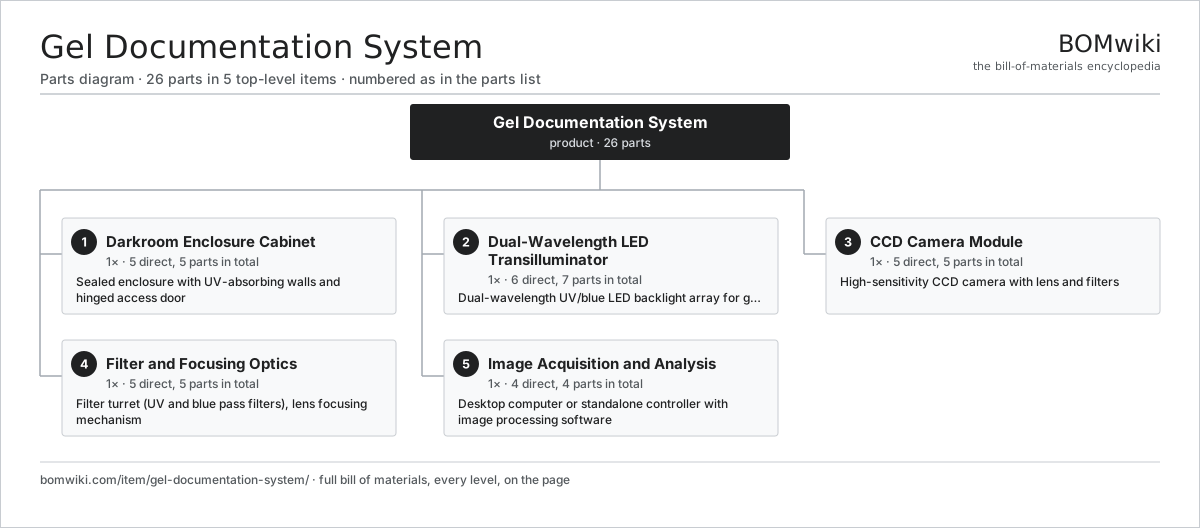
| # | Part | Qty | What it does |
|---|---|---|---|
| 1 | Darkroom Enclosure Cabinet 5 parts | 1× | Sealed enclosure with UV-absorbing walls and hinged access door |
| 2 | Dual-Wavelength LED Transilluminator 6 parts | 1× | Dual-wavelength UV/blue LED backlight array for gel visualization |
| 3 | CCD Camera Module 5 parts | 1× | High-sensitivity CCD camera with lens and filters |
| 4 | Filter and Focusing Optics 5 parts | 1× | Filter turret (UV and blue pass filters), lens focusing mechanism |
| 5 | Image Acquisition and Analysis 4 parts | 1× | Desktop computer or standalone controller with image processing software |
3D model
No 3D model yet. Have a CAD file of this? Add a 3D model. STL renders right on this page; STEP, FreeCAD, and OpenSCAD sources are welcome too (openly licensed, like all 3D models on BOMwiki).
Build & assembly graph
expand / collapse · shared sub-assemblies converge · links to related products · est. labourTap an assembly to expand/collapse · tap a part to open it · use “Open page” for any node · drag to pan, scroll to zoom.
Bill of materials for Gel Documentation System
5 top-level lines · 30 rows shown · 26 parts total · indented to 3 levels| # | Item / sub-assembly | Part no. | Qty/assy | Ext. qty | Parts | Type |
|---|---|---|---|---|---|---|
| 1 | Darkroom Enclosure Cabinet 5 parts | gel-doc-darkroom-cabinet | 1× | 1 | 5 | assembly |
| 1.1 | Cabinet Structural Frame | gel-doc-cabinet-frame | 1× | 1 | · | part |
| 1.2 | Black Interior Panels | gel-doc-cabinet-walls | 1× | 1 | · | part |
| 1.3 | Hinged Polycarbonate Top | gel-doc-hinged-lid | 1× | 1 | · | part |
| 1.4 | Gel Sample Tray | gel-doc-sample-tray | 1× | 1 | · | part |
| 1.5 | Lid Interlock Switch | gel-doc-door-switch | 1× | 1 | · | part |
| 2 | Dual-Wavelength LED Transilluminator 6 parts | gel-doc-transilluminator | 1× | 1 | 7 | assembly |
| 2.1 | UV-C LED Array 302 nm | gel-doc-uv-led-array | 1× | 1 | · | part |
| 2.2 | Blue LED Array 470 nm | gel-doc-blue-led-array | 1× | 1 | · | part |
| 2.3 | LED Current Driver Module | gel-doc-led-driver | 2× | 2 | · | part |
| 2.4 | UV/Blue Wavelength Selector | gel-doc-switching-relay | 1× | 1 | · | part |
| 2.5 | LED Heat-Sink Extrusion | gel-doc-transilluminator-heat-sink | 1× | 1 | · | part |
| 2.6 | LED Cooling Fan | gel-doc-cooling-fan | 1× | 1 | · | part |
| 3 | CCD Camera Module 5 parts | gel-doc-camera-assembly | 1× | 1 | 5 | assembly |
| 3.1 | CCD Image Sensor | gel-doc-ccd-sensor | 1× | 1 | · | part |
| 3.2 | Camera Optical Lens | gel-doc-camera-lens | 1× | 1 | · | part |
| 3.3 | Thermoelectric Camera Cooler | gel-doc-ccd-cooler | 1× | 1 | · | part |
| 3.4 | Mechanical Leaf Shutter | gel-doc-camera-shutter | 1× | 1 | · | part |
| 3.5 | Autofocus Stepper Motor | gel-doc-focus-motor | 1× | 1 | · | part |
| 4 | Filter and Focusing Optics 5 parts | gel-doc-optical-system | 1× | 1 | 5 | assembly |
| 4.1 | Motorized Filter Wheel | gel-doc-filter-turret | 1× | 1 | · | part |
| 4.2 | UV Bandpass Filter | gel-doc-uv-filter | 1× | 1 | · | part |
| 4.3 | Blue Bandpass Filter | gel-doc-blue-filter | 1× | 1 | · | part |
| 4.4 | Macro Telephoto Objective | gel-doc-macro-lens | 1× | 1 | · | part |
| 4.5 | Optical Alignment Plate | gel-doc-optical-bench | 1× | 1 | · | part |
| 5 | Image Acquisition and Analysis 4 parts | gel-doc-analysis-unit | 1× | 1 | 4 | assembly |
| 5.1 | CCD USB or FireWire Interface | gel-doc-camera-interface | 1× | 1 | · | part |
| 5.2 | Image Acquisition PC or SBC | gel-doc-computer | 1× | 1 | · | part |
| 5.3 | Image Analysis Software | gel-doc-analysis-software | 1× | 1 | · | part |
| 5.4 | LCD Display Monitor | gel-doc-monitor | 1× | 1 | · | part |
Something wrong in this list? Report a problem with this BOM.
Sourcing: possible vendors
Browse the supplier directory → Prices, MOQ, and lead times are algorithmic estimates, not quotes, and not claims about these companies. Company mappings are curated by keyword; est. price band $1k–$500k. How estimates work| Vendor | HQ | Specialty | MOQ | Lead time |
|---|---|---|---|---|
| thermofisher.com ↗ | Waltham, US | Lab instruments | 100 units | 10–18 wks |
|
🇺🇸Agilent
agilent.com ↗
|
Santa Clara, US | Analytical instruments | 100 units | 10–18 wks |
|
🇺🇸Bruker
bruker.com ↗
|
Billerica, US | Scientific instruments | 100 units | 10–18 wks |
|
🇯🇵Shimadzu
shimadzu.com ↗
|
Kyoto, JP | Analytical instruments | 100 units | 10–18 wks |
|
🇺🇸Waters
waters.com ↗
|
Milford, US | Chromatography & MS | 100 units | 10–18 wks |
1,378-word article