Geothermal Loop Drilling Rig
ProductOverview
Geothermal heat pump systems require closed-loop heat exchange with the earth. Instead of ground-source heat pumps operating on open-loop wells (extracting and reinjecting groundwater), closed-loop systems use sealed plastic piping filled with water-glycol heat transfer fluid. The piping is installed in vertical boreholes (50–500 m deep) drilled and grouted specifically for this application. The geothermal loop drilling rig is a specialized machine designed to bore these boreholes and install the piping in a single integrated operation.
A typical residential geothermal installation requires 3–6 boreholes, each 100–200 meters deep, with total loop length of 1500–3000 meters. A commercial building might need 20+ boreholes. The drilling rig must be compact enough to fit in a residential backyard yet powerful enough to bore through rock, and it must maintain precise borehole diameter and straightness to ensure grout seal integrity and piping fit.
How it works
The geothermal loop rig is a hydraulic machine mounted on a tracked chassis. The Drill Mast is a vertical lattice tower (10–25 m tall) with integrated hydraulic feed cylinders. The operator sits in an enclosed cabin and controls all functions via joystick and foot pedals. The Rotary Drive Head is mounted at the base of the mast and drives the Drill String at variable speed (0–200 RPM).
The drilling sequence is continuous: as the bit bores downward, the circulation pump forces heat-transfer fluid (a water-glycol mix) down through the hollow drill pipe. The fluid exits the bit and flows back up the annulus (the gap between drill pipe and borehole wall), cooling the bit and lifting rock cuttings. The fluid returns to the insulated reservoir.
Meanwhile, the Loop Piping Reel spools out geothermal loop piping at a precisely controlled rate. The piping (typically 3/4–1 inch HDPE or PEX, thermally rated) is fed down the borehole alongside the drill string using guide tubes. As drilling progresses meter by meter, the piping is lowered continuously.
When the target depth is reached, the drill string is withdrawn. The Grout Pump then circulates bentonite grout into the annulus, sealing the borehole and creating a thermally conductive path between the piping and the surrounding rock. The grout is a engineered mix: fine bentonite powder suspended in water, with additives (sand, mica powder) to match the thermal conductivity of the local rock formation.
Key systems
Drill mast and feed: The Drill Mast is a vertical lattice tower, rigid and straight. Two or four hydraulic feed cylinders (50–100 tonne each) are mounted internally or externally, pushing downward with precise force. The operator modulates feed pressure via foot pedal; the rotary head (powered independently) rotates the drill string. Feed rate in soft soil is 1–3 meters per minute; in hard rock, 0.2–1 meter per minute.
Rotary drive: The Rotary Drive Head is a hydraulic motor with a swivel. A variable displacement hydraulic pump controlled by foot pedal varies the rotary speed from 0–200 RPM. Soft formations (silt, sand) drill faster (100–200 RPM); hard rock (granite, limestone) drills slower (30–60 RPM) to avoid bit breakage. The swivel allows drilling fluid to circulate without the hose twisting.
Drill string: The Drill String is lightweight (thin-wall steel pipe, 25–41 mm OD) rather than heavy like a water well drill string. The pipe is hollow and has an internal spiral or bore to allow circulation fluid to pass through. Typical connections are API (compatible with water well pipe) or proprietary threads. The Drill Bit is a standard roller-cone or PDC bit (76–127 mm diameter, chosen for rock hardness and abrasiveness).
Circulation system: The Circulation Pump is a separate positive-displacement pump (gear or vane pump, 50–150 GPM) driven by a hydraulic motor. This separation from the main hydraulic system allows the operator to maintain circulation even if the feed or rotation is paused. The Fluid Tank is insulated to retain heat; in winter, the circulation fluid warms as it circulates, improving drilling efficiency. In summer, a Fluid Cooler rejects excess heat.
Loop piping and reel: The Loop Piping Reel is a large spool (2–4 m diameter) holding 500–2000 meters of geothermal piping (3/4–1.5 inch HDPE or PEX, rated for 200+ psi). The piping is fed through guide tubes down the center of the drill string or alongside it in the annulus. A hydraulic brake on the reel is modulated by the operator to maintain tension and feed rate. As the borehole deepens, more piping is released from the reel.
Grouting system: After drilling, the drill string is withdrawn and the Grout Pump is activated. A bentonite slurry (80–100 kg/m³ bentonite powder mixed with water) is prepared in a mixing tank. The peristaltic pump (10–30 GPM) circulates grout down a tremie tube (a small pipe that reaches the borehole bottom). Grout flows up the annulus, completely filling the space around the piping. Grout serves multiple functions: it seals the borehole (preventing groundwater inflow), it provides thermal contact between the piping and the rock, and it stabilizes the piping position against collapse.
Power system: A single diesel engine (100–200 kW) drives a variable displacement pump. This pump supplies all hydraulic functions: mast feed, rotation, circulation, grouting, track drive, and leveling jacks. The operator uses directional control spool valves to route flow to each function. A hydraulic cooler (aluminum radiator with fan) maintains oil temperature at 45–55 °C.
Chassis and mobility: The tracked undercarriage (similar to a bulldozer) allows the rig to traverse soft ground, rough terrain, and backyard sites without damage. Four hydraulic stabilizer jacks level the rig and provide additional ground contact for drilling stability. The entire unit is 20–40 tonne, small enough to be transported on a flatbed trailer.
Field operations
A geothermal loop installation crew (driller, helper, and piping technician) sets up the rig on a residential lot in 2–3 hours. Boreholes are drilled in a grid or line pattern, typically 2–4 meters apart. Each borehole is drilled 100–300 meters deep depending on the heating/cooling load and the local earth thermal conductivity.
Drilling typically takes 8–16 hours per 100 meters of depth, depending on formation hardness. Soft soil (clay, silt) is drilled quickly; competent limestone or granite is slower. The crew monitors drill bit wear, circulation pressure, and drilling rate. If the rate slows suddenly, it signals a formation change or bit dulling, the drill string is withdrawn and the bit is inspected and re-sharpened if needed.
After each borehole is drilled to target depth, grouting begins. High-quality grout (thermally conductive blend with sand and mica) is critical; poor grout reduces the heat transfer efficiency of the closed loop. The grout is pumped at slow rates (10–20 GPM) to ensure complete filling and to displace all trapped air.
Once all boreholes are drilled and grouted, the loop piping is connected at the surface in series or parallel circuits (typical: two U-tube loops per borehole, daisy-chained). The circuits are flushed to remove sediment, pressure-tested to 300 psi, and then connected to the geothermal heat pump inside the building. A circulating pump in the building continuously moves the heat transfer fluid through the closed loop.
Design considerations
The depth and number of boreholes are determined by thermal load calculations. A rule of thumb: each meter of borehole provides 30–50 watts of heat transfer (depending on rock type and groundwater flow). A 3-ton heat pump (10 kW) requires 200–300 meters of borehole depth. A building in the northeast USA with thermal conductivity ~2.5 W/m·K would use 4 boreholes at 75 m depth.
Borehole spacing is critical. Boreholes should be 2–4 meters apart to minimize thermal interference. If boreholes are too close, heat builds up in the surrounding rock during summer, reducing efficiency. If too far apart, the drilling cost rises. A 3×2 grid of six boreholes (each 100 m deep) is typical for a residential system; drilling, grouting, and piping installation takes 3–5 days.
Grout quality directly impacts long-term performance. Bentonite alone (80 kg/m³) has low thermal conductivity (~0.5 W/m·K). Adding sand and mica can increase conductivity to 1.5–2.0 W/m·K, matching typical earth materials. Custom thermally enhanced grout mixes are now standard for high-performance installations.
Piping material is HDPE or PEX, rated for 200+ psi and -40 to +70 °C. Connections are crimped or fusion-welded, not screwed threads, to eliminate leak paths. A single pin-hole leak can introduce air into the closed loop, causing corrosion and heat transfer loss.
The geothermal loop rig represents a convergence of water well drilling, grouting, and heat pump technology. Its specialized design, compact, mobile, powerful, and designed for precision, makes modern closed-loop geothermal systems economically viable for residential and commercial applications in diverse climates.
Geothermal Loop Drilling Rig parts and their functions
8 top-level parts · 62 parts in total · full bill of materials below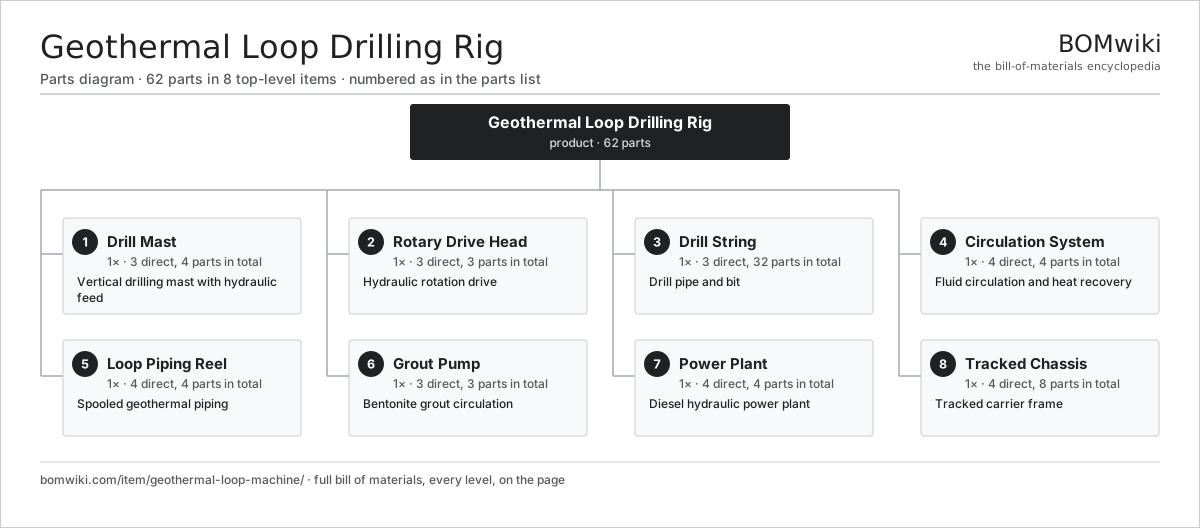
| # | Part | Qty | What it does |
|---|---|---|---|
| 1 | Drill Mast 3 parts | 1× | Vertical drilling mast with hydraulic feed |
| 2 | Rotary Drive Head 3 parts | 1× | Hydraulic rotation drive |
| 3 | Drill String 3 parts | 1× | Drill pipe and bit |
| 4 | Circulation System 4 parts | 1× | Fluid circulation and heat recovery |
| 5 | Loop Piping Reel 4 parts | 1× | Spooled geothermal piping |
| 6 | Grout Pump 3 parts | 1× | Bentonite grout circulation |
| 7 | Power Plant 4 parts | 1× | Diesel hydraulic power plant |
| 8 | Tracked Chassis 4 parts | 1× | Tracked carrier frame |
3D model
No 3D model yet. Have a CAD file of this? Add a 3D model. STL renders right on this page; STEP, FreeCAD, and OpenSCAD sources are welcome too (openly licensed, like all 3D models on BOMwiki).
Build & assembly graph
expand / collapse · shared sub-assemblies converge · links to related products · est. labourTap an assembly to expand/collapse · tap a part to open it · use “Open page” for any node · drag to pan, scroll to zoom.
Bill of materials for Geothermal Loop Drilling Rig
8 top-level lines · 36 rows shown · 62 parts total · indented to 3 levels| # | Item / sub-assembly | Part no. | Qty/assy | Ext. qty | Parts | Type |
|---|---|---|---|---|---|---|
| 1 | Drill Mast 3 parts | geothermal-loop-machine-drill-mast | 1× | 1 | 4 | assembly |
| 1.1 | Mast Frame | geothermal-loop-machine-mast-frame | 1× | 1 | · | part |
| 1.2 | Feed Cylinder | geothermal-loop-machine-feed-cylinder | 2× | 2 | · | part |
| 1.3 | Crown Block | geothermal-loop-machine-crown-block | 1× | 1 | · | part |
| 2 | Rotary Drive Head 3 parts | geothermal-loop-machine-rotary-head | 1× | 1 | 3 | assembly |
| 2.1 | Hydraulic Rotation Motor | geothermal-loop-machine-rotary-motor | 1× | 1 | · | part |
| 2.2 | Rotary Swivel | geothermal-loop-machine-rotary-swivel | 1× | 1 | · | part |
| 2.3 | Rotary Bearing | geothermal-loop-machine-rotary-bearing | 1× | 1 | · | part |
| 3 | Drill String 3 parts | geothermal-loop-machine-drill-string | 1× | 1 | 32 | assembly |
| 3.1 | Drill Pipe | geothermal-loop-machine-drill-pipe | 30× | 30 | · | part |
| 3.2 | Drill Bit | geothermal-loop-machine-drill-bit | 1× | 1 | · | part |
| 3.3 | Drill Pipe Connections | geothermal-loop-machine-drill-connections | 1× | 1 | · | part |
| 4 | Circulation System 4 parts | geothermal-loop-machine-mud-system | 1× | 1 | 4 | assembly |
| 4.1 | Fluid Tank | geothermal-loop-machine-mud-tank | 1× | 1 | · | part |
| 4.2 | Circulation Pump | geothermal-loop-machine-circulation-pump | 1× | 1 | · | part |
| 4.3 | Fluid Cooler | geothermal-loop-machine-fluid-cooler | 1× | 1 | · | part |
| 4.4 | Circulation Lines | geothermal-loop-machine-circulating-lines | 1× | 1 | · | part |
| 5 | Loop Piping Reel 4 parts | geothermal-loop-machine-loop-reel | 1× | 1 | 4 | assembly |
| 5.1 | Reel Frame | geothermal-loop-machine-reel-frame | 1× | 1 | · | part |
| 5.2 | Reel Drum | geothermal-loop-machine-reel-drum | 1× | 1 | · | part |
| 5.3 | Reel Brake | geothermal-loop-machine-reel-brake | 1× | 1 | · | part |
| 5.4 | Piping Guides | geothermal-loop-machine-loop-guides | 1× | 1 | · | part |
| 6 | Grout Pump 3 parts | geothermal-loop-machine-grout-pump | 1× | 1 | 3 | assembly |
| 6.1 | Grout Pump Unit | geothermal-loop-machine-grout-pump-unit | 1× | 1 | · | part |
| 6.2 | Grout Mixing Tank | geothermal-loop-machine-grout-tank | 1× | 1 | · | part |
| 6.3 | Grout Lines | geothermal-loop-machine-grout-lines | 1× | 1 | · | part |
| 7 | Power Plant 4 parts | geothermal-loop-machine-power-unit | 1× | 1 | 4 | assembly |
| 7.1 | Diesel Engine | geothermal-loop-machine-engine | 1× | 1 | · | part |
| 7.2 | Main Hydraulic Pump | geothermal-loop-machine-hydraulic-pump | 1× | 1 | · | part |
| 7.3 | Circulation Motor | geothermal-loop-machine-pump-motor | 1× | 1 | · | part |
| 7.4 | Hydraulic Cooler | geothermal-loop-machine-cooler | 1× | 1 | · | part |
| 8 | Tracked Chassis 4 parts | geothermal-loop-machine-track-chassis | 1× | 1 | 8 | assembly |
| 8.1 | Chassis Frame | geothermal-loop-machine-chassis-frame | 1× | 1 | · | part |
| 8.2 | Tracks | geothermal-loop-machine-tracks | 2× | 2 | · | part |
| 8.3 | Track Drive Motor | geothermal-loop-machine-track-drive | 1× | 1 | · | part |
| 8.4 | Stabilizer Jacks | geothermal-loop-machine-stabilizers | 4× | 4 | · | part |
Something wrong in this list? Report a problem with this BOM.
Sourcing: possible vendors
Browse the supplier directory → Prices, MOQ, and lead times are algorithmic estimates, not quotes, and not claims about these companies. Company mappings are curated by keyword; est. price band $15k–$2M. How estimates work| Vendor | HQ | Specialty | MOQ | Lead time |
|---|---|---|---|---|
| caterpillar.com ↗ | Irving, US | Construction & mining equipment | made to order | 16–28 wks |
|
🇯🇵Komatsu
komatsu.com ↗
|
Tokyo, JP | Construction & mining equipment | made to order | 16–28 wks |
|
🇸🇪Volvo CE
volvoce.com ↗
|
Gothenburg, SE | Construction equipment | made to order | 16–28 wks |
|
🇨🇭Liebherr
liebherr.com ↗
|
Bulle, CH | Cranes & heavy equipment | made to order | 16–28 wks |
|
🇨🇳XCMG
xcmg.com ↗
|
Xuzhou, CN | Construction machinery | made to order | 16–28 wks |
1,588-word article