Glider Launch Winch
ProductOverview
A glider launch winch accelerates an unpowered sailplane from zero to flying speed (~40 kts) in 20–30 seconds, pulling the towed glider up a steep climb angle to 300–400 m altitude. At that height the glider pilot releases the tow rope and transitions to soaring flight, circling in thermals or ridge lift to gain altitude. The winch is the simplest, most economical way to launch a fleet of gliders; a single winch can launch 30+ aircraft in a day at a typical soaring club.
The device consists of a large rotating drum storing up to 1000 m of 7 mm steel cable, an engine providing ~40 kW of continuous power, a friction clutch that smoothly accelerates the drum, and emergency safety systems including a cable-cutting guillotine. A remote pulley 1–2 km downwind redirects the return leg back to the winch, allowing reuse of the outbound line without crew repositioning.
Mechanics
The Main Drum is a large-diameter (1.2 m) steel spool wound with up to 1000 m of 7 mm high-tensile rope. As the engine runs, the Gasoline Engine drives the Friction Clutch multi-plate clutch, which gradually accelerates the drum from zero to full speed. The operator commands the Clutch Actuation hydraulic slave cylinder, controlling slip in the clutch plates so the glider experiences a smooth acceleration rather than a sudden jolt.
The Layering Cage traversing guide moves back and forth across the Main Drum width as the rope winds, ensuring parallel layers that pack efficiently and unwind predictably. Each layer sits flat on the one below, so the drum can store ~1000 m of rope.
As the outbound rope extends across the airfield, it passes over a Return Pulley positioned 1–2 km downwind on a Pulley Pylon tower. The glider pilot follows the rope up; at the target altitude or if overspeed conditions develop, the pilot pulls the release lever, disconnecting the tow hook. The outbound rope then falls to the ground, and the Cable Tensioner maintains slight tension on the return leg so it can be wound back in without slack or fouling.
Power and control
The Gasoline Engine is typically a 4-stroke petrol engine of ~40 kW, often sourced from a VW Beetle or Porsche road car and mounted in the winch frame. The Fuel Tank holds ~50 L on-board. The Cooling System dissipates heat, critical during rapid-fire launching (5–10 launches per hour).
The operator at the Operator Cabin controls three functions: engine throttle (via Throttle Lever), clutch engagement (via Clutch Actuation), and emergency stop (via Emergency Stop Button). The Instrument Cluster displays engine RPM, cable tension in kilonewtons, and hydraulic pressure. As the pilot releases the glider and the rope falls slack, the operator reduces throttle and engages the Brake Assembly secondary brake to bring the drum to a stop for the next rewind.
Rewind takes 3–5 minutes: the engine idles, the brake is released, and the operator gently applies the clutch in reverse, pulling the return rope back onto the drum while the field crew untangles and removes the released tow rope from the ground.
Safety
The Emergency Guillotine emergency system is the critical safety device. If the winch becomes unstable (one Drum Bearing fails, a rope layer breaks and comes off the drum), the field crew or a radio signal can trigger the Guillotine Actuator explosive cartridge or pneumatic piston, dropping the Guillotine Blade shear blade and severing the rope. This releases the glider immediately, allowing the pilot to land safely while the winch comes to a stop under the Brake Assembly.
Additional interlocks: the Warning Light illuminate if engine RPM exceeds the safe launch speed (overspeed check), and the Emergency Solenoid on the control panel allows the operator to vent hydraulic pressure to the brake, stopping the drum instantly if anything feels wrong.
Operation
Typical launch sequence:
- Crew attaches glider tow hook to the ground end of the rope, stretches it 500–700 m downfield.
- Operator starts the Gasoline Engine and engages the Friction Clutch smoothly.
- Glider accelerates at ~1 g, climbing the Return Pulley up to 3–4° above horizontal.
- At 300–400 m, pilot releases the tow hook; glider converts height to forward speed and climbs away.
- Outbound rope falls; operator reduces throttle and applies Brake Assembly.
- Crew rewinds the rope onto the Main Drum via the Layering Cage mechanism.
- Next glider is hooked up; cycle repeats every ~5–10 minutes.
A single winch can launch 30–50 gliders in a day, with the same rope used dozens of times. Modern electric winches are replacing petrol versions at some clubs, but cable-based launch remains the dominant method for sailplane training and sport flying.
Glider Launch Winch parts and their functions
8 top-level parts · 53 parts in total · full bill of materials below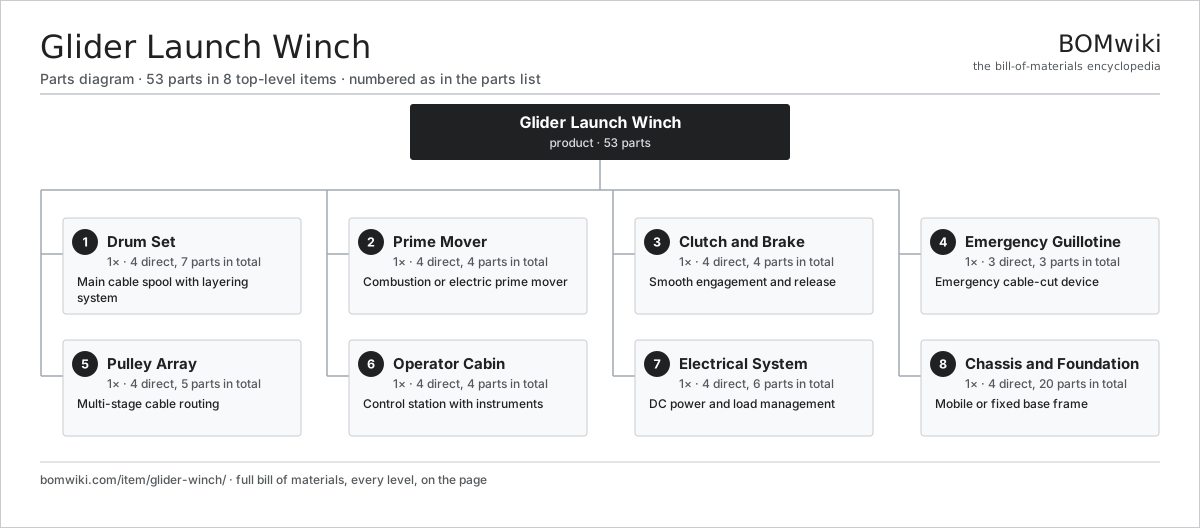
| # | Part | Qty | What it does |
|---|---|---|---|
| 1 | Drum Set 4 parts | 1× | Main cable spool with layering system |
| 2 | Prime Mover 4 parts | 1× | Combustion or electric prime mover |
| 3 | Clutch and Brake 4 parts | 1× | Smooth engagement and release |
| 4 | Emergency Guillotine 3 parts | 1× | Emergency cable-cut device |
| 5 | Pulley Array 4 parts | 1× | Multi-stage cable routing |
| 6 | Operator Cabin 4 parts | 1× | Control station with instruments |
| 7 | Electrical System 4 parts | 1× | DC power and load management |
| 8 | Chassis and Foundation 4 parts | 1× | Mobile or fixed base frame |
3D model
No 3D model yet. Have a CAD file of this? Add a 3D model. STL renders right on this page; STEP, FreeCAD, and OpenSCAD sources are welcome too (openly licensed, like all 3D models on BOMwiki).
Build & assembly graph
expand / collapse · shared sub-assemblies converge · links to related products · est. labourTap an assembly to expand/collapse · tap a part to open it · use “Open page” for any node · drag to pan, scroll to zoom.
Bill of materials for Glider Launch Winch
8 top-level lines · 39 rows shown · 53 parts total · indented to 3 levels| # | Item / sub-assembly | Part no. | Qty/assy | Ext. qty | Parts | Type |
|---|---|---|---|---|---|---|
| 1 | Drum Set 4 parts | glider-winch-drum-set | 1× | 1 | 7 | assembly |
| 1.1 | Main Drum | glider-winch-main-drum | 1× | 1 | · | part |
| 1.2 | Layering Cage | glider-winch-layering-cage | 1× | 1 | · | part |
| 1.3 | Drum Bearing | glider-winch-drum-bearing | 4× | 4 | · | part |
| 1.4 | Drum Brake | glider-winch-drum-brake | 1× | 1 | · | part |
| 2 | Prime Mover 4 parts | glider-winch-engine | 1× | 1 | 4 | assembly |
| 2.1 | Gasoline Engine | glider-winch-gasoline-engine | 1× | 1 | · | part |
| 2.2 | Fuel Tank | glider-winch-fuel-tank | 1× | 1 | · | part |
| 2.3 | Cooling System | glider-winch-cooling-system | 1× | 1 | · | part |
| 2.4 | Starter Motor | glider-winch-starter-motor | 1× | 1 | · | part |
| 3 | Clutch and Brake 4 parts | glider-winch-clutch-brake | 1× | 1 | 4 | assembly |
| 3.1 | Friction Clutch | glider-winch-friction-clutch | 1× | 1 | · | part |
| 3.2 | Clutch Actuation | glider-winch-clutch-actuation | 1× | 1 | · | part |
| 3.3 | Brake Assembly | glider-winch-brake-assembly | 1× | 1 | · | part |
| 3.4 | Clutch Cooler | glider-winch-clutch-cooler | 1× | 1 | · | part |
| 4 | Emergency Guillotine 3 parts | glider-winch-guillotine | 1× | 1 | 3 | assembly |
| 4.1 | Guillotine Blade | glider-winch-guillotine-blade | 1× | 1 | · | part |
| 4.2 | Guillotine Actuator | glider-winch-guillotine-actuator | 1× | 1 | · | part |
| 4.3 | Guillotine Housing | glider-winch-guillotine-housing | 1× | 1 | · | part |
| 5 | Pulley Array 4 parts | glider-winch-pulley-array | 1× | 1 | 5 | assembly |
| 5.1 | Return Pulley | glider-winch-return-pulley | 1× | 1 | · | part |
| 5.2 | Pulley Pylon | glider-winch-pulley-pylon | 1× | 1 | · | part |
| 5.3 | Pulley Bearing | glider-winch-pulley-bearing | 2× | 2 | · | part |
| 5.4 | Cable Tensioner | glider-winch-cable-tensioner | 1× | 1 | · | part |
| 6 | Operator Cabin 4 parts | glider-winch-operator-cab | 1× | 1 | 4 | assembly |
| 6.1 | Cab Frame | glider-winch-cab-frame | 1× | 1 | · | part |
| 6.2 | Instrument Cluster | glider-winch-instrument-cluster | 1× | 1 | · | part |
| 6.3 | Throttle Lever | glider-winch-throttle-lever | 1× | 1 | · | part |
| 6.4 | Emergency Stop Button | glider-winch-emergency-stop-button | 1× | 1 | · | part |
| 7 | Electrical System 4 parts | glider-winch-electrical | 1× | 1 | 6 | assembly |
| 7.1 | Battery | glider-winch-battery | 2× | 2 | · | part |
| 7.2 | Alternator | glider-winch-alternator | 1× | 1 | · | part |
| 7.3 | Warning Light | glider-winch-warning-lights | 2× | 2 | · | part |
| 7.4 | Emergency Solenoid | glider-winch-emergency-solenoid | 1× | 1 | · | part |
| 8 | Chassis and Foundation 4 parts | glider-winch-chassis | 1× | 1 | 20 | assembly |
| 8.1 | Base Frame | glider-winch-base-frame | 1× | 1 | · | part |
| 8.2 | Drum Shaft | glider-winch-drum-shaft | 1× | 1 | · | part |
| 8.3 | Shaft Support | glider-winch-shaft-support | 2× | 2 | · | part |
| 8.4 | Foundation Bolt | glider-winch-foundation-bolts | 16× | 16 | · | part |
Something wrong in this list? Report a problem with this BOM.
Sourcing: possible vendors
Browse the supplier directory → Prices, MOQ, and lead times are algorithmic estimates, not quotes, and not claims about these companies. Company mappings are curated by keyword; est. price band $50k–$300M. How estimates work| Vendor | HQ | Specialty | MOQ | Lead time |
|---|---|---|---|---|
|
🇺🇸Boeing
boeing.com ↗
|
Arlington, US | Aerospace OEM | made to order | 40–80 wks |
|
🇫🇷Airbus
airbus.com ↗
|
Toulouse, FR | Aerospace OEM | made to order | 40–80 wks |
| lockheedmartin.com ↗ | Bethesda, US | Aerospace & defense | made to order | 40–80 wks |
|
🇧🇷Embraer
embraer.com ↗
|
São José dos Campos, BR | Aircraft OEM | made to order | 40–80 wks |
| txtav.com ↗ | Wichita, US | Aircraft OEM | made to order | 40–80 wks |
855-word article