Glute-Ham Developer
ProductOverview
The glute-ham developer is a bench for loading the posterior chain, hamstrings, glutes, and spinal erectors, without a barbell. The user kneels-to-horizontal with thighs on a split Split Hip Pad and ankles clamped in the Footplate and Roller Assembly, then raises and lowers the torso through hip and knee action. Its signature movement, the glute-ham raise, is one of the few exercises that trains the hamstrings simultaneously as hip extensors and knee flexors, the dual role they play in sprinting. The machine entered Western strength training via Soviet-influenced powerlifting in the 1970s and became ubiquitous through CrossFit affiliates, which also use it for GHD sit-ups.
Mechanically it is a passive structure, no springs, stacks, or cables. The engineering problems are adjustment range, stiffness under a cantilevered human, and pad geometry.
Frame and loads
The load case is severe for a bench: a 100 kg user fully horizontal puts their entire mass on a lever roughly a metre from the Foot Tower, so the GHD Frame sees large overturning and torsional moments, plus dynamic overshoot when athletes rep fast. The Main Beam connects the two towers and is the highest-stressed member; commercial frames use 60–75 mm square tube at 2.5–3 mm wall with gusseted Sheet Metal Panel plates at the tower joints. The Rear Base Foot is widened because GHD sit-ups throw the user's centre of mass behind the foot tower at the bottom of each rep.
Pad carriage
Users from 1.5 to 2 m tall need the horizontal distance between pad apex and footplate to match their femur-plus-shank length, so the Adjustable Pad Carriage slides along the main beam. A Carriage Slide Tube telescopes over the beam on Carriage Wear Bushing liners, indexing into the Position Hole Strip strip with a Carriage Pop-Pin. Because pin-in-hole joints always carry a little clearance, better machines add a Secondary Lock Knob that clamps the carriage after pinning, play here is felt directly as pad rock under the hips. Positioning convention: for glute-ham raises the pad is set so the knees press into the lower third of the pads; for back extensions the pad apex sits at the hip crease, a carriage position several holes further out.
Split hip pad
The pad is split into two convex Pad Half cushions with a central gap. The convexity lets the pelvis rotate over a rounded fulcrum rather than fold over an edge, and the gap relieves soft-tissue pressure. Foam is high-density (similar to a squat bench, 60–90 kg/m³) at 100–130 mm thickness, since the entire body weight concentrates on two thigh-sized contact patches. Both halves bolt to the Pad Mounting Frame atop the Pad Mast.
Foot assembly
Anchoring is what distinguishes a GHD from a back-extension bench. The feet push soles-flat against the Footplate while the ankles are captured between two pairs of Ankle Roller cylinders, lower pair behind the Achilles, upper pair over the calves. During the knee-flexion phase of a glute-ham raise the user is effectively doing an inverted leg curl, and the upper rollers react that force; during back extensions the lower rollers and plate do the work. Each roller pair rides a fixed Roller Axle, and the whole Foot Tower slides and pins via its own Foot Tower Pop-Pin to set clamp distance for different shoe and calf sizes.
Handles and transport
Mounting a GHD is awkward by design, the user must climb into a clamped position, so Handle Tube grips sit below the hip pad for entry, exit, and self-assistance on early reps (athletes push off the handles to complete raises they cannot yet do strict). At 60–100 kg the bench moves on a Transport Kit kit: tilt onto the rear Transport Wheel pair using the Lift Handle.
Maintenance
Wear points are the pad vinyl at the thigh contact patches, roller foam compression set, pop-pin springs, and elongation of the index holes on heavily used carriages. The Fastener Set joints at the towers are re-torqued periodically because the cyclic moment loading works bolted connections loose faster than on static benches.
Glute-Ham Developer parts and their functions
7 top-level parts · 41 parts in total · full bill of materials below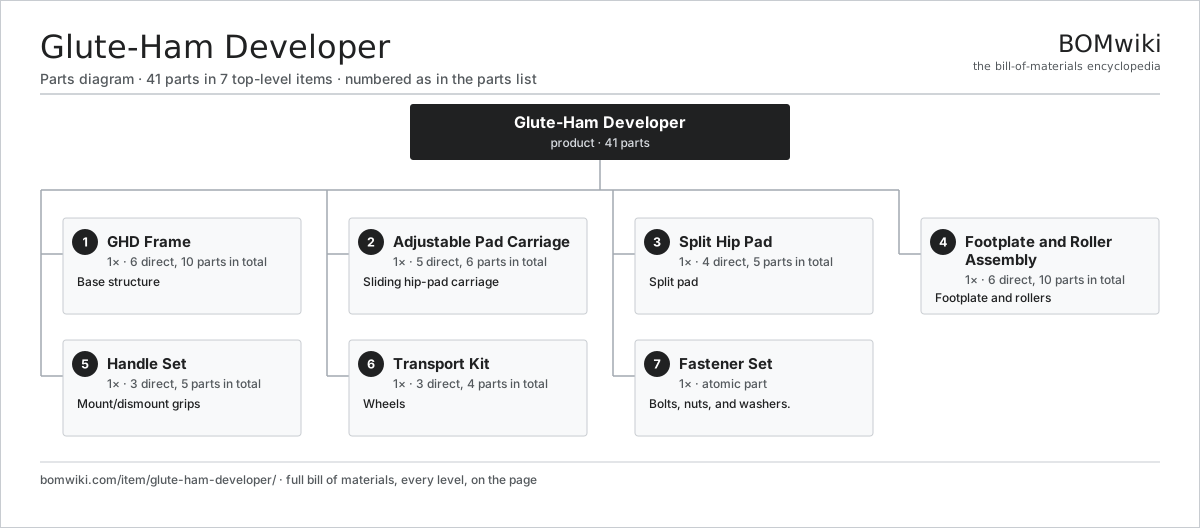
| # | Part | Qty | What it does |
|---|---|---|---|
| 1 | GHD Frame 6 parts | 1× | Base structure |
| 2 | Adjustable Pad Carriage 5 parts | 1× | Sliding hip-pad carriage |
| 3 | Split Hip Pad 4 parts | 1× | Split pad |
| 4 | Footplate and Roller Assembly 6 parts | 1× | Footplate and rollers |
| 5 | Handle Set 3 parts | 1× | Mount/dismount grips |
| 6 | Transport Kit 3 parts | 1× | Wheels |
| 7 | Fastener Set | 1× | Bolts, nuts, and washers. |
3D model
No 3D model yet. Have a CAD file of this? Add a 3D model. STL renders right on this page; STEP, FreeCAD, and OpenSCAD sources are welcome too (openly licensed, like all 3D models on BOMwiki).
Build & assembly graph
expand / collapse · shared sub-assemblies converge · links to related products · est. labourTap an assembly to expand/collapse · tap a part to open it · use “Open page” for any node · drag to pan, scroll to zoom.
Bill of materials for Glute-Ham Developer
7 top-level lines · 34 rows shown · 41 parts total · indented to 3 levels| # | Item / sub-assembly | Part no. | Qty/assy | Ext. qty | Parts | Type |
|---|---|---|---|---|---|---|
| 1 | GHD Frame 6 parts | glute-ham-developer-frame | 1× | 1 | 10 | assembly |
| 1.1 | Main Beam | glute-ham-developer-main-beam | 1× | 1 | · | part |
| 1.2 | Front Base Foot | glute-ham-developer-front-base | 1× | 1 | · | part |
| 1.3 | Rear Base Foot | glute-ham-developer-rear-base | 1× | 1 | · | part |
| 1.4 | Support Upright | glute-ham-developer-upright | 2× | 2 | · | part |
| 1.5 | Rubber Floor Cap | glute-ham-developer-foot-cap | 4× | 4 | · | part |
| 1.6 | Sheet Metal Panel | sheet-panel | 1× | 1 | · | part |
| 2 | Adjustable Pad Carriage 5 parts | glute-ham-developer-pad-carriage | 1× | 1 | 6 | assembly |
| 2.1 | Carriage Slide Tube | glute-ham-developer-carriage-tube | 1× | 1 | · | part |
| 2.2 | Carriage Pop-Pin | glute-ham-developer-carriage-poppin | 1× | 1 | · | part |
| 2.3 | Carriage Wear Bushing | glute-ham-developer-carriage-bushing | 2× | 2 | · | part |
| 2.4 | Position Hole Strip | glute-ham-developer-position-holes | 1× | 1 | · | part |
| 2.5 | Secondary Lock Knob | glute-ham-developer-lock-knob | 1× | 1 | · | part |
| 3 | Split Hip Pad 4 parts | glute-ham-developer-hip-pad | 1× | 1 | 5 | assembly |
| 3.1 | Pad Half | glute-ham-developer-pad-half | 2× | 2 | · | part |
| 3.2 | Pad Mast | glute-ham-developer-pad-mast | 1× | 1 | · | part |
| 3.3 | Pad Mounting Frame | glute-ham-developer-pad-frame | 1× | 1 | · | part |
| 3.4 | Fastener Set | fastener-set | 1× | 1 | · | part |
| 4 | Footplate and Roller Assembly 6 parts | glute-ham-developer-foot-assembly | 1× | 1 | 10 | assembly |
| 4.1 | Footplate | glute-ham-developer-footplate | 1× | 1 | · | part |
| 4.2 | Ankle Roller | glute-ham-developer-roller | 4× | 4 | · | part |
| 4.3 | Roller Axle | glute-ham-developer-roller-axle | 2× | 2 | · | part |
| 4.4 | Foot Tower | glute-ham-developer-foot-tower | 1× | 1 | · | part |
| 4.5 | Foot Tower Pop-Pin | glute-ham-developer-foot-poppin | 1× | 1 | · | part |
| 4.6 | O-Ring Set | oring-set | 1× | 1 | · | part |
| 5 | Handle Set 3 parts | glute-ham-developer-handles | 1× | 1 | 5 | assembly |
| 5.1 | Handle Tube | glute-ham-developer-handle-tube | 2× | 2 | · | part |
| 5.2 | Handle Grip Sleeve | glute-ham-developer-handle-grip | 2× | 2 | · | part |
| 5.3 | Fastener Set | fastener-set | 1× | 1 | · | part |
| 6 | Transport Kit 3 parts | glute-ham-developer-transport | 1× | 1 | 4 | assembly |
| 6.1 | Transport Wheel | glute-ham-developer-wheel | 2× | 2 | · | part |
| 6.2 | Wheel Axle Bolt | glute-ham-developer-wheel-axle | 1× | 1 | · | part |
| 6.3 | Lift Handle | glute-ham-developer-lift-handle | 1× | 1 | · | part |
| 7 | Fastener Set | fastener-set | 1× | 1 | · | part |
Something wrong in this list? Report a problem with this BOM.
Related products
same domain, ranked by shared parts Adjustable Weight Bench
38 parts · shares 2 with this page
Curved Manual Treadmill
411 parts · shares 1 with this page
Push Sled
42 parts · shares 1 with this page
Adjustable Weight Bench
38 parts · shares 2 with this page
Curved Manual Treadmill
411 parts · shares 1 with this page
Push Sled
42 parts · shares 1 with this page
 Anti-Gravity Treadmill
96 parts · shares 1 with this page
Anti-Gravity Treadmill
96 parts · shares 1 with this page
 Climbing Auto-Belay
49 parts · shares 1 with this page
Hydraulic Circuit Trainer
61 parts · shares 1 with this page
Climbing Auto-Belay
49 parts · shares 1 with this page
Hydraulic Circuit Trainer
61 parts · shares 1 with this page
Sourcing: possible vendors
Browse the supplier directory → Prices, MOQ, and lead times are algorithmic estimates, not quotes, and not claims about these companies. Company mappings are curated by keyword; est. price band $100–$10k. How estimates work| Vendor | HQ | Specialty | MOQ | Lead time |
|---|---|---|---|---|
| lifefitness.com ↗ | Rosemont, US | Fitness equipment | 200 units | 8–14 wks |
| technogym.com ↗ | Cesena, IT | Fitness equipment | 200 units | 8–14 wks |
|
🇺🇸Peloton
onepeloton.com ↗
|
New York, US | Connected fitness | 200 units | 8–14 wks |
| johnsonhealthtech.com ↗ | Taichung, TW | Fitness (Matrix) | 200 units | 8–14 wks |
|
🇺🇸Precor
precor.com ↗
|
Woodinville, US | Fitness equipment | 200 units | 8–14 wks |
758-word article