Glycol Chiller
ProductOverview
A glycol chiller produces a coolant loop circulating propylene glycol/water solution (anti-freeze mixture) for outdoor or variable-ambient cooling applications. Unlike pure-water chillers (which freeze at 0 °C), glycol chillers maintain flow and heat-transfer capability down to -5 or -20 °C, making them ideal for outdoor misting fans, snow-making machines, seasonal process cooling, and climates with winter freeze-ups.
The chiller houses a hermetic refrigeration circuit (compressor, condenser, receiver) that cools glycol via a brazed plate heat exchanger. A variable-displacement pump circulates the cold glycol through customer loops (outdoor misting fans, snow-making machines, etc.) at 5–30 m³/h. Electronic controls modulate compressor speed and pump displacement to track load and ambient conditions, achieving 40–60% energy savings vs. fixed-speed designs.
How it works
Refrigeration circuit: The hermetic scroll compressor (5–30 kW) draws suction vapor at 30–50 psi and compresses it to 200–250 psi discharge pressure. Hot discharge gas flows to the air-cooled condenser coil, where an EC fan cools it to saturation; liquid condenses and collects in the receiver tank. Expansion valve control (via thermostatic or electronic modulation) regulates flow into the heat exchanger.
Glycol heat exchange: Refrigerant at -15 °C enters the plate heat exchanger on one side; glycol solution enters at ambient temperature (e.g., +15 °C after returning from outdoor loops). In counter-flow, the refrigerant evaporates and absorbs latent heat from the glycol, exiting as low-pressure vapor (~35 psi) back to the compressor suction. The glycol exits the HX at setpoint temperature (e.g., -2 °C for freeze protection) and flows to customer circuits.
Glycol reservoir: The insulated glycol tank (50–200 L) acts as a buffer, absorbing transient load spikes and allowing for thermal expansion. A pressurized expansion tank (20 L) connected to the reservoir accommodates volumetric changes as temperature varies (glycol density changes ~0.6%/°C). A float level switch alerts if glycol inventory drops below safe operating level (indicating a leak).
Pump & flow control: The variable-displacement pump (5–30 m³/h) is driven by a 5–15 kW 3-phase motor. Modern designs use proportional pump displacement: if load (delta-T across customer coils) is low, pump displacement reduces, cutting motor power from 15 kW to 5 kW. A VFD on the pump motor further optimizes speed; at 50% displacement and 50% motor speed, power draw drops to ~1 kW (vs. 5 kW fixed-speed designs).
Temperature & pressure control: The outlet temperature sensor (Pt100 RTD) monitors chilled-glycol leaving the chiller. The PLC controller compares actual temperature to setpoint and issues 0–100% modulation commands to the compressor VFD. Higher demand (lower outlet temp than setpoint) increases compressor frequency (30–60 Hz); lower demand decreases it. A pressure gauge monitors glycol-side pressure (typically 2–4 bar); if it exceeds 5 bar, the relief valve cracks open, protecting the HX and piping.
Condenser fan modulation: An EC fan on the air-cooled condenser varies speed proportionally to maintain discharge pressure near setpoint (e.g., 200 psi). In cold ambient (<5 °C), the fan may run at 20% speed; on hot days (>35 °C), it runs at 100%. This fan modulation saves 30–50% condenser fan energy vs. fixed-speed operation.
Safety & alarms: A dual-channel safety relay monitors:
- High discharge pressure: >300 psi (fouled condenser, ambient overtemp) → compressor shutoff.
- Low flow: glycol flow <50% design → pump cavitation, compressor protection.
- Low glycol level: float switch tripped → system stop, maintenance alert.
Glycol Selection & Maintenance
Fluid chemistry:
Propylene glycol/water solution: 40–50% glycol by volume.
- Freezing point: -20 °C at 50% glycol.
- Boiling point: >100 °C (safe for refrigeration circuits).
- Specific heat: ~3.5 kJ/kg·K (vs. 4.18 for water); slightly lower but acceptable.
- Viscosity @ -5 °C: ~50 cSt (pumpable at 3 bar).
Inhibitors & additives: Corrosion inhibitors (silicates or organic), biocides (to prevent algae in open reservoirs), and anti-foam agents.
Initial fill & conditioning:
- New glycol solution is hygroscopic; water content drops from 50 ppm to <200 ppm after 6–8 weeks operation.
- First-year annual analysis (ISO 4406 particle count, water content, acid number) recommended.
Annual maintenance:
- Check water content via Karl Fischer titration; if >500 ppm, perform vacuum dehydration.
- Monitor viscosity; if high-shear samples >2000 cSt @ 40 °C, fluid is degrading (oxidation); replace glycol.
- Inspect pump inlet filter for particulate; clean or replace if pressure drop >0.5 bar.
Glycol change-out interval: 5–7 years under normal operation; sooner if fluid analysis shows acid number >0.3 mg KOH/g.
Application Examples
Outdoor misting fan: Chiller produces -2 °C glycol at 10 m³/h; misting fan operates year-round without freeze-up.
Snow-making machine: Chiller output is -8 °C glycol; snow maker's compressed-air heat exchanger cools air below freezing point, nucleating snow crystals.
Process cooling in cold climates: Food-plant refrigerated conveyor systems use glycol loops to avoid ice formation in product contact surfaces.
Seasonal hydronic heating/cooling: Building loop can be switched from heating (winter) to glycol-chilled cooling (summer) without biocide loss or freeze risk.
Comparison with Alternative Chillers
| Feature | Glycol Chiller | Water Chiller | Chilled-Water Cooler |
|---|---|---|---|
| Freeze protection | Yes (-20 °C) | No (0 °C limit) | Outdoor units need freeze protection |
| Outdoor capability | Yes (natural) | No (requires auxiliary heating) | Location-dependent |
| Heat transfer coeff. | Lower (glycol viscous) | Higher (water low viscosity) | Medium (water-side only) |
| Pump power | Higher (glycol viscous) | Lower (water thin) | Medium |
| Maintenance | Fluid analysis annually | Minimal | Biocide/passivation programs |
| Cost (CAPEX) | Moderate | Lower | Higher |
Glycol chillers are essential in freeze-risk applications; the slight efficiency penalty is offset by superior reliability and no auxiliary heaters.
Integration with Variable-Load Systems
Load-responsive operation:
- Customer loops (outdoor coils) experience variable heat load: misting fans on sunny days (high load), evenings/winter (low load).
- Glycol chiller with VFD pump and VFD compressor modulates to track inlet/outlet delta-T, maintaining setpoint while reducing energy by 30–50% vs. fixed-capacity designs.
- Example: -2 °C outlet setpoint maintained at all loads; pump displacement ranges 25–100%, compressor speed 30–100%.
Installation & Commissioning
Piping: Insulated glycol lines (minimum 1" foam wrap) prevent heat loss from outdoor loops. Pitch lines at 0.25 in/ft slope minimum to ensure air release and prevent vapor lock at pump inlet.
Thermal expansion: Glycol expands ~0.6%/°C; a 100 L system changing from 25 °C to -5 °C (30 °C swing) expands ~1.8 L. Pressurized expansion tank absorbs this; system pressure range is typically 1–5 bar.
Glycol fill: Use pre-mixed solutions from supplier (measured ratios guarantee freeze point). Partial fills or on-site mixing with regular water can result in incorrect freeze protection.
Standards & Efficiency
- ASHRAE 90.1: Chiller minimum efficiency ratio (EER) and full-load rating conditions.
- ISO 9000/ISO 14644: Cleanliness standards for glycol systems in sensitive applications.
- ANSI/AHRI 550: Chiller performance rating and standardized test conditions.
Glycol chillers enable year-round cooling in freeze-risk climates; proper fluid maintenance and electronic controls are critical for long equipment life.
Glycol Chiller parts and their functions
8 top-level parts · 44 parts in total · full bill of materials below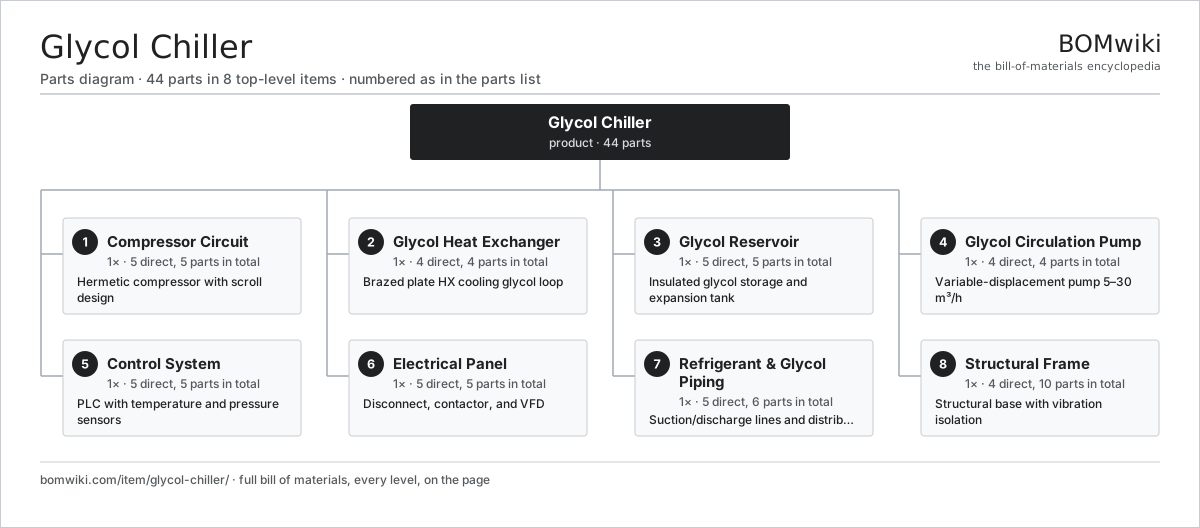
| # | Part | Qty | What it does |
|---|---|---|---|
| 1 | Compressor Circuit 5 parts | 1× | Hermetic compressor with scroll design |
| 2 | Glycol Heat Exchanger 4 parts | 1× | Brazed plate HX cooling glycol loop |
| 3 | Glycol Reservoir 5 parts | 1× | Insulated glycol storage and expansion tank |
| 4 | Glycol Circulation Pump 4 parts | 1× | Variable-displacement pump 5–30 m³/h |
| 5 | Control System 5 parts | 1× | PLC with temperature and pressure sensors |
| 6 | Electrical Panel 5 parts | 1× | Disconnect, contactor, and VFD |
| 7 | Refrigerant & Glycol Piping 5 parts | 1× | Suction/discharge lines and distribution manifold |
| 8 | Structural Frame 4 parts | 1× | Structural base with vibration isolation |
3D model
No 3D model yet. Have a CAD file of this? Add a 3D model. STL renders right on this page; STEP, FreeCAD, and OpenSCAD sources are welcome too (openly licensed, like all 3D models on BOMwiki).
Build & assembly graph
expand / collapse · shared sub-assemblies converge · links to related products · est. labourTap an assembly to expand/collapse · tap a part to open it · use “Open page” for any node · drag to pan, scroll to zoom.
Bill of materials for Glycol Chiller
8 top-level lines · 45 rows shown · 44 parts total · indented to 3 levels| # | Item / sub-assembly | Part no. | Qty/assy | Ext. qty | Parts | Type |
|---|---|---|---|---|---|---|
| 1 | Compressor Circuit 5 parts | glycol-chiller-compressor-circuit | 1× | 1 | 5 | assembly |
| 1.1 | Scroll Compressor | glycol-chiller-compressor | 1× | 1 | · | part |
| 1.2 | Air Condenser Coil | glycol-chiller-air-condenser-coil | 1× | 1 | · | part |
| 1.3 | Condenser Fan | glycol-chiller-condenser-fan | 1× | 1 | · | part |
| 1.4 | Receiver Tank | glycol-chiller-receiver-tank | 1× | 1 | · | part |
| 1.5 | Sight Glass | glycol-chiller-sight-glass | 1× | 1 | · | part |
| 2 | Glycol Heat Exchanger 4 parts | glycol-chiller-heat-exchanger | 1× | 1 | 4 | assembly |
| 2.1 | Plate HX Core | glycol-chiller-plate-core | 1× | 1 | · | part |
| 2.2 | Glycol Inlet Port | glycol-chiller-inlet-port | 1× | 1 | · | part |
| 2.3 | Glycol Outlet Port | glycol-chiller-outlet-port | 1× | 1 | · | part |
| 2.4 | Glycol Relief Valve | glycol-chiller-relief-valve | 1× | 1 | · | part |
| 3 | Glycol Reservoir 5 parts | glycol-chiller-reservoir | 1× | 1 | 5 | assembly |
| 3.1 | Tank Shell | glycol-chiller-tank-shell | 1× | 1 | · | part |
| 3.2 | Float Switch | glycol-chiller-float-level-switch | 1× | 1 | · | part |
| 3.3 | Fill Cap | glycol-chiller-fill-cap | 1× | 1 | · | part |
| 3.4 | Drain Valve | glycol-chiller-drain-valve | 1× | 1 | · | part |
| 3.5 | Expansion Tank | glycol-chiller-expansion-tank | 1× | 1 | · | part |
| 4 | Glycol Circulation Pump 4 parts | glycol-chiller-circulation-pump | 1× | 1 | 4 | assembly |
| 4.1 | Pump Motor | glycol-chiller-pump-motor | 1× | 1 | · | part |
| 4.2 | Pump Head | glycol-chiller-pump-head | 1× | 1 | · | part |
| 4.3 | Pump Coupling | glycol-chiller-pump-coupling | 1× | 1 | · | part |
| 4.4 | Pump Strainer | glycol-chiller-pump-strainer | 1× | 1 | · | part |
| 5 | Control System 5 parts | glycol-chiller-controls | 1× | 1 | 5 | assembly |
| 5.1 | Outlet Temp Sensor | glycol-chiller-outlet-temp-sensor | 1× | 1 | · | part |
| 5.2 | Inlet Temp Sensor | glycol-chiller-inlet-temp-sensor | 1× | 1 | · | part |
| 5.3 | Pressure Transducer | glycol-chiller-pressure-transducer | 1× | 1 | · | part |
| 5.4 | PLC Controller | glycol-chiller-controller-plc | 1× | 1 | · | part |
| 5.5 | Safety Relay | glycol-chiller-safety-relay | 1× | 1 | · | part |
| 6 | Electrical Panel 5 parts | glycol-chiller-electrical-panel | 1× | 1 | 5 | assembly |
| 6.1 | Main Disconnect | glycol-chiller-main-disconnect | 1× | 1 | · | part |
| 6.2 | Pump Contactor | glycol-chiller-pump-contactor | 1× | 1 | · | part |
| 6.3 | Compressor VFD | glycol-chiller-compressor-vfd | 1× | 1 | · | part |
| 6.4 | Pump VFD | glycol-chiller-pump-vfd | 1× | 1 | · | part |
| 6.5 | Control Transformer | glycol-chiller-control-transformer | 1× | 1 | · | part |
| 7 | Refrigerant & Glycol Piping 5 parts | glycol-chiller-piping | 1× | 1 | 6 | assembly |
| 7.1 | Suction Line | glycol-chiller-suction-line | 1× | 1 | · | part |
| 7.2 | Discharge Line | glycol-chiller-discharge-line | 1× | 1 | · | part |
| 7.3 | Liquid Line | glycol-chiller-liquid-line | 1× | 1 | · | part |
| 7.4 | Distribution Manifold | glycol-chiller-distribution-manifold | 1× | 1 | · | part |
| 7.5 | Isolation Valve | glycol-chiller-isolation-ball-valve | 2× | 2 | · | part |
| 8 | Structural Frame 4 parts | glycol-chiller-frame | 1× | 1 | 10 | assembly |
| 8.1 | Base Rails | glycol-chiller-base-rails | 1× | 1 | · | part |
| 8.2 | Vibration Isolator | glycol-chiller-vibration-isolator | 4× | 4 | · | part |
| 8.3 | Leveling Foot | glycol-chiller-leveling-feet | 4× | 4 | · | part |
| 8.4 | Mounting Bolts | glycol-chiller-mounting-bolt-set | 1× | 1 | · | part |
Something wrong in this list? Report a problem with this BOM.
Sourcing: possible vendors
Browse the supplier directory → Prices, MOQ, and lead times are algorithmic estimates, not quotes, and not claims about these companies. Company mappings are curated by keyword; est. price band $100–$20k. How estimates work| Vendor | HQ | Specialty | MOQ | Lead time |
|---|---|---|---|---|
|
🇺🇸Carrier
carrier.com ↗
|
Palm Beach Gardens, US | HVAC | 500 units | 8–14 wks |
| tranetechnologies.com ↗ | Davidson, US | HVAC | 500 units | 8–14 wks |
|
🇯🇵Daikin
daikin.com ↗
|
Osaka, JP | HVAC | 500 units | 8–14 wks |
|
🇺🇸Lennox
lennox.com ↗
|
Richardson, US | HVAC | 500 units | 8–14 wks |
| johnsoncontrols.com ↗ | Milwaukee, US | Building systems | 500 units | 8–14 wks |
1,290-word article