Aircraft De-Icing Rig
ProductOverview
An aircraft de-icing rig is a specialized truck-mounted spraying system designed to remove ice, snow, and frost from aircraft surfaces prior to flight. Modern rigs use a heated glycol/water mixture (typically 40–60% concentration of propylene or ethylene glycol) applied at 55–65 °C to melt frozen precipitation and provide holdover protection (Type I fluid immediate de-ice, Type IV extended holdover).
De-icing is a critical safety operation performed during winter weather at northern latitude and high-altitude airports (Denver, Minneapolis, Canadian airports, European hubs). A single de-ice operation costs $500–2000 per aircraft and adds 20–30 minutes to turnaround time but prevents takeoff incidents due to lift-destroying ice.
Truck Chassis & Powertrain
The Truck Chassis is typically a heavy-duty 6×4 or 6×6 truck (Mercedes Econic, Scania, Volvo) with turbo-diesel engine (200–300 kW). The truck must:
- Support 30–50 ton payload (hot tanks + equipment).
- Provide reliable hydraulic power to boom and spray systems.
- Maintain 2+ hour operational endurance per shift.
The Diesel Engine drives both:
- Main hydraulic pump (100–150 cc/rev, supplying boom actuation + spray pump motor).
- Circulation pump heater motor (via belt or direct hydraulic motor).
Boom tip weight (loaded basket + nozzles + hoses) creates significant cantilever stress on the truck frame. Modern rigs use turntable slew rings (bearing rated 80+ ton static) and reinforced chassis rails to handle 15+ ton dynamic loads during articulation.
Heated Tanks & Glycol Conditioning
The Fluid Tanks consist of two primary vessels:
- Hot tank (3000–5000 L): Contains heated fluid maintained at 58 ± 2 °C by the Heating System.
- Holdover tank (1000–2000 L): Contains unheated Type IV glycol concentrate (100% strength, freezing point −40 °C).
Glycol types (ASTM D6358):
- Type I: Immediate de-ice, rapid acting, poor holdover (15–30 min on unheated skin).
- Type IV: Polymer-thickened fluid, extended holdover (45 min–4 hours depending on aircraft, ambient, skin heating).
The Mixing Chamber proportionally blends hot Type I with cold Type IV to achieve required concentration. Example: 60% hot Type I (at 60 °C) + 40% cold Type IV (unheated) = approx. 50% effective concentration at nozzle, sufficient for de-ice + 1-hour holdover.
Heating System Design
The Heating System uses indirect heating (diesel burner never contacts fluid) to prevent glycol degradation:
- Diesel burner (10–50 kW): Atomizes fuel, ignites in combustion chamber, exhausts through Heat Exchanger.
- Heat exchanger: Aluminum tube-and-fin, transferring combustion heat to circulating glycol.
- Thermostat valve: Continuously modulates bypass fraction, maintaining outlet temp at 58 ± 2 °C.
Thermal efficiency: Typically 70–85% (heat transferred to fluid / heat released by fuel). A 40-minute de-ice operation uses 20–40 L diesel (proportional to ambient temp).
Cold start operation (−30 °C): Burner pre-warms hot tank for 30–60 minutes before first spray, consuming 10–20 L fuel and raising tank temp from ambient to 45+ °C.
Boom Geometry & Reach
The Hydro-Boom is articulated in two or three stages:
- Main boom: 30–45 m primary section, typically 45° fixed angle.
- Secondary boom: 15–25 m jib, articulates ±45° for fuselage coverage and tail access.
- Basket: 2 × 1.5 m platform, mounted at boom tip, holds 1–2 operators + nozzle manifold.
Reach performance:
- Boeing 737: Fuselage length 35 m, main deck at 3.5 m height → boom tip positioned 35–40 m horizontal reach, 8–10 m height.
- Airbus A380: Fuselage 73 m, upper deck at 7 m, tail pylon 18 m height → requires full boom extension + elevated angle, 50–60 m reach.
Boom articulation is hydraulic (slow speed, 0.5–1 m/s), allowing precise operator positioning. Rapid boom movement risks personnel injury (basket swing) and aircraft damage (nozzles striking fuselage).
Spray System & Nozzle Array
The Spray Pump & Proportioning draws fluid from the mixing chamber via a centrifugal pump (80–150 L/min, motor-driven) and propels it through Nozzle Spray Manifold mounted on the basket rim.
Nozzle design:
- Orifice: 0.8–1.2 mm diameter (smaller orifice = finer mist, larger = longer throw).
- Spray cone: 60° conical pattern, overlapping adjacent nozzles for uniform coverage.
- Quantity: 12–24 nozzles, typically arranged in arc (covers fuselage width).
Spray zones (controlled by proportional solenoids):
- Forward fuselage: 2–4 nozzles, covers cockpit + forward cabin.
- Main fuselage: 6–10 nozzles, covers wing roots + main deck.
- Wings: 2–4 nozzles each side, sprays upper + lower surfaces.
- Tail: 2–4 nozzles, reaches horizontal + vertical stabilizers.
Operators select zones via radio remote or basket-mounted buttons, enabling coverage of specific aircraft configurations (regional turboprops vs. widebody).
Spray velocity: Depends on nozzle pressure (typically 2–3 bar). Higher pressure increases throw distance but reduces dwell time on surface. Optimal: 1–2 bar for thorough wetting without bouncing glycol off wings.
De-Icing Procedure & Timing
Pre-spray (check):
- Verify aircraft parked, engines shut down.
- Position tug/rig nearby, establish ground bonding cable (electrical safety).
- Heat hot tank to 60 °C, holdover tank ready.
De-ice sequence:
- Forward fuselage (1–2 min): Remove frost/snow from cockpit, upper forward cabin.
- Wings (2–3 min): Upper surfaces first (load-bearing), then lower.
- Main fuselage (1 min): Deck, doors, probes.
- Tail (1 min): Vertical + horizontal stabs, drain lines.
- Final check (1 min): Verifying all surfaces wet, no ice remainders.
Total time: Boeing 737 (5–10 min clean weather, 15 min heavy snow), A380 (20–30 min), regional turboprop (3–5 min).
Post-spray:
- Glycol drips off wing/fuselage (10–30 second dwell) before taxi clearance.
- Holdover type (I, II, III, IV) determines max holdover time (15 min to 4+ hours).
- Pilot must take off within holdover window or request re-spray.
Safety & Environmental Compliance
Personnel safety:
- Basket guard rails + fall restraint lanyard (OSHA requirement).
- Emergency descent valve (manual or automatic) allowing safe lowering if boom hydraulics fail.
- Grounding & Containment bonding cable prevents static discharge (glycol can ignite above 450 °C with static spark in dry conditions).
Environmental protection:
- Drip Containment Tray under tanks captures spills (min 110% tank capacity, required by EPA/ICAO).
- Runway isolation: De-ice typically performed at remote holding areas, not on active taxiways.
- Glycol recovery: Modern facilities pump used glycol to recyclers (cost offset: −$0.50/L recovered).
Fluid specs (ASTM D6358):
- Propylene glycol (safer if ingested by wildlife) vs. ethylene glycol (more common, more toxic).
- Anti-corrosion additives (protect aluminum airframes).
- Anti-microbial agents (prevent bacteria growth in tanks during storage).
Operational Patterns & Maintenance
Daily cycle (typical winter shift):
- Start-up (30–60 min): Pre-heat tanks, run circulation loop, test proportioning valves.
- De-ice operations (4–8 aircraft): 5–30 min each, average 6 operations per 8-hour shift.
- Refueling: Mid-shift glycol top-up (400–800 L per aircraft = deplete hot tank in 2–4 operations).
- Diesel fuel: 20–40 L per 8-hour shift (heating burner continuous, truck engine intermittent).
| Component | Service Interval | Cost |
|---|---|---|
| Glycol Heating Burner | 500 h inspection | $200–400 |
| Heat Exchanger Cleaning | Annual (scale removal) | $500–800 |
| Pump Seal Replacement | 2000 h | $1000–1500 |
| Hose Replacement (full rig) | 5 years | $2000–3000 |
| Boom Slew Ring Overhaul | 10,000 h | $5000–8000 |
| Major Overhaul | 10,000 h | $30,000–50,000 |
Lifespan: Typical de-ice rig operates 10–15 years (8000–12,000 hours) before retirement or major rebuild. Tropical/warm-weather airports use de-ice rigs sparingly (emergency only), extending asset life. Northern hubs (Minneapolis, Montreal, Scandinavia) operate rigs 6 months/year, daily, consuming 100+ aircraft per season.
Climate & Altitude Challenges
- High altitude (Denver 5280 ft, Bogota 8660 ft): Thinner air reduces burner efficiency, requires larger heater or longer pre-heat time.
- Extreme cold (−40 °C): Glycol viscosity increases (Type I may exceed 10,000 cp at −40 °C), risking pump cavitation. Solution: larger heater, insulation, pre-circulation.
- Tropical heat (Middle East, Singapore): Glycol oxidation risk if tank temps drift above 65 °C; thermostat must be strictly enforced.
- Salt spray (coastal airports): Aluminum heat exchanger prone to corrosion; regular flushing with fresh water required.
Aircraft De-Icing Rig parts and their functions
8 top-level parts · 113 parts in total · full bill of materials below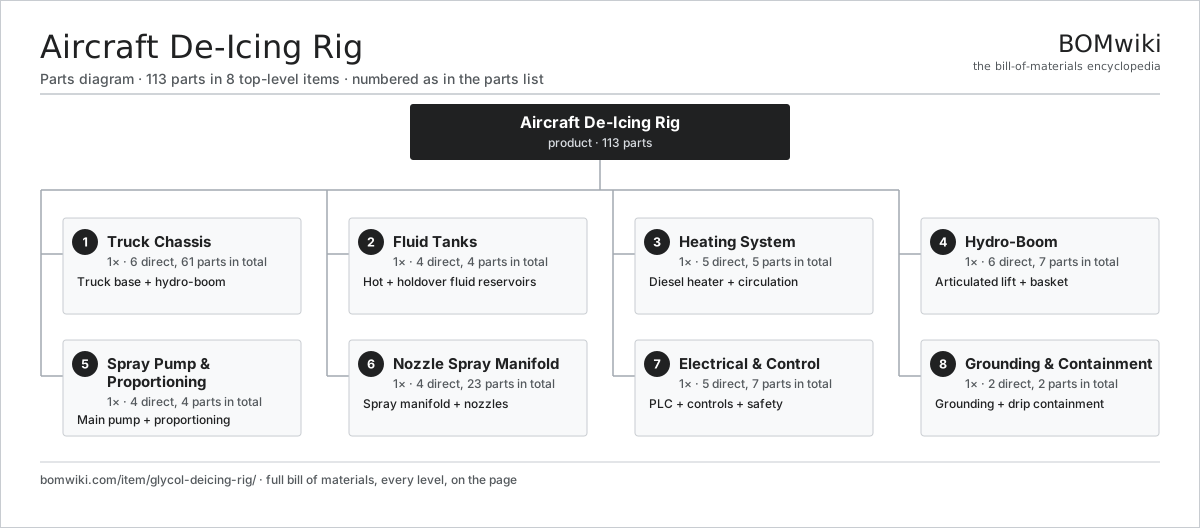
| # | Part | Qty | What it does |
|---|---|---|---|
| 1 | Truck Chassis 6 parts | 1× | Truck base + hydro-boom |
| 2 | Fluid Tanks 4 parts | 1× | Hot + holdover fluid reservoirs |
| 3 | Heating System 5 parts | 1× | Diesel heater + circulation |
| 4 | Hydro-Boom 6 parts | 1× | Articulated lift + basket |
| 5 | Spray Pump & Proportioning 4 parts | 1× | Main pump + proportioning |
| 6 | Nozzle Spray Manifold 4 parts | 1× | Spray manifold + nozzles |
| 7 | Electrical & Control 5 parts | 1× | PLC + controls + safety |
| 8 | Grounding & Containment 2 parts | 1× | Grounding + drip containment |
3D model
No 3D model yet. Have a CAD file of this? Add a 3D model. STL renders right on this page; STEP, FreeCAD, and OpenSCAD sources are welcome too (openly licensed, like all 3D models on BOMwiki).
Build & assembly graph
expand / collapse · shared sub-assemblies converge · links to related products · est. labourTap an assembly to expand/collapse · tap a part to open it · use “Open page” for any node · drag to pan, scroll to zoom.
Bill of materials for Aircraft De-Icing Rig
8 top-level lines · 49 rows shown · 113 parts total · indented to 3 levels| # | Item / sub-assembly | Part no. | Qty/assy | Ext. qty | Parts | Type |
|---|---|---|---|---|---|---|
| 1 | Truck Chassis 6 parts | glycol-deicing-rig-chassis | 1× | 1 | 61 | assembly |
| 1.1 | Truck Frame | glycol-deicing-rig-frame | 1× | 1 | · | part |
| 1.2 | Diesel Engine | glycol-deicing-rig-engine | 1× | 1 | · | part |
| 1.3 | Main Hydraulic Pump | glycol-deicing-rig-hydraulic-pump-main | 1× | 1 | · | part |
| 1.4 | Axle Assembly | glycol-deicing-rig-axles | 3× | 3 | · | part |
| 1.5 | Wheel Assembly 5 parts | wheel-assembly | 6× | 6 | 9 | assembly |
| 1.5.1 | Alloy Wheel | alloy-wheel | 1× | 6 | · | part |
| 1.5.2 | Tire | tire | 1× | 6 | · | part |
| 1.5.3 | TPMS Sensor | tpms-sensor | 1× | 6 | · | part |
| 1.5.4 | Lug Nut | lug-nut | 5× | 30 | · | part |
| 1.5.5 | Valve Stem | valve-stem | 1× | 6 | · | part |
| 1.6 | Suspension System | glycol-deicing-rig-suspension | 1× | 1 | · | part |
| 2 | Fluid Tanks 4 parts | glycol-deicing-rig-tanks | 1× | 1 | 4 | assembly |
| 2.1 | Hot Tank | glycol-deicing-rig-hot-tank | 1× | 1 | · | part |
| 2.2 | Holdover Tank | glycol-deicing-rig-holdover-tank | 1× | 1 | · | part |
| 2.3 | Mixing Chamber | glycol-deicing-rig-mixing-chamber | 1× | 1 | · | part |
| 2.4 | Tank Insulation | glycol-deicing-rig-tank-insulation | 1× | 1 | · | part |
| 3 | Heating System 5 parts | glycol-deicing-rig-heating-system | 1× | 1 | 5 | assembly |
| 3.1 | Diesel Burner | glycol-deicing-rig-heater-burner | 1× | 1 | · | part |
| 3.2 | Heat Exchanger | glycol-deicing-rig-heat-exchanger | 1× | 1 | · | part |
| 3.3 | Circulation Pump | glycol-deicing-rig-circulation-pump | 1× | 1 | · | part |
| 3.4 | Thermostat Valve | glycol-deicing-rig-thermostat-valve | 1× | 1 | · | part |
| 3.5 | Heater Exhaust | glycol-deicing-rig-exhaust-pipe | 1× | 1 | · | part |
| 4 | Hydro-Boom 6 parts | glycol-deicing-rig-boom-assembly | 1× | 1 | 7 | assembly |
| 4.1 | Boom Base | glycol-deicing-rig-boom-base | 1× | 1 | · | part |
| 4.2 | Main Boom | glycol-deicing-rig-boom-main | 1× | 1 | · | part |
| 4.3 | Secondary Boom | glycol-deicing-rig-boom-secondary | 1× | 1 | · | part |
| 4.4 | Boom Cylinder | glycol-deicing-rig-boom-cylinders | 2× | 2 | · | part |
| 4.5 | Operator Basket | glycol-deicing-rig-basket | 1× | 1 | · | part |
| 4.6 | Boom Rotation Drive | glycol-deicing-rig-boom-rotation-drive | 1× | 1 | · | part |
| 5 | Spray Pump & Proportioning 4 parts | glycol-deicing-rig-pump-system | 1× | 1 | 4 | assembly |
| 5.1 | Centrifugal Pump | glycol-deicing-rig-spray-pump | 1× | 1 | · | part |
| 5.2 | Proportioning Valve | glycol-deicing-rig-proportioning-valve | 1× | 1 | · | part |
| 5.3 | Flow Meter | glycol-deicing-rig-flow-meter | 1× | 1 | · | part |
| 5.4 | Pressure Relief Valve | glycol-deicing-rig-pressure-relief | 1× | 1 | · | part |
| 6 | Nozzle Spray Manifold 4 parts | glycol-deicing-rig-nozzle-array | 1× | 1 | 23 | assembly |
| 6.1 | Nozzle Rail | glycol-deicing-rig-nozzle-rail | 1× | 1 | · | part |
| 6.2 | Spray Nozzle | glycol-deicing-rig-nozzle-head | 18× | 18 | · | part |
| 6.3 | Solenoid Valve | glycol-deicing-rig-nozzle-solenoid | 3× | 3 | · | part |
| 6.4 | Supply Hose Assy | glycol-deicing-rig-supply-hose | 1× | 1 | · | part |
| 7 | Electrical & Control 5 parts | glycol-deicing-rig-electrical-system | 1× | 1 | 7 | assembly |
| 7.1 | Battery | glycol-deicing-rig-battery | 2× | 2 | · | part |
| 7.2 | Alternator | glycol-deicing-rig-alternator | 1× | 1 | · | part |
| 7.3 | Control PLC | glycol-deicing-rig-control-plc | 1× | 1 | · | part |
| 7.4 | Control Console | glycol-deicing-rig-console | 1× | 1 | · | part |
| 7.5 | Pressure Sensor | glycol-deicing-rig-pressure-transducers | 2× | 2 | · | part |
| 8 | Grounding & Containment 2 parts | glycol-deicing-rig-ground-connection | 1× | 1 | 2 | assembly |
| 8.1 | Ground Bonding Cable | glycol-deicing-rig-ground-cable | 1× | 1 | · | part |
| 8.2 | Drip Containment Tray | glycol-deicing-rig-drip-tray | 1× | 1 | · | part |
Something wrong in this list? Report a problem with this BOM.
Sourcing: possible vendors
Browse the supplier directory → Prices, MOQ, and lead times are algorithmic estimates, not quotes, and not claims about these companies. Company mappings are curated by keyword; est. price band $30k–$1.5M. How estimates work| Vendor | HQ | Specialty | MOQ | Lead time |
|---|---|---|---|---|
| oshkoshaerotech.com ↗ | Orlando, US | Airport ground support | made to order | 16–30 wks |
| tld-group.com ↗ | Paris, FR | Ground support equipment | made to order | 16–30 wks |
| textrongse.txtsv.com ↗ | Augusta, US | Ground support equipment | made to order | 16–30 wks |
| vestergaardcompany.com ↗ | Skanderborg, DK | De-icers & GSE | made to order | 16–30 wks |
| mallaghangse.com ↗ | Dungannon, GB | Ground support equipment | made to order | 16–30 wks |
1,367-word article