GPS-Disciplined Oscillator
ProductOverview
A GPS-disciplined oscillator (GPSDO) is a precision frequency reference that combines the long-term stability of global navigation satellite signals with the short-term phase stability of a temperature-controlled crystal oscillator. The resulting device produces a 10 MHz output with frequency accuracy better than one part in a billion, sufficient to serve as a traceable reference standard for calibrating laboratory equipment, synchronizing communication networks, and enabling scientific experiments requiring nanosecond-level timing.
The instrument is indispensable in metrology laboratories, telecommunications facilities, observatories, and any application where frequency references must be correlated across distributed sites. A GPS signal available worldwide removes the need for time-synchronization cables between facilities; each GPSDO independently locks to the same satellite constellation, ensuring universal coherence.
Architecture: Oscillator Disciplining
The oven-controlled crystal oscillator (OCXO) generates a 10 MHz signal with inherent stability <1 ppm/day (free-running). This is excellent for a stand-alone oscillator but insufficient for applications requiring parts-per-billion accuracy. The GPS receiver provides a nanosecond-accurate timing reference (1 pulse-per-second, 1 PPS) derived from atomic clocks aboard satellites.
The disciplining servo loop compares the OCXO output (divided to 1 Hz) against the 1 PPS GPS signal. Any phase difference between them is measured by a time-interval counter with nanosecond resolution. The servo processor computes a proportional-integral (PI) control signal that adjusts the OCXO's electrostatic frequency control (EFC) input, pulling the oscillator frequency toward GPS truth.
Over hours, the OCXO locks to the GPS frequency to within <0.1 ppb, combining the rapid response and low jitter of the local oscillator with the long-term stability of the GPS constellation. The result is a frequency reference with nanosecond-scale timing and parts-per-billion frequency accuracy simultaneously.
Time and Frequency Measurement Metrics
Understanding GPSDO specifications requires familiarity with frequency stability metrics:
Frequency Accuracy: The difference between the measured frequency and the true value. A ±10 ppb specification means the 10 MHz output is stable to 10 Hz absolute: 10,000,000 ±10 Hz. For many instruments, this is indistinguishable from truly "perfect" frequency.
Phase Jitter: Short-term variations in the cycle-to-cycle timing of the 10 MHz signal. <50 ps RMS jitter means the 100 ns clock period (at 10 MHz) varies by <0.05% cycle-to-cycle. This is critical for precision time-interval measurements and analog-to-digital converter sampling where timing uncertainty directly limits measurement resolution.
Holdover Stability: After GPS signal loss, the OCXO continues to output stable frequency. Typical specifications allow <100 ppb drift per day, meaning the frequency can drift by up to 1000 Hz over 24 hours without satellite input. Holdover prediction algorithms measure the OCXO's inherent aging rate and apply a correction, extending holdover accuracy to <50 ppb per day.
Allan Deviation (σ(τ)): A statistical measure of frequency stability over different time scales. For a GPSDO:
- At τ = 1 second: <50 ppb (limited by GPS receiver noise and OCXO phase noise)
- At τ = 100 seconds: <10 ppb (servo loop averaging)
- At τ = 1 day: <1 ppb (GPS orbit and atmosphere effects)
GPS Receiver and Satellite Signal
The GPS receiver tracks at least four satellites in view, computing position and precise time from signal transmission times. The 1 PPS output is synchronized to UTC (Coordinated Universal Time) within 100 nanoseconds, far more accurate than any terrestrial frequency reference.
The active antenna includes a low-noise amplifier and high-Q patch radiator tuned to the 1.575 GHz L1 GPS band. An SAW band-pass filter rejects out-of-band interference from cellular (1.8–2.1 GHz) and Wi-Fi (2.4 GHz) signals. External antenna options allow rooftop mounting away from RF interference, critical for locations with poor satellite visibility or high electromagnetic noise.
Cold-start acquisition (from power-on) takes 3–5 minutes as the receiver downloads satellite almanac and ephemeris data. Warm-start (with cached satellite data) takes <1 minute. Continuous operation keeps all data in memory, enabling hot-start in <10 seconds.
Operating Modes and Redundancy
GPS-Disciplined Mode: Servo loop is active, continuously correcting OCXO to match GPS. Output frequency is locked to <1 ppb.
Holdover Mode: GPS signal lost (e.g., antenna cable cut, signal blocked). Servo loop holds last correction; OCXO drifts at inherent rate (<50 ppb/day with prediction). The status LED turns red, alerting operators.
External Reference Mode: The external 10 MHz reference port accepts another frequency reference (e.g., from a neighboring GPSDO or a cesium standard). The servo loop disciplines the OCXO to this external signal, enabling frequency transfer without GPS.
Free-Running Mode: Servo loop is disabled. OCXO runs autonomous, drifting <0.05 ppm/°C (0.5 ppm over 0–50°C). Useful for debugging or temporary operation without satellites.
Phase Coherence and Timing Distribution
Multiple GPSDO units disciplined by GPS achieve phase coherence better than 100 ns across global distances. This enables:
Time Stamping: Events recorded across multiple instruments can be correlated to nanosecond precision by tagging with the local 1 PPS output.
Synchronized Measurement: An oscilloscope and protocol analyzer in different labs, each locked to their GPSDO, measure the same signal with synchronized time bases. Waveforms can be averaged across multiple test runs without timing alignment concerns.
Distributed Atomic Clock Networks: Multiple GPSDOs in a facility provide a unified timing reference that never requires human synchronization or resetting.
Warm-Up and Warm-Start Behavior
The proportional heater maintains the crystal at 60°C ±0.1°C. During power-on (cold start), the oven takes ~30 minutes to reach steady-state temperature, and the OCXO frequency stabilizes to <10 ppb. For laboratory work requiring minimal wait time, many setups leave GPSDOs powered continuously (modern units consume only 40 W and cost <$5/month in electricity).
Successive power cycles achieve warm-start in <5 minutes as the oven rapidly returns to set temperature with cached satellite data.
Typical Applications
Calibration Laboratories: GPSDO is the transfer standard for 10 MHz frequency calibration. Test equipment is periodically connected to the GPSDO output and frequency verified. Most lab frequency counters achieve ±1 ppm accuracy; comparing against a GPSDO (<10 ppb) reveals aging and temperature drift.
Data Centers and Synchronization: Time-stamping servers and packet switches rely on GPSDO for network synchronization. Frequency timing-advance algorithm (FTA) or PTP (precision time protocol) schemes use multiple GPSDOs to discipline clock systems, ensuring sub-microsecond synchronization across a facility.
Radio Transmitter Standards: Broadcast and amateur radio stations use GPSDO to hold transmitted frequency within legal limits (e.g., FM broadcast <2 ppm error). The stable reference prevents drift that would reduce receiver tuning headroom and violate FCC/OFCOM regulations.
Scientific Experiments: Gravitational wave detectors, atomic clocks, and precision spectroscopy rely on frequency references stable to parts per billion or better. GPSDO serves as the primary time base or as a monitor of secondary references.
Limitations and Failure Modes
GPS signal loss due to jamming, spoofing, or antenna obstruction causes the unit to enter holdover mode. Preparation requires either (1) backup antennas with clear sky views, (2) external frequency references, or (3) acceptance of <100 ppb per day drift.
Receiver multipath (GPS signals reflecting off buildings before reaching the antenna) degrades timing accuracy from <50 ns to >500 ns. Clear antenna placement, away from reflective surfaces, is critical.
Very old GPSDOs may exhibit aging of the OCXO quartz resonator (~1 ppm per year), causing the servo loop to reach its tuning limit before full stability. Periodic factory service and crystal replacement restore accuracy.
Electromagnetic interference (EMI) from high-power RF transmitters can corrupt the GPS receiver's low-level satellite signals. Shielded antenna cables and ferrite filtering on power and signal leads mitigate this risk in electrically hostile environments.
Despite these potential challenges, a well-designed GPSDO deployed in a suitable environment provides frequency and timing accuracy rivaling cesium atomic clocks at a fraction of cost and power consumption.
GPS-Disciplined Oscillator parts and their functions
8 top-level parts · 48 parts in total · full bill of materials below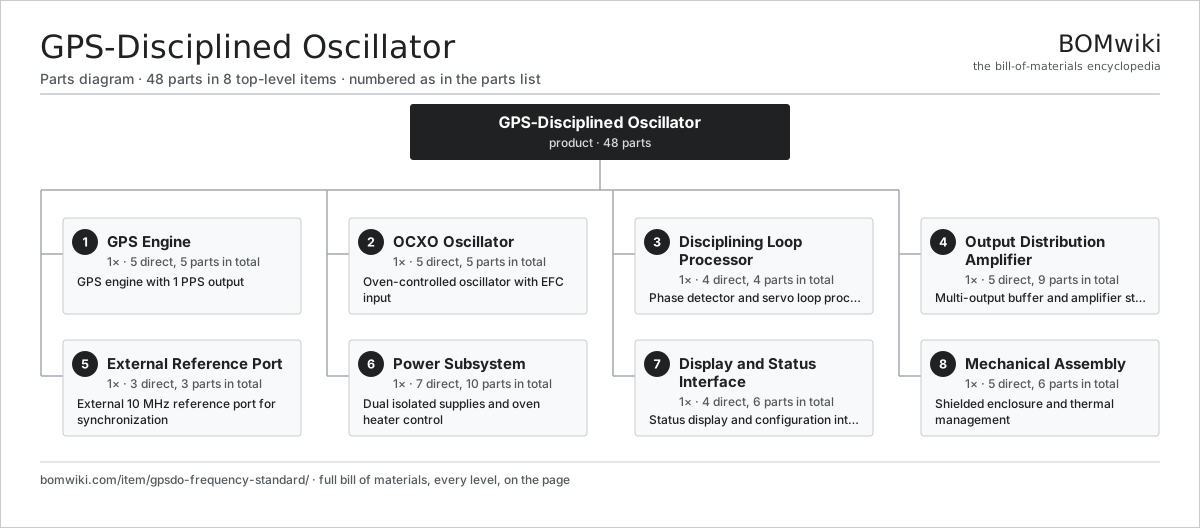
| # | Part | Qty | What it does |
|---|---|---|---|
| 1 | GPS Engine 5 parts | 1× | GPS engine with 1 PPS output |
| 2 | OCXO Oscillator 5 parts | 1× | Oven-controlled oscillator with EFC input |
| 3 | Disciplining Loop Processor 4 parts | 1× | Phase detector and servo loop processor |
| 4 | Output Distribution Amplifier 5 parts | 1× | Multi-output buffer and amplifier stages |
| 5 | External Reference Port 3 parts | 1× | External 10 MHz reference port for synchronization |
| 6 | Power Subsystem 7 parts | 1× | Dual isolated supplies and oven heater control |
| 7 | Display and Status Interface 4 parts | 1× | Status display and configuration interface |
| 8 | Mechanical Assembly 5 parts | 1× | Shielded enclosure and thermal management |
3D model
No 3D model yet. Have a CAD file of this? Add a 3D model. STL renders right on this page; STEP, FreeCAD, and OpenSCAD sources are welcome too (openly licensed, like all 3D models on BOMwiki).
Build & assembly graph
expand / collapse · shared sub-assemblies converge · links to related products · est. labourTap an assembly to expand/collapse · tap a part to open it · use “Open page” for any node · drag to pan, scroll to zoom.
Bill of materials for GPS-Disciplined Oscillator
8 top-level lines · 46 rows shown · 48 parts total · indented to 3 levels| # | Item / sub-assembly | Part no. | Qty/assy | Ext. qty | Parts | Type |
|---|---|---|---|---|---|---|
| 1 | GPS Engine 5 parts | gpsdo-frequency-standard-gps-receiver | 1× | 1 | 5 | assembly |
| 1.1 | GPS Receiver IC | gpsdo-frequency-standard-gps-chip | 1× | 1 | · | part |
| 1.2 | Active GPS Antenna | gpsdo-frequency-standard-antenna | 1× | 1 | · | part |
| 1.3 | SMA Antenna Jack | gpsdo-frequency-standard-antenna-connector | 1× | 1 | · | part |
| 1.4 | SAW Band-Pass Filter | gpsdo-frequency-standard-rf-filter | 1× | 1 | · | part |
| 1.5 | 1 PPS Output Buffer | gpsdo-frequency-standard-pps-output | 1× | 1 | · | part |
| 2 | OCXO Oscillator 5 parts | gpsdo-frequency-standard-ocxo | 1× | 1 | 5 | assembly |
| 2.1 | AT-Cut Crystal | gpsdo-frequency-standard-crystal-resonator | 1× | 1 | · | part |
| 2.2 | Crystal Oven | gpsdo-frequency-standard-crystal-oven | 1× | 1 | · | part |
| 2.3 | EFC Tuning DAC | gpsdo-frequency-standard-efc-dac | 1× | 1 | · | part |
| 2.4 | EFC Varactor Network | gpsdo-frequency-standard-efc-deflection | 1× | 1 | · | part |
| 2.5 | OCXO Output Driver | gpsdo-frequency-standard-output-buffer | 1× | 1 | · | part |
| 3 | Disciplining Loop Processor 4 parts | gpsdo-frequency-standard-disciplining-loop | 1× | 1 | 4 | assembly |
| 3.1 | Time Interval Counter | gpsdo-frequency-standard-phase-detector | 1× | 1 | · | part |
| 3.2 | Disciplining Servo Processor | gpsdo-frequency-standard-servo-processor | 1× | 1 | · | part |
| 3.3 | Calibration EEPROM | gpsdo-frequency-standard-calibration-memory | 1× | 1 | · | part |
| 3.4 | Holdover Algorithm | gpsdo-frequency-standard-holdover-predictor | 1× | 1 | · | part |
| 4 | Output Distribution Amplifier 5 parts | gpsdo-frequency-standard-output-distribution | 1× | 1 | 9 | assembly |
| 4.1 | Programmable Divider | gpsdo-frequency-standard-output-divider | 1× | 1 | · | part |
| 4.2 | 10 MHz Output Amplifier | gpsdo-frequency-standard-output-buffer-10mhz | 2× | 2 | · | part |
| 4.3 | 1 PPS Output Driver | gpsdo-frequency-standard-output-buffer-pps | 1× | 1 | · | part |
| 4.4 | BNC Output Connector | gpsdo-frequency-standard-output-connector-bnc | 4× | 4 | · | part |
| 4.5 | 50Ω Matching Network | gpsdo-frequency-standard-output-impedance | 1× | 1 | · | part |
| 5 | External Reference Port 3 parts | gpsdo-frequency-standard-reference-input | 1× | 1 | 3 | assembly |
| 5.1 | Reference Input BNC | gpsdo-frequency-standard-ref-input-connector | 1× | 1 | · | part |
| 5.2 | Reference Amplifier | gpsdo-frequency-standard-ref-input-amplifier | 1× | 1 | · | part |
| 5.3 | Reference Source Selector | gpsdo-frequency-standard-ref-selection-mux | 1× | 1 | · | part |
| 6 | Power Subsystem 7 parts | gpsdo-frequency-standard-power-supply | 1× | 1 | 10 | assembly |
| 6.1 | Isolation Transformer | gpsdo-frequency-standard-transformer | 1× | 1 | · | part |
| 6.2 | Bridge Rectifier | gpsdo-frequency-standard-rectifier | 2× | 2 | · | part |
| 6.3 | +15V Linear Regulator | gpsdo-frequency-standard-regulator-15v-pos | 1× | 1 | · | part |
| 6.4 | -15V Linear Regulator | gpsdo-frequency-standard-regulator-15v-neg | 1× | 1 | · | part |
| 6.5 | 5V Switching Regulator | gpsdo-frequency-standard-regulator-5v | 1× | 1 | · | part |
| 6.6 | Oven Heater Controller | gpsdo-frequency-standard-oven-heater-driver | 1× | 1 | · | part |
| 6.7 | Bulk Filter Capacitor | gpsdo-frequency-standard-filter-caps | 3× | 3 | · | part |
| 7 | Display and Status Interface 4 parts | gpsdo-frequency-standard-display-control | 1× | 1 | 6 | assembly |
| 7.1 | 2-Line LCD Display | gpsdo-frequency-standard-lcd-2line | 1× | 1 | · | part |
| 7.2 | Mode Selection Button | gpsdo-frequency-standard-button-mode | 3× | 3 | · | part |
| 7.3 | Lock Status LED | gpsdo-frequency-standard-led-lock | 1× | 1 | · | part |
| 7.4 | Display Control Board | gpsdo-frequency-standard-display-board | 1× | 1 | · | part |
| 8 | Mechanical Assembly 5 parts | gpsdo-frequency-standard-housing | 1× | 1 | 6 | assembly |
| 8.1 | Aluminum Rack-Mount Chassis | gpsdo-frequency-standard-chassis | 1× | 1 | · | part |
| 8.2 | Front Panel Bezel | gpsdo-frequency-standard-front-bezel | 1× | 1 | · | part |
| 8.3 | RF Shielding Partition | gpsdo-frequency-standard-internal-shield | 2× | 2 | · | part |
| 8.4 | Thermal Isolation Washer | gpsdo-frequency-standard-thermal-isolation | 1× | 1 | · | part |
| 8.5 | Ventilation Opening | gpsdo-frequency-standard-cooling-vents | 1× | 1 | · | part |
Something wrong in this list? Report a problem with this BOM.
Sourcing: possible vendors
Browse the supplier directory → Prices, MOQ, and lead times are algorithmic estimates, not quotes, and not claims about these companies. Company mappings are curated by keyword; est. price band $1k–$500k. How estimates work| Vendor | HQ | Specialty | MOQ | Lead time |
|---|---|---|---|---|
| thermofisher.com ↗ | Waltham, US | Lab instruments | 100 units | 10–18 wks |
|
🇺🇸Agilent
agilent.com ↗
|
Santa Clara, US | Analytical instruments | 100 units | 10–18 wks |
|
🇺🇸Bruker
bruker.com ↗
|
Billerica, US | Scientific instruments | 100 units | 10–18 wks |
|
🇯🇵Shimadzu
shimadzu.com ↗
|
Kyoto, JP | Analytical instruments | 100 units | 10–18 wks |
|
🇺🇸Waters
waters.com ↗
|
Milford, US | Chromatography & MS | 100 units | 10–18 wks |
1,388-word article