Grain Roller Mill
ProductOverview
A grain roller mill is a mechanical device that cracks malted grain using two or three parallel rollers rotating at different speeds. The mill is essential in brewing and distilling: it breaks the hard grain husk and hull while minimizing flour (fine particles) production, which would otherwise cause stuck sparges in the mash tun. The system consists of a Roller Assembly driven by a Motor and Drive, fed from a Grain Hopper, with a Gap Adjustment system for precise crack size, discharging through a Discharge Chute and optionally a Dust Collection Hood for dust containment.
How it works
Malted grain falls from the Grain Hopper under gravity, controlled by the Hopper Gate. The grain lands on the Drive Roller, which is actively driven by the Motor and Drive (typically at 50–400 RPM, variable via VFD). The Driven Roller sits below or alongside the drive roller, spaced by a precise gap (typically 0.5–2.0 mm) set via the Gap Adjustment screw. Both rollers have Roller Grooves (serrated or embossed patterns) that grip the grain and prevent slipping.
As the grain passes between the rollers, the differential rotation (drive roller faster than driven roller, or the driven roller free-spinning on the grain) creates a shearing action. The hard hull and husk are cracked along their grain boundaries, but the starch remains largely unbroken. The gap setting is critical: too wide and you get large fragments and undercrushed grain; too narrow and you produce fine flour, which causes lauter difficulties.
The cracked grain exits via the Discharge Chute, which slopes at 30–45 degrees, allowing gravity to feed the product into a collection bag or mill outlet. A Collection Valve isolates the chute when not in use.
As grain is milled, fine dust particles (flour) are produced. If equipped, the Dust Collection Hood enclosure surrounds the roller nip and connects via a Dust Inlet Port to a shop vacuum or dust collector. The hood's Internal Baffle redirects airflow, drawing fines into the vacuum and through a Filter Bag.
The Base Frame is a robust steel structure that absorbs the radial forces from the rollers and grain stress. Rubber Feet isolation pads and Leveling Screws dampen vibration and ensure level installation on the brewery floor.
Gap adjustment is performed manually via the Adjustment Screw, a precision micrometer with a 0.5 mm pitch. The Adjustment Handle (typically a wheel or crank) is turned by the operator, and the Gap Indicator dial shows the current gap in millimeters. A Spring Return prevents the secondary roller from drifting downward due to grain load, and a Lock Mechanism (lock nut or pin) locks the setting to prevent accidental change during operation.
Key adjustments and considerations
- Gap setting: Typical brew settings are 0.8–1.2 mm for a coarse crush suitable for mashing. Distilleries may prefer 1.0–1.5 mm for even coarser material.
- Speed: Higher speeds increase throughput but also generate more flour. 150–250 RPM is a good compromise between speed and quality.
- Differential speed: If a belt or gear connects the rollers, the speed ratio can be 1:1 (same speed) to 1:4. A slight differential favors good crack geometry.
- Hopper management: Keeping the hopper filled ensures steady grain feed. A full hopper also provides back-pressure that helps maintain even spacing.
Advantages over hammermills
- Better grain quality: Produces large, consistent fragments and minimal flour.
- Lower energy: Shear-based cracking uses far less power than impact-based crushing.
- Consistent lautering: Large fragments drain cleanly; flour causes stuck sparges and poor efficiency.
- Reusable: The cracked grain can be stored and is not damaged by prolonged holding.
Grain Roller Mill parts and their functions
7 top-level parts · 41 parts in total · full bill of materials below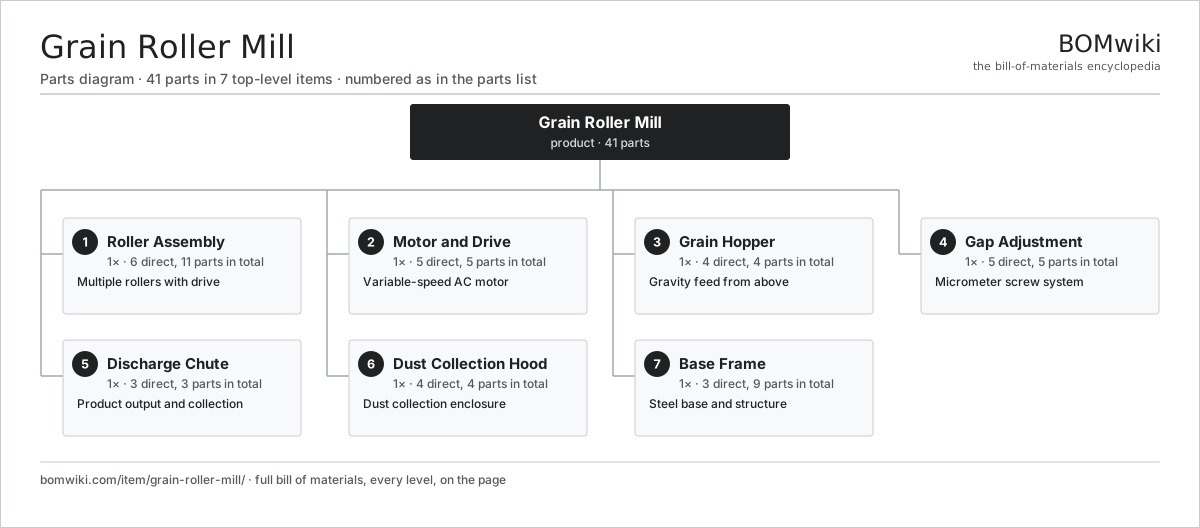
| # | Part | Qty | What it does |
|---|---|---|---|
| 1 | Roller Assembly 6 parts | 1× | Multiple rollers with drive |
| 2 | Motor and Drive 5 parts | 1× | Variable-speed AC motor |
| 3 | Grain Hopper 4 parts | 1× | Gravity feed from above |
| 4 | Gap Adjustment 5 parts | 1× | Micrometer screw system |
| 5 | Discharge Chute 3 parts | 1× | Product output and collection |
| 6 | Dust Collection Hood 4 parts | 1× | Dust collection enclosure |
| 7 | Base Frame 3 parts | 1× | Steel base and structure |
3D model
No 3D model yet. Have a CAD file of this? Add a 3D model. STL renders right on this page; STEP, FreeCAD, and OpenSCAD sources are welcome too (openly licensed, like all 3D models on BOMwiki).
Build & assembly graph
expand / collapse · shared sub-assemblies converge · links to related products · est. labourTap an assembly to expand/collapse · tap a part to open it · use “Open page” for any node · drag to pan, scroll to zoom.
Bill of materials for Grain Roller Mill
7 top-level lines · 37 rows shown · 41 parts total · indented to 3 levels| # | Item / sub-assembly | Part no. | Qty/assy | Ext. qty | Parts | Type |
|---|---|---|---|---|---|---|
| 1 | Roller Assembly 6 parts | grain-roller-mill-roller-assembly | 1× | 1 | 11 | assembly |
| 1.1 | Drive Roller | grain-roller-mill-drive-roller | 1× | 1 | · | part |
| 1.2 | Driven Roller | grain-roller-mill-driven-roller | 1× | 1 | · | part |
| 1.3 | Bearing Housing | grain-roller-mill-roller-bearing-housing | 4× | 4 | · | part |
| 1.4 | Roller Shaft | grain-roller-mill-roller-shaft | 2× | 2 | · | part |
| 1.5 | Roller Grooves | grain-roller-mill-roller-surface-grooves | 2× | 2 | · | part |
| 1.6 | Gap Sensor | grain-roller-mill-roller-gaps-sensor | 1× | 1 | · | part |
| 2 | Motor and Drive 5 parts | grain-roller-mill-motor | 1× | 1 | 5 | assembly |
| 2.1 | Motor Body | grain-roller-mill-motor-body | 1× | 1 | · | part |
| 2.2 | VFD | grain-roller-mill-vfd-drive | 1× | 1 | · | part |
| 2.3 | Coupling | grain-roller-mill-coupling | 1× | 1 | · | part |
| 2.4 | Drive Belt | grain-roller-mill-drive-belt | 1× | 1 | · | part |
| 2.5 | Tension Idler | grain-roller-mill-belt-tension-roller | 1× | 1 | · | part |
| 3 | Grain Hopper 4 parts | grain-roller-mill-hopper | 1× | 1 | 4 | assembly |
| 3.1 | Hopper Body | grain-roller-mill-hopper-body | 1× | 1 | · | part |
| 3.2 | Hopper Volume | grain-roller-mill-hopper-volume | 1× | 1 | · | part |
| 3.3 | Hopper Gate | grain-roller-mill-hopper-gate | 1× | 1 | · | part |
| 3.4 | Vibrator Assist | grain-roller-mill-hopper-vibrator | 1× | 1 | · | part |
| 4 | Gap Adjustment 5 parts | grain-roller-mill-gap-adjustment | 1× | 1 | 5 | assembly |
| 4.1 | Adjustment Screw | grain-roller-mill-adjustment-screw | 1× | 1 | · | part |
| 4.2 | Adjustment Handle | grain-roller-mill-adjustment-handle | 1× | 1 | · | part |
| 4.3 | Gap Indicator | grain-roller-mill-adjustment-indicator | 1× | 1 | · | part |
| 4.4 | Spring Return | grain-roller-mill-spring-return | 1× | 1 | · | part |
| 4.5 | Lock Mechanism | grain-roller-mill-lock-mechanism | 1× | 1 | · | part |
| 5 | Discharge Chute 3 parts | grain-roller-mill-discharge-chute | 1× | 1 | 3 | assembly |
| 5.1 | Chute Body | grain-roller-mill-chute-body | 1× | 1 | · | part |
| 5.2 | Chute Angle | grain-roller-mill-chute-angle | 1× | 1 | · | part |
| 5.3 | Collection Valve | grain-roller-mill-chute-collection-valve | 1× | 1 | · | part |
| 6 | Dust Collection Hood 4 parts | grain-roller-mill-dust-hood | 1× | 1 | 4 | assembly |
| 6.1 | Hood Cover | grain-roller-mill-dust-hood-cover | 1× | 1 | · | part |
| 6.2 | Dust Inlet Port | grain-roller-mill-dust-inlet-port | 1× | 1 | · | part |
| 6.3 | Internal Baffle | grain-roller-mill-dust-baffle | 1× | 1 | · | part |
| 6.4 | Filter Bag | grain-roller-mill-dust-filter-bag | 1× | 1 | · | part |
| 7 | Base Frame 3 parts | grain-roller-mill-frame | 1× | 1 | 9 | assembly |
| 7.1 | Frame Beam | grain-roller-mill-frame-beam | 1× | 1 | · | part |
| 7.2 | Rubber Feet | grain-roller-mill-feet-rubber | 4× | 4 | · | part |
| 7.3 | Leveling Screw | grain-roller-mill-leveling-screw | 4× | 4 | · | part |
Something wrong in this list? Report a problem with this BOM.
Sourcing: possible vendors
Browse the supplier directory → Prices, MOQ, and lead times are algorithmic estimates, not quotes, and not claims about these companies. Company mappings are curated by keyword; est. price band $1k–$500k. How estimates work| Vendor | HQ | Specialty | MOQ | Lead time |
|---|---|---|---|---|
| gea.com ↗ | Düsseldorf, DE | Process technology | 20 units | 12–20 wks |
| buhlergroup.com ↗ | Uzwil, CH | Food & materials processing | 20 units | 12–20 wks |
| tetrapak.com ↗ | Pully, CH | Food packaging & processing | 20 units | 12–20 wks |
| jbtc.com ↗ | Chicago, US | Food processing equipment | 20 units | 12–20 wks |
| alfalaval.com ↗ | Lund, SE | Heat transfer & separation | 20 units | 12–20 wks |
685-word article