Greenhouse Exhaust Fan
ProductOverview
A greenhouse traps solar radiation by design, and on a clear day interior temperature can climb 15–20 K above ambient within an hour of the sun breaking through. The exhaust fan is the active half of the standard ventilation answer: mounted in one gable wall, it pushes air out, and the resulting slight vacuum draws fresh air in through motorised or gravity intake louvres in the opposite wall. One complete air exchange per minute is the usual sizing rule for summer cooling, so a 200 m³ hobby greenhouse needs roughly the 21,000 m³/h this 90 cm fan delivers.
The machine itself is simple and long-established: a six-blade Propeller Assembly in a Fan Housing with a venturi orifice, driven by an induction Drive Motor through a Belt Drive, cycled by a Thermostat, with a Backdraft Shutter sealing the opening whenever the fan rests.
How it works
The propeller is an axial fan optimised for high volume at low static pressure, a greenhouse presents only the 10–30 Pa drop of its intake louvres, nothing like the duct resistance a centrifugal blower is built for. Six stamped aluminium Fan Blades are clamped at fixed pitch in a cast Blade Hub, balanced as an assembly, and locked to the shaft by a Taper Bushing.
Blade-tip clearance dominates propeller efficiency, which is why the housing's Venturi Ring matters: the spun inlet ring closes the gap between blade tips and orifice to about 1% of diameter. Without it, high-pressure air from the blade face simply leaks back around the tips, costing 5–10% of flow.
The Belt Drive exists because large propellers want to turn slowly. A 90 cm blade at the motor's 1,425 rpm would have supersonic-adjacent tip noise and absurd power draw; flow scales linearly with rpm but power with rpm cubed, so the 2.5:1 reduction through the Motor Pulley and heavy Driven Pulley gets the propeller to an efficient, quiet 580 rpm. The propeller shaft rides in two greasable Bearing Blocks on the Cross Frame, and the Belt Tensioner base takes up belt stretch, the Drive Belt is the principal service item, typically replaced every one to two seasons.
The motor is a permanent-split-capacitor single-phase induction machine: a Run Capacitor phase-shifts current in the auxiliary winding of the Stator Assembly to create the rotating field that drags the squirrel-cage Rotor Assembly around. The TEAO (totally enclosed, air-over) Motor Housing is specified because greenhouse air is the worst small-motor environment short of a washdown plant: near 100% humidity, condensation cycles and sulphur sprays. Sealed Ball Bearings and a Thermal Fuse in the winding finish the protection.
Shutter and controls
The Backdraft Shutter is a one-way air valve with no actuator. When the fan starts, about 25 Pa of pressure swings the five light Shutter Vanes open against gravity; when it stops, they fall closed onto their Felt Seals. The Tie Bar forces all vanes to move together, preventing the flutter that would otherwise hammer the Pivot Bushings. A closed shutter matters most in winter: an unsealed 1 m² wall opening would dump heat all night, so vane fit and felt condition directly affect the heating bill.
Control is a bang-bang loop. The capillary-bulb Thermostat hangs at crop height, not at the gable, where stratified hot air would read several degrees high, and switches the motor through a Relay contactor in the sealed Junction Box. Its ~1.5 K differential sets the cycling rate; tighter control wastes motor starts, looser control stresses the crop. The Speed Switch reconnects the two-speed winding for mild days when full flow would overcool, and in larger houses several fans are staged at successive set-points instead.
Sizing and practice
Greenhouse fan ratings follow AMCA-standardised airflow tests, quoted at free air and at 25 Pa static; the 25 Pa figure is the honest one since intake louvres always impose back-pressure. Installers size intakes at 1.25–1.5 times the fan opening area so the limiting orifice is never the inlet. In summer the same fan drives evaporative pad cooling, outside air pulled through wet cellulose pads on the intake wall drops several kelvin below ambient before crossing the crop. Routine maintenance is short: grease the bearing blocks each season, re-tension or replace the belt, wash dust off the blades (a dirty propeller loses measurable flow), and check the shutter falls fully closed.
Greenhouse Exhaust Fan parts and their functions
6 top-level parts · 70 parts in total · full bill of materials below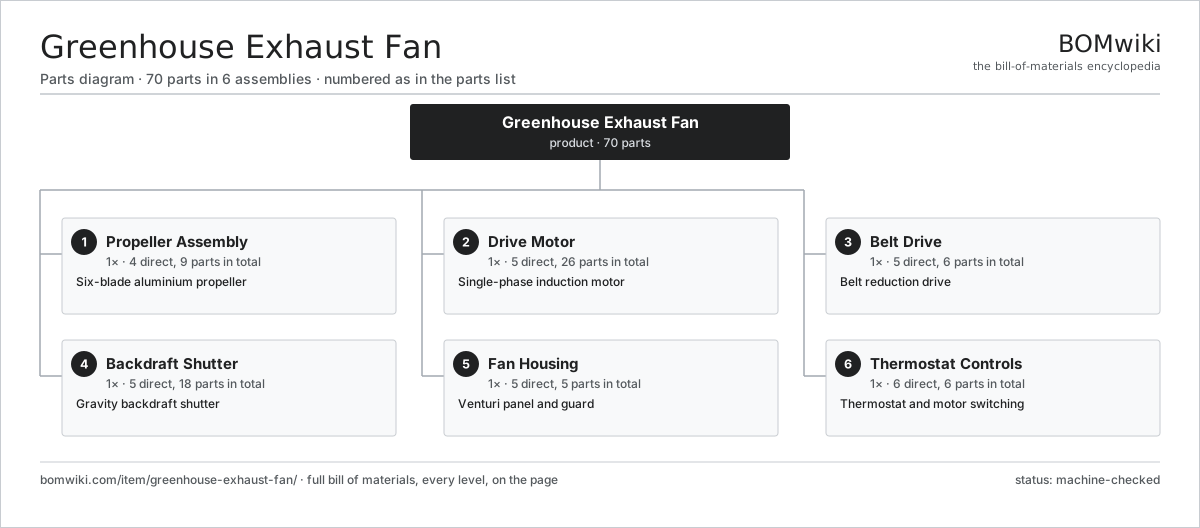
| # | Part | Qty | What it does |
|---|---|---|---|
| 1 | Propeller Assembly 4 parts | 1× | Six-blade aluminium propeller |
| 2 | Drive Motor 5 parts | 1× | Single-phase induction motor |
| 3 | Belt Drive 5 parts | 1× | Belt reduction drive |
| 4 | Backdraft Shutter 5 parts | 1× | Gravity backdraft shutter |
| 5 | Fan Housing 5 parts | 1× | Venturi panel and guard |
| 6 | Thermostat Controls 6 parts | 1× | Thermostat and motor switching |
3D model
No 3D model yet. Have a CAD file of this? Add a 3D model — STL renders right on this page; STEP, FreeCAD, and OpenSCAD sources are welcome too (openly licensed, like all 3D models on BOMwiki).
Build & assembly graph
expand / collapse · shared sub-assemblies converge · links to related products · est. labourTap an assembly to expand/collapse · tap a part to open it · use “Open page” for any node · drag to pan, scroll to zoom.
Bill of materials for Greenhouse Exhaust Fan
6 top-level lines · 43 rows shown · 70 parts total · indented to 3 levels| # | Item / sub-assembly | Part no. | Qty/assy | Ext. qty | Parts | Type |
|---|---|---|---|---|---|---|
| 1 | Propeller Assembly 4 parts | greenhouse-exhaust-fan-prop | 1× | 1 | 9 | assembly |
| 1.1 | Fan Blade | greenhouse-exhaust-fan-blade | 6× | 6 | · | part |
| 1.2 | Blade Hub | greenhouse-exhaust-fan-hub | 1× | 1 | · | part |
| 1.3 | Taper Bushing | greenhouse-exhaust-fan-taper-bushing | 1× | 1 | · | part |
| 1.4 | Fastener Set | fastener-set | 1× | 1 | · | part |
| 2 | Drive Motor 5 parts | greenhouse-exhaust-fan-motor | 1× | 1 | 26 | assembly |
| 2.1 | Stator Assembly 3 parts | stator-assembly | 1× | 1 | 3 | assembly |
| 2.1.1 | Stator Core (laminations) | stator-core | 1× | 1 | · | part |
| 2.1.2 | Copper Winding | copper-winding | 1× | 1 | · | part |
| 2.1.3 | Slot Insulation | stator-insulation | 1× | 1 | · | part |
| 2.2 | Rotor Assembly 4 parts | rotor-assembly | 1× | 1 | 19 | assembly |
| 2.2.1 | Rotor Shaft | rotor-shaft | 1× | 1 | · | part |
| 2.2.2 | Rotor Core | rotor-core | 1× | 1 | · | part |
| 2.2.3 | Neodymium Magnet | neodymium-magnet | 16× | 16 | · | part |
| 2.2.4 | Ball Bearing | ball-bearing | 1× | 1 | · | part |
| 2.3 | Ball Bearing | ball-bearing | 2× | 2 | · | part |
| 2.4 | Motor Housing | motor-housing | 1× | 1 | · | part |
| 2.5 | Run Capacitor | greenhouse-exhaust-fan-run-capacitor | 1× | 1 | · | part |
| 3 | Belt Drive 5 parts | greenhouse-exhaust-fan-belt-drive | 1× | 1 | 6 | assembly |
| 3.1 | Drive Belt | drive-belt | 1× | 1 | · | part |
| 3.2 | Motor Pulley | greenhouse-exhaust-fan-motor-pulley | 1× | 1 | · | part |
| 3.3 | Driven Pulley | greenhouse-exhaust-fan-driven-pulley | 1× | 1 | · | part |
| 3.4 | Bearing Block | greenhouse-exhaust-fan-bearing-block | 2× | 2 | · | part |
| 3.5 | Belt Tensioner | greenhouse-exhaust-fan-tensioner | 1× | 1 | · | part |
| 4 | Backdraft Shutter 5 parts | greenhouse-exhaust-fan-shutter | 1× | 1 | 18 | assembly |
| 4.1 | Shutter Frame | greenhouse-exhaust-fan-shutter-frame | 1× | 1 | · | part |
| 4.2 | Shutter Vane | greenhouse-exhaust-fan-shutter-vane | 5× | 5 | · | part |
| 4.3 | Tie Bar | greenhouse-exhaust-fan-tie-bar | 1× | 1 | · | part |
| 4.4 | Pivot Bushing | greenhouse-exhaust-fan-pivot-bushing | 10× | 10 | · | part |
| 4.5 | Felt Seal | greenhouse-exhaust-fan-felt-seal | 1× | 1 | · | part |
| 5 | Fan Housing 5 parts | greenhouse-exhaust-fan-housing | 1× | 1 | 5 | assembly |
| 5.1 | Venturi Ring | greenhouse-exhaust-fan-venturi | 1× | 1 | · | part |
| 5.2 | Sheet Metal Panel | sheet-panel | 1× | 1 | · | part |
| 5.3 | Intake Guard | greenhouse-exhaust-fan-guard | 1× | 1 | · | part |
| 5.4 | Cross Frame | greenhouse-exhaust-fan-cross-frame | 1× | 1 | · | part |
| 5.5 | Fastener Set | fastener-set | 1× | 1 | · | part |
| 6 | Thermostat Controls 6 parts | greenhouse-exhaust-fan-controls | 1× | 1 | 6 | assembly |
| 6.1 | Thermostat | greenhouse-exhaust-fan-thermostat | 1× | 1 | · | part |
| 6.2 | Relay | relay | 1× | 1 | · | part |
| 6.3 | Speed Switch | greenhouse-exhaust-fan-speed-switch | 1× | 1 | · | part |
| 6.4 | Thermal Fuse | thermal-fuse | 1× | 1 | · | part |
| 6.5 | Junction Box | greenhouse-exhaust-fan-junction-box | 1× | 1 | · | part |
| 6.6 | Wire Bundle | wire-bundle | 1× | 1 | · | part |
Related products
same domain, ranked by shared parts Hedge Trimmer
68 parts · shares 10 with this page
Hedge Trimmer
68 parts · shares 10 with this page
 Leaf Blower
68 parts · shares 10 with this page
Leaf Blower
68 parts · shares 10 with this page
 Pole Saw
60 parts · shares 10 with this page
Pole Saw
60 parts · shares 10 with this page
 Snow Blower
111 parts · shares 10 with this page
Snow Blower
111 parts · shares 10 with this page
 Robotic Lawn Mower
136 parts · shares 9 with this page
Robotic Lawn Mower
136 parts · shares 9 with this page
Sourcing: possible vendors
Prices, MOQ, and lead times are algorithmic estimates, not quotes, and not claims about these companies. Company mappings are curated by keyword; est. price band $80–$5k. How estimates work| Vendor | HQ | Specialty | MOQ | Lead time |
|---|---|---|---|---|
| husqvarna.com ↗ | Stockholm, SE | Outdoor power products | 500 units | 8–14 wks |
|
🇩🇪STIHL
stihl.com ↗
|
Waiblingen, DE | Chainsaws & outdoor power | 500 units | 8–14 wks |
|
🇺🇸Toro
thetorocompany.com ↗
|
Bloomington, US | Turf & outdoor equipment | 500 units | 8–14 wks |
| powerequipment.honda.com ↗ | Tokyo, JP | Engines & outdoor power | 500 units | 8–14 wks |
|
🇨🇳Chervon
chervongroup.com ↗
|
Nanjing, CN | Power tools (EGO, SKIL) | 500 units | 8–14 wks |
824-word article