Ground Freezing Plant
ProductOverview
A ground freezing plant is a refrigeration system that circulates sub-zero brine (or liquid nitrogen) through boreholes to solidify soil in place temporarily. Ground freezing is used to stabilize weak or water-bearing strata during excavation, prevent inflow into open cuts, and maintain walls of shafts. Traditional dewatering (pumping) can cause massive settlement; freezing instead stabilizes the water table in place without drainage, making it invaluable for construction under critical infrastructure (highways, railways, basements of historic buildings).
The technique is expensive, $5–$20 per m³ of frozen zone, but indispensable when ground is saturated silt or sand with low mechanical strength and high permeability.
Refrigeration Cycle
The plant operates a standard vapor-compression refrigeration loop:
- Refrigeration Compressor pressurizes low-pressure refrigerant vapor (typically R-404A or R-507, safety-approved for unattended underground use) to 15–25 bar absolute
- Refrigerant Condenser rejects heat to ambient air (or groundwater if available) and condenses refrigerant to liquid at 35–45°C
- Refrigerant Expansion Device reduces pressure through a thermostatic valve, flash-evaporates some liquid, and allows remaining liquid to expand into the Refrigerant Evaporator
- Refrigerant Evaporator is a plate heat exchanger where brine circulates on the secondary side; refrigerant evaporates on the primary side, cooling brine from +5°C inlet to −15 to −25°C outlet
The cooled brine is pumped via Brine Circulation Pump into downhole Freeze Pipe Sections and returns at elevated temperature (warmed by ground heat absorption). The closed loop repeats continuously, maintaining steady-state cooling.
Brine Composition and Properties
Two brine types are used:
| Type | Temperature | Density | Cost | Applications |
|---|---|---|---|---|
| Calcium chloride (CaCl₂) | −8 to −15°C | 1.2 SG | Low | Shallow, moderate freezing; poor performance below −15°C |
| Ethylene glycol (50:50 with water) | −15 to −25°C | 1.05 SG | High | Deep or rapid freezing; environmental concern if spilled |
Selection depends on required freezing temperature, which is determined by soil strength gain desired. Silt at −20°C has compressive strength of 2–4 MPa; at −30°C, 5–10 MPa. Deeper freezing (lower temperature) requires longer freeze times (30–60 days vs. 10–20 days).
Freeze Pipe Installation and Spacing
Freeze Pipe Sections (typically 12–25 mm OD steel) are installed in boreholes drilled to depth. Pipe spacing ranges from 0.5–3 m depending on required freeze zone thickness and ground type:
- 1–2 m spacing in silt or sand: freezes 1.5–2 m perpendicular radius per pipe
- 2–4 m spacing in clay: slower freezing but same final strength
- 0.5–1 m spacing in highly permeable sand or water-bearing strata: rapid heat load
The freeze zone grows radially as brine circulates. In silt, a pipe at −20°C freezes to 1.5 m radius in 20–30 days; in sand with high water flow, only 1 m radius in the same time.
Overlapping freeze zones create uniform frozen monolith. Spacing is confirmed via Ground Temperature Probe probes installed in intermediate boreholes; once all probes reach target temperature (e.g., −5°C), the excavation zone is safe.
Freeze Process Monitoring
The Main Control PLC/Microcontroller continuously monitors:
- Supply brine temperature Brine Temperature Display Thermometer: −15 to −25°C setpoint; controlled via Refrigerant Expansion Device valve adjustment
- Ground temperature Ground Temperature Probe: thermistor probes installed at multiple radius distances from active freeze pipes; data logged to Temperature Data Logger
- Return brine temperature: should be 5–10°C warmer than supply (indicates heat pickup rate)
Freezing is complete when monitoring points reach steady-state, typically −3 to −5°C or lower, depending on design target.
System Components and Efficiency
The Refrigeration Chiller Unit is a packaged system (truck- or skid-mounted) containing:
- Compressor: screw or reciprocating, driven by Pump Drive Motor (electric or diesel)
- Condenser: air-cooled (standard) or water-cooled (if adequate water available; more efficient)
- Evaporator: plate-frame heat exchanger; capacity 300–2000 kW refrigeration
- Receiver tank Liquid Refrigerant Receiver: stores liquid refrigerant and separates vapor/liquid at system outlet
The Brine Circulation Pump circulates 100–500 l/min depending on number of active freeze pipes and heat load. Pump discharge pressure is 5–10 bar (low pressure due to downhole pipe friction).
System COP (coefficient of performance, refrigeration ton per kW input) is typically 1.5–2.5 depending on compressor efficiency and temperature lift (warmer ambient = higher COP).
Freeze Wall Quality and Limitations
Strengths:
- Stabilizes unstable strata (loose sand, silt, soft clay) to temporary 5+ MPa strength
- Stops water inflow (ice seal)
- Allows removal of weak strata by excavation
Limitations:
- High cost: $10–$20 per m³ frozen (vs. <$1 for conventional dewatering)
- Slow: requires 10–30 days freeze time before excavation
- Limited depth: beyond 50–100 m, heat load becomes excessive and freeze time prohibitive
- Environmental concern: ethylene glycol spill is reportable; calcium chloride is less hazardous but corrosive
- Temporary nature: freeze wall thaws in weeks once refrigeration stops; excavation must be rapid
Typical Application Sequence
Shaft sinking through saturated silt at 15 m depth:
- Design (weeks 1–2): determine required frozen wall thickness (2–3 m), freeze pipe spacing (1–1.5 m), and temperature (−20°C for 3–5 MPa strength)
- Drilling (weeks 3–4): drill 40–50 boreholes, 20 m depth; install freeze pipes and monitoring thermistor holes
- Freezing (weeks 5–8): connect chiller; circulation begins; monitor temperatures daily
- Verification (week 8–9): all monitoring points achieve −5°C or lower; ground strength test (test pit excavation with probe penetration)
- Excavation (weeks 9–12): shaft sinking; frozen wall prevents collapse and inflow
- Thaw (after excavation): turn off chiller; ground returns to ambient temperature in 2–4 weeks
Total cost: $20k–$100k depending on shaft size and depth.
Maintenance and Operational Concerns
Compressor:
- Oil analysis every 500 operating hours; oil change annually
- Bearing replacement every 10,000–20,000 hours
- Efficiency degradation (lower COP) signals wear; rebuild or replacement typical at 30,000–40,000 hours
Brine Circulation:
- Contamination from pipe corrosion (dissolved iron) reduces thermal performance
- Strainer System Inlet Strainer inspected and cleaned weekly
- Brine replacement every 5–10 years or if contamination exceeds 500 ppm
Expansion Device:
- Thermostatic valve hunting (oscillation) causes temperature swings >±2°C; superheat adjustment or replacement required
- Electronic expansion valve (EEV) offers better control but adds cost and complexity
Freeze Pipe Blockages:
- Ice formation inside downhole pipe if return temperature drops below 0°C; prevented by return-side heating or insulation
- Scale buildup from high-hardness brine; flushing with hot water (40–50°C) required periodically
Plant Noise and Vibration:
- Compressor noise 75–85 dB(A); requires muffler and vibration isolation for nearby residences
- Routine balancing and bearing inspection minimize vibration transmission to surface''
Emerging Technology
Modern systems employ:
- Indirect cooling: secondary loop with low-GWP refrigerant (HFO-based) reduces environmental impact
- Ammonia systems: higher efficiency but require stricter safety compliance; used in large municipal projects
- Hybrid dewatering: combine localized ground freezing with dewatering to reduce cost and speed timeline
Ground Freezing Plant parts and their functions
6 top-level parts · 34 parts in total · full bill of materials below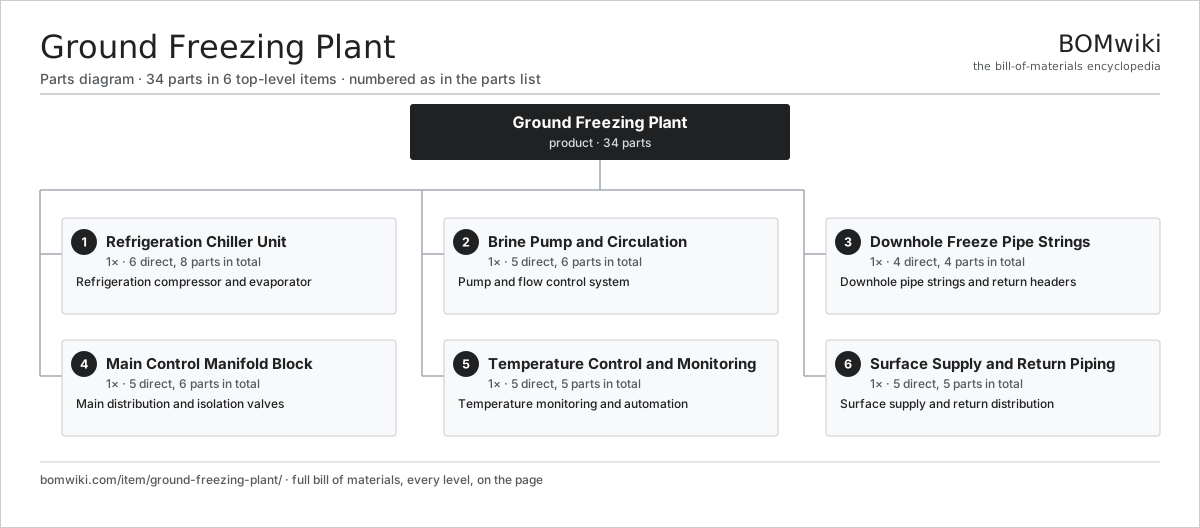
| # | Part | Qty | What it does |
|---|---|---|---|
| 1 | Refrigeration Chiller Unit 6 parts | 1× | Refrigeration compressor and evaporator |
| 2 | Brine Pump and Circulation 5 parts | 1× | Pump and flow control system |
| 3 | Downhole Freeze Pipe Strings 4 parts | 1× | Downhole pipe strings and return headers |
| 4 | Main Control Manifold Block 5 parts | 1× | Main distribution and isolation valves |
| 5 | Temperature Control and Monitoring 5 parts | 1× | Temperature monitoring and automation |
| 6 | Surface Supply and Return Piping 5 parts | 1× | Surface supply and return distribution |
3D model
No 3D model yet. Have a CAD file of this? Add a 3D model. STL renders right on this page; STEP, FreeCAD, and OpenSCAD sources are welcome too (openly licensed, like all 3D models on BOMwiki).
Build & assembly graph
expand / collapse · shared sub-assemblies converge · links to related products · est. labourTap an assembly to expand/collapse · tap a part to open it · use “Open page” for any node · drag to pan, scroll to zoom.
Bill of materials for Ground Freezing Plant
6 top-level lines · 36 rows shown · 34 parts total · indented to 3 levels| # | Item / sub-assembly | Part no. | Qty/assy | Ext. qty | Parts | Type |
|---|---|---|---|---|---|---|
| 1 | Refrigeration Chiller Unit 6 parts | ground-freezing-plant-chiller-unit | 1× | 1 | 8 | assembly |
| 1.1 | Refrigeration Compressor | ground-freezing-plant-compressor | 1× | 1 | · | part |
| 1.2 | Refrigerant Condenser | ground-freezing-plant-condenser | 1× | 1 | · | part |
| 1.3 | Refrigerant Evaporator | ground-freezing-plant-evaporator | 1× | 1 | · | part |
| 1.4 | Refrigerant Expansion Device | ground-freezing-plant-expansion-device | 1× | 1 | · | part |
| 1.5 | Liquid Refrigerant Receiver | ground-freezing-plant-receiver-tank | 1× | 1 | · | part |
| 1.6 | Pressure Sensor | pressure-sensor | 3× | 3 | · | part |
| 2 | Brine Pump and Circulation 5 parts | ground-freezing-plant-brine-circulation | 1× | 1 | 6 | assembly |
| 2.1 | Brine Circulation Pump | ground-freezing-plant-brine-pump | 1× | 1 | · | part |
| 2.2 | Pump Drive Motor | ground-freezing-plant-pump-motor | 1× | 1 | · | part |
| 2.3 | Pump Discharge Header | ground-freezing-plant-pump-discharge-header | 1× | 1 | · | part |
| 2.4 | Brine Flow Rate Meter | ground-freezing-plant-flow-meter | 1× | 1 | · | part |
| 2.5 | Pressure Sensor | pressure-sensor | 2× | 2 | · | part |
| 3 | Downhole Freeze Pipe Strings 4 parts | ground-freezing-plant-freeze-piping | 1× | 1 | 4 | assembly |
| 3.1 | Freeze Pipe Sections | ground-freezing-plant-freeze-pipes | 1× | 1 | · | part |
| 3.2 | Insulated Return Pipes | ground-freezing-plant-insulated-return | 1× | 1 | · | part |
| 3.3 | Downhole Header Assembly | ground-freezing-plant-pipe-headers | 1× | 1 | · | part |
| 3.4 | Check Valve Assembly | ground-freezing-plant-check-valve | 1× | 1 | · | part |
| 4 | Main Control Manifold Block 5 parts | ground-freezing-plant-manifold-block | 1× | 1 | 6 | assembly |
| 4.1 | Main Isolation Ball Valve | ground-freezing-plant-isolation-valve | 1× | 1 | · | part |
| 4.2 | Three-Way Diverter Valve | ground-freezing-plant-diverter-valve | 1× | 1 | · | part |
| 4.3 | System Pressure Relief Valve | ground-freezing-plant-pressure-relief | 1× | 1 | · | part |
| 4.4 | System Flush and Drain Valve | ground-freezing-plant-flush-valve | 1× | 1 | · | part |
| 4.5 | Pressure Sensor | pressure-sensor | 2× | 2 | · | part |
| 5 | Temperature Control and Monitoring 5 parts | ground-freezing-plant-control-system | 1× | 1 | 5 | assembly |
| 5.1 | Main Control PLC/Microcontroller | ground-freezing-plant-control-unit | 1× | 1 | · | part |
| 5.2 | Ground Temperature Probe | ground-freezing-plant-temperature-sensor | 1× | 1 | · | part |
| 5.3 | Brine Temperature Display Thermometer | ground-freezing-plant-brine-thermometer | 1× | 1 | · | part |
| 5.4 | Temperature Data Logger | ground-freezing-plant-data-logger | 1× | 1 | · | part |
| 5.5 | Operator Status Display Panel | ground-freezing-plant-display-panel | 1× | 1 | · | part |
| 6 | Surface Supply and Return Piping 5 parts | ground-freezing-plant-piping-package | 1× | 1 | 5 | assembly |
| 6.1 | Insulated Supply Piping | ground-freezing-plant-supply-pipe | 1× | 1 | · | part |
| 6.2 | Return Flow Piping | ground-freezing-plant-return-pipe | 1× | 1 | · | part |
| 6.3 | Pipe Insulation Jacket | ground-freezing-plant-insulation-jacket | 1× | 1 | · | part |
| 6.4 | System Inlet Strainer | ground-freezing-plant-strainer | 1× | 1 | · | part |
| 6.5 | Pressure Sensor | pressure-sensor | 1× | 1 | · | part |
Something wrong in this list? Report a problem with this BOM.
Related products
same domain, ranked by shared parts All-Terrain Mobile Crane
594 parts · shares 1 with this page
All-Terrain Mobile Crane
594 parts · shares 1 with this page
 Articulated Dump Truck
128 parts · shares 1 with this page
Articulated Dump Truck
128 parts · shares 1 with this page
 Articulated Haul Truck
128 parts · shares 1 with this page
Articulated Haul Truck
128 parts · shares 1 with this page
 Articulating Boom Lift
120 parts · shares 1 with this page
Articulating Boom Lift
120 parts · shares 1 with this page
 Asphalt Batch Plant
160 parts · shares 1 with this page
Asphalt Batch Plant
160 parts · shares 1 with this page
 Asphalt Distributor Truck
113 parts · shares 1 with this page
Asphalt Distributor Truck
113 parts · shares 1 with this page
Sourcing: possible vendors
Browse the supplier directory → Prices, MOQ, and lead times are algorithmic estimates, not quotes, and not claims about these companies. Company mappings are curated by keyword; est. price band $15k–$2M. How estimates work| Vendor | HQ | Specialty | MOQ | Lead time |
|---|---|---|---|---|
| caterpillar.com ↗ | Irving, US | Construction & mining equipment | made to order | 16–28 wks |
|
🇯🇵Komatsu
komatsu.com ↗
|
Tokyo, JP | Construction & mining equipment | made to order | 16–28 wks |
|
🇸🇪Volvo CE
volvoce.com ↗
|
Gothenburg, SE | Construction equipment | made to order | 16–28 wks |
|
🇨🇭Liebherr
liebherr.com ↗
|
Bulle, CH | Cranes & heavy equipment | made to order | 16–28 wks |
|
🇨🇳XCMG
xcmg.com ↗
|
Xuzhou, CN | Construction machinery | made to order | 16–28 wks |
1,194-word article