Ground Power Unit
ProductOverview
A ground power unit (GPU) is an essential airport infrastructure device supplying continuous AC electrical power to parked aircraft during boarding, maintenance, or overnight storage. Aircraft engines (when not running) cannot power onboard systems: flight deck lighting, galley appliances, air conditioning, cockpit avionics, and lavatory ventilation all require external power.
The GPU delivers 115/208 V 3-phase AC at precisely 400 Hz, a frequency standard set by aircraft design (most airframe induction motors are wound for 400 Hz, not the 50 Hz or 60 Hz of civil power grids). Frequency stability is critical: deviations >±10 Hz risk motor stalling, loss of air conditioning, and avionics instability.
Modern GPU design trend is shifting toward solid-state conversion (DC input, AC synthesis via inverters) to reduce emissions and noise; however, diesel-driven rotary units remain dominant due to reliability and lower capital cost.
Diesel Engine & Generator
The Prime Mover (turbocharged 4–6 cylinder diesel) is optimized for constant-speed operation (1500 rpm) at variable load. Unlike automotive engines (variable RPM), GPU engines maintain rigid 1500 rpm via fuel injection control to ensure output frequency stability (1500 rpm × 8 poles on typical alternator = 400 Hz exact).
Engine power rating:
- 60 kW unit: Suitable for regional turboprops, regional jets (15–50 passengers).
- 90 kW unit: Typical for narrow-body aircraft (737, A320, 150+ passengers).
- 150 kW unit: Required for widebody (777, A380, 300+ passengers, 3 AC buses + DC conversion + galley load).
The AC Generator (brushless AC alternator, 400 Hz) outputs stable frequency despite engine load variations. At 90% load (drawing 80+ amperes) vs. 20% load (drawing 15 amperes), the frequency must remain 400 ± 10 Hz; the Frequency Governor (electronic engine governor) modulates fuel injection to maintain constant engine speed.
Heat dissipation: A 150 kW generator at 90% load (135 kW output) develops 15–20 kW waste heat. The Cooling System (radiator + electric fan) rejects this heat, maintaining engine coolant at 80–90 °C. Insufficient cooling causes automatic engine shutdown (high-temp cutout) and prolonged aircraft wait.
Cable Management & Aircraft Connection
The Power Cable Reel stores 50–100 m 4/0 AWG power cable. Manual rewind (hand-crank) is common on budget units; motorized reel (1–2 kW AC motor) is typical on modern units, reducing operator fatigue during turnarounds.
Cable quality matters:
- Undersized cable (lower gauge): Voltage drop over distance reduces output voltage (e.g., 208 V dropping to 190 V at aircraft inlet) → insufficient power for large loads (simultaneous galley + AC).
- Damaged insulation: Salt spray, UV damage, or abrasion exposes conductor → safety hazard, ground faults.
- Poor connector: Loose contact (increased resistance) generates heat at interface, potential arc damage.
Modern aircraft inlets (L15–30P female receptacle, 30 A rated) define conductor size: 4/0 AWG is minimum for 90+ kVA units; ultra-high-power GPUs (250+ kVA for military transport) use 3/0 or 2/0 gauge oversized cable to reduce voltage drop.
Frequency & Voltage Stability
The Distribution Panel displays real-time frequency (digital meter, ±1 Hz precision) and RMS voltage (per phase). Operators monitor these continuously:
Frequency deviations:
- 390 Hz: Induction motor slip increases (if motor is designed for 400 Hz), reducing air conditioning cooling capacity.
- 410 Hz: Over-frequency can trip aircraft AC bus frequency relay (many aircraft have hard upper limit 405–410 Hz), causing loss of external power and hot-switch to onboard APU.
Voltage deviations:
- Low voltage (< 100 V per phase): Insufficient to run galley ovens, cabin pressurization compressor, or flight deck instruments. Potential for avionics resets or compass unreliability.
- High voltage (> 220 V per phase): Risks transformer saturation and nuisance AC bus faults.
Load shedding protocol: If GPU frequency drifts >10 Hz or voltage >±10%, ground crew manually unplug GPU cable, forcing aircraft to switch to onboard APU (gas-turbine auxiliary power unit). This adds 5+ minutes to turnaround and consumes 10–20 gallons of precious onboard fuel.
Operational Patterns
Typical narrow-body (Boeing 737) operation:
- Aircraft parks at gate, engines shut down.
- GPU is positioned 10–15 m from aircraft fuselage.
- Cable is unrolled, Aircraft Connector plugged into aircraft inlet receptacle.
- GPU engine starts (remote button from ground crew handheld or WiFi-enabled remote), stabilizes to 400 Hz.
- Aircraft ground crew confirm power on cockpit "External Power" indicator light (green illumination).
- Continuous supply: 30–120 minutes (typical turnaround), drawing 30–80 A (30–60 kW).
- At flight departure, aircraft plugs APU or engine bleed (if available), crew unplug GPU cable.
- GPU engine shuts down (manual or automatic via time relay).
Widebody overnight operation (aircraft parked for 8+ hours):
- GPU runs continuously, drawing lower average power (20–40 A) for cabin pressurization, lighting, galley heating.
- Fuel consumption: 3–5 L/hour × 8 hours = 24–40 L overnight shift.
- Unattended operation requires automated controls (engine auto-stop on low frequency or no-load timeout).
Noise & Environmental Compliance
Modern airports enforce noise limits:
- Day (6 AM–10 PM): <85 dB(A) at 25 m.
- Night: <80 dB(A) or GPU must not operate between 10 PM–6 AM.
Diesel GPUs are inherently noisy (engine combustion + alternator cooling fan). Manufacturers achieve <85 dB via:
- Engine muffler (acoustic silencer, −5 to −10 dB reduction).
- Radiator fan variable speed (lower RPM during low-load periods).
- Vibration isolation mounts (reduce structure-borne noise radiated from frame).
Emissions: Modern GPUs (post-2010) meet:
- EPA Tier 3 or 4 (NOx + particulate limits).
- ICAO Annex 16 Chapter 3 standards. Older units may fail modern terminal compliance audits, leading to GPU fleet replacement at major hubs.
Variants & Emerging Technology
Solid-state GPU (emerging, 2020+):
- Input: 400 V 3-phase from shore power or onboard battery bank.
- Conversion: Rectifier + inverter synthesizing 115/208 V 400 Hz output.
- Advantages: Zero emissions, <70 dB(A) noise, instant frequency response.
- Disadvantages: High capital cost ($200k+ vs. $60k–80k diesel), complex electronics, less proven reliability in harsh apron environments.
Hybrid GPU:
- Diesel engine + battery + inverter, engine shuts down during low-load periods (idle aircraft).
- Fuel savings: 30–40% reduction in long-term consumption.
Bus-towed GPU: Occasionally used at smaller airports, GPU mounted in engine compartment of tow tug, reducing equipment inventory.
Maintenance & Fleet Management
| Component | Service Interval | Cost |
|---|---|---|
| Engine Oil | 250 h | $150–300 |
| Air Filter | 500 h | $100–150 |
| Generator Brush Inspection (if applicable) | 1000 h | $300–500 |
| Fuel Tank Cleaning | 2000 h | $500–800 |
| Cable Insulation Testing | Annual | $200–400 |
| Major Overhaul | 8000 h / 5 years | $25,000–40,000 |
Typical fleet: Large hub (LAX, Frankfurt) operates 40–80 GPUs, rotating through service schedules to maintain 85–90% availability (15–20 units in maintenance at any time). Downtime exceeding 10% triggers rapid overhauling or temporary unit rentals to avoid aircraft delays.
Lifespan: Quality diesel GPUs operate 15–20 years (8000–12,000 service hours) before major rebuild or scrap. Engine block fatigue and radiator core corrosion (salt spray) are primary life-limiting factors.
Safety & Bonding
Before GPU connection, aircraft must be electrically bonded to ground via dedicated bonding cable (copper braid, 35+ mm²), ensuring zero potential difference. Improper bonding risks:
- Static electricity buildup during fuel transfer (nearby operations).
- Fault current path ambiguity, potential for shock hazard to maintenance personnel.
- Compass/avionics interference.
The Ground Indicator indicator on the GPU confirms bonding continuity to aircraft frame (measured resistance <0.1 ohm). Ground crew must verify this light before starting GPU engine.
Ground Power Unit parts and their functions
8 top-level parts · 33 parts in total · full bill of materials below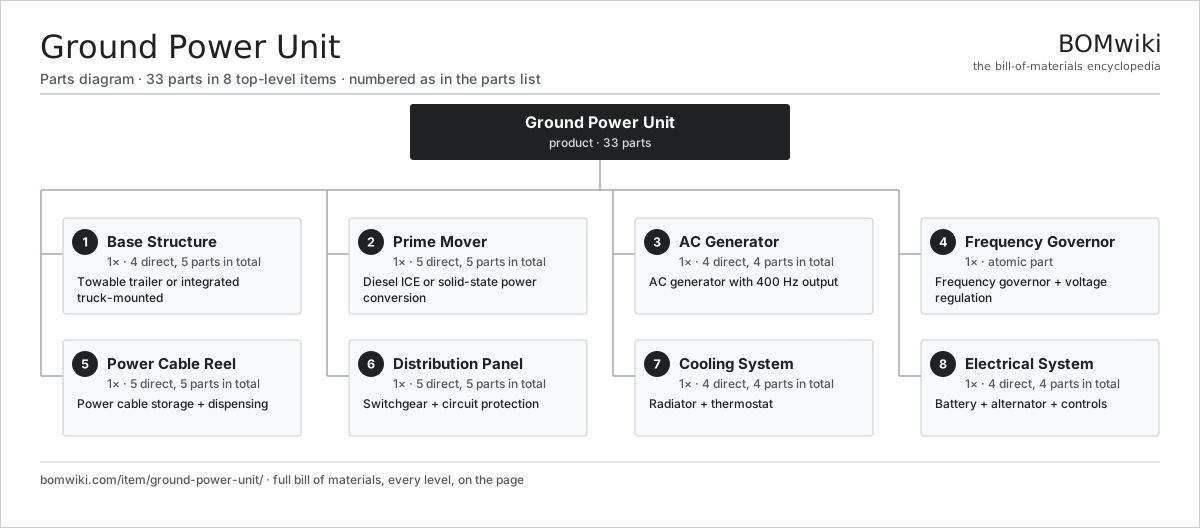
| # | Part | Qty | What it does |
|---|---|---|---|
| 1 | Base Structure 4 parts | 1× | Towable trailer or integrated truck-mounted |
| 2 | Prime Mover 5 parts | 1× | Diesel ICE or solid-state power conversion |
| 3 | AC Generator 4 parts | 1× | AC generator with 400 Hz output |
| 4 | Frequency Governor | 1× | Frequency governor + voltage regulation |
| 5 | Power Cable Reel 5 parts | 1× | Power cable storage + dispensing |
| 6 | Distribution Panel 5 parts | 1× | Switchgear + circuit protection |
| 7 | Cooling System 4 parts | 1× | Radiator + thermostat |
| 8 | Electrical System 4 parts | 1× | Battery + alternator + controls |
3D model
No 3D model yet. Have a CAD file of this? Add a 3D model. STL renders right on this page; STEP, FreeCAD, and OpenSCAD sources are welcome too (openly licensed, like all 3D models on BOMwiki).
Build & assembly graph
expand / collapse · shared sub-assemblies converge · links to related products · est. labourTap an assembly to expand/collapse · tap a part to open it · use “Open page” for any node · drag to pan, scroll to zoom.
Bill of materials for Ground Power Unit
8 top-level lines · 39 rows shown · 33 parts total · indented to 3 levels| # | Item / sub-assembly | Part no. | Qty/assy | Ext. qty | Parts | Type |
|---|---|---|---|---|---|---|
| 1 | Base Structure 4 parts | ground-power-unit-base | 1× | 1 | 5 | assembly |
| 1.1 | Trailer Frame | ground-power-unit-frame | 1× | 1 | · | part |
| 1.2 | Wheels & Axle | ground-power-unit-wheels | 2× | 2 | · | part |
| 1.3 | Towing Coupling | ground-power-unit-coupling | 1× | 1 | · | part |
| 1.4 | Stabilizing Feet | ground-power-unit-feet | 1× | 1 | · | part |
| 2 | Prime Mover 5 parts | ground-power-unit-engine | 1× | 1 | 5 | assembly |
| 2.1 | Diesel Engine | ground-power-unit-diesel-engine | 1× | 1 | · | part |
| 2.2 | Fuel Tank | ground-power-unit-fuel-tank | 1× | 1 | · | part |
| 2.3 | Fuel Pump | ground-power-unit-fuel-pump | 1× | 1 | · | part |
| 2.4 | Air Filter | ground-power-unit-air-filter | 1× | 1 | · | part |
| 2.5 | Muffler | ground-power-unit-muffler | 1× | 1 | · | part |
| 3 | AC Generator 4 parts | ground-power-unit-generator | 1× | 1 | 4 | assembly |
| 3.1 | Alternator | ground-power-unit-alternator | 1× | 1 | · | part |
| 3.2 | Voltage Regulator | ground-power-unit-voltage-regulator | 1× | 1 | · | part |
| 3.3 | Frequency Governor | ground-power-unit-frequency-control | 1× | 1 | · | part |
| 3.4 | Main Breaker | ground-power-unit-circuit-breaker | 1× | 1 | · | part |
| 4 | Frequency Governor | ground-power-unit-frequency-control | 1× | 1 | · | part |
| 5 | Power Cable Reel 5 parts | ground-power-unit-cable-reel | 1× | 1 | 5 | assembly |
| 5.1 | Reel Drum | ground-power-unit-reel-drum | 1× | 1 | · | part |
| 5.2 | Power Cable | ground-power-unit-cable | 1× | 1 | · | part |
| 5.3 | Aircraft Connector | ground-power-unit-cable-connector | 1× | 1 | · | part |
| 5.4 | Reel Motor | ground-power-unit-reel-motor | 1× | 1 | · | part |
| 5.5 | Slip Ring | ground-power-unit-slip-ring | 1× | 1 | · | part |
| 6 | Distribution Panel 5 parts | ground-power-unit-distribution-panel | 1× | 1 | 5 | assembly |
| 6.1 | Panel Enclosure | ground-power-unit-panel-enclosure | 1× | 1 | · | part |
| 6.2 | Frequency Meter | ground-power-unit-frequency-meter | 1× | 1 | · | part |
| 6.3 | Voltage Meter | ground-power-unit-voltage-meter | 1× | 1 | · | part |
| 6.4 | Ground Indicator | ground-power-unit-ground-led | 1× | 1 | · | part |
| 6.5 | Remote Start Button | ground-power-unit-remote-start-button | 1× | 1 | · | part |
| 7 | Cooling System 4 parts | ground-power-unit-cooling-system | 1× | 1 | 4 | assembly |
| 7.1 | Radiator | ground-power-unit-radiator | 1× | 1 | · | part |
| 7.2 | Cooling Fan | ground-power-unit-cooling-fan | 1× | 1 | · | part |
| 7.3 | Thermostat | ground-power-unit-thermostat-valve | 1× | 1 | · | part |
| 7.4 | Hoses | ground-power-unit-coolant-hoses | 1× | 1 | · | part |
| 8 | Electrical System 4 parts | ground-power-unit-electrical-system | 1× | 1 | 4 | assembly |
| 8.1 | Battery | ground-power-unit-battery | 1× | 1 | · | part |
| 8.2 | Starter Motor | ground-power-unit-starter-motor | 1× | 1 | · | part |
| 8.3 | Battery Charger | ground-power-unit-battery-charger | 1× | 1 | · | part |
| 8.4 | Control Panel | ground-power-unit-switch-panel | 1× | 1 | · | part |
Something wrong in this list? Report a problem with this BOM.
Sourcing: possible vendors
Browse the supplier directory → Prices, MOQ, and lead times are algorithmic estimates, not quotes, and not claims about these companies. Company mappings are curated by keyword; est. price band $30k–$1.5M. How estimates work| Vendor | HQ | Specialty | MOQ | Lead time |
|---|---|---|---|---|
| oshkoshaerotech.com ↗ | Orlando, US | Airport ground support | made to order | 16–30 wks |
| tld-group.com ↗ | Paris, FR | Ground support equipment | made to order | 16–30 wks |
| textrongse.txtsv.com ↗ | Augusta, US | Ground support equipment | made to order | 16–30 wks |
| vestergaardcompany.com ↗ | Skanderborg, DK | De-icers & GSE | made to order | 16–30 wks |
| mallaghangse.com ↗ | Dungannon, GB | Ground support equipment | made to order | 16–30 wks |
1,241-word article