Ballistic Guard Booth
ProductOverview
Ballistic guard booths are hardened shelters protecting security personnel at perimeter checkpoints, entry control points, and critical infrastructure facilities. They provide NIJ Level III (7.62×51 NATO rifle) or Level IV (armor-piercing rounds) ballistic protection while maintaining operational visibility, communication, and environmental comfort.
Typical deployment:
- Military base entry control points (ECP)
- Embassy perimeter security stations
- Prison or detention facility gatehouse
- High-value facility checkpoint (power plant, water treatment, government building)
A single booth costs $150,000–300,000 depending on ballistic level and feature set. For installations protecting assets worth millions or critical infrastructure with significant threat profiles, the investment is economically justified and often mandated by security standards.
Ballistic Protection Design
Ceramic Composite Construction
The booth walls use composite armor: aluminum oxide ceramic tiles bonded to steel backing plate. This combination exploits both materials' strengths:
- Ceramic layer: Hard, brittle material shatters projectile and absorbs kinetic energy. Aluminum oxide (Al₂O₃) has hardness ~2000 HV, second only to diamond. A 7.62×51 NATO steel-core round (750 m/s muzzle velocity) strikes ceramic, shatters into fragments, loses ~80% of kinetic energy in ceramic layer.
- Steel backing: Ductile support absorbs remaining energy through plastic deformation. AISI 1025 steel at 12 mm thickness provides secondary containment; even if ceramic cracks, steel prevents projectile penetration.
Performance: Level III composite (75 mm total thickness) reliably stops repeated 7.62×51 NATO strikes at normal incidence. Level IV requires additional hardened steel layers and reaches 150+ mm thickness, reducing interior space.
Window Protection
Ballistic glass windows consist of:
- 25 mm polycarbonate (Lexan or Makrolon): Tough, absorbs impact energy without shattering; maintains transparency.
- Polymer laminate interlayer (polyvinyl butyral): Prevents fragmentation; holds glass pieces together post-impact.
- 6 mm annealed glass: Provides optical clarity and backing support.
Multi-layer construction (total 37+ mm) is required to achieve NIJ Level III rating. Glass alone cannot sustain rifle impact; polycarbonate without backing will crater and eventually perforate. The laminate interlayer is critical, without it, glass splinters become secondary projectiles inside the booth.
Trade-off: Thicker windows reduce light transmission (clear windows are critical for visibility). Typical transmission is 75–85%, acceptable for outdoor checkpoints.
Operational Features
Climate Control
The HVAC system maintains positive interior pressure (+0.1 inches of water column). Benefits:
- Chemical/biological protection: Positive pressure prevents external contaminated air from infiltrating if external airborne threat (chemical weapons, biological aerosol) is present.
- Comfort: HEPA filtration removes urban particulates (dust, pollution), improving air quality for guards spending 8-hour shifts.
Typical system:
- Intake: 500 CFM centrifugal blower draws exterior air through HEPA + activated carbon filters.
- Distribution: Filtered air is distributed via ducting to booth interior.
- Exhaust: One-way damper allows interior air to exhaust while maintaining positive pressure.
Operating cost: ~5 kWh/day for HVAC operation (modest footprint for climate control).
Communication & Alerting
- Intercom: Two-way speaker allows personnel outside booth to communicate with guard without opening door (critical in high-threat scenarios).
- Two-way radio: External antenna mounted on roof; connected to base radio inside booth, enables secure communication with patrol vehicles and control center.
- Panic button: Hardwired momentary contact button directly triggers silent or audible alarm at central security station; no network dependency (redundant path).
Gun Port Design
Two concealed gun ports (rifle/shotgun) are optional. Design philosophy:
- Normally sealed: Sliding steel shutter, locked in closed position. Guards cannot inadvertently discharge through port.
- Emergency access: Manual pin unlock allows authorized personnel to manually open shutter. Designed for last-resort defensive use (rarely employed).
- Recoil containment: Reinforced opening minimizes blast/recoil propagation into booth.
Modern security doctrine discourages reliance on guard marksmanship; instead, emphasizes perimeter barriers, vehicle control, and rapid response of armed backup. Gun ports are legacy features, less common in new designs.
Installation & Site Preparation
Foundation & Anchoring
Booth weight: 15–20 tons (composite walls are dense). Installation requires:
- Concrete pad: Minimum 300 mm thick concrete slab, 5 m × 5 m footprint, 20 MPa compressive strength.
- Anchor bolts: Eight M20 grade 8.8 bolts, embedded 250 mm in concrete via epoxy-bonded anchor sleeves, rated for 150 kN tensile load each. Spacing balances moment distribution.
- Leveling: Field shims ensure booth is level within ±5 mm over 3 m span; critical for door operation and visual alignment.
Foundation setup: 3–5 days (excavation, concrete curing, anchor installation).
Electrical Integration
- Main inlet: 480 VAC 30 A disconnect switch; provides power for HVAC, lighting, communication equipment.
- Control transformer: 480 VAC to 24 VDC secondary supplies safety-critical loads (door lock, panic button, emergency lighting).
- UPS backup: 24 VDC battery backup (40 Ah sealed lead-acid) maintains door locks and intercom for 4–8 hours if AC power fails. This is critical, guards must be able to exit in emergency.
Total electrical work: 2–3 days.
Security Protocols & Guard Procedures
Standard Checkpoint Operation
- Vehicle approach: Driver approaches booth, stops at standoff distance (typically 10–15 meters) to prevent ramming.
- Initial interaction: Guard observes driver via window, conducts verbal communication via intercom. Vehicle occupants are outside booth, at standoff.
- Documentation check: Guard reviews driver identification and vehicle documents through window. No booth entry required; reduces guard exposure.
- Access decision: Guard presses button authorizing vehicle passage (barrier lowered) or denies access. If denied, backup response (additional guards, law enforcement) is called.
Entire interaction occurs with guard inside hardened booth, minimizing personal exposure.
Emergency Escalation
If situation escalates (aggressive behavior, attempted breach):
- Panic button: Guard activates hardwired panic button; central station receives immediate alert with booth location.
- Lockdown: Door magnetic lock engages (fail-safe design ensures door locks regardless of electrical fault state if activated by manual key inside booth).
- Backup response: Armed rapid response team dispatches to booth location; estimated response time 2–5 minutes depending on facility size.
- Interior communication: Guard remains on radio with response team, providing real-time threat assessment.
Structural Integrity Maintenance
After any ballistic impact (or suspected impact), booth must be inspected:
- Ceramic layer: Examine for cracks or spalling. If damage is visible, ceramic tiles must be replaced (cost: ~$500–1000 per tile, hours of labor to remove and re-install).
- Glass: Any visible cracks in ballistic windows require full window unit replacement ($5,000–10,000 per window).
- Steel frame: Dents or bending are tolerated unless structural alignment is compromised (verified by surveyor).
Facilities in high-threat areas (active combat zones, politically volatile regions) prepare replacement components in advance.
Maintenance & Service
Preventive Maintenance (Quarterly)
- HVAC filter change: Replace HEPA cartridge (cost: ~$200 per cartridge).
- Weatherproofing: Inspect rubber seals around door and windows; apply silicone sealant if gaps appear.
- Communication test: Verify intercom function, test panic button triggering.
- Lock operation: Manually cycle door lock 5 times; ensure smooth operation without binding.
Annual Service
- Full inspection: Licensed security integrator inspects structure for corrosion, loose fasteners, water intrusion.
- Electrical inspection: Verify 480 VAC / 24 VDC systems, test UPS battery capacity, inspect wiring for damage.
- Window clarity: Clean ballistic glass (only soft cloth, no abrasive cleaners); assess optical clarity reduction.
Annual service cost: $5,000–10,000.
Standards & Regulatory
- NIJ Standard 0101.06: Ballistic resistance of body armor, defines protection levels.
- UL 752: Standard for safety glazing material, ballistic resistance.
- ASTM F1233: Standard test method for ballistic impact resistance of transparent armor.
- OSHA 1910.176: Safe handling of hazardous materials (applies to placement of booth near chemical facilities).
- ADA Accessibility Guidelines: Booth doors and interior must be accessible to personnel with disabilities (wheelchair access, accessible intercom height).
Economics & Threat Assessment
A basic NIJ Level III booth (ceramic composite + ballistic windows) costs $150,000–200,000. Level IV (armor-piercing rated) reaches $250,000–350,000. Operating costs (electricity, maintenance, staffing) are $50,000–80,000 annually.
Threat assessment determines investment justification:
- Low-threat civilian facility: Standard booth insufficient; portable or mobile solutions preferred.
- Medium-threat (active crime area): Booth justifies cost; reduces guard casualty risk.
- High-threat (embassy, military base): Multiple booths deployed; upgraded amenities (climate control, redundant communication) expected.
For a facility protecting assets >$10M or critical infrastructure (power, water, communications), a single successful breach costing $1M+ in damages or downtime makes booth investment a cost-effective risk mitigation.
Ballistic Guard Booth parts and their functions
8 top-level parts · 105 parts in total · full bill of materials below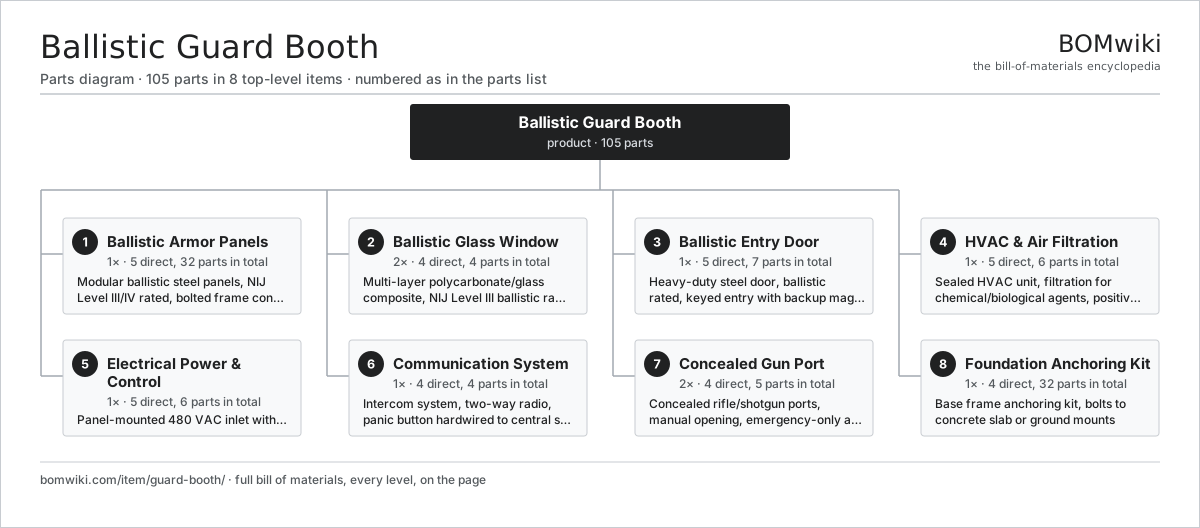
| # | Part | Qty | What it does |
|---|---|---|---|
| 1 | Ballistic Armor Panels 5 parts | 1× | Modular ballistic steel panels, NIJ Level III/IV rated, bolted frame construction |
| 2 | Ballistic Glass Window 4 parts | 2× | Multi-layer polycarbonate/glass composite, NIJ Level III ballistic rating |
| 3 | Ballistic Entry Door 5 parts | 1× | Heavy-duty steel door, ballistic rated, keyed entry with backup magnetic lock |
| 4 | HVAC & Air Filtration 5 parts | 1× | Sealed HVAC unit, filtration for chemical/biological agents, positive pressure interior |
| 5 | Electrical Power & Control 5 parts | 1× | Panel-mounted 480 VAC inlet with 24 VDC logic supply |
| 6 | Communication System 4 parts | 1× | Intercom system, two-way radio, panic button hardwired to central station |
| 7 | Concealed Gun Port 4 parts | 2× | Concealed rifle/shotgun ports, manual opening, emergency-only access |
| 8 | Foundation Anchoring Kit 4 parts | 1× | Base frame anchoring kit, bolts to concrete slab or ground mounts |
3D model
No 3D model yet. Have a CAD file of this? Add a 3D model. STL renders right on this page; STEP, FreeCAD, and OpenSCAD sources are welcome too (openly licensed, like all 3D models on BOMwiki).
Build & assembly graph
expand / collapse · shared sub-assemblies converge · links to related products · est. labourTap an assembly to expand/collapse · tap a part to open it · use “Open page” for any node · drag to pan, scroll to zoom.
Bill of materials for Ballistic Guard Booth
8 top-level lines · 44 rows shown · 105 parts total · indented to 3 levels| # | Item / sub-assembly | Part no. | Qty/assy | Ext. qty | Parts | Type |
|---|---|---|---|---|---|---|
| 1 | Ballistic Armor Panels 5 parts | guard-booth-armored-panels | 1× | 1 | 32 | assembly |
| 1.1 | Steel Backing Plate | guard-booth-steel-backing-plate | 4× | 4 | · | part |
| 1.2 | Ceramic Ballistic Insert | guard-booth-ceramic-insert | 4× | 4 | · | part |
| 1.3 | High-Strength Epoxy Bond | guard-booth-epoxy-adhesive-layer | 4× | 4 | · | part |
| 1.4 | Panel Frame Angle Iron | guard-booth-panel-frame | 4× | 4 | · | part |
| 1.5 | Corner Mounting Bracket | guard-booth-mounting-bracket | 16× | 16 | · | part |
| 2 | Ballistic Glass Window 4 parts | guard-booth-ballistic-glass-windows | 2× | 2 | 4 | assembly |
| 2.1 | Polycarbonate Impact Layer | guard-booth-polycarbonate-layer | 1× | 2 | · | part |
| 2.2 | Laminate Interlayer Film | guard-booth-laminate-interlayer | 1× | 2 | · | part |
| 2.3 | Annealed Glass Backing Pane | guard-booth-annealed-glass-backing | 1× | 2 | · | part |
| 2.4 | Window Frame Assembly | guard-booth-frame-glazing | 1× | 2 | · | part |
| 3 | Ballistic Entry Door 5 parts | guard-booth-door-assembly | 1× | 1 | 7 | assembly |
| 3.1 | Steel Door Leaf Panel | guard-booth-door-leaf | 1× | 1 | · | part |
| 3.2 | Door Frame Assembly | guard-booth-door-frame | 1× | 1 | · | part |
| 3.3 | Heavy-Duty Ball Bearing Hinge | guard-booth-heavy-duty-hinge | 3× | 3 | · | part |
| 3.4 | Mortise Lock Cylinder | guard-booth-mortise-lock | 1× | 1 | · | part |
| 3.5 | Emergency Magnetic Lock | guard-booth-magnetic-lock-emergency | 1× | 1 | · | part |
| 4 | HVAC & Air Filtration 5 parts | guard-booth-hvac-system | 1× | 1 | 6 | assembly |
| 4.1 | Centrifugal Intake Blower | guard-booth-intake-fan | 1× | 1 | · | part |
| 4.2 | HEPA Filter Cartridge | guard-booth-hepa-filter | 2× | 2 | · | part |
| 4.3 | Activated Carbon Pre-Filter | guard-booth-activated-carbon-cartridge | 1× | 1 | · | part |
| 4.4 | Air Distribution Duct | guard-booth-ducting-distribution | 1× | 1 | · | part |
| 4.5 | Backdraft Damper | guard-booth-exhaust-damper | 1× | 1 | · | part |
| 5 | Electrical Power & Control 5 parts | guard-booth-electrical-power | 1× | 1 | 6 | assembly |
| 5.1 | Main Power Inlet | guard-booth-main-breaker-inlet | 1× | 1 | · | part |
| 5.2 | Step-Down Transformer | guard-booth-step-down-transformer | 1× | 1 | · | part |
| 5.3 | 120 VAC Lighting Panel | guard-booth-lighting-outlet-panel | 1× | 1 | · | part |
| 5.4 | LED Emergency Light | guard-booth-emergency-lighting | 2× | 2 | · | part |
| 5.5 | UPS Battery Backup | guard-booth-uninterruptible-power-supply | 1× | 1 | · | part |
| 6 | Communication System 4 parts | guard-booth-communication-equipment | 1× | 1 | 4 | assembly |
| 6.1 | Two-Way Intercom Speaker | guard-booth-intercom-speaker | 1× | 1 | · | part |
| 6.2 | Radio Antenna Mount | guard-booth-radio-antenna-mount | 1× | 1 | · | part |
| 6.3 | Hardwired Panic Button | guard-booth-panic-button | 1× | 1 | · | part |
| 6.4 | Direct-Line Telephone Handset | guard-booth-telephone-handset | 1× | 1 | · | part |
| 7 | Concealed Gun Port 4 parts | guard-booth-gun-port-assembly | 2× | 2 | 5 | assembly |
| 7.1 | Port Opening Frame | guard-booth-port-opening-frame | 1× | 2 | · | part |
| 7.2 | Sliding Shutter Plate | guard-booth-shutter-slide-plate | 1× | 2 | · | part |
| 7.3 | Guide Rail Assembly | guard-booth-guide-rail | 2× | 4 | · | part |
| 7.4 | Port Locking Mechanism | guard-booth-locking-mechanism | 1× | 2 | · | part |
| 8 | Foundation Anchoring Kit 4 parts | guard-booth-foundation-anchors | 1× | 1 | 32 | assembly |
| 8.1 | M20 Anchor Bolt | guard-booth-foundation-bolt | 8× | 8 | · | part |
| 8.2 | Square Washer Plate | guard-booth-washer-plate | 8× | 8 | · | part |
| 8.3 | Self-Locking Nut | guard-booth-locking-nut | 8× | 8 | · | part |
| 8.4 | Concrete Anchor Sleeve | guard-booth-concrete-sleeve-insert | 8× | 8 | · | part |
Something wrong in this list? Report a problem with this BOM.
Sourcing: possible vendors
Browse the supplier directory → Prices, MOQ, and lead times are algorithmic estimates, not quotes, and not claims about these companies. Company mappings are curated by keyword; est. price band $200–$100M. How estimates work| Vendor | HQ | Specialty | MOQ | Lead time |
|---|---|---|---|---|
| smithsdetection.com ↗ | London, GB | Security screening | made to order | 24–52 wks |
|
🇺🇸Leidos
leidos.com ↗
|
Reston, US | Security & screening | made to order | 24–52 wks |
|
🇺🇸Rapiscan
rapiscansystems.com ↗
|
Torrance, US | X-ray screening | made to order | 24–52 wks |
|
🇫🇷Thales
thalesgroup.com ↗
|
Paris, FR | Defense electronics | made to order | 24–52 wks |
| baesystems.com ↗ | London, GB | Defense | made to order | 24–52 wks |
1,380-word article