Gum Rolling & Scoring Machine
ProductOverview
A gum rolling and scoring machine is an industrial system that compresses and thinens raw chewing gum slabs, scores them into breakable pieces, dusts them with powder to prevent sticking, and cools them to final firmness. The machine is designed for high-volume chewing gum production, typical output is 200–800 kg per hour. The system combines precision rolling, automated scoring, powder application, and cooling into a single integrated line.
The gum roller is essential to modern chewing gum production. It replaces manual slabbing and cutting with continuous, high-speed automation. The scored breakaway pattern, typically a grid or parallel lines, allows consumers to break large sheets into individual pieces. Powder dusting (talc, starch, or sorbitol) prevents the sticky surface from adhering during storage and handling.
Rolling and compression
The machine begins with the feed hopper, a gravity-fed bin that holds gum slabs or chunks. A pneumatic pusher plate reciprocates at 0.5–2 Hz, advancing pre-formed gum slabs into the nip of two hardened steel rollers (300 mm diameter, 400 mm wide). The rollers counter-rotate at 0.5–2 m/min surface speed, compressing and thinning the gum to 3–6 mm thickness. The upper roller is mounted on adjustable bearing blocks that allow fine control of nip gap via mechanical shims or servo adjustment. Nip pressure is maintained at 50–200 bar depending on gum hardness and desired final thickness.
As gum passes through the rolling stand, it emerges as a thin, uniform sheet ready for further processing. The roller surface is precision-ground and highly polished (Ra <0.8 µm) to prevent texture transfer and ensure smooth gum appearance.
Scoring and perforation
Immediately downstream of the rollers, a rotating scoring drum (150 mm diameter) with radial surgical-grade blades cuts perforation lines into the rolled gum. The scoring drum is synchronized to the main roller speed via the PLC, ensuring consistent blade penetration and spacing. Blades are typically spaced 30 mm apart, creating a grid or parallel stripe pattern. Blade penetration is carefully controlled at 50–70% of gum thickness to create breakaway seams without cutting completely through.
Operators can adjust blade spacing by repositioning blade inserts in the drum slots (a 30-minute task). Different SKUs may have different scoring patterns: some require a coarse grid (100 mm spacing for large chew pieces), others a fine grid (10 mm spacing for small gum bits). The drum is regularly inspected and blades are rotated or replaced every 100 operating hours due to dulling from sugar and adhesive contact.
Powder dusting
As the scored gum exits the Scoring & Perforation Unit, it encounters a powder dusting system with 3–4 nozzles positioned above the gum stream. The nozzles spray a fine mist of talc, starch, or sorbitol powder using 3 bar compressed air. The powder coating serves multiple purposes:
- Prevents surface sticking during cooling and storage
- Improves texture and feel (powder absorbs oils)
- Reduces machinery buildup and adhesion
The powder feed screw (0.25 kW motor) adjusts powder flow rate via variable frequency; typical consumption is 0.5–2 kg per 100 kg gum. Powder waste is minimized by careful nozzle positioning and air pressure tuning.
Cooling and texture development
After powder dusting, the gum travels on a stainless steel conveyor belt at 0.5–2 m/min. The belt is mesh-style, allowing air circulation from below. A cooling fan (0.5 kW blower) circulates ambient air (or chilled water from an optional external loop) over the gum surface. Cooling time ranges from 3–8 minutes depending on final thickness and ambient temperature. The gum texture hardens as it cools; the final product should be firm enough to prevent surface indentation but still flexible enough to chew without brittleness.
Some facilities use chilled water via a heat-exchange loop instead of air cooling, which is faster (2–3 minutes) but requires a separate chiller unit (capital cost ~€15,000).
Control and user interface
The PLC control system orchestrates all operations. An integrated 7-inch touchscreen HMI allows operators to input recipe parameters:
- Roller gap (nip distance in mm, translated to 50–200 bar pressure)
- Line speed (0.5–2 m/min, controlled via VFD on main motor)
- Scoring blade depth (adjusted as % of gum thickness via servo feedback)
- Powder flow rate (adjusted via variable-speed screw frequency)
- Cooling fan speed (0–100% blower motor speed)
The PLC reads sensor feedback from a thickness gauge (optical or capacitive) installed just downstream of the rollers, and adjusts nip pressure in real-time to maintain target thickness. If thickness drifts by >0.2 mm, the PLC raises an alarm and decreases line speed until tolerance is restored.
Production metrics and daily operation
A typical gum roller running at 1 m/min line speed with 50 kg gum input per hour can process 200–250 kg per hour of finished powder-dusted scored gum. A full 8-hour shift yields 1,600–2,000 kg of finished product, enough for a mid-size chewing gum manufacturer. Larger operations run two machines in parallel, achieving 3,000–4,000 kg per day.
Maintenance and wear
The roller surfaces are subject to slow abrasion from sugar crystal and adhesive contact; after 2,000–5,000 operating hours, they are stripped, re-ground, and re-polished (cost ~€3,000 per roller). The scoring blades are replaced as a set every 100–150 operating hours (cost ~€400 per set of 6–8). The powder feed screw auger accumulates moisture-absorbing powder residue and is cleaned daily and replaced every 2–3 years.
Roller bearings are sealed cartridge units rated 10–15 years. The main motor and gearbox are rated for 20+ years with regular greasing of gearbox ports every 500 hours.
Integration in chewing gum lines
The gum roller is the centerpiece of a chewing gum production line. Upstream, raw gum base (a blend of rubber compounds, resins, waxes) is softened via a jacketed mixing kettle and extruded into slabs. Downstream, the roller output can proceed directly to wrapping (via twist wrapper or flat-film wrapper), or to secondary coating (e.g., sugar shell, chocolate, or enamel).
A complete chewing gum line from raw compound to wrapped and boxed product spans 15–20 meters and involves 8–12 distinct machine modules.
Gum Rolling & Scoring Machine parts and their functions
8 top-level parts · 85 parts in total · full bill of materials below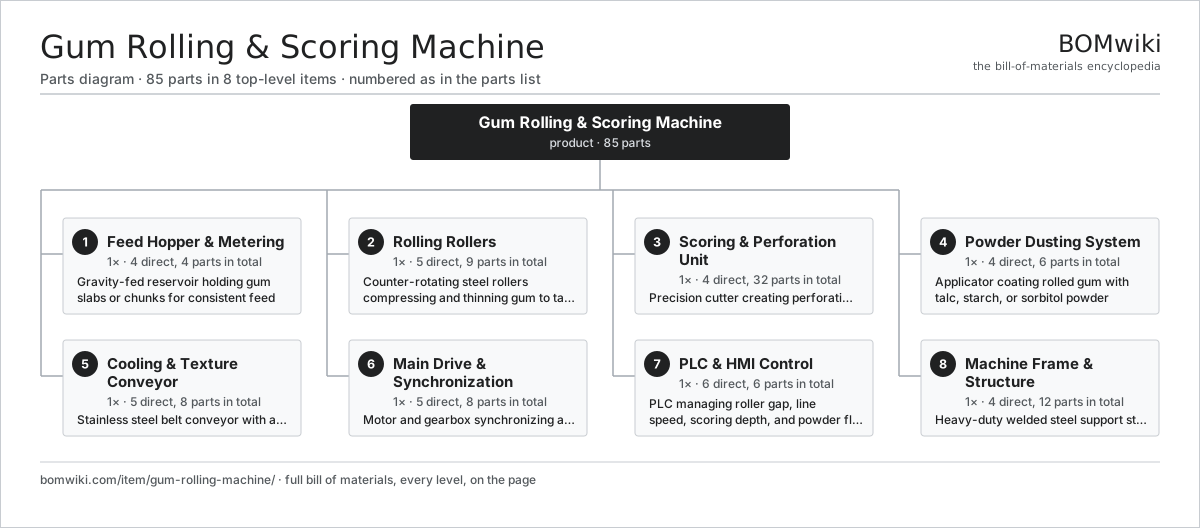
| # | Part | Qty | What it does |
|---|---|---|---|
| 1 | Feed Hopper & Metering 4 parts | 1× | Gravity-fed reservoir holding gum slabs or chunks for consistent feed |
| 2 | Rolling Rollers 5 parts | 1× | Counter-rotating steel rollers compressing and thinning gum to target thickness |
| 3 | Scoring & Perforation Unit 4 parts | 1× | Precision cutter creating perforation lines or grid marks for easy breaking |
| 4 | Powder Dusting System 4 parts | 1× | Applicator coating rolled gum with talc, starch, or sorbitol powder |
| 5 | Cooling & Texture Conveyor 5 parts | 1× | Stainless steel belt conveyor with ambient or chilled air for texture hardening |
| 6 | Main Drive & Synchronization 5 parts | 1× | Motor and gearbox synchronizing all moving components at precise speeds |
| 7 | PLC & HMI Control 6 parts | 1× | PLC managing roller gap, line speed, scoring depth, and powder flow |
| 8 | Machine Frame & Structure 4 parts | 1× | Heavy-duty welded steel support structure with vibration isolation |
3D model
No 3D model yet. Have a CAD file of this? Add a 3D model. STL renders right on this page; STEP, FreeCAD, and OpenSCAD sources are welcome too (openly licensed, like all 3D models on BOMwiki).
Build & assembly graph
expand / collapse · shared sub-assemblies converge · links to related products · est. labourTap an assembly to expand/collapse · tap a part to open it · use “Open page” for any node · drag to pan, scroll to zoom.
Bill of materials for Gum Rolling & Scoring Machine
8 top-level lines · 49 rows shown · 85 parts total · indented to 3 levels| # | Item / sub-assembly | Part no. | Qty/assy | Ext. qty | Parts | Type |
|---|---|---|---|---|---|---|
| 1 | Feed Hopper & Metering 4 parts | gum-rolling-machine-feed-hopper | 1× | 1 | 4 | assembly |
| 1.1 | Hopper Vessel | gum-rolling-machine-hopper-bin | 1× | 1 | · | part |
| 1.2 | Gum Pusher Plate | gum-rolling-machine-pusher-plate | 1× | 1 | · | part |
| 1.3 | Pusher Cylinder | gum-rolling-machine-pneumatic-cylinder | 1× | 1 | · | part |
| 1.4 | Hopper Level Sensor | gum-rolling-machine-level-sensor | 1× | 1 | · | part |
| 2 | Rolling Rollers 5 parts | gum-rolling-machine-rolling-stand | 1× | 1 | 9 | assembly |
| 2.1 | Upper Roller | gum-rolling-machine-upper-roller | 1× | 1 | · | part |
| 2.2 | Lower Roller | gum-rolling-machine-lower-roller | 1× | 1 | · | part |
| 2.3 | Roller Bearing | gum-rolling-machine-roller-bearing | 4× | 4 | · | part |
| 2.4 | Adjustable Bearing Block | gum-rolling-machine-bearing-block | 2× | 2 | · | part |
| 2.5 | Drive Pulley | gum-rolling-machine-drive-pulley | 1× | 1 | · | part |
| 3 | Scoring & Perforation Unit 4 parts | gum-rolling-machine-scoring-head | 1× | 1 | 32 | assembly |
| 3.1 | Scoring Drum | gum-rolling-machine-scoring-drum | 1× | 1 | · | part |
| 3.2 | Scoring Blade | gum-rolling-machine-scoring-blades | 6× | 6 | · | part |
| 3.3 | Servo Motor 4 parts | servo-motor | 1× | 1 | 24 | assembly |
| 3.3.1 | Stator Assembly 3 parts + deeper › | stator-assembly | 1× | 1 | 3 | assembly |
| 3.3.2 | Rotor Assembly 4 parts + deeper › | rotor-assembly | 1× | 1 | 19 | assembly |
| 3.3.3 | Encoder | encoder | 1× | 1 | · | part |
| 3.3.4 | Motor Housing | motor-housing | 1× | 1 | · | part |
| 3.4 | Blade Depth Stop | gum-rolling-machine-depth-adjuster | 1× | 1 | · | part |
| 4 | Powder Dusting System 4 parts | gum-rolling-machine-powder-duster | 1× | 1 | 6 | assembly |
| 4.1 | Powder Hopper | gum-rolling-machine-powder-hopper | 1× | 1 | · | part |
| 4.2 | Air-Atomize Dust Nozzle | gum-rolling-machine-dust-nozzles | 3× | 3 | · | part |
| 4.3 | Powder Feed Screw | gum-rolling-machine-metering-screw | 1× | 1 | · | part |
| 4.4 | Connector | connector | 1× | 1 | · | part |
| 5 | Cooling & Texture Conveyor 5 parts | gum-rolling-machine-cooling-belt | 1× | 1 | 8 | assembly |
| 5.1 | Cooling Conveyor Belt | gum-rolling-machine-conveyor-belt | 1× | 1 | · | part |
| 5.2 | Conveyor Drive Motor | gum-rolling-machine-conveyor-motor | 1× | 1 | · | part |
| 5.3 | Drive Belt | drive-belt | 1× | 1 | · | part |
| 5.4 | Cooling Fan Motor | gum-rolling-machine-cooling-fan | 1× | 1 | · | part |
| 5.5 | Ball Bearing | ball-bearing | 4× | 4 | · | part |
| 6 | Main Drive & Synchronization 5 parts | gum-rolling-machine-drive-unit | 1× | 1 | 8 | assembly |
| 6.1 | Main Motor | gum-rolling-machine-main-motor | 1× | 1 | · | part |
| 6.2 | Planetary Gearbox | gum-rolling-machine-planetary-gearbox | 1× | 1 | · | part |
| 6.3 | Drive Belt | drive-belt | 2× | 2 | · | part |
| 6.4 | Belt Tensioner | gum-rolling-machine-tensioner | 2× | 2 | · | part |
| 6.5 | Ball Bearing | ball-bearing | 2× | 2 | · | part |
| 7 | PLC & HMI Control 6 parts | gum-rolling-machine-control-cabinet | 1× | 1 | 6 | assembly |
| 7.1 | Microcontroller | mcu | 1× | 1 | · | part |
| 7.2 | Variable Frequency Drive | gum-rolling-machine-vfd-drive | 1× | 1 | · | part |
| 7.3 | Servo Amplifier | lollipop-forming-machine-servo-drive | 1× | 1 | · | part |
| 7.4 | Power Supply | power-supply | 1× | 1 | · | part |
| 7.5 | LCD Panel | lcd-panel | 1× | 1 | · | part |
| 7.6 | Connector | connector | 1× | 1 | · | part |
| 8 | Machine Frame & Structure 4 parts | gum-rolling-machine-frame | 1× | 1 | 12 | assembly |
| 8.1 | Sheet Metal Panel | sheet-panel | 2× | 2 | · | part |
| 8.2 | Fastener Set | fastener-set | 4× | 4 | · | part |
| 8.3 | Heavy-Duty Isolator Feet | gum-rolling-machine-base-feet | 4× | 4 | · | part |
| 8.4 | Wire Bundle | wire-bundle | 2× | 2 | · | part |
Something wrong in this list? Report a problem with this BOM.
Sourcing: possible vendors
Browse the supplier directory → Prices, MOQ, and lead times are algorithmic estimates, not quotes, and not claims about these companies. Company mappings are curated by keyword; est. price band $1k–$500k. How estimates work| Vendor | HQ | Specialty | MOQ | Lead time |
|---|---|---|---|---|
| gea.com ↗ | Düsseldorf, DE | Process technology | 20 units | 12–20 wks |
| buhlergroup.com ↗ | Uzwil, CH | Food & materials processing | 20 units | 12–20 wks |
| tetrapak.com ↗ | Pully, CH | Food packaging & processing | 20 units | 12–20 wks |
| jbtc.com ↗ | Chicago, US | Food processing equipment | 20 units | 12–20 wks |
| alfalaval.com ↗ | Lund, SE | Heat transfer & separation | 20 units | 12–20 wks |
1,134-word article