Hand Crank Generator
ProductOverview
A hand-crank generator converts sustained manual cranking into low-voltage DC electricity for charging phones, powering emergency lights, or operating radios during power outages, camping, or disaster situations. A single person cranking at 1 Hz (~60 rpm hand crank) can generate 1–5 W of electrical power continuously, enough to trickle-charge a battery or run small LED flashlights.
The device is completely portable, weighs less than 1 kg, requires no fuel or batteries (except optional storage battery), and has indefinite shelf life. Energy comes entirely from human muscle power: an average person can sustain 5 W output for 30–60 minutes before fatigue sets in. A 5-minute crank session generates ~1–2 Wh of energy, sufficient to charge a phone by 1–2%.
Hand-crank generators are widely distributed by emergency management agencies, sold in outdoor retailers, and deployed in developing countries for reliable emergency power and phone charging in remote areas with unreliable grid.
Mechanical Power Input
Human power output varies by fitness and effort:
- Sedentary person, easy crank: 0.5–1 W (30–60 min endurance)
- Average person, moderate crank: 1–3 W (20–30 min endurance)
- Athlete, hard crank: 5–10 W (5–10 min burst)
The ergonomic crank arm (200–300 mm length) is optimized for torque: a person exerting 1 N of force at 200 mm radius generates 0.2 N·m torque. Comfortable crank rates are 1–2 Hz (60–120 rpm hand crank); faster rates cause joint stress and rapid fatigue.
Gearbox Multiplication
The speed-multiplying gearbox converts slow crank rotation (1–2 Hz, 60–120 rpm) to fast generator input (500–2000 rpm). A 10:1 to 50:1 input pinion to output gear ratio achieves this.
Torque and speed are inversely related: if the crank exerts 0.2 N·m at 100 rpm, the output provides (0.2 N·m × 10) = 2 N·m at 1000 rpm (for 10:1 ratio). Power is conserved (ignoring friction losses of ~10%):
- Input power: 0.2 N·m × 100 rpm × 2π/60 ≈ 2 W
- Output power (90% efficient gearbox): 1.8 W
Friction losses scale with speed and load; plastic gears (common in portable units) suffer 15–20% loss, while metal gears (10:1 ratio) achieve 90–95% efficiency.
Generator and Power Conversion
The permanent-magnet generator (PMG) spins at 500–2000 rpm, generating AC voltage proportional to speed. A typical small PMG (10–20 W rating) produces:
- 500 rpm: ~5 V AC (no load)
- 1000 rpm: ~10 V AC
- 2000 rpm: ~20 V AC
The diode bridge converts AC to DC, and a voltage regulator clamps output to 5 V (for USB) or 12 V (for broader device compatibility).
Efficiency cascade:
- Hand crank: 2 W input
- Gearbox loss (10%): 1.8 W at generator input
- Generator loss (PMG is ~70% efficient): 1.26 W electrical
- Rectifier loss (Schottky diodes): 1.2 W DC output
- Voltage regulator loss (linear): ~1 W useful output
Net efficiency is ~50%: a person must supply 4 W of crank power to deliver 2 W of useful electrical power.
Modern designs use MPPT (maximum power point tracking) control to optimize generator loading, improving efficiency to 60–70%. However, cost and complexity make MPPT rare in portable hand-crank units.
Output Regulation and Safety
The output regulator serves multiple purposes:
- Voltage clamping: Prevents overvoltage during rapid cranking (if user suddenly spins fast, output could spike to 20+ V, damaging 5 V devices). A Zener diode clamps output to safe level.
- Current limiting: A series resistor limits current to safe levels (typically 2–4 A max for USB).
- Thermal protection: Excess power during overcharging is dissipated as heat (inefficient but safe).
A blocking diode prevents battery backfeed through the generator when no crank power is being delivered, critical for battery preservation.
Battery Storage (Optional)
Some hand-crank units include an integral rechargeable battery module (5–20 Wh, lithium-ion or LiFePO₄). This allows:
- Energy smoothing: Cranking output is pulsed (AC frequency modulation); battery smooths this to stable DC load.
- Delayed use: User cranks for 5 minutes, stores energy in battery, then uses electricity later (no continuous cranking required).
- Higher peak power: Battery can deliver 5–10 A peak for high-power devices (power tools, heaters), while crank generator is limited to 2–3 A average.
A battery management system (BMS) protects cells from overcharge, over-discharge, and thermal runaway.
Practical Power Budgets
Continuous cranking (1–2 W output) can:
- Charge smartphone: ~2% per minute crank = 50 min to full charge (not practical)
- Run emergency flashlight: 500 mW LED (~50 lumens) for 4 hours per minute crank
- Operate AM/FM radio: 200 mW radio receiver, indefinite operation
- Power hand-pump water purifier: 5 W pump, 12 minutes crank per gallon purified
With optional battery storage (10 Wh):
- Smartphone charge: 30–50% capacity (1–2 hours heavy use)
- Laptop partial charge: 10–15% capacity (not practical)
- LED flashlight: 10–20 hours runtime
Applications and Deployment
Emergency preparedness: Red Cross, disaster relief, military field operations distribute hand-crank generators for:
- Communication (radio, walkie-talkie)
- Signaling (emergency light, strobe)
- Information (phone to call for help)
Developing world: NGOs (Eton, BayGen) deploy solar-hybrid hand-crank units in refugee camps and remote clinics, providing reliable backup power where grid is unavailable.
Outdoor recreation: Hikers, campers, sailors carry hand-crank generators as lightweight backup, weighing less than spare battery packs.
Limitations
- Labor intensive: Continuous cranking is physically demanding; few people can sustain >3 W for >1 hour.
- Low power: Compared to gasoline generator (1–5 kW), hand-crank is 1000× weaker.
- Skill required: Untrained users over-crank (spinning fast, causing regulator dissipation) or under-crank (slow speed, low efficiency).
- Reliability: Mechanical wear on bearings and gears after 1000+ hours of operation; not suitable for daily use.
Modern improvements: Hybrid solar-hand-crank units combine small PV panel (2–5 W) with hand-crank generator, allowing passive solar charging during day and emergency crank backup at night. These systems (Eton Scorpion II, BayGen Freeplay) cost $50–150 and are industry standard for emergency kits.
Hand-crank generators remain relevant as a zero-fuel emergency backup, particularly in developing regions and disaster scenarios where grid failure and fuel scarcity are serious challenges.
Hand Crank Generator parts and their functions
8 top-level parts · 34 parts in total · full bill of materials below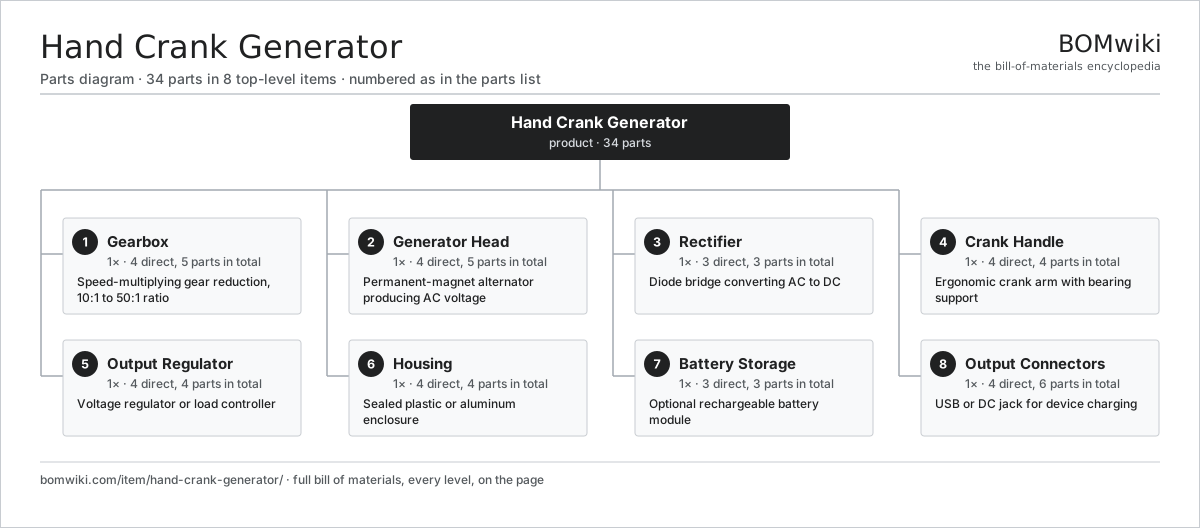
| # | Part | Qty | What it does |
|---|---|---|---|
| 1 | Gearbox 4 parts | 1× | Speed-multiplying gear reduction, 10:1 to 50:1 ratio |
| 2 | Generator Head 4 parts | 1× | Permanent-magnet alternator producing AC voltage |
| 3 | Rectifier 3 parts | 1× | Diode bridge converting AC to DC |
| 4 | Crank Handle 4 parts | 1× | Ergonomic crank arm with bearing support |
| 5 | Output Regulator 4 parts | 1× | Voltage regulator or load controller |
| 6 | Housing 4 parts | 1× | Sealed plastic or aluminum enclosure |
| 7 | Battery Storage 3 parts | 1× | Optional rechargeable battery module |
| 8 | Output Connectors 4 parts | 1× | USB or DC jack for device charging |
3D model
No 3D model yet. Have a CAD file of this? Add a 3D model. STL renders right on this page; STEP, FreeCAD, and OpenSCAD sources are welcome too (openly licensed, like all 3D models on BOMwiki).
Build & assembly graph
expand / collapse · shared sub-assemblies converge · links to related products · est. labourTap an assembly to expand/collapse · tap a part to open it · use “Open page” for any node · drag to pan, scroll to zoom.
Bill of materials for Hand Crank Generator
8 top-level lines · 38 rows shown · 34 parts total · indented to 3 levels| # | Item / sub-assembly | Part no. | Qty/assy | Ext. qty | Parts | Type |
|---|---|---|---|---|---|---|
| 1 | Gearbox 4 parts | hand-crank-gearbox | 1× | 1 | 5 | assembly |
| 1.1 | Input Pinion | hand-crank-input-pinion | 1× | 1 | · | part |
| 1.2 | Output Gear | hand-crank-output-gear | 1× | 1 | · | part |
| 1.3 | Gear Shaft | hand-crank-gear-shaft | 2× | 2 | · | part |
| 1.4 | Gear Housing | hand-crank-gear-housing | 1× | 1 | · | part |
| 2 | Generator Head 4 parts | hand-crank-generator-head | 1× | 1 | 5 | assembly |
| 2.1 | Generator Stator | hand-crank-gen-stator | 1× | 1 | · | part |
| 2.2 | Generator Rotor | hand-crank-gen-rotor | 1× | 1 | · | part |
| 2.3 | Generator Bearing | hand-crank-gen-bearing | 2× | 2 | · | part |
| 2.4 | Shaft Coupling | hand-crank-gen-shaft-coupling | 1× | 1 | · | part |
| 3 | Rectifier 3 parts | hand-crank-rectifier | 1× | 1 | 3 | assembly |
| 3.1 | Diode Bridge | hand-crank-diode-bridge | 1× | 1 | · | part |
| 3.2 | Filter Capacitor | hand-crank-filter-cap | 1× | 1 | · | part |
| 3.3 | Rectifier PCB | hand-crank-rectifier-pcb | 1× | 1 | · | part |
| 4 | Crank Handle 4 parts | hand-crank-handle | 1× | 1 | 4 | assembly |
| 4.1 | Crank Arm | hand-crank-handle-arm | 1× | 1 | · | part |
| 4.2 | Crank Grip | hand-crank-handle-grip | 1× | 1 | · | part |
| 4.3 | Handle Pivot | hand-crank-handle-pivot-bearing | 1× | 1 | · | part |
| 4.4 | Handle Stop | hand-crank-handle-stop-collar | 1× | 1 | · | part |
| 5 | Output Regulator 4 parts | hand-crank-output-regulator | 1× | 1 | 4 | assembly |
| 5.1 | Shunt Regulator | hand-crank-shunt-regulator | 1× | 1 | · | part |
| 5.2 | Zener Diode | hand-crank-zener-diode | 1× | 1 | · | part |
| 5.3 | Series Resistor | hand-crank-series-resistor | 1× | 1 | · | part |
| 5.4 | Blocking Diode | hand-crank-blocking-diode | 1× | 1 | · | part |
| 6 | Housing 4 parts | hand-crank-housing | 1× | 1 | 4 | assembly |
| 6.1 | Case Upper | hand-crank-case-upper | 1× | 1 | · | part |
| 6.2 | Case Lower | hand-crank-case-lower | 1× | 1 | · | part |
| 6.3 | Case Seal | hand-crank-case-seal | 1× | 1 | · | part |
| 6.4 | Case Ventilation | hand-crank-case-ventilation | 1× | 1 | · | part |
| 7 | Battery Storage 3 parts | hand-crank-battery-storage | 1× | 1 | 3 | assembly |
| 7.1 | Battery Cells | hand-crank-battery-cells | 1× | 1 | · | part |
| 7.2 | Battery BMS | hand-crank-battery-bms | 1× | 1 | · | part |
| 7.3 | Battery Compartment | hand-crank-battery-compartment | 1× | 1 | · | part |
| 8 | Output Connectors 4 parts | hand-crank-output-connectors | 1× | 1 | 6 | assembly |
| 8.1 | USB Connector | hand-crank-usb-connector | 1× | 1 | · | part |
| 8.2 | DC Jack | hand-crank-dc-jack | 1× | 1 | · | part |
| 8.3 | LED Indicator | hand-crank-led-indicator | 2× | 2 | · | part |
| 8.4 | Polyfuse | hand-crank-polyfuse | 2× | 2 | · | part |
Something wrong in this list? Report a problem with this BOM.
Sourcing: possible vendors
Browse the supplier directory → Prices, MOQ, and lead times are algorithmic estimates, not quotes, and not claims about these companies. Company mappings are curated by keyword; est. price band $100–$20M. How estimates work| Vendor | HQ | Specialty | MOQ | Lead time |
|---|---|---|---|---|
|
🇩🇰Vestas
vestas.com ↗
|
Aarhus, DK | Wind turbines | 500 units | 12–24 wks |
| firstsolar.com ↗ | Tempe, US | PV modules | 500 units | 12–24 wks |
|
🇨🇳LONGi
longi.com ↗
|
Xi'an, CN | Solar wafers & modules | 500 units | 12–24 wks |
| enphase.com ↗ | Fremont, US | Microinverters & storage | 500 units | 12–24 wks |
|
🇨🇳Sungrow
sungrowpower.com ↗
|
Hefei, CN | Solar inverters & storage | 500 units | 12–24 wks |
1,101-word article