Hard Hat
ProductOverview
A hard hat is personal protective equipment designed to absorb and deflect impact from falling objects on construction sites, preventing skull fractures and head injuries. The protective dome shell is the primary structure; the internal suspension system creates a 3–5 cm air gap between the shell and the wearer's head, allowing controlled deceleration of impact forces.
The engineering challenge is balancing protection (thick, rigid shell) against comfort and wearability (lightweight, not excessively hot). A hard hat worn for 8–12 hours in construction environments must be comfortable enough to encourage consistent use; if uncomfortable, workers remove or wear hats improperly, negating protection.
Impact Absorption Mechanism
Shell Deformation & Energy Dissipation
The HDPE shell does not remain rigid during impact. Instead, it undergoes controlled deformation, absorbing impact energy through:
Elastic deformation: The shell flexes inward during impact, bending at stress points. This bending absorbs energy without permanent damage (elastic deformation is recovered after impact).
Plastic deformation: At higher impact energies, the shell undergoes permanent shape change. This plastic deformation is a safety feature: it indicates the hat has absorbed maximum energy and should be retired.
Suspension system damping: The nylon webbing and padding deforms during impact, extending the deceleration time.
ANSI Z89.1 Test Procedure
The American National Standards Institute (ANSI) establishes the hard hat impact standard. The Z89.1 test simulates a falling object impact:
Type I Test (frontal impact):
- Object: 5 kg steel weight (11 pounds)
- Drop height: 1.2 meters (4 feet)
- Impact energy: E = mgh = 5 kg × 9.81 m/s² × 1.2 m ≈ 59 J
- Test apparatus: Weight dropped on hat mounted on a headform (rigid head model)
- Acceptable result: Peak acceleration <80 G on the headform; no shell penetration
Type II Test (lateral impact):
- Same 59 J impact applied from the side
- Tests protection against impacts from the side or rear
An 80 G deceleration over the ~50 ms impact time is significant but survivable. Compare to unprotected head impact with a 5 kg object falling 1.2 m:
- Without hat: Peak deceleration ~300–500 G (near-certain fatal injury)
- With hat: Peak deceleration 60–80 G (survivable; possible concussion, but no skull fracture)
The hat reduces peak deceleration by 75–80%, converting an almost certainly fatal injury into a survivable one.
Material Selection: HDPE
High-density polyethylene (HDPE) is chosen for hard hat shells because:
- Impact strength: Superior to lower-density plastics (LDPE, LLDPE). At 20 °C, HDPE Izod impact strength is 3–8 J/cm² (varies by grade), compared to 1–2 J/cm² for LDPE.
- Rigidity: Modulus of elasticity ~1.1 GPa, sufficient to support a 5 kg + headform load without excessive deflection.
- Temperature stability: HDPE maintains impact strength across a wide temperature range (-20 to +60 °C). At -20 °C, impact strength decreases to ~50% of room-temperature value, but remains adequate.
- UV resistance: HDPE can be formulated with UV-absorbing stabilizers (carbon black or benzotriazoles) to resist UV embrittlement. Pigmented HDPE shells last 5+ years in sunlight without significant degradation.
- Cost: HDPE is commodity plastic, relatively inexpensive compared to polycarbonate or glass-filled nylon, making hard hats affordable ($15–50 per unit).
The internal ribs are critical: they reinforce the shell against bending without adding weight. A smooth shell might deflect excessively under a falling object, bottoming out and contacting the wearer's head. Ribs distribute the load, preventing point-loading.
Suspension System Design
The suspension harness is as critical as the shell. It performs two functions:
Prevents direct contact: The 3–5 cm air gap between the shell and the head means that even if the shell undergoes large deformation (>1 cm), the head is protected from contact with the shell interior.
Extends impact deceleration time: The webbing and padding deform during impact, extending the impact duration from ~10 ms (direct contact with shell) to ~30–50 ms (with suspension deflection). This extended duration reduces peak acceleration significantly (longer deceleration time = lower peak acceleration for the same impact energy).
Headband & Padding
The front-to-back headband supports the head and is padded with foam strips on the forehead and back. This padding:
- Distributes the head's weight across multiple contact points rather than concentrating pressure on the crown
- Absorbs perspiration and improves comfort for extended wear
- Provides slight damping during impact (foam compresses, absorbing energy)
The sweatband on the forehead is essential: during an 8-hour construction shift in summer heat, a worker's forehead perspiration would drip into the eyes without the absorbent foam. The foam-backed fabric wicks moisture away, improving comfort and safety (sweaty eyes can impair vision).
Ratchet Adjustment
The ratchet adjustment system allows one-handed tightening/loosening of the suspension, accommodating a 5–10 cm head circumference range. This is important because:
- Workers wear hats over hard hats (e.g., baseball caps on extremely sunny days) or under hoods (in winter)
- Workers swap hats on a job site, and the ratchet allows quick fit adjustment
- The ratchet prevents the hat from shifting during work, which could occur with a loose fit
A properly fitted hard hat (ratchet tightened so the hat does not shift) is essential for protection. A loose hat can slide off during a fall or rotate during impact, negating protection.
Optional Accessories
Brim Extensions
Some optional brims (front visors or rear brims) provide sun and rain protection, extending the hard hat's functionality. However, brims are optional because:
- They add weight (50–100 g) and wind resistance
- They can catch on overhead structures on job sites
- They are not universally needed (outdoor vs. indoor construction)
A front visor reduces daytime glare, improving visibility when working at heights looking downward. A rear brim is less common (provides limited sun protection on the neck).
Accessory Mounting
The molded mounting slots allow attachment of:
- Flashlights: For low-light work
- Face shields: For grinding or high-velocity particle work
- Hearing protection earcups: For noisy environments
- Respirators: For dusty environments (though full-face respirators are incompatible with hard hats)
These accessories are mounted via plastic or metal brackets that slide or screw into the molded slots, allowing quick removal and reinstallation.
Limitations & Complementary PPE
Important: A hard hat protects against falling objects from above. It does NOT effectively protect against:
- Side impacts: Type I hats protect the crown; Type II hats protect sides. A blow to the side of the head at a 45° angle might partially miss the hard hat.
- Electrical hazards: HDPE is non-conductive (good), but has no special electrical protection. In high-voltage environments, a dielectric hard hat is required.
- Chemical exposure: HDPE is resistant to most chemicals but not all (strong solvents can cause swelling).
- Heat: HDPE melts above 120 °C; not suitable for foundries or welding.
For comprehensive head protection, hard hats are worn with:
- Safety glasses/goggles: Protecting eyes from dust and particles
- Face shields: Protecting the face from splashes or grinding sparks
- Hearing protection: Earplugs or earmuffs (often mounted on hard hat)
Maintenance & Lifespan
Hard hats have a limited lifespan:
- Maximum service life: 5 years (ANSI Z89.1 recommendation), regardless of condition. After 5 years, UV and thermal degradation accumulate; the shell becomes brittle and loses impact strength.
- Impact damage: After any significant impact (dropped from height, hit by falling object), the hat should be visually inspected and stress-tested. If the shell shows cracks, permanent indentation >6 mm, or has absorbed an impact within recent years, the hat is retired.
- Maintenance: Clean with mild soap and water; dry completely before wearing. Avoid solvents that might damage the shell or suspension.
- Storage: Store in a cool, dry location away from direct sunlight. Do not stack heavy objects on hats; compression over time permanently deforms the shell.
A typical hard hat in active construction use (exposed to sun and impacts) is replaced every 2–3 years. A hard hat in light use (indoors, occasional wear) can last the full 5 years.
Standards & Variations
Different countries and industries use different hard hat standards:
- ANSI Z89.1 (USA): Type I (frontal impact), Type II (frontal + lateral impact)
- EN 397 (Europe): Equivalent to ANSI Type I; includes electrical insulation classes
- CSA Z94.1 (Canada): Similar to ANSI
ANSI Type II (lateral impact protection) is preferred in construction where impacts from the side are common (workers near scaffolding, machinery, or moving objects). Type I is sufficient for most general construction, factory work, and outdoor tasks.
Some specialty hard hats include:
- Electrical insulation: Dielectric hard hats for electrical work (non-conductive material)
- Chemical resistant shells: Special HDPE formulations resistant to specific chemical exposures
- Reflective striping: Retroreflective tape for low-light or high-speed traffic zones
- Ventilated shells: Extra vent holes for tropical climates or intensive labor
These variants add cost but are necessary for specific job sites.
Hard Hat parts and their functions
7 top-level parts · 28 parts in total · full bill of materials below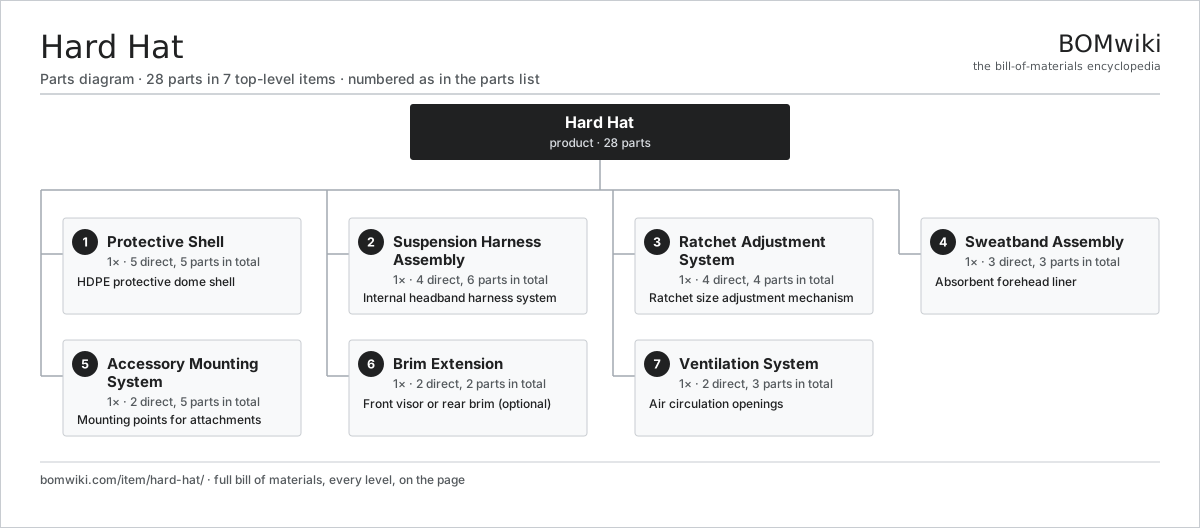
| # | Part | Qty | What it does |
|---|---|---|---|
| 1 | Protective Shell 5 parts | 1× | HDPE protective dome shell |
| 2 | Suspension Harness Assembly 4 parts | 1× | Internal headband harness system |
| 3 | Ratchet Adjustment System 4 parts | 1× | Ratchet size adjustment mechanism |
| 4 | Sweatband Assembly 3 parts | 1× | Absorbent forehead liner |
| 5 | Accessory Mounting System 2 parts | 1× | Mounting points for attachments |
| 6 | Brim Extension 2 parts | 1× | Front visor or rear brim (optional) |
| 7 | Ventilation System 2 parts | 1× | Air circulation openings |
3D model
No 3D model yet. Have a CAD file of this? Add a 3D model. STL renders right on this page; STEP, FreeCAD, and OpenSCAD sources are welcome too (openly licensed, like all 3D models on BOMwiki).
Build & assembly graph
expand / collapse · shared sub-assemblies converge · links to related products · est. labourTap an assembly to expand/collapse · tap a part to open it · use “Open page” for any node · drag to pan, scroll to zoom.
Bill of materials for Hard Hat
7 top-level lines · 29 rows shown · 28 parts total · indented to 3 levels| # | Item / sub-assembly | Part no. | Qty/assy | Ext. qty | Parts | Type |
|---|---|---|---|---|---|---|
| 1 | Protective Shell 5 parts | hard-hat-shell | 1× | 1 | 5 | assembly |
| 1.1 | HDPE Shell | hard-hat-hdpe-material | 1× | 1 | · | part |
| 1.2 | Internal Ribs | hard-hat-shell-ribs | 1× | 1 | · | part |
| 1.3 | Shell Pigmentation | hard-hat-shell-color | 1× | 1 | · | part |
| 1.4 | Reflective Stripe | hard-hat-reflective-stripes | 1× | 1 | · | part |
| 1.5 | Brim Mount Points | hard-hat-brim-attachment | 1× | 1 | · | part |
| 2 | Suspension Harness Assembly 4 parts | hard-hat-suspension | 1× | 1 | 6 | assembly |
| 2.1 | Headband | hard-hat-headband | 1× | 1 | · | part |
| 2.2 | Side Support Strap | hard-hat-side-straps | 2× | 2 | · | part |
| 2.3 | Anchor Rivets | hard-hat-anchor-points | 1× | 1 | · | part |
| 2.4 | Band Padding | hard-hat-padding-strips | 2× | 2 | · | part |
| 3 | Ratchet Adjustment System 4 parts | hard-hat-ratchet-adjuster | 1× | 1 | 4 | assembly |
| 3.1 | Ratchet Wheel | hard-hat-ratchet-wheel | 1× | 1 | · | part |
| 3.2 | Ratchet Pawl | hard-hat-ratchet-pawl | 1× | 1 | · | part |
| 3.3 | Ratchet Mount | hard-hat-ratchet-bracket | 1× | 1 | · | part |
| 3.4 | Adjustment Strap | hard-hat-adjustment-strap | 1× | 1 | · | part |
| 4 | Sweatband Assembly 3 parts | hard-hat-sweatband | 1× | 1 | 3 | assembly |
| 4.1 | Sweatband Fabric | hard-hat-sweatband-fabric | 1× | 1 | · | part |
| 4.2 | Sweatband Foam | hard-hat-sweatband-foam | 1× | 1 | · | part |
| 4.3 | Sweatband Adhesive | hard-hat-sweatband-glue | 1× | 1 | · | part |
| 5 | Accessory Mounting System 2 parts | hard-hat-accessory-slots | 1× | 1 | 5 | assembly |
| 5.1 | Accessory Slot | hard-hat-slot-pocket | 4× | 4 | · | part |
| 5.2 | Accessory Rail | hard-hat-accessory-rail | 1× | 1 | · | part |
| 6 | Brim Extension 2 parts | hard-hat-brim-extension | 1× | 1 | 2 | assembly |
| 6.1 | Visor Plastic | hard-hat-visor-material | 1× | 1 | · | part |
| 6.2 | Visor Bracket | hard-hat-visor-mount | 1× | 1 | · | part |
| 7 | Ventilation System 2 parts | hard-hat-ventilation-holes | 1× | 1 | 3 | assembly |
| 7.1 | Vent Opening | hard-hat-vent-hole | 2× | 2 | · | part |
| 7.2 | Vent Mesh Screen | hard-hat-vent-mesh | 1× | 1 | · | part |
Something wrong in this list? Report a problem with this BOM.
Sourcing: possible vendors
Browse the supplier directory → Prices, MOQ, and lead times are algorithmic estimates, not quotes, and not claims about these companies. Company mappings are curated by keyword; est. price band $20–$2k. How estimates work| Vendor | HQ | Specialty | MOQ | Lead time |
|---|---|---|---|---|
|
🇺🇸Coleman
coleman.com ↗
|
Chicago, US | Camping gear | 1,000 units | 6–10 wks |
| thenorthface.com ↗ | Denver, US | Outdoor apparel & gear | 1,000 units | 6–10 wks |
|
🇺🇸YETI
yeti.com ↗
|
Austin, US | Coolers & drinkware | 1,000 units | 6–10 wks |
| decathlon.com ↗ | Villeneuve-d'Ascq, FR | Sporting goods | 1,000 units | 6–10 wks |
|
🇺🇸Garmin
garmin.com ↗
|
Olathe, US | GPS & wearables | 1,000 units | 6–10 wks |
1,509-word article