Hazmat Suit (Level A)
ProductOverview
A Level A hazmat suit is the highest grade of chemical protective clothing in the US EPA scheme: a one-piece gas-tight envelope that fully encapsulates the wearer, their self-contained breathing apparatus, and their communications gear. It is specified when the hazard is an unknown or skin-toxic gas or vapor, anhydrous ammonia, chlorine, hydrogen fluoride, organophosphates, where even Level B's vapor-permeable interfaces would admit harmful concentrations. European practice certifies the equivalent garment as EN 943-2 Type 1a; the corresponding US standard is NFPA 1991, which adds flash-fire and liquefied-gas options.
The defining property is that the suit is a sealed pressure vessel, if a soft one. Exhaled SCBA air vents through one-way valves, so the interior runs at a slight positive pressure relative to ambient, any leak path flows outward, not inward. Every design detail below serves the integrity of that envelope.
The envelope
The Suit Shell is cut from Barrier Laminate Fabric, typically several polymer barrier films (PTFE, PE, EVOH and similar) laminated to a textile scrim. Certification requires each listed chemical to take more than 480 minutes to permeate the fabric in standardized testing, permeation, molecular diffusion through intact material, is the governing failure mode, distinct from penetration through holes. Every seam is stitched or welded and then capped with welded Seam Sealing Tape, because needle holes are penetration paths. The SCBA Accommodation Hump adds dorsal volume for a 6.8 L cylinder and backplate, and Knee Reinforcement Patch and Elbow Reinforcement Patch patches take the abrasion that would otherwise grind through the barrier films at contact points.
The wearer sees out through the Visor Assembly: a 2 mm Visor Pane welded into the hood via the Visor Weld Flange, giving roughly 200° of horizontal vision. An Anti-fog Insert limits condensation from exhaled humidity, and sacrificial Tear-off Visor Cover films are peeled off when splash obscures sight.
The single opening is the Gas-tight Closure, a Gas-tight Zipper whose elastomer lips compress into a continuous seal as the heavy Zipper Slider passes. It is the most failure-critical part of the suit: it is waxed with Zipper Sealant Wax before each use, closed by a trained assistant using the Closure Lanyard, and shielded from splash by the Splash Flap. A Level A wearer cannot don or doff alone.
Interfaces: gloves, boots, valves
Hands and feet are where the gas envelope must end in something usable. Each Glove System is a three-layer stack, sweat-managing Inner Glove, certified Barrier Glove in butyl or laminate film, and a tough Outer Glove, clamped to the sleeve by the quarter-turn Glove Bayonet Ring sealed with an O-Ring Set. The ring system means a punctured glove is a field-replaceable consumable rather than a suit write-off.
At the feet, a Attached Sock Boot of suit laminate is welded to each leg through the Boot Seam Flange, keeping the envelope continuous to the toes; the wearer then steps into a steel-toe Outer Safety Boot, with the Boot Splash Cuff skirt shedding liquid over the boot top.
The Exhaust Valve Set complete the pressure scheme. Each of the three valves holds a silicone Valve Diaphragm that cracks outward at a few millibar and seals bubble-tight in reverse, mounted in a Valve Body under a louvred Valve Splash Cover that keeps splash off the diaphragm. SCBA exhalation continuously feeds the interior, so the suit visibly inflates in use and the valves meter the excess out.
Wearing it
Inside, the Internal Fit System hardware makes an oversized envelope workable: the Internal Waist Belt carries suit weight and keeps the visor indexed to the facepiece, the Crotch Strap stops the hood lifting when arms go up, and Sleeve Tether cords let a wearer withdraw a hand into the suit body, to adjust a radio or wipe the visor, and recover the sleeve. An optional Airline Pass-through accepts an external air hose, holding the SCBA cylinder in reserve and extending work time.
The physiological cost is severe. The suit blocks all evaporative cooling, so metabolic heat accumulates; with SCBA the ensemble adds 20–25 kg, and entries are typically limited to 20–30 minutes with mandatory rehabilitation between cycles. Heat stress, not air supply, usually ends an entry.
Testing and service life
Gas-tightness is verified, not assumed. Per ASTM F1052 the suit is sealed using the Pressure Test Port hardware, Test Inflation Adapter in one valve seat, Valve Test Plug blanks in the rest, inflated to about 1 kPa, and watched on the Test Gauge; pressure may not fall more than 20 % in four minutes. The test is run at purchase, annually, and after every use or repair. Reusable suits serve five to ten years with documented test history; after a significant chemical exposure most suits are condemned, since permeated contaminant cannot reliably be removed from the laminate.
Hazmat Suit (Level A) parts and their functions
8 top-level parts · 56 parts in total · full bill of materials below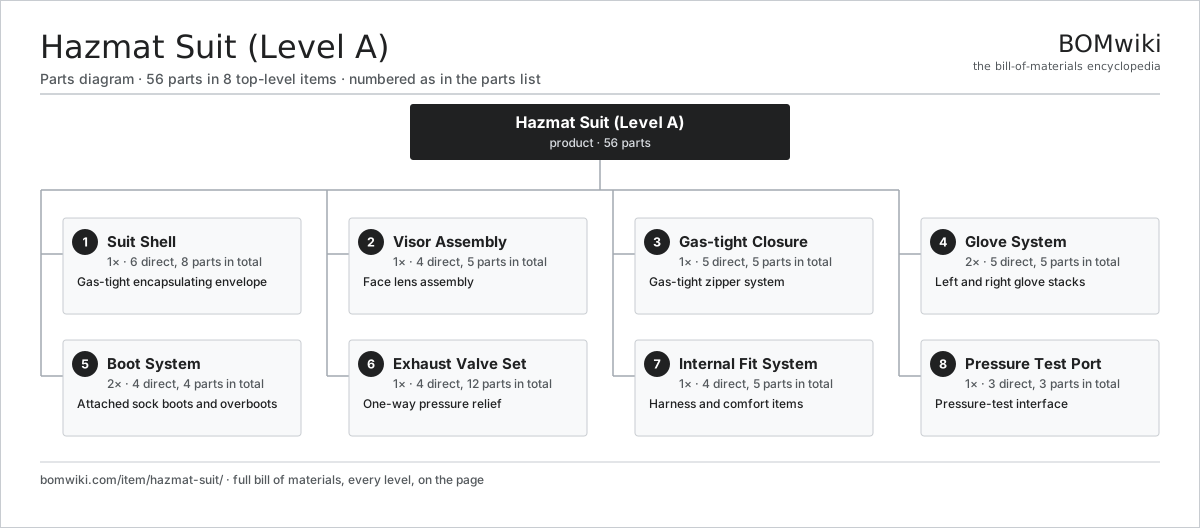
| # | Part | Qty | What it does |
|---|---|---|---|
| 1 | Suit Shell 6 parts | 1× | Gas-tight encapsulating envelope |
| 2 | Visor Assembly 4 parts | 1× | Face lens assembly |
| 3 | Gas-tight Closure 5 parts | 1× | Gas-tight zipper system |
| 4 | Glove System 5 parts | 2× | Left and right glove stacks |
| 5 | Boot System 4 parts | 2× | Attached sock boots and overboots |
| 6 | Exhaust Valve Set 4 parts | 1× | One-way pressure relief |
| 7 | Internal Fit System 4 parts | 1× | Harness and comfort items |
| 8 | Pressure Test Port 3 parts | 1× | Pressure-test interface |
3D model
No 3D model yet. Have a CAD file of this? Add a 3D model. STL renders right on this page; STEP, FreeCAD, and OpenSCAD sources are welcome too (openly licensed, like all 3D models on BOMwiki).
Build & assembly graph
expand / collapse · shared sub-assemblies converge · links to related products · est. labourTap an assembly to expand/collapse · tap a part to open it · use “Open page” for any node · drag to pan, scroll to zoom.
Bill of materials for Hazmat Suit (Level A)
8 top-level lines · 43 rows shown · 56 parts total · indented to 3 levels| # | Item / sub-assembly | Part no. | Qty/assy | Ext. qty | Parts | Type |
|---|---|---|---|---|---|---|
| 1 | Suit Shell 6 parts | hazmat-suit-shell | 1× | 1 | 8 | assembly |
| 1.1 | Barrier Laminate Fabric | hazmat-suit-barrier-laminate | 1× | 1 | · | part |
| 1.2 | Seam Sealing Tape | hazmat-suit-seam-tape | 1× | 1 | · | part |
| 1.3 | SCBA Accommodation Hump | hazmat-suit-scba-hump | 1× | 1 | · | part |
| 1.4 | Knee Reinforcement Patch | hazmat-suit-knee-reinforcement | 2× | 2 | · | part |
| 1.5 | Elbow Reinforcement Patch | hazmat-suit-elbow-reinforcement | 2× | 2 | · | part |
| 1.6 | Hood Section | hazmat-suit-hood-section | 1× | 1 | · | part |
| 2 | Visor Assembly 4 parts | hazmat-suit-visor | 1× | 1 | 5 | assembly |
| 2.1 | Visor Pane | hazmat-suit-visor-pane | 1× | 1 | · | part |
| 2.2 | Anti-fog Insert | hazmat-suit-antifog-insert | 1× | 1 | · | part |
| 2.3 | Visor Weld Flange | hazmat-suit-visor-flange | 1× | 1 | · | part |
| 2.4 | Tear-off Visor Cover | hazmat-suit-tearoff-cover | 2× | 2 | · | part |
| 3 | Gas-tight Closure 5 parts | hazmat-suit-closure | 1× | 1 | 5 | assembly |
| 3.1 | Gas-tight Zipper | hazmat-suit-gastight-zipper | 1× | 1 | · | part |
| 3.2 | Zipper Slider | hazmat-suit-zipper-slider | 1× | 1 | · | part |
| 3.3 | Splash Flap | hazmat-suit-splash-flap | 1× | 1 | · | part |
| 3.4 | Closure Lanyard | hazmat-suit-pull-lanyard | 1× | 1 | · | part |
| 3.5 | Zipper Sealant Wax | hazmat-suit-zipper-wax | 1× | 1 | · | part |
| 4 | Glove System 5 parts | hazmat-suit-glove-system | 2× | 2 | 5 | assembly |
| 4.1 | Inner Glove | hazmat-suit-inner-glove | 1× | 2 | · | part |
| 4.2 | Barrier Glove | hazmat-suit-barrier-glove | 1× | 2 | · | part |
| 4.3 | Outer Glove | hazmat-suit-outer-glove | 1× | 2 | · | part |
| 4.4 | Glove Bayonet Ring | hazmat-suit-glove-ring | 1× | 2 | · | part |
| 4.5 | O-Ring Set | oring-set | 1× | 2 | · | part |
| 5 | Boot System 4 parts | hazmat-suit-boot-system | 2× | 2 | 4 | assembly |
| 5.1 | Attached Sock Boot | hazmat-suit-sock-boot | 1× | 2 | · | part |
| 5.2 | Boot Seam Flange | hazmat-suit-boot-flange | 1× | 2 | · | part |
| 5.3 | Outer Safety Boot | hazmat-suit-safety-boot | 1× | 2 | · | part |
| 5.4 | Boot Splash Cuff | hazmat-suit-boot-cuff | 1× | 2 | · | part |
| 6 | Exhaust Valve Set 4 parts | hazmat-suit-exhaust-valves | 1× | 1 | 12 | assembly |
| 6.1 | Valve Diaphragm | hazmat-suit-valve-diaphragm | 3× | 3 | · | part |
| 6.2 | Valve Body | hazmat-suit-valve-body | 3× | 3 | · | part |
| 6.3 | Valve Splash Cover | hazmat-suit-valve-cover | 3× | 3 | · | part |
| 6.4 | Valve Gasket | hazmat-suit-valve-gasket | 3× | 3 | · | part |
| 7 | Internal Fit System 4 parts | hazmat-suit-internal-fit | 1× | 1 | 5 | assembly |
| 7.1 | Internal Waist Belt | hazmat-suit-waist-belt | 1× | 1 | · | part |
| 7.2 | Crotch Strap | hazmat-suit-crotch-strap | 1× | 1 | · | part |
| 7.3 | Sleeve Tether | hazmat-suit-glove-tether | 2× | 2 | · | part |
| 7.4 | Airline Pass-through | hazmat-suit-airline-passthrough | 1× | 1 | · | part |
| 8 | Pressure Test Port 3 parts | hazmat-suit-test-port | 1× | 1 | 3 | assembly |
| 8.1 | Test Inflation Adapter | hazmat-suit-test-adapter | 1× | 1 | · | part |
| 8.2 | Valve Test Plug | hazmat-suit-test-plug | 1× | 1 | · | part |
| 8.3 | Test Gauge | hazmat-suit-test-kit-gauge | 1× | 1 | · | part |
Something wrong in this list? Report a problem with this BOM.
Sourcing: possible vendors
Browse the supplier directory → Prices, MOQ, and lead times are algorithmic estimates, not quotes, and not claims about these companies. Company mappings are curated by keyword; est. price band $30–$1M. How estimates work| Vendor | HQ | Specialty | MOQ | Lead time |
|---|---|---|---|---|
| rosenbauer.com ↗ | Leonding, AT | Fire apparatus | 200 units | 8–14 wks |
|
🇺🇸Oshkosh
oshkoshcorp.com ↗
|
Oshkosh, US | Specialty trucks (Pierce) | 200 units | 8–14 wks |
| msasafety.com ↗ | Cranberry Township, US | Safety equipment | 200 units | 8–14 wks |
|
🇩🇪Dräger
draeger.com ↗
|
Lübeck, DE | Safety & medical tech | 200 units | 8–14 wks |
| honeywell.com ↗ | Charlotte, US | Building & safety tech | 200 units | 8–14 wks |
870-word article