Heliostat
ProductOverview
A heliostat is a large mirror tracking system that reflects direct-beam sunlight onto a fixed receiver (such as a power tower, solar furnace, or process-heat exchanger). Unlike fixed flat-plate collectors, heliostats concentrate solar flux by more than one order of magnitude, reaching temperatures of 1000–3500 °C depending on receiver design. They are the foundation of central receiver tower plants (SunPower, ABENGOA plants in Spain), research facilities (Plataforma Solar de Almería), and distributed industrial heating.
The heliostat continuously adjusts its mirror facets in two axes (azimuth and elevation) to track the sun's apparent motion throughout the day. A control electronics package samples solar position via on-board pyranometers or a reference sun-tracking sensor, then commands the azimuth and elevation drives to minimize the angle between the mirror normal and the incident sunlight direction. Tracking error is typically ±0.1°, necessary to deliver the focused beam to a small receiver aperture.
How it Works
Mirror Facets
The Mirror Facets assembly comprises 30–40 individual glass-mirror segments (typically 1–2 m²) arranged in a flat array. Each segment is a precision-cut piece of borosilicate glass with a vacuum-deposited or chemically-silvered aluminum-oxide back surface. The segments are mounted in an aluminum support frame with Fastener Clips that allow thermal expansion without cracking glass. Borosilicate is chosen for its low thermal expansion coefficient (3 × 10⁻⁶ /K) and high optical transmittance; the silvered surface achieves 90–94% reflectance at normal incidence, degrading slightly at oblique angles.
Azimuth Drive
The entire mirror assembly rotates about a vertical axis via the Azimuth Drive. The Azimuth Motor (typically 2–3 kW AC or DC) drives through a Azimuth Gearbox (50:1 to 100:1 worm reducer) to a Azimuth Bearing Ring, a large-diameter slew bearing rated for 360° continuous rotation. The gear ratio limits slew speed to 3–5°/min, a conservative rate that reduces tracking overshoot and optical aberration. An Encoder Disk on the motor shaft reports position to the controller; the Azimuth Brake (spring-set, fail-safe) holds the mirror during power loss or stow.
Elevation Drive
A pair of heliostat-elevation-actuators (linear hydraulic or electric cylinders) are mechanically connected via the Elevation Linkage to tilt the mirror frame. The linkage geometry converts linear stroke to elevation angle (typically ±30° to ±60° depending on latitude and application). A Potentiometer Feedback transducer provides real-time angle feedback. Stoppers at each limit prevent over-travel and wind-stow collision.
Pedestal
The Pedestal is a steel tower rising 8–15 m above grade, supporting the azimuth slew bearing at its top. The Pedestal Column is a vertical tube, stiffened by Pedestal Gussets and anchored to a massive Pedestal Base Plate embedded in a reinforced-concrete foundation mat. The pedestal must resist not only the vertical load of the mirror (15–25 tons) but also bending moments from azimuth acceleration, elevation tilt, and steady 45 m/s wind loads.
Control Electronics
The Control Electronics cabinet houses a Microcontroller running a sun-tracking algorithm, a Motor Drive Module providing variable-frequency or PWM drive to the motors, Power Distribution (breakers, contactors), and a relay pair for brake and safety interlocks. The cabinet is NEMA 4X (stainless-steel) with thermostat-controlled ventilation. Command signals arrive over industrial Ethernet (Modbus TCP) or hardwired analog commands (0–10 V).
Tracking Sensor
The Tracking Sensor typically comprises two pyranometers (four-quadrant silicon photodiode arrays) mounted on the mirror frame itself, or a reference sun-position sensor mounted elsewhere. By comparing irradiance on opposing quadrants, the controller computes the angle error and issues corrective commands to both axes. The Sensor Junction Box amplifies and filters these signals to a 0–10 V range for the Microcontroller.
Cabling and Foundation
Power and signals route through the Cable Tray, which includes 3-phase power, shielded signal pairs, and a Earthing Braid for EMC compliance. The Foundation Hardware consists of eight anchor bolts epoxy-grouted into the concrete mat, plus a Ballast Frame holding concrete or filled sand bags to ensure overturning resistance during wind and seismic events.
Operating Envelope
Heliostats typically operate between −20 °C and +60 °C, and are parked (stowed to 0° elevation, azimuth uncontrolled) during high winds above 45–65 m/s. Daily tracking is bidirectional, the mirror points east at dawn, follows the sun westward throughout the day, and parks west at sunset to minimize nighttime weather exposure. Winter tracking is less productive at high latitudes due to low sun angle, but modern layouts use banks of south-facing heliostats to maximize winter solstice performance.
Standards and Design Life
Large heliostats are designed to a 20–30 year operational life, with annual maintenance of facet cleaning, bearing lubrication, and seal replacement. Mirror facets are replaceable modules, allowing in-place refurbishment. European (DIN, CEN) and U.S. (ASME, IEEE) standards govern structural loads, electrical safety, and thermal controls. The field is moving toward distributed modular heliostats with integrated wireless control to simplify deployment in utility-scale solar-thermal plants.
Heliostat parts and their functions
8 top-level parts · 153 parts in total · full bill of materials below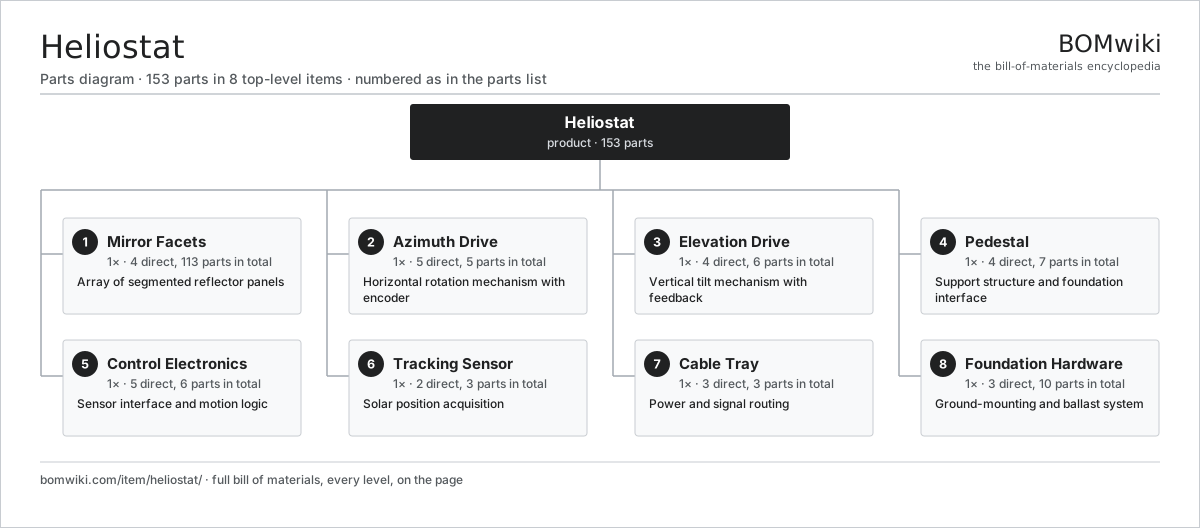
| # | Part | Qty | What it does |
|---|---|---|---|
| 1 | Mirror Facets 4 parts | 1× | Array of segmented reflector panels |
| 2 | Azimuth Drive 5 parts | 1× | Horizontal rotation mechanism with encoder |
| 3 | Elevation Drive 4 parts | 1× | Vertical tilt mechanism with feedback |
| 4 | Pedestal 4 parts | 1× | Support structure and foundation interface |
| 5 | Control Electronics 5 parts | 1× | Sensor interface and motion logic |
| 6 | Tracking Sensor 2 parts | 1× | Solar position acquisition |
| 7 | Cable Tray 3 parts | 1× | Power and signal routing |
| 8 | Foundation Hardware 3 parts | 1× | Ground-mounting and ballast system |
3D model
No 3D model yet. Have a CAD file of this? Add a 3D model. STL renders right on this page; STEP, FreeCAD, and OpenSCAD sources are welcome too (openly licensed, like all 3D models on BOMwiki).
Build & assembly graph
expand / collapse · shared sub-assemblies converge · links to related products · est. labourTap an assembly to expand/collapse · tap a part to open it · use “Open page” for any node · drag to pan, scroll to zoom.
Bill of materials for Heliostat
8 top-level lines · 38 rows shown · 153 parts total · indented to 3 levels| # | Item / sub-assembly | Part no. | Qty/assy | Ext. qty | Parts | Type |
|---|---|---|---|---|---|---|
| 1 | Mirror Facets 4 parts | heliostat-mirror-facets | 1× | 1 | 113 | assembly |
| 1.1 | Glass Segments | heliostat-glass-segments | 36× | 36 | · | part |
| 1.2 | Facet Frame | heliostat-facet-frame | 1× | 1 | · | part |
| 1.3 | Fastener Clips | heliostat-fastener-clips | 72× | 72 | · | part |
| 1.4 | Thermal Expansion Joints | heliostat-thermal-expansion-joints | 4× | 4 | · | part |
| 2 | Azimuth Drive 5 parts | heliostat-azimuth-drive | 1× | 1 | 5 | assembly |
| 2.1 | Azimuth Motor | heliostat-azimuth-motor | 1× | 1 | · | part |
| 2.2 | Azimuth Gearbox | heliostat-azimuth-gearbox | 1× | 1 | · | part |
| 2.3 | Azimuth Bearing Ring | heliostat-azimuth-bearing-ring | 1× | 1 | · | part |
| 2.4 | Encoder Disk | heliostat-encoder-disk | 1× | 1 | · | part |
| 2.5 | Azimuth Brake | heliostat-azimuth-brake | 1× | 1 | · | part |
| 3 | Elevation Drive 4 parts | heliostat-elevation-drive | 1× | 1 | 6 | assembly |
| 3.1 | Elevation Actuator | heliostat-elevation-actuator | 2× | 2 | · | part |
| 3.2 | Elevation Linkage | heliostat-elevation-linkage | 1× | 1 | · | part |
| 3.3 | Potentiometer Feedback | heliostat-potentiometer-feedback | 1× | 1 | · | part |
| 3.4 | Elevation Stopper | heliostat-elevation-stopper | 2× | 2 | · | part |
| 4 | Pedestal 4 parts | heliostat-pedestal | 1× | 1 | 7 | assembly |
| 4.1 | Pedestal Column | heliostat-pedestal-column | 1× | 1 | · | part |
| 4.2 | Pedestal Gussets | heliostat-pedestal-gussets | 4× | 4 | · | part |
| 4.3 | Pedestal Base Plate | heliostat-pedestal-base-plate | 1× | 1 | · | part |
| 4.4 | Cable Conduit | heliostat-cable-conduit | 1× | 1 | · | part |
| 5 | Control Electronics 5 parts | heliostat-control-electronics | 1× | 1 | 6 | assembly |
| 5.1 | Microcontroller | mcu | 1× | 1 | · | part |
| 5.2 | Motor Drive Module | heliostat-motor-drive-module | 1× | 1 | · | part |
| 5.3 | Power Distribution | heliostat-power-distribution | 1× | 1 | · | part |
| 5.4 | Enclosure | heliostat-enclosure | 1× | 1 | · | part |
| 5.5 | Relay | relay | 2× | 2 | · | part |
| 6 | Tracking Sensor 2 parts | heliostat-tracking-sensor | 1× | 1 | 3 | assembly |
| 6.1 | Pyranometer | heliostat-pyranometer | 2× | 2 | · | part |
| 6.2 | Sensor Junction Box | heliostat-sensor-junction-box | 1× | 1 | · | part |
| 7 | Cable Tray 3 parts | heliostat-cable-tray | 1× | 1 | 3 | assembly |
| 7.1 | Power Cable | heliostat-power-cable | 1× | 1 | · | part |
| 7.2 | Signal Bundle | heliostat-signal-bundle | 1× | 1 | · | part |
| 7.3 | Earthing Braid | heliostat-earthing-braid | 1× | 1 | · | part |
| 8 | Foundation Hardware 3 parts | heliostat-foundation-hardware | 1× | 1 | 10 | assembly |
| 8.1 | Anchor Bolts | heliostat-anchor-bolts | 8× | 8 | · | part |
| 8.2 | Bearing Pad | heliostat-bearing-pad | 1× | 1 | · | part |
| 8.3 | Ballast Frame | heliostat-ballast-frame | 1× | 1 | · | part |
Something wrong in this list? Report a problem with this BOM.
Sourcing: possible vendors
Browse the supplier directory → Prices, MOQ, and lead times are algorithmic estimates, not quotes, and not claims about these companies. Company mappings are curated by keyword; est. price band $100–$20M. How estimates work| Vendor | HQ | Specialty | MOQ | Lead time |
|---|---|---|---|---|
|
🇩🇰Vestas
vestas.com ↗
|
Aarhus, DK | Wind turbines | 500 units | 12–24 wks |
| firstsolar.com ↗ | Tempe, US | PV modules | 500 units | 12–24 wks |
|
🇨🇳LONGi
longi.com ↗
|
Xi'an, CN | Solar wafers & modules | 500 units | 12–24 wks |
| enphase.com ↗ | Fremont, US | Microinverters & storage | 500 units | 12–24 wks |
|
🇨🇳Sungrow
sungrowpower.com ↗
|
Hefei, CN | Solar inverters & storage | 500 units | 12–24 wks |
879-word article