Hot Box Detector
ProductOverview
A hot-box detector is a stationary wayside monitoring system that automatically detects bearing failures in passing freight and passenger trains by measuring the infrared radiation (thermal signature) of journal bearings as wheels pass. A bearing overheating is a precursor to seizure, which in turn causes axle drag, wheel flat-spotting, and potentially derailment. Modern railways depend on these detectors to identify failing cars before they cause catastrophic failure, enabling crews to stop and inspect the train or re-route it to a repair facility. The system is entirely automatic and non-contact, the Infrared Thermal Scanner observes passing trains from the track side and alerts the Signal Processing and Control Cabinet, which logs the event and transmits an alarm via the Data Telemetry Modem to the operations center.
The Infrared Thermal Scanner mounted on a Trackside Mounting Structure uses an IR Detector Array (microbolometer) to sense thermal radiation from the journal bearing as the train passes. A Axle Rotation Wheel Sensor (inductive or photoelectric) is triggered by a passing wheel, signaling the Signal Processing and Control Cabinet to sample and store the IR image. The controller runs a pre-loaded temperature profile for the track location and vehicle type, and compares the observed bearing temperature to learned baselines; if a bearing reads more than 30–50 °C above the normal range for its speed and ambient temperature, an alarm is latched. The Data Telemetry Modem immediately transmits the alert to central dispatch, providing car number, train direction, bearing location, and measured temperature.
How it works
A fully-loaded freight train approaches the detector site at 80 km/h. The Axle Rotation Wheel Sensor detects the leading wheel set and triggers the Signal Processing and Control Cabinet to arm. As subsequent wheels pass, the controller captures IR Detector Array thermal images at high rate (50–100 Hz). Each image is a vertical line of 8–16 pixels, where each pixel represents a small vertical strip of the bearing area. By combining successive images, the system reconstructs a thermal profile of the entire bearing surface as it sweeps past the Optical and Mirror Assembly window.
The Microcontroller computes the peak temperature in each profile and compares it to a reference table based on train speed (from Axle Rotation Wheel Sensor pulse frequency), ambient temperature (via weather station input or lineside sensor), and expected bearing temperature for the rail class. A normal bearing on a 100-car freight train might range 55–75 °C depending on speed and friction. If the Threshold Logic Board logic detects a bearing at 105 °C (indicating likely imminent failure), the Alarm Relay latches and the Data Logger Memory records the event with timestamp, speed, car number (if automated via train consist reporting), and precise temperature.
Simultaneously, the Data Telemetry Modem dials the operations center (via GSM/Cellular Modem cellular connection) and transmits an SMS or data packet reporting "Hot bearing Detector 47A, southbound freight, car 15 of 110, 102 °C, speed 85 km/h, 14:37 UTC." Dispatch immediately notifies the train crew by radio, and the locomotive engineer plots the nearest siding. The crew brings the train to a stop, walks or inspects the reported car, and confirms either a real failure (journal seizing, smoke visible) or a false positive (brake operation heat, cold weather thermal anomaly). Modern algorithms, trained on years of data, achieve 95%+ accuracy.
Design considerations
The IR Detector Array uses microbolometer technology because it is passive, requires no cryogenic cooling, and tolerates the vibration and temperature extremes of railroad trackside. Pyroelectric alternatives (older) require periodic recalibration and are slower. The Optical and Mirror Assembly mirror and lens are angled to view the bearing journal from the side as the wheel passes; a perpendicular view would miss the hottest spots which are often on the under-journal (load-bearing) side.
The Axle Rotation Wheel Sensor is crucial for synchronization: wheels pass at unpredictable intervals, and if IR sampling were continuous, the array would collect gigabytes of worthless baseline data. The inductive trigger on a wheel's magnetic impulse is robust and requires no line-of-sight; it operates reliably in rain and dust. The Microcontroller running thermal-profile analysis is computationally simple, a few arithmetic comparisons per second, so low-power embedded CPUs suffice.
Power budget is critical in remote locations. The Solar Panel provides 20–50 W during daylight, charging the Battery Backup for night operation. A full day of sampling 200 trains draws only 50–100 Wh; overnight trickle draw is minimal. The Data Telemetry Modem is the largest consumer, transmitting 30–50 SMS alerts per day (each ~50 bytes), consuming 2–5 Wh. Solar-only systems with battery reserve are economical and eliminate the need for lineside AC feeder cables.
Maintenance is straightforward: the Lens Wiper Blade is motorized to clean the IR Window after rain, preventing condensation; every 12 months the optical path is aligned and the Threshold Logic Board setpoints are adjusted for seasonal drift in bearing temperature profiles. False-alarm tuning is continuous: if a detector reports 50 hot bearings per month and only 2 are confirmed as real failures, the threshold is raised slightly to reduce nuisance alerts.
Hot Box Detector parts and their functions
7 top-level parts · 39 parts in total · full bill of materials below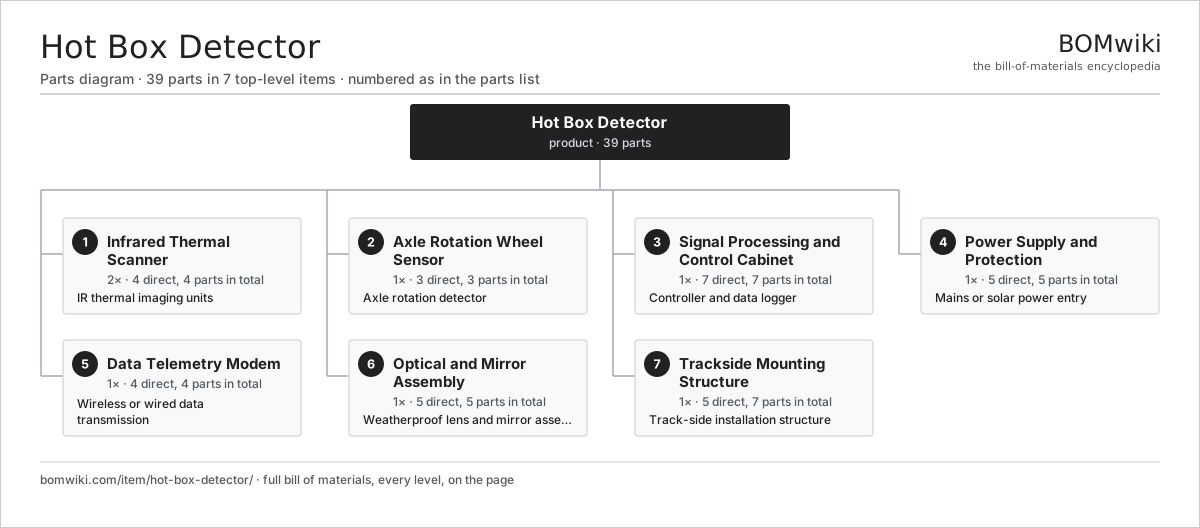
| # | Part | Qty | What it does |
|---|---|---|---|
| 1 | Infrared Thermal Scanner 4 parts | 2× | IR thermal imaging units |
| 2 | Axle Rotation Wheel Sensor 3 parts | 1× | Axle rotation detector |
| 3 | Signal Processing and Control Cabinet 7 parts | 1× | Controller and data logger |
| 4 | Power Supply and Protection 5 parts | 1× | Mains or solar power entry |
| 5 | Data Telemetry Modem 4 parts | 1× | Wireless or wired data transmission |
| 6 | Optical and Mirror Assembly 5 parts | 1× | Weatherproof lens and mirror assembly |
| 7 | Trackside Mounting Structure 5 parts | 1× | Track-side installation structure |
3D model
No 3D model yet. Have a CAD file of this? Add a 3D model. STL renders right on this page; STEP, FreeCAD, and OpenSCAD sources are welcome too (openly licensed, like all 3D models on BOMwiki).
Build & assembly graph
expand / collapse · shared sub-assemblies converge · links to related products · est. labourTap an assembly to expand/collapse · tap a part to open it · use “Open page” for any node · drag to pan, scroll to zoom.
Bill of materials for Hot Box Detector
7 top-level lines · 40 rows shown · 39 parts total · indented to 3 levels| # | Item / sub-assembly | Part no. | Qty/assy | Ext. qty | Parts | Type |
|---|---|---|---|---|---|---|
| 1 | Infrared Thermal Scanner 4 parts | hot-box-detector-infrared-scanner | 2× | 2 | 4 | assembly |
| 1.1 | IR Detector Array | hot-box-detector-ir-detector-array | 1× | 2 | · | part |
| 1.2 | Infrared Lens | hot-box-detector-lens-assembly | 1× | 2 | · | part |
| 1.3 | IR Electronics Module | hot-box-detector-electronics-module | 1× | 2 | · | part |
| 1.4 | IR Window | hot-box-detector-ir-window | 1× | 2 | · | part |
| 2 | Axle Rotation Wheel Sensor 3 parts | hot-box-detector-wheel-sensor | 1× | 1 | 3 | assembly |
| 2.1 | Pulse Trigger Sensor | hot-box-detector-wheel-pulse-sensor | 1× | 1 | · | part |
| 2.2 | Trigger Magnet | hot-box-detector-sensor-magnet | 1× | 1 | · | part |
| 2.3 | Sensor Mount Bracket | hot-box-detector-sensor-mount | 1× | 1 | · | part |
| 3 | Signal Processing and Control Cabinet 7 parts | hot-box-detector-processing-cabinet | 1× | 1 | 7 | assembly |
| 3.1 | Microcontroller | hot-box-detector-microcontroller | 1× | 1 | · | part |
| 3.2 | Data Logger Memory | hot-box-detector-data-logger | 1× | 1 | · | part |
| 3.3 | Threshold Logic Board | hot-box-detector-temperature-threshold | 1× | 1 | · | part |
| 3.4 | Alarm Relay | hot-box-detector-alarm-relay | 1× | 1 | · | part |
| 3.5 | Display Status Panel | hot-box-detector-display-panel | 1× | 1 | · | part |
| 3.6 | Electronics Enclosure | hot-box-detector-enclosure | 1× | 1 | · | part |
| 3.7 | Enclosure Cooling Fan | hot-box-detector-cooling-fan | 1× | 1 | · | part |
| 4 | Power Supply and Protection 5 parts | hot-box-detector-power-supply | 1× | 1 | 5 | assembly |
| 4.1 | Main Breaker | hot-box-detector-mains-breaker | 1× | 1 | · | part |
| 4.2 | Fuse Holder | hot-box-detector-fuse-holder | 1× | 1 | · | part |
| 4.3 | Solar Panel | hot-box-detector-solar-panel | 1× | 1 | · | part |
| 4.4 | Battery Backup | hot-box-detector-battery-backup | 1× | 1 | · | part |
| 4.5 | Surge Protection Device | hot-box-detector-surge-suppressor | 1× | 1 | · | part |
| 5 | Data Telemetry Modem 4 parts | hot-box-detector-telemetry-modem | 1× | 1 | 4 | assembly |
| 5.1 | GSM/Cellular Modem | hot-box-detector-gsm-modem | 1× | 1 | · | part |
| 5.2 | Cellular Antenna | hot-box-detector-antenna | 1× | 1 | · | part |
| 5.3 | Serial Interface Module | hot-box-detector-serial-interface | 1× | 1 | · | part |
| 5.4 | Modem Cable | hot-box-detector-modem-cable | 1× | 1 | · | part |
| 6 | Optical and Mirror Assembly 5 parts | hot-box-detector-optical-housing | 1× | 1 | 5 | assembly |
| 6.1 | Optical Housing | hot-box-detector-aluminum-housing | 1× | 1 | · | part |
| 6.2 | Reflective Mirror | hot-box-detector-mirror-optic | 1× | 1 | · | part |
| 6.3 | Mirror Tilt Screw | hot-box-detector-mirror-tilt-adjustment | 1× | 1 | · | part |
| 6.4 | Lens Wiper Blade | hot-box-detector-wiper-blade | 1× | 1 | · | part |
| 6.5 | Optical Seal Gasket | hot-box-detector-sealed-gasket | 1× | 1 | · | part |
| 7 | Trackside Mounting Structure 5 parts | hot-box-detector-mounting-frame | 1× | 1 | 7 | assembly |
| 7.1 | Mounting Post | hot-box-detector-mounting-post | 1× | 1 | · | part |
| 7.2 | Attachment Bracket | hot-box-detector-mounting-bracket | 2× | 2 | · | part |
| 7.3 | Height Adjuster | hot-box-detector-height-adjustment | 1× | 1 | · | part |
| 7.4 | Vibration Isolator | hot-box-detector-vibration-isolator | 2× | 2 | · | part |
| 7.5 | Fastener Set | fastener-set | 1× | 1 | · | part |
Something wrong in this list? Report a problem with this BOM.
Sourcing: possible vendors
Browse the supplier directory → Prices, MOQ, and lead times are algorithmic estimates, not quotes, and not claims about these companies. Company mappings are curated by keyword; est. price band $500k–$60M. How estimates work| Vendor | HQ | Specialty | MOQ | Lead time |
|---|---|---|---|---|
|
🇨🇳CRRC
crrcgc.cc ↗
|
Beijing, CN | Rolling stock & rail systems | made to order | 40–72 wks |
|
🇫🇷Alstom
alstom.com ↗
|
Saint-Ouen, FR | Rail rolling stock | made to order | 40–72 wks |
| mobility.siemens.com ↗ | Munich, DE | Rail systems | made to order | 40–72 wks |
| stadlerrail.com ↗ | Bussnang, CH | Rail rolling stock | made to order | 40–72 wks |
|
🇺🇸Wabtec
wabteccorp.com ↗
|
Pittsburgh, US | Rail equipment | made to order | 40–72 wks |
921-word article