Hot Fill Line
ProductOverview
Hot-fill-hold-cool is the simplest form of aseptic processing and the workhorse of juice and ready-to-drink beverage production. The principle is thermal lethality: a product heated to 70–90 °C and held at that temperature long enough to kill vegetative pathogens and some spores, then sealed in a bottle while hot and cooled to ambient, relies on the residual thermal kill of the sealed product interior. Unlike aseptic filling (which requires sterile chambers and H2O2 vapor), hot-fill-hold-cool is mechanical and robust, no H2O2 generators, no vacuum chambers, no complex H2O2 validation. It is ideal for acid products (juice, tea, sauce) where heat-resistant spoilage organisms (like mold and lactobacilli) are absent and Clostridium botulinum (the safety driver in low-acid foods) is not a concern.
The product is heated in a heat exchanger, filled into bottles while at 70–90 °C, capped immediately (before it cools), and then cooled gradually in a water-spray tunnel. The cap forms an airtight seal while the product is hot, trapping a small headspace of steam and hot product; as the product cools, the steam condenses, forming a partial vacuum that sucks the bottle cap down tighter, a self-tightening seal. Shelf life at ambient is 6–12 months for juice and 12–24 months for acidic condiments, with superior color and flavor retention compared to retort canning.
How it works
Heating: Incoming product (from a 20 °C supply) passes through a plate-frame heat exchanger where steam or hot water supplies thermal energy. The product raises from 20 °C to 70–90 °C in seconds. A thermostatic bypass valve downstream prevents over-heating; if temperature exceeds setpoint (e.g., 85 °C), excess hot product is diverted back to the feed tank. The heated product then flows to an insulated holding tank (100–500 liter, heated jacket) that maintains temperature until the filler draws from it. The tank agitator prevents thermal stratification and settling of particulates.
Filling: A rotary or piston filler (4–6 fill heads on a rotating turret) draws hot product from the tank and dispenses it into bottles that are indexed one by one onto a fill platform. Piston pumps are preferred for hot fill because they are more tolerant of thermal expansion of seals and product density changes. Fill heads with heat-resistant PTFE or ceramic seals can handle 70–90 °C product indefinitely. Volume is metered by piston stroke; typical accuracy is ±10–20 mL per 300–500 mL bottle, which is acceptable for juice and beverage products.
Capping: Immediately (within 2–5 seconds) after the bottle is filled, it is moved to a capping station where a hot-rated capping spindle applies a cap and torques it to 2–5 N·m. The bottle still contains product at 80–85 °C; the plastic or glass is hot to the touch. The cap is either a standard screw-cap (plastic) or a flip-top cap, applied while hot. As the product cools, the internal gas pressure and liquid contraction create a partial vacuum inside the bottle, pulling the cap seal tighter and forming a strong hermetic seal. This is the self-closing mechanism that makes hot-fill-hold-cool work.
Cooling: The capped, filled bottles enter a long water-spray cooling tunnel (5–15 meters, depending on desired cooling rate). Water spray from overhead and side nozzles gradually cools the bottles from 80–85 °C down to 40–50 °C over 5–15 minutes. Slow cooling is intentional: rapid cooling stresses plastic bottles (they may warp or shrink excessively) and can cause the cap to loosen if the interior reaches ambient too quickly. The cooling tunnel is insulated to stabilize temperature and is sloped so condensate and spray water drain to a sump, then to a floor drain. A thermostatic mixing valve maintains spray water at 15–25 °C for consistent cooling performance.
Drying and discharge: After cooling to ~40 °C, bottles exit the cooling tunnel, pass through an optional air-dry station (high-velocity jets removing surface water), and then move to labeling and case-packing. At this point, the bottles are sealed, cooled, and shelf-stable.
Thermal basis for shelf stability
The lethality of heat depends on the time-temperature combination. For acid products (pH <4.0, like juice and most sauces), the dominant spoilage organisms are osmophilic yeasts (Zygosaccharomyces rouxii) and acetic acid bacteria, not Clostridium botulinum (which cannot grow below pH 4.6). A heat treatment of 70 °C for just 5 seconds kills most vegetative cells and heat-sensitive spores. For a 500 mL bottle filled at 75 °C with air temperature and cooling time, the product interior takes 2–3 minutes to cool below 65 °C, so the total lethal time is 5 sec (active heating) + 2–3 min (passive cooling) = 2–3 minutes, sufficient to achieve shelf stability.
For longer shelf life (12+ months) and for products with particulates, a higher fill temperature (85–90 °C) and longer active holding time in the tank may be specified. Process schedules are typically validated by microbiological challenge studies.
Advantages and limitations
Advantages:
- Simple, robust machinery (no pressure vessels, no H2O2 chambers, no complex control)
- Low capital cost ($200,000–$500,000 for a line)
- Excellent product quality (minimal thermal damage, color and flavor retention)
- Flexible packaging (any plastic or glass bottle)
- Ambient shelf life without cold chain (6–12 months for juice, longer for sauces)
Limitations:
- Applicable only to acid products (pH <4.0); low-acid products require retort or aseptic filling
- Packaging must be heat-stable (plastic bottles must resist 85 °C without deformation; glass is preferred)
- Cooling tower required (or access to cool well water), consuming 100–500 GPH
- Throughput is moderate (50–150 bottles/min), compared to 200+ for retort canning
Common issues and troubleshooting
Insufficient cooling: If the cooling tunnel is too short or the water supply is warm, bottles may exit still warm (>50 °C), allowing condensation inside the bottle during storage and microbial growth. Remedy: extend the cooling tunnel, use chilled water, or reduce line speed to increase tunnel residence time.
Cap loosening after cooling: If the interior of the bottle cools too rapidly (e.g., if spray water is ice-cold), the partial vacuum may be weak, and the cap can loosen, allowing air ingress and spoilage. Remedy: maintain spray water at 15–25 °C (not below 10 °C); verify thermostatic mixer is working; slow the cooling rate if needed.
Bottle deformation: Plastic bottles (especially thin-walled designs) may shrink or wrinkle during rapid cooling. Remedy: use heavier-gauge plastic, slow the cooling rate, and ensure spray water is not too cold. Glass bottles are immune.
Product oxidation: Some juices (especially cloudy apple juice) are sensitive to oxidation at 80–85 °C. If the fill headspace is too large or the cap seal is initially loose, oxygen can diffuse in, causing browning or off-flavor. Remedy: minimize headspace, ensure fill volume is consistent, and verify cap torque is within specification.
Seal failure and leakage: If caps are not properly torqued or if bottle threads are damaged, caps may leak after cooling, allowing microbial ingress. Remedy: audit cap torque setting (use a torque wrench to verify 2–5 N·m), inspect bottle threads, and reject any bottles with visible defects.
Validation and regulatory requirements
Hot-fill-hold-cool processes are regulated by FDA (21 CFR 114) and must be validated via thermal processing authority review or in-house microbiological testing. A process schedule specifies product fill temperature, holding time, cooling procedure, and proof of shelf stability (accelerated shelf-life testing, challenge studies). All process data (temperature, fill volume, production date/time) must be logged; deviations (failure to reach fill temperature, premature cooling, under-fill) must trigger product hold and investigation.
Energy and water consumption
A typical 100 bottle/min line requires:
- 15–25 kW heating (to raise product from 20 °C to 85 °C at 100–200 L/min)
- 5–10 kW cooling pump and motor
- 200–400 GPH cooling water (depending on cooling rate and ambient temperature)
Operating 8 hours per day, this is 120–200 kWh per day ($6–$10 at $0.05/kWh) plus cooling water cost. A 500-bottle cooling tunnel with 10-minute residence time requires 4–8 liters of water per bottle × 100 bottles/min = 400–800 liters/min, which is substantial; many facilities recirculate cooling water through a chiller to reduce consumption.
Hot Fill Line parts and their functions
8 top-level parts · 45 parts in total · full bill of materials below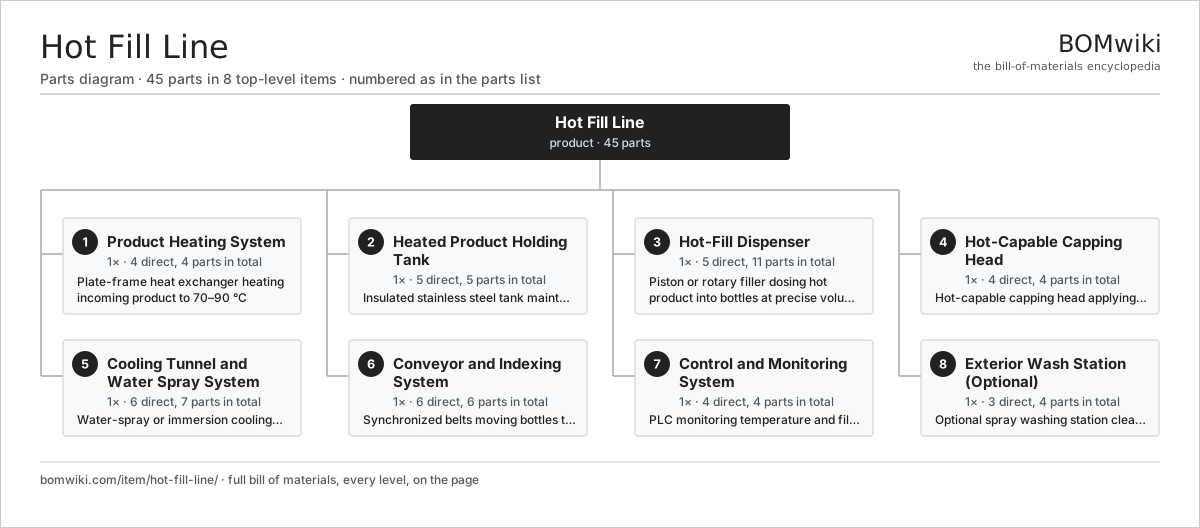
| # | Part | Qty | What it does |
|---|---|---|---|
| 1 | Product Heating System 4 parts | 1× | Plate-frame heat exchanger heating incoming product to 70–90 °C |
| 2 | Heated Product Holding Tank 5 parts | 1× | Insulated stainless steel tank maintaining product temperature pre-fill |
| 3 | Hot-Fill Dispenser 5 parts | 1× | Piston or rotary filler dosing hot product into bottles at precise volume |
| 4 | Hot-Capable Capping Head 4 parts | 1× | Hot-capable capping head applying caps while bottle contents are >65 °C |
| 5 | Cooling Tunnel and Water Spray System 6 parts | 1× | Water-spray or immersion cooling chamber reducing bottles from 85 °C to 40 °C |
| 6 | Conveyor and Indexing System 6 parts | 1× | Synchronized belts moving bottles through heat, fill, cap, and cooling stations |
| 7 | Control and Monitoring System 4 parts | 1× | PLC monitoring temperature and fill volume, logging production data |
| 8 | Exterior Wash Station (Optional) 3 parts | 1× | Optional spray washing station cleaning exterior of bottles post-fill |
3D model
No 3D model yet. Have a CAD file of this? Add a 3D model. STL renders right on this page; STEP, FreeCAD, and OpenSCAD sources are welcome too (openly licensed, like all 3D models on BOMwiki).
Build & assembly graph
expand / collapse · shared sub-assemblies converge · links to related products · est. labourTap an assembly to expand/collapse · tap a part to open it · use “Open page” for any node · drag to pan, scroll to zoom.
Bill of materials for Hot Fill Line
8 top-level lines · 45 rows shown · 45 parts total · indented to 3 levels| # | Item / sub-assembly | Part no. | Qty/assy | Ext. qty | Parts | Type |
|---|---|---|---|---|---|---|
| 1 | Product Heating System 4 parts | hot-fill-line-product-heater | 1× | 1 | 4 | assembly |
| 1.1 | Plate Heat Exchanger | hot-fill-line-plate-heat-exchanger | 1× | 1 | · | part |
| 1.2 | Steam Pressure Regulator | hot-fill-line-steam-regulator | 1× | 1 | · | part |
| 1.3 | Thermostatic Bypass Valve | hot-fill-line-thermostatic-bypass | 1× | 1 | · | part |
| 1.4 | Product Flow Control | hot-fill-line-flow-control | 1× | 1 | · | part |
| 2 | Heated Product Holding Tank 5 parts | hot-fill-line-holding-tank | 1× | 1 | 5 | assembly |
| 2.1 | Tank Vessel | hot-fill-line-tank-vessel | 1× | 1 | · | part |
| 2.2 | Tank Agitator | hot-fill-line-tank-agitator | 1× | 1 | · | part |
| 2.3 | Tank Heating Element | hot-fill-line-tank-heater | 1× | 1 | · | part |
| 2.4 | Tank Temperature Sensor | hot-fill-line-tank-thermometer | 1× | 1 | · | part |
| 2.5 | Tank Feed Pump | hot-fill-line-tank-pump | 1× | 1 | · | part |
| 3 | Hot-Fill Dispenser 5 parts | hot-fill-line-filler | 1× | 1 | 11 | assembly |
| 3.1 | Filler Bowls | hot-fill-line-fill-bowls | 1× | 1 | · | part |
| 3.2 | Piston Pump Heads | hot-fill-line-fill-pistons | 4× | 4 | · | part |
| 3.3 | Filler Drive Motor | hot-fill-line-fill-motor | 1× | 1 | · | part |
| 3.4 | Filler Heating Jacket | hot-fill-line-hot-water-jacket | 1× | 1 | · | part |
| 3.5 | Piston Position Sensor | hot-fill-line-fill-sensor | 4× | 4 | · | part |
| 4 | Hot-Capable Capping Head 4 parts | hot-fill-line-capper | 1× | 1 | 4 | assembly |
| 4.1 | Cap Dispenser Chute | hot-fill-line-cap-chute | 1× | 1 | · | part |
| 4.2 | Capping Spindle | hot-fill-line-cap-spindle | 1× | 1 | · | part |
| 4.3 | Cap Collet | hot-fill-line-heat-resistant-collet | 1× | 1 | · | part |
| 4.4 | Torque Spring Assembly | hot-fill-line-torque-adjustment | 1× | 1 | · | part |
| 5 | Cooling Tunnel and Water Spray System 6 parts | hot-fill-line-cooling-tunnel | 1× | 1 | 7 | assembly |
| 5.1 | Cooling Chamber Vessel | hot-fill-line-cooling-chamber | 1× | 1 | · | part |
| 5.2 | Spray Headers | hot-fill-line-spray-headers | 2× | 2 | · | part |
| 5.3 | Cooling Water Pump | hot-fill-line-cooling-pump | 1× | 1 | · | part |
| 5.4 | Water Temperature Mixer | hot-fill-line-temperature-mixer | 1× | 1 | · | part |
| 5.5 | Drain Sump | hot-fill-line-drain-sump | 1× | 1 | · | part |
| 5.6 | Bottle Indexing Pusher | hot-fill-line-bottle-pusher | 1× | 1 | · | part |
| 6 | Conveyor and Indexing System 6 parts | hot-fill-line-conveyor-system | 1× | 1 | 6 | assembly |
| 6.1 | Input Conveyor | hot-fill-line-input-conveyor | 1× | 1 | · | part |
| 6.2 | Indexing Accumulator | hot-fill-line-indexing-accumulator | 1× | 1 | · | part |
| 6.3 | Filler Pusher | hot-fill-line-fill-pusher | 1× | 1 | · | part |
| 6.4 | Capper Pusher | hot-fill-line-cap-pusher | 1× | 1 | · | part |
| 6.5 | Cooling Tunnel Belt | hot-fill-line-cooling-belt | 1× | 1 | · | part |
| 6.6 | Main Drive Motor | hot-fill-line-conveyor-motor | 1× | 1 | · | part |
| 7 | Control and Monitoring System 4 parts | hot-fill-line-control-system | 1× | 1 | 4 | assembly |
| 7.1 | Control PLC | hot-fill-line-plc | 1× | 1 | · | part |
| 7.2 | HMI Touchscreen | hot-fill-line-hmi-display | 1× | 1 | · | part |
| 7.3 | Fill Weight Sensor | hot-fill-line-fill-weight-sensor | 1× | 1 | · | part |
| 7.4 | Production Counter | hot-fill-line-production-counter | 1× | 1 | · | part |
| 8 | Exterior Wash Station (Optional) 3 parts | hot-fill-line-decontamination-station | 1× | 1 | 4 | assembly |
| 8.1 | Wash Spray Nozzles | hot-fill-line-wash-nozzles | 2× | 2 | · | part |
| 8.2 | Wash Water Pump | hot-fill-line-wash-pump | 1× | 1 | · | part |
| 8.3 | Wash Drain Sump | hot-fill-line-wash-drain | 1× | 1 | · | part |
Something wrong in this list? Report a problem with this BOM.
Sourcing: possible vendors
Browse the supplier directory → Prices, MOQ, and lead times are algorithmic estimates, not quotes, and not claims about these companies. Company mappings are curated by keyword; est. price band $1k–$500k. How estimates work| Vendor | HQ | Specialty | MOQ | Lead time |
|---|---|---|---|---|
| gea.com ↗ | Düsseldorf, DE | Process technology | 20 units | 12–20 wks |
| buhlergroup.com ↗ | Uzwil, CH | Food & materials processing | 20 units | 12–20 wks |
| tetrapak.com ↗ | Pully, CH | Food packaging & processing | 20 units | 12–20 wks |
| jbtc.com ↗ | Chicago, US | Food processing equipment | 20 units | 12–20 wks |
| alfalaval.com ↗ | Lund, SE | Heat transfer & separation | 20 units | 12–20 wks |
1,409-word article