HPGR Grinding Rolls
ProductOverview
High-pressure grinding rolls (HPGR) compress ore between two counter-rotating studded rolls under 100+ bar hydraulic pressure, achieving size reduction and liberation without the slow tumbling action of ball mills. A typical HPGR system comprises two large cylindrical grinding rolls, each 1.5–2.5 m in diameter, that rotate in opposite directions at 60–100 rpm. The upper roll is loaded vertically by hydraulic cylinders, pressing it against the stationary lower roll with forces up to 3,000–5,000 kN. Ore fed from a hopper flows between the rolls and emerges crushed and pre-conditioned for downstream processing, flotation, gravity separation, or leaching.
The machine excels at reducing energy consumption per tonne compared to conventional mills. A single HPGR pass often achieves comminution equivalent to multiple stages of jaw crushing and ball milling, lowering operating cost. Equipment is applied across gold, copper, iron, and industrial minerals sectors, particularly where feed liberation and product fineness matter.
How it works
Ore is gravity-fed from a hopper into the roll gap at a controlled rate, 20–50 t/h. As material enters, the upper grinding roll presses down with hydraulic force. The two rolls rotate in opposite directions, the upper roll backward, the lower roll forward, ensuring material is nipped and carried through the gap. Friction and direct pressure crush and grind the ore to a target size.
The hydraulic system maintains consistent grinding pressure by means of a variable displacement pump and proportional relief valves. A pressure sensor at each roll nip point feeds real-time data to the control system, which adjusts pump displacement and proportional valve openings to hold pressure within a tight band, typically 120–140 bar for iron ore, 100–130 bar for softer ores. This automatic feedback prevents roll stalling while maximizing throughput.
Crushed material exits by gravity from beneath the lower roll into a discharge chute, where it may be conveyed to a screen or directly to downstream circuits. Any material bouncing back or stalled above the rolls is prevented from entering by the narrow nip angle and the rearward rotation of the upper roll.
Roll Design and Wear
The roll shells are cast steel, balanced to 2.5 ISO 1940/G 6.3 or better. The rolling surface is embedded with tungsten carbide studs in a hexagonal array, typically 15–25 mm protrusions. During operation, these studs indent ore, causing micro-fracture and size reduction far more efficiently than smooth roll compression. The studs also prevent slippage.
Stud wear is inevitable; ore hardness and abrasivity determine stud life. A hard-rock mine may achieve 1,000–3,000 grinding hours before a major overhaul, while a softer ore circuit extends to 5,000+ hours. Roll shells themselves last longer, multiple stud replacement campaigns across a shell lifetime.
Drive and Power
Each roll is driven independently by a separate AC induction motor, 500–1500 kW depending on roll size and target product. Motors operate at 6 or 10 kV and are soft-started via VFD for smooth acceleration. The variable frequency drive allows speed adjustment: running at reduced speed lowers power draw but also reduces throughput; optimal speed varies by ore and desired product size.
Power is transmitted from motor to gearbox via a flexible shaft coupling. The gearbox is a parallel-helical type, typically reducing 1800 rpm motor speed to 60–100 rpm at the roll shaft. The roll shaft carries roller bearings to support radial and thrust loads from grinding pressure and stud impact.
Hydraulic System
The hydraulic circuit is the system's heart. A variable displacement piston pump draws oil from the reservoir and delivers it at a pressure set by a proportional relief valve. Two pressure cylinders apply this pressure to the upper roll, pressing it down with a load proportional to pump pressure. If ore feed stalls or pressure exceeds setpoint, the relief valve spills excess oil back to tank, protecting both rolls and cylinders from overload.
Filters maintain oil cleanliness to ISO 18/16/13; dirty oil clogs valve spools and causes erratic pressure control. The reservoir typically holds 10–20 m³, allows settling of wear particles, and features internal baffles and coolers to manage thermal load, a full-power HPGR can generate 500+ kW of heat through grinding and valve throttling.
Structure and Installation
The main frame is a welded steel structure, ~40–60 t of structural steel, with principal girders arranged to support roll nip pressures and shock loads. Roll alignment is critical: rolls must run parallel within 0.5 mm across their width to ensure even product size and prevent stud crushing on one side. Many designs incorporate mechanical or hydraulic ''jacking'' to adjust roll position during commissioning and wear.
Vibration isolation pads under the frame reduce transmission of grinding vibration to the foundation. A typical machine occupies a 8 m × 5 m footprint and rises 6–8 m high when the drive motor and hydraulic manifold are accounted for.
Operational Advantages and Challenges
Advantages: A single HPGR can replace two stages of conventional comminution (e.g., jaw crusher + ball mill), reducing capital footprint and electrical energy per tonne. Pre-liberation improves downstream recovery in flotation and gravity circuits.
Challenges: High capital cost (£2–4 million for a 50 t/h unit), precision commissioning, and the need for skilled maintenance of the hydraulic system. Stud life is ore-specific and unpredictable; hard, abrasive ores may require frequent replacement campaigns. Unbalanced or misaligned rolls fail prematurely.
Typical Ore Applications
Iron ore, particularly hard hematite and magnetite concentrates, benefits greatly from HPGR pre-comminution. Copper sulfide and oxide ores show improved flotation recovery when HPGR-ground. Gold ores, especially refractory types, benefit from lower-cost comminution. Industrial minerals such as feldspar, silica sand, and kaolin also use HPGR where energy savings and product uniformity justify the investment.
HPGR Grinding Rolls parts and their functions
8 top-level parts · 33 parts in total · full bill of materials below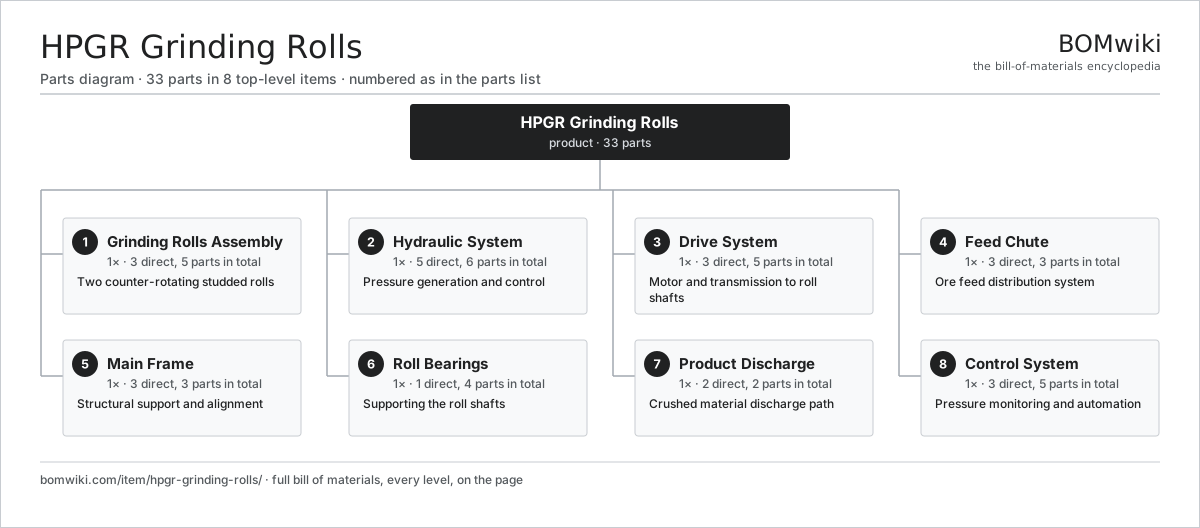
| # | Part | Qty | What it does |
|---|---|---|---|
| 1 | Grinding Rolls Assembly 3 parts | 1× | Two counter-rotating studded rolls |
| 2 | Hydraulic System 5 parts | 1× | Pressure generation and control |
| 3 | Drive System 3 parts | 1× | Motor and transmission to roll shafts |
| 4 | Feed Chute 3 parts | 1× | Ore feed distribution system |
| 5 | Main Frame 3 parts | 1× | Structural support and alignment |
| 6 | Roll Bearings 1 parts | 1× | Supporting the roll shafts |
| 7 | Product Discharge 2 parts | 1× | Crushed material discharge path |
| 8 | Control System 3 parts | 1× | Pressure monitoring and automation |
3D model
No 3D model yet. Have a CAD file of this? Add a 3D model. STL renders right on this page; STEP, FreeCAD, and OpenSCAD sources are welcome too (openly licensed, like all 3D models on BOMwiki).
Build & assembly graph
expand / collapse · shared sub-assemblies converge · links to related products · est. labourTap an assembly to expand/collapse · tap a part to open it · use “Open page” for any node · drag to pan, scroll to zoom.
Bill of materials for HPGR Grinding Rolls
8 top-level lines · 31 rows shown · 33 parts total · indented to 3 levels| # | Item / sub-assembly | Part no. | Qty/assy | Ext. qty | Parts | Type |
|---|---|---|---|---|---|---|
| 1 | Grinding Rolls Assembly 3 parts | hpgr-grinding-rolls-grinding-rolls | 1× | 1 | 5 | assembly |
| 1.1 | Roll Shell | hpgr-grinding-rolls-roll-shell | 2× | 2 | · | part |
| 1.2 | Carbide Stud Segments | hpgr-grinding-rolls-stud-segments | 1× | 1 | · | part |
| 1.3 | Roll Shaft | hpgr-grinding-rolls-roll-shaft | 2× | 2 | · | part |
| 2 | Hydraulic System 5 parts | hpgr-grinding-rolls-hydraulic-system | 1× | 1 | 6 | assembly |
| 2.1 | Hydraulic Pump | hpgr-grinding-rolls-hydraulic-pump | 1× | 1 | · | part |
| 2.2 | Pressure Cylinders | hpgr-grinding-rolls-pressure-cylinders | 2× | 2 | · | part |
| 2.3 | Hydraulic Valve Block | hpgr-grinding-rolls-hydraulic-valves | 1× | 1 | · | part |
| 2.4 | Hydraulic Reservoir | hpgr-grinding-rolls-hydraulic-reservoir | 1× | 1 | · | part |
| 2.5 | Hydraulic Filters | hpgr-grinding-rolls-hydraulic-filters | 1× | 1 | · | part |
| 3 | Drive System 3 parts | hpgr-grinding-rolls-drive-system | 1× | 1 | 5 | assembly |
| 3.1 | Main AC Motor | hpgr-grinding-rolls-main-motor | 2× | 2 | · | part |
| 3.2 | Gearbox | hpgr-grinding-rolls-gearbox | 1× | 1 | · | part |
| 3.3 | Shaft Coupling | hpgr-grinding-rolls-shaft-coupling | 2× | 2 | · | part |
| 4 | Feed Chute 3 parts | hpgr-grinding-rolls-feed-chute | 1× | 1 | 3 | assembly |
| 4.1 | Ore Hopper | hpgr-grinding-rolls-hopper | 1× | 1 | · | part |
| 4.2 | Chute Liner | hpgr-grinding-rolls-chute-liner | 1× | 1 | · | part |
| 4.3 | Chute Support Structure | hpgr-grinding-rolls-chute-support | 1× | 1 | · | part |
| 5 | Main Frame 3 parts | hpgr-grinding-rolls-frame | 1× | 1 | 3 | assembly |
| 5.1 | Frame Girders | hpgr-grinding-rolls-frame-girders | 1× | 1 | · | part |
| 5.2 | Roll Alignment System | hpgr-grinding-rolls-alignment-system | 1× | 1 | · | part |
| 5.3 | Vibration Isolation Pads | hpgr-grinding-rolls-mounting-pads | 1× | 1 | · | part |
| 6 | Roll Bearings 1 parts | hpgr-grinding-rolls-roller-bearings | 1× | 1 | 4 | assembly |
| 6.1 | Ball Bearing | ball-bearing | 4× | 4 | · | part |
| 7 | Product Discharge 2 parts | hpgr-grinding-rolls-product-discharge | 1× | 1 | 2 | assembly |
| 7.1 | Discharge Chute | hpgr-grinding-rolls-discharge-chute | 1× | 1 | · | part |
| 7.2 | Scalping Screen | hpgr-grinding-rolls-discharge-screen | 1× | 1 | · | part |
| 8 | Control System 3 parts | hpgr-grinding-rolls-control-system | 1× | 1 | 5 | assembly |
| 8.1 | Pressure Sensor | pressure-sensor | 2× | 2 | · | part |
| 8.2 | Programmable Logic Controller | hpgr-grinding-rolls-plc | 1× | 1 | · | part |
| 8.3 | Variable Frequency Drive | hpgr-grinding-rolls-vfd | 2× | 2 | · | part |
Something wrong in this list? Report a problem with this BOM.
Sourcing: possible vendors
Browse the supplier directory → Prices, MOQ, and lead times are algorithmic estimates, not quotes, and not claims about these companies. Company mappings are curated by keyword; est. price band $200k–$5M. How estimates work| Vendor | HQ | Specialty | MOQ | Lead time |
|---|---|---|---|---|
| caterpillar.com ↗ | Irving, US | Construction & mining equipment | made to order | 20–36 wks |
|
🇯🇵Komatsu
komatsu.com ↗
|
Tokyo, JP | Construction & mining equipment | made to order | 20–36 wks |
|
🇸🇪Sandvik
rocktechnology.sandvik ↗
|
Stockholm, SE | Mining & rock technology | made to order | 20–36 wks |
|
🇸🇪Epiroc
epiroc.com ↗
|
Stockholm, SE | Mining & drilling equipment | made to order | 20–36 wks |
|
🇫🇮Metso
metso.com ↗
|
Helsinki, FI | Crushing & minerals processing | made to order | 20–36 wks |
1,074-word article