Hydraulic Circuit Trainer
ProductOverview
A hydraulic circuit trainer is the simplest and most mechanical approach to exercise resistance: the user manually pumps pressurized hydraulic fluid through adjustable valves connected to cylinders, which resist motion. There is no motor, no electricity, no electronics. The user's effort drives a pump, which pressurizes fluid, which flows through a needle valve into cylinders whose load resists the user's movement. Resistance is adjusted by turning a knob that opens or closes a Flow Control Valve, restricting fluid flow.
The appeal is mechanical elegance and long service life. A machine from the 1970s with basic maintenance still works identically to a new one. The lack of electronics means no software bugs, no battery replacement, no power dependency. The machine works in any temperature or humidity.
Hydraulic fluid and circuit basics
The Hydraulic Fluid Reservoir holds ISO VG 46 hydraulic oil, a mineral oil with viscosity optimized for small pump and valve systems. At 50°C the oil has a viscosity of 46 centistokes. This is thin enough to flow through small orifices at human-powered pressures (50–200 bar), but thick enough to provide a consistent "damping" feel.
When the user presses a lever or pedal, the Hydraulic Pump displaces a fixed volume of oil (typically 10–30 cubic centimeters per stroke) into the Main Valve Manifold. The pump is a positive-displacement unit: each stroke always delivers the same volume of fluid, regardless of back-pressure. Two Check Valve one-way valves in the pump prevent reverse flow: one allows inlet from the reservoir, the other allows outlet to the main circuit.
The pressurized fluid then flows toward the Hydraulic Cylinder Pair. If there were no restriction, the cylinders would extend at high speed with negligible resistance. But a Flow Control Valve is inserted into the line, a needle valve that restricts flow. The more the needle valve is closed, the more back-pressure builds and the more the pump must work. This back-pressure (sensed by the user as resistance during the motion) rises until it exceeds the Pressure Relief Valve setting, at which point excess oil vents back to the Hydraulic Fluid Reservoir to prevent over-pressurization.
Pump and user interface
The pump is driven directly by the Movement Lever and Linkage. A Cylinder Link Rod couples the user's lever or pedal motion to the pump piston. Each downstroke of the lever drives one pump stroke, displacing oil. Return motion of the lever is powered by Hydraulic Cylinder Pair that push back (on opposite sides of the piston), or by the user simply reversing their motion.
The Pump Drive Rod ensures that the lever and pump piston move in synchrony. The pump is typically housed in a compact Pump Casting (a ductile iron or aluminum casting) with minimal mass, so the pump motion is lightweight and responsive.
Resistance adjustment
The Flow Control Valve is the heart of resistance control. It is a needle valve: a tapered needle on a threaded stem that closes against a conical seat. Turning the hand wheel or knob Adjustment Dial Screw opens or closes the needle, metering flow.
With the needle fully open (minimal restriction), a stroke of the pump displaces oil freely into the cylinders and very little back-pressure accumulates. The user feels light resistance. Closing the needle restricts flow. If the needle is closed to 50% of full open, the pump must work twice as hard to displace the same volume of oil, because the narrower passage creates higher back-pressure. At 90% closed, the pump effort increases dramatically: the user cannot complete a stroke at normal speed, and must push very hard and slowly.
Most commercial trainers have 8–12 marked settings (a detent-locked knob) for discrete resistance levels. Some allow continuous adjustment. The relationship is non-linear: the last 10% of closure often creates much higher resistance than the first 90%, because flow-restriction effects are exponential.
The Mechanical Pressure Gauge provides feedback. As the user presses hard, the gauge needle rises. At the Pressure Relief Valve setting (e.g., 150 bar), excess pressure vents to the tank and the gauge plateaus. A user at low resistance settings might generate 30–50 bar; a user at maximum setting might reach 150–200 bar before the relief opens.
Cylinders and resistance feel
Each Cylinder Barrel is a double-acting cylinder: fluid can be pressurized on either the rod-end or the cap-end side. One cylinder extends as the other retracts (controlled by the manifold valve logic), creating balanced motion and force.
The Piston Assembly is sealed with O-Ring Set rings that prevent oil from leaking past the piston. A high-quality seal system is durable for 10+ years, but over time seals wear and internal leakage increases. Once leakage becomes significant, the cylinder "feels soft", the user must work harder to achieve the same resistance, because some of the pumped oil is leaking internally rather than building pressure.
The pressure from the pump acts on the piston face, multiplied by the piston area. A 25 mm bore piston has an area of ~490 mm² (cap-end) and ~300 mm² (rod-end, because the rod takes up space). At 100 bar, the cap-end pressure generates ~4900 N of force; the rod-end generates ~3000 N. This asymmetry is intentional: it determines the balance point where the system feels "neutral" (neither pushing nor pulling) when the pump is idle.
Manifold and circuit control
The Main Valve Manifold is a single ductile iron or aluminum block, drilled with internal passages and bored with cavity pockets. The Pressure Relief Valve sits in one cavity, the Flow Control Valve in another. Other internal passages route fluid from pump to cylinders to tank.
The design allows one or two cylinders to be connected with logic that either:
- Balances: fluid pressure is roughly equal on both ends at idle, and both cylinders extend/retract together.
- Sequence: one cylinder extends fully before the other begins.
- Alternating: cylinders extend and retract on alternate pump strokes.
Most machines use the balance or simple parallel configuration. A trainer designed for leg presses has two cylinders (one per leg) in parallel; a rowing machine might have one large cylinder driven by a bank of smaller pump strokes.
Reliability and maintenance
The Return Filter is a 10–25 micron cartridge that removes contaminants from oil returning to the tank. It should be replaced every 1–2 years or every 500 hours of use, whichever comes first. A clogged filter can restrict return flow and cause high back-pressure, making the machine feel stiff or unresponsive.
The Drain Plug is a magnetic drain plug that collects ferrous wear particles from cylinders and pump. Draining and inspecting the plug every 6 months is good preventive maintenance; a large buildup of metal powder signals seal wear and the need for service.
The Fluid Level Gauge (sight glass or dipstick) is checked before each session. If oil level drops between sessions, leakage is occurring (usually from a worn seal or loose hose fitting). Small leaks tolerate "top-up" oil additions for a time, but large leaks require seal or hose replacement.
The O-Ring Set seals in the cylinders are the main wear items and the hardest to service. A leaking cylinder typically requires professional removal and rebuilding, a cost of $100–300 per cylinder in labor.
Advantages and limitations
The all-mechanical design is robust. A hydraulic trainer from 1975 in a commercial gym still produces the same resistance as when new. No software updates, no power cuts, no batteries to replace.
Resistance is smooth and progressive. The flow-restriction principle means there is no discrete "lock-out" position; the motion can be stopped at any point.
However, the machines are heavy (80–150 kg depending on size) and cannot be adjusted for different exercises easily. A hydraulic leg press is always a leg press; you cannot quickly convert it to a rowing or arm trainer. And the pump-per-motion design means effort and resistance are coupled: a faster pump stroke against a closed needle produces more resistance than a slow stroke. Inexperienced users sometimes find this unintuitive.
The machines are also slow to change resistance: adjusting the needle valve takes several full turns, and each adjustment requires a couple of test strokes to feel the new resistance. Machines with 8–12 discrete detent positions solve this partly, but still require manual manipulation.
Hydraulic trainers are ideal for rehabilitation settings, where the smooth resistance and mechanical simplicity are assets, and for boutique training studios or home gyms where reliability and low maintenance are valued.
Hydraulic Circuit Trainer parts and their functions
8 top-level parts · 61 parts in total · full bill of materials below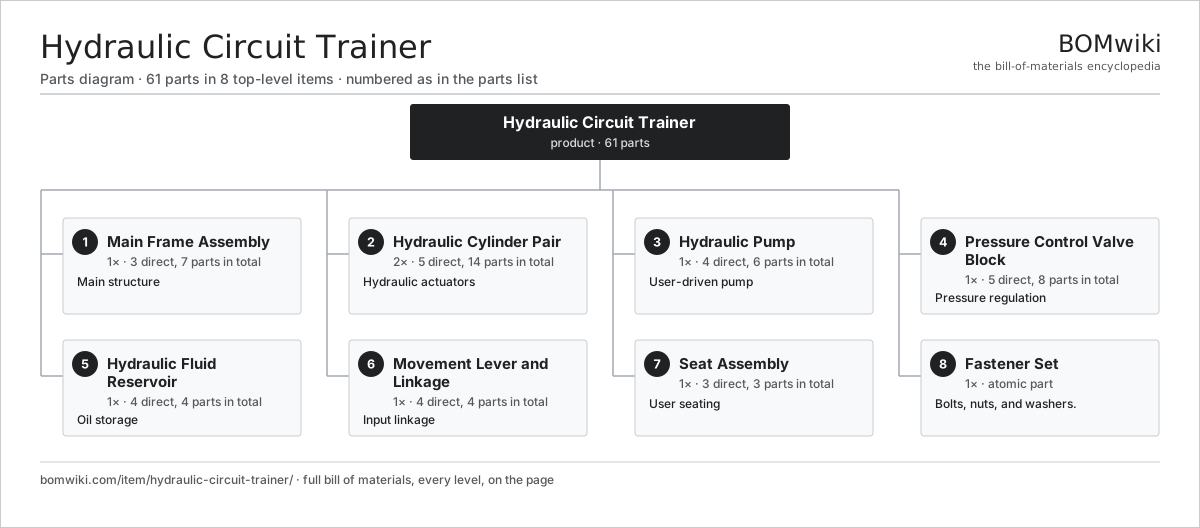
| # | Part | Qty | What it does |
|---|---|---|---|
| 1 | Main Frame Assembly 3 parts | 1× | Main structure |
| 2 | Hydraulic Cylinder Pair 5 parts | 2× | Hydraulic actuators |
| 3 | Hydraulic Pump 4 parts | 1× | User-driven pump |
| 4 | Pressure Control Valve Block 5 parts | 1× | Pressure regulation |
| 5 | Hydraulic Fluid Reservoir 4 parts | 1× | Oil storage |
| 6 | Movement Lever and Linkage 4 parts | 1× | Input linkage |
| 7 | Seat Assembly 3 parts | 1× | User seating |
| 8 | Fastener Set | 1× | Bolts, nuts, and washers. |
3D model
No 3D model yet. Have a CAD file of this? Add a 3D model. STL renders right on this page; STEP, FreeCAD, and OpenSCAD sources are welcome too (openly licensed, like all 3D models on BOMwiki).
Build & assembly graph
expand / collapse · shared sub-assemblies converge · links to related products · est. labourTap an assembly to expand/collapse · tap a part to open it · use “Open page” for any node · drag to pan, scroll to zoom.
Bill of materials for Hydraulic Circuit Trainer
8 top-level lines · 36 rows shown · 61 parts total · indented to 3 levels| # | Item / sub-assembly | Part no. | Qty/assy | Ext. qty | Parts | Type |
|---|---|---|---|---|---|---|
| 1 | Main Frame Assembly 3 parts | hydraulic-circuit-trainer-frame | 1× | 1 | 7 | assembly |
| 1.1 | Side Rail | hydraulic-circuit-trainer-frame-rails | 2× | 2 | · | part |
| 1.2 | Cross Beam | hydraulic-circuit-trainer-cross-beams | 3× | 3 | · | part |
| 1.3 | Component Mount Plate | hydraulic-circuit-trainer-mounting-plate | 2× | 2 | · | part |
| 2 | Hydraulic Cylinder Pair 5 parts | hydraulic-circuit-trainer-cylinders | 2× | 2 | 14 | assembly |
| 2.1 | Cylinder Barrel | hydraulic-circuit-trainer-cylinder-body | 2× | 4 | · | part |
| 2.2 | Piston Assembly | hydraulic-circuit-trainer-piston | 2× | 4 | · | part |
| 2.3 | Piston Rod | hydraulic-circuit-trainer-rod | 2× | 4 | · | part |
| 2.4 | O-Ring Set | oring-set | 4× | 8 | · | part |
| 2.5 | Port Fitting | hydraulic-circuit-trainer-port-fitting | 4× | 8 | · | part |
| 3 | Hydraulic Pump 4 parts | hydraulic-circuit-trainer-pump-assy | 1× | 1 | 6 | assembly |
| 3.1 | Pump Casting | hydraulic-circuit-trainer-pump-body | 1× | 1 | · | part |
| 3.2 | Pump Piston | hydraulic-circuit-trainer-pump-piston | 1× | 1 | · | part |
| 3.3 | Check Valve | hydraulic-circuit-trainer-check-valve | 2× | 2 | · | part |
| 3.4 | Pump Port | hydraulic-circuit-trainer-pump-port | 2× | 2 | · | part |
| 4 | Pressure Control Valve Block 5 parts | hydraulic-circuit-trainer-valve-block | 1× | 1 | 8 | assembly |
| 4.1 | Main Valve Manifold | hydraulic-circuit-trainer-main-manifold | 1× | 1 | · | part |
| 4.2 | Pressure Relief Valve | hydraulic-circuit-trainer-relief-valve | 1× | 1 | · | part |
| 4.3 | Flow Control Valve | hydraulic-circuit-trainer-flow-control-valve | 2× | 2 | · | part |
| 4.4 | Mechanical Pressure Gauge | hydraulic-circuit-trainer-pressure-gauge | 1× | 1 | · | part |
| 4.5 | Adjustment Dial Screw | hydraulic-circuit-trainer-adjustment-screw | 3× | 3 | · | part |
| 5 | Hydraulic Fluid Reservoir 4 parts | hydraulic-circuit-trainer-fluid-reservoir | 1× | 1 | 4 | assembly |
| 5.1 | Tank Vessel | hydraulic-circuit-trainer-tank-body | 1× | 1 | · | part |
| 5.2 | Return Filter | hydraulic-circuit-trainer-tank-filter | 1× | 1 | · | part |
| 5.3 | Drain Plug | hydraulic-circuit-trainer-tank-drain | 1× | 1 | · | part |
| 5.4 | Fluid Level Gauge | hydraulic-circuit-trainer-fluid-level-sight | 1× | 1 | · | part |
| 6 | Movement Lever and Linkage 4 parts | hydraulic-circuit-trainer-lever-assy | 1× | 1 | 4 | assembly |
| 6.1 | Primary Lever | hydraulic-circuit-trainer-lever-arm | 1× | 1 | · | part |
| 6.2 | Lever Pivot Pin | hydraulic-circuit-trainer-pivot-pin | 1× | 1 | · | part |
| 6.3 | Cylinder Link Rod | hydraulic-circuit-trainer-connecting-rod | 1× | 1 | · | part |
| 6.4 | Pump Drive Rod | hydraulic-circuit-trainer-pump-link | 1× | 1 | · | part |
| 7 | Seat Assembly 3 parts | hydraulic-circuit-trainer-seat-assy | 1× | 1 | 3 | assembly |
| 7.1 | Seat Frame | hydraulic-circuit-trainer-seat-frame | 1× | 1 | · | part |
| 7.2 | Seat Pad | hydraulic-circuit-trainer-seat-cushion | 1× | 1 | · | part |
| 7.3 | Backrest Support | hydraulic-circuit-trainer-backrest | 1× | 1 | · | part |
| 8 | Fastener Set | fastener-set | 1× | 1 | · | part |
Something wrong in this list? Report a problem with this BOM.
Related products
same domain, ranked by shared parts


Sourcing: possible vendors
Browse the supplier directory → Prices, MOQ, and lead times are algorithmic estimates, not quotes, and not claims about these companies. Company mappings are curated by keyword; est. price band $100–$10k. How estimates work| Vendor | HQ | Specialty | MOQ | Lead time |
|---|---|---|---|---|
| lifefitness.com ↗ | Rosemont, US | Fitness equipment | 200 units | 8–14 wks |
| technogym.com ↗ | Cesena, IT | Fitness equipment | 200 units | 8–14 wks |
|
🇺🇸Peloton
onepeloton.com ↗
|
New York, US | Connected fitness | 200 units | 8–14 wks |
| johnsonhealthtech.com ↗ | Taichung, TW | Fitness (Matrix) | 200 units | 8–14 wks |
|
🇺🇸Precor
precor.com ↗
|
Woodinville, US | Fitness equipment | 200 units | 8–14 wks |
1,497-word article