Hydraulic Disc Brake Set
ProductOverview
A hydraulic disc brake is an actuated clamping system that uses pressurized oil (mineral or DOT-based) to transmit the rider's lever force directly to the caliper pistons, which squeeze friction pads against a steel rotor. This provides powerful, modulated stopping force with minimal hand effort, typically 20–40 N of lever pressure generates 500–1500 N of clamping force.
Hydraulic brakes became standard on mountain bikes in the 2000s, replacing mechanical cable-actuated rim brakes and early hydraulic systems. Today, they dominate all categories of cycling: road, gravel, mountain, e-bikes, and cargo bikes. The sealed architecture keeps water and dirt out, improving reliability in harsh conditions.
How it works
When the rider squeezes the brake lever, the primary piston (11–13 mm diameter) inside the master cylinder pushes hydraulic fluid through the hose to one or two caliper pistons (10–16 mm diameter). The pistons extend outward, pressing friction pads against the rotor surface, creating friction that slows the wheel.
The relationship is proportional: light pressure on the lever creates light clamping force (good for modulation and trail braking); hard squeezing increases pressure exponentially, creating maximum braking force. This proportionality is the key advantage over mechanical brakes, which have a more linear (less intuitive) power curve.
The hydraulic system achieves high mechanical advantage through Pascals Law: if the master cylinder has a 12 mm diameter and the caliper has two 14 mm pistons, the force multiplication is roughly 2.7x, so 50 N of hand force becomes 135 N of piston force, multiplied again by the lever arm of the pad to rotor radius.
When the lever is released, a return spring pushes the master piston back, creating a small vacuum that draws fluid back through the hose. The caliper pistons retract slightly via return springs, creating ~0.5–1 mm of pad clearance from the rotor. If this clearance is too large, the brake feels spongy; if too small, the pads rub and create drag and heat.
Fluid types
Mineral oil (used by SRAM, Magura) is easier to bleed, less hygroscopic (absorbs less water), and safe if spilled on paint or rubber. It is viscous and stable across a wide temperature range (−20 °C to +80 °C). Mineral oil is the dominant choice for mountain biking.
DOT 4 (used by Shimano, Campagnolo, Magura some models) is a polyglycol-based fluid that is hygroscopic, it absorbs water from humid air, degrading performance if not replaced regularly. However, DOT 4 does not damage paint and is widely available (car brake systems use it). Shimano's proprietary formulation is labeled SHIMANO BP fluid.
DOT 5.1 is similar to DOT 4 but with better high-temperature stability. Some high-end mountain bikes use it, but it is less common and more expensive.
Mixing fluid types is dangerous and will cause seals to swell or fail. Flushing the old fluid completely before adding a new type is required.
Brake force and modulation
Peak braking force is determined by master piston area, caliper piston area, rotor diameter (larger rotors give more leverage), and pad friction coefficient.
Friction pads come in two main types:
- Sintered metal (bronze-based): coefficient of friction 0.5–0.7, very durable (400–800 km life), good heat dissipation, less squealing, but heavier and louder on initial bite.
- Organic resin-based: coefficient of friction 0.4–0.6, shorter life (200–400 km), quieter, gentler initial feel, but prone to glazing if overheated.
Most riders prefer sintered pads for trail and enduro riding (sustained braking, heat load); organic pads are popular for XC and road use (lighter weight, quieter).
Modulation refers to the rider's ability to fine-tune braking force over the lever range. Hydraulic brakes offer excellent modulation: the first 5 mm of lever travel produces low pressure (0–50 bar), allowing feather-light braking on technical terrain. Further lever travel increases pressure exponentially (100–200 bar), delivering full stopping power. This curve is intuitive and makes trail braking (staying on the brakes while cornering) safe and predictable.
Rotor sizes and standards
Rotors come in three ISO standard sizes:
- 160 mm: Light bikes, XC riding, rim brake frame compatibility. Lighter, cooler running, but requires higher lever pressure.
- 180 mm: Balanced choice for trail and gravel. Most common size.
- 203 mm: Enduro, gravity, and e-bikes. Larger mass = better heat dissipation and heat capacity. Requires slightly less lever pressure but adds weight and width to the brake assembly.
Larger rotors do not necessarily give more braking force; a 203 mm rotor with weak pads may brake identically to a 160 mm rotor with strong pads. However, larger rotors run cooler during sustained descents, reducing pad glazing and fade.
Rotor materials are typically stainless steel (standard) or aluminum core with steel overlay (lighter). Stainless steel rotors are more durable and resistant to corrosion; aluminum core rotors are lighter but less common.
Maintenance and durability
Pad life depends on riding style and pad type. Sintered pads may last 400–800 km; organic pads 200–400 km. Continuous braking (long descents) wears pads much faster than modulated braking.
Fluid degradation is the primary maintenance task. Mineral oil absorbs water at ~0.1% per 100 hours; DOT fluids absorb water much faster. When water content exceeds 2%, boiling point drops and brake performance degrades. Flushing the system (via the bleeder valves) every 100–200 hours is recommended.
Hose aging can cause slow internal degradation. After 5+ years, even unused hoses may weep slightly. Replacement hoses cost $30–$60.
Piston seal degradation happens slowly but inevitably. If a caliper piston leaks, or the master cylinder loses pressure (slow squeeze/fade), the seals must be replaced. Seal kits cost $20–$40 per brake.
Rotor warping can occur from poor brake feel post-crash or from heat. Rotors can often be "trued" (bent back into alignment) using a rotor truing tool; severely warped rotors require replacement ($30–$60).
Bleed procedures are necessary when air enters the system (lever feels spongy, or after hose replacement). Bleeding is done at the caliper bleeder valve, using a syringe filled with fresh fluid, pushing fluid (and air) out while the lever is cycled. Proper technique is critical, trapped air ruins brake feel.
Installation and compatibility
Frame and fork fit: Brakes mount via IS 2000 standard (51 mm between bolt holes) or post-mount (74 mm). Adapters exist to bridge different standards, but direct fit is always preferred.
Rotor fit: Rotors bolt to the wheel hub with six M5 bolts (ISO standard). Hub-specific rotors (e.g., centerlock for Shimano wheels) require special carriers.
Hose routing: The hose is routed under the down tube and along the seat stays, anchored with cable clips to prevent contact with the wheel or drivetrain. Hose length is cut to fit the frame; too short causes stress and kinks; too long creates slack and poor steering feel.
Lever reach adjustment: Most modern levers have a reach screw that adjusts the distance from the grip to the lever blade, accommodating different hand sizes and riding preferences.
Performance context
Hydraulic disc brakes are now the universal choice for serious cycling. Mechanical rim brakes (or cable-actuated disc brakes) persist only on vintage or budget bikes. The advantages over mechanicals are decisive: far greater power, better modulation, all-weather reliability, and easier maintenance.
Electric mountain bikes (e-MTBs) often use larger rotors (180–203 mm) to handle the extra mass and speed; cargo bikes also adopt larger brakes for safety. Road and gravel bikes increasingly ship with hydraulic discs (replacing rim brakes), enabling all-weather riding and better tire clearance.
The sealed, self-contained design also allows brakes to be integrated with other systems, e.g., ABS (anti-lock braking) modules, or wireless shifters. The future of disc brakes points toward smarter, lighter designs with better thermal management.
Hydraulic Disc Brake Set parts and their functions
7 top-level parts · 40 parts in total · full bill of materials below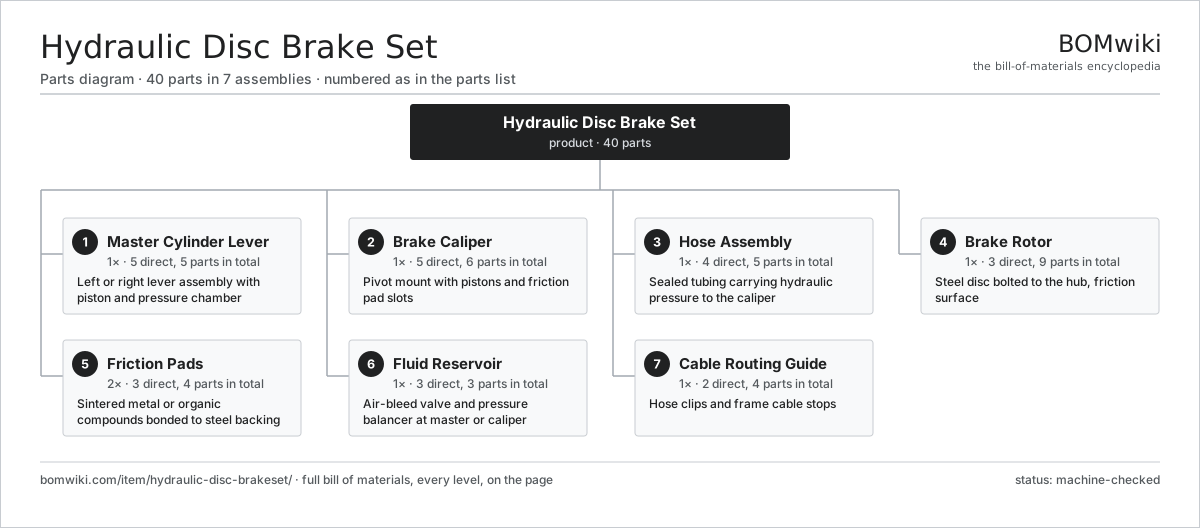
| # | Part | Qty | What it does |
|---|---|---|---|
| 1 | Master Cylinder Lever 5 parts | 1× | Left or right lever assembly with piston and pressure chamber |
| 2 | Brake Caliper 5 parts | 1× | Pivot mount with pistons and friction pad slots |
| 3 | Hose Assembly 4 parts | 1× | Sealed tubing carrying hydraulic pressure to the caliper |
| 4 | Brake Rotor 3 parts | 1× | Steel disc bolted to the hub, friction surface |
| 5 | Friction Pads 3 parts | 2× | Sintered metal or organic compounds bonded to steel backing |
| 6 | Fluid Reservoir 3 parts | 1× | Air-bleed valve and pressure balancer at master or caliper |
| 7 | Cable Routing Guide 2 parts | 1× | Hose clips and frame cable stops |
3D model
No 3D model yet. Have a CAD file of this? Add a 3D model — STL renders right on this page; STEP, FreeCAD, and OpenSCAD sources are welcome too (openly licensed, like all 3D models on BOMwiki).
Build & assembly graph
expand / collapse · shared sub-assemblies converge · links to related products · est. labourTap an assembly to expand/collapse · tap a part to open it · use “Open page” for any node · drag to pan, scroll to zoom.
Bill of materials for Hydraulic Disc Brake Set
7 top-level lines · 32 rows shown · 40 parts total · indented to 3 levels| # | Item / sub-assembly | Part no. | Qty/assy | Ext. qty | Parts | Type |
|---|---|---|---|---|---|---|
| 1 | Master Cylinder Lever 5 parts | hydraulic-disc-brakeset-master-cylinder | 1× | 1 | 5 | assembly |
| 1.1 | Lever Body | hydraulic-disc-brakeset-lever-body | 1× | 1 | · | part |
| 1.2 | Primary Piston | hydraulic-disc-brakeset-piston-primary | 1× | 1 | · | part |
| 1.3 | Lever Spring Return | hydraulic-disc-brakeset-lever-spring-return | 1× | 1 | · | part |
| 1.4 | Master Seal Kit | hydraulic-disc-brakeset-master-seal-kit | 1× | 1 | · | part |
| 1.5 | Hose Connection Barb | hydraulic-disc-brakeset-hose-connection-barb | 1× | 1 | · | part |
| 2 | Brake Caliper 5 parts | hydraulic-disc-brakeset-brake-caliper | 1× | 1 | 6 | assembly |
| 2.1 | Caliper Body | hydraulic-disc-brakeset-caliper-body | 1× | 1 | · | part |
| 2.2 | Caliper Piston | hydraulic-disc-brakeset-caliper-piston | 2× | 2 | · | part |
| 2.3 | Caliper Seal Kit | hydraulic-disc-brakeset-caliper-seal-kit | 1× | 1 | · | part |
| 2.4 | Pad Carrier Arm | hydraulic-disc-brakeset-pad-carrier-arm | 1× | 1 | · | part |
| 2.5 | Caliper Lever Pin | hydraulic-disc-brakeset-caliper-lever-pin | 1× | 1 | · | part |
| 3 | Hose Assembly 4 parts | hydraulic-disc-brakeset-hose-assembly | 1× | 1 | 5 | assembly |
| 3.1 | Hose Core | hydraulic-disc-brakeset-hose-core | 1× | 1 | · | part |
| 3.2 | Hose Braid | hydraulic-disc-brakeset-hose-braid | 1× | 1 | · | part |
| 3.3 | Hose Ferrule Pair | hydraulic-disc-brakeset-hose-ferrule-pair | 2× | 2 | · | part |
| 3.4 | Hose Banjo Bolt | hydraulic-disc-brakeset-hose-banjo-bolt | 1× | 1 | · | part |
| 4 | Brake Rotor 3 parts | hydraulic-disc-brakeset-brake-rotor | 1× | 1 | 9 | assembly |
| 4.1 | Rotor Center | hydraulic-disc-brakeset-rotor-center | 1× | 1 | · | part |
| 4.2 | Rotor Friction Rings | hydraulic-disc-brakeset-rotor-friction-rings | 2× | 2 | · | part |
| 4.3 | Rotor Mounting Bolts | hydraulic-disc-brakeset-rotor-mounting-bolts | 6× | 6 | · | part |
| 5 | Friction Pads 3 parts | hydraulic-disc-brakeset-friction-pads | 2× | 2 | 4 | assembly |
| 5.1 | Pad Backing Plate | hydraulic-disc-brakeset-pad-backing-plate | 2× | 4 | · | part |
| 5.2 | Pad Friction Material | hydraulic-disc-brakeset-pad-friction-material | 1× | 2 | · | part |
| 5.3 | Pad Shim Set | hydraulic-disc-brakeset-pad-shim-set | 1× | 2 | · | part |
| 6 | Fluid Reservoir 3 parts | hydraulic-disc-brakeset-fluid-reservoir | 1× | 1 | 3 | assembly |
| 6.1 | Reservoir Cup | hydraulic-disc-brakeset-reservoir-cup | 1× | 1 | · | part |
| 6.2 | Fluid Line | hydraulic-disc-brakeset-fluid-line | 1× | 1 | · | part |
| 6.3 | Air Bleeder Valve | hydraulic-disc-brakeset-air-bleeder-valve | 1× | 1 | · | part |
| 7 | Cable Routing Guide 2 parts | hydraulic-disc-brakeset-cable-routing-guide | 1× | 1 | 4 | assembly |
| 7.1 | Cable Clip | hydraulic-disc-brakeset-cable-clip | 3× | 3 | · | part |
| 7.2 | Cable Stop Tab | hydraulic-disc-brakeset-cable-stop-tab | 1× | 1 | · | part |
Sourcing: possible vendors
Prices, MOQ, and lead times are algorithmic estimates, not quotes, and not claims about these companies. Company mappings are curated by keyword; est. price band $200–$12k. How estimates work| Vendor | HQ | Specialty | MOQ | Lead time |
|---|---|---|---|---|
|
🇹🇼Giant
giant-bicycles.com ↗
|
Taichung, TW | Bicycles | 500 units | 6–12 wks |
|
🇺🇸Trek
trekbikes.com ↗
|
Waterloo, US | Bicycles | 500 units | 6–12 wks |
| specialized.com ↗ | Morgan Hill, US | Bicycles | 500 units | 6–12 wks |
|
🇹🇼Merida
merida-bikes.com ↗
|
Yuanlin, TW | Bicycles | 500 units | 6–12 wks |
| cannondale.com ↗ | Wilton, US | Bicycles | 500 units | 6–12 wks |
1,304-word article