Hydraulic Hose Crimper
ProductOverview
A hydraulic hose crimper is an essential service tool for assembling high-pressure hydraulic hose assemblies in the field or workshop. It compresses SAE flange or straight-thread fittings onto hose tubes, creating a permanent leak-proof seal rated for 210–350 bar working pressure. The crimper uses a Pump Unit to build pressure in a Pressure Cylinder, driving a Die Set that squeezes the fitting ferrule into the hose braid and tube. Proper crimp force is critical: under-crimped hoses leak; over-crimped hoses develop internal shear cracks in the tube, failing prematurely under load. Modern crimpers include pressure gauges and calibration procedures to ensure repeatability ±5%.
Die sets and hose standards
The Die Set consists of a fixed lower die and rotating upper die, matched to specific hose gauge and fitting style. Common standards are SAE J343 (37° JIC flare, straight thread), SAE J518 (SAE flange, ISO 1210 cavity), and metric ISO 1402 (DIN 2353, metric thread). A typical shop stocks die sets for −6, −8, −10, −12, −16, and −20 hose sizes, covering 6 mm ID up to 32 mm ID. The Die Insert (removable hardened steel or carbide) matches the specific hose braid count and tube dimensions; using the wrong insert size results in loose or fractured fittings.
Crimping process and pressure setting
Operator positions the assembled hose and fitting (pre-assembled in clamp-style fixture) into the die cavity. The Pump Unit is actuated (electric button or hand crank), pressurizing the Pressure Cylinder. As pressure rises, the upper die descends slowly, compressing the fitting ferrule around the hose braid. Pressure is monitored via the Force or Pressure Gauge (Bourdon tube dial 0–250 bar). When the gauge reaches the calibrated setpoint for that hose size (e.g., 180 bar for −8 hose), the operator holds pressure for 2–3 seconds (dwell time) to ensure ferrule consolidation, then releases. Total cycle time is 10–30 seconds including setup and manual hose positioning.
Rotating die advantage
Premium crimpers feature a Rotating Die (upper die on ball bearings) that freely rotates during the crimp stroke. This distributes pressure evenly around the ferrule perimeter, preventing high spots and micro-cracking. Manual crimpers (lower cost) use a fixed upper die, requiring careful initial hose alignment and slower pressure ramp to avoid uneven loading. Rotating dies cost 20–30% more but increase first-pass success rate and extend die life (fewer rework cycles).
Calibration and quality assurance
Crimp quality is verified by destructive pull-testing: a sample hose assembly is clamped at both ends in a tensile tester, pulled to 130% of hose burst rating (e.g., 1400 bar for 1000 bar hose), and must not leak or separate. Every 500 crimps, the tool is recalibrated: pressure relief valve is adjusted to the specification pressure ±5 bar, and test couplers (known good, manufactured fittings) are run through the crimp cycle and pull-tested. If pull strength falls below 95% of specification, dies are inspected for wear and replaced if scoring > 0.1 mm is detected.
Pump sizing and duty cycle
Electric pump crimpers (24 VDC, 0.5–2 HP) are suitable for production environments (100+ crimps per shift). They deliver 5–10 L/min at 250 bar, completing cycle times of 10–15 seconds including pressure bleed-down. Manual hand pump crimpers (2–5 cc per stroke) are portable and suitable for field service (5–20 crimps per day); cycle time is 20–30 seconds. Both can maintain 250 bar continuously for 30+ seconds without overheating.
Common fittings and hose types
SAE J343 straight-thread JIC fittings are most common in mobile equipment; fitting threads are 37° flare seat per SAE J516. ISO 1402 metric fittings (DIN 2353) are standard in European equipment; metric hose sizes (10 mm = −6, 16 mm = −10) map to SAE equivalents. Hose specifications are EN 286 (high-pressure compact hose, 210 bar) and SAE 100R2 (compact hose, 280 bar, −40 to +100 °C fluid temperature range).
Maintenance and failure modes
Crimpers require annual inspection of pump seal condition (no visible leaks at shaft), cylinder rod smoothness (actuate slowly, listen for grinding), and die set wear (measure cavity depth, replace if > 0.2 mm wear detected). Common failure modes: under-crimped fittings (relief valve set too low) cause slow leaks in service; over-crimped fittings cause tube internal cracking; worn dies produce oversized ferrule grooves, reducing clamp load. Fluid cleanliness ISO 18/16/13 is sufficient (pump is low-precision gear type); change fluid every 2 years.
Standards and safety
Hose and fitting assembly follows EN 856 (hose) and ISO 1402 (fittings) minimum standards. All crimped hose is marked with hose size, pressure rating, fitting type, and shop identification (ink stamp or label). Shop records of pull-test results are maintained for 5 years to document traceability. OSHA requires guarding of crimper yoke to prevent hand pinch hazards; electric crimpers must have deadman button control (release stops pump).
Hydraulic Hose Crimper parts and their functions
8 top-level parts · 27 parts in total · full bill of materials below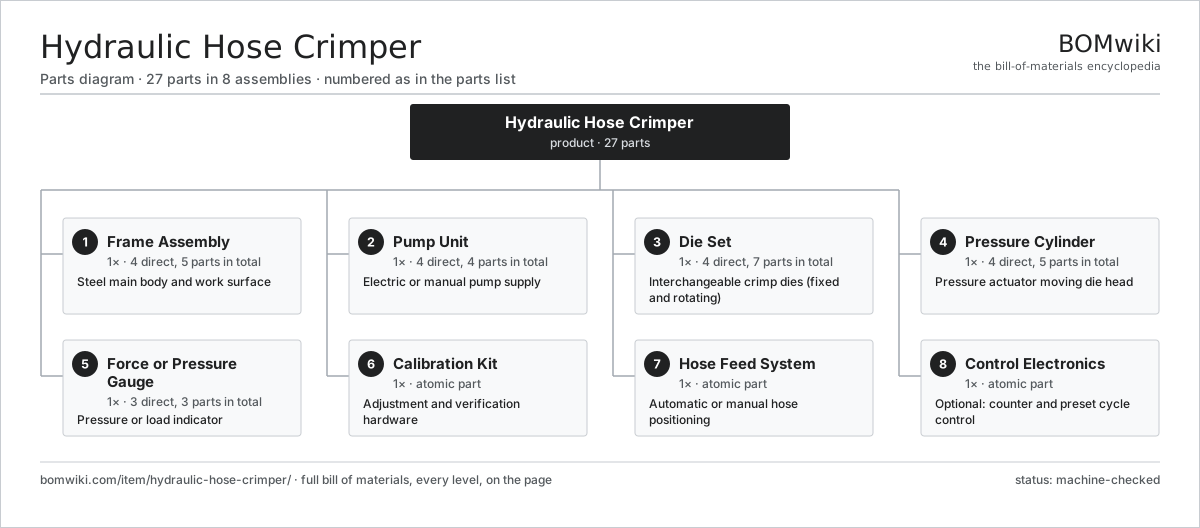
| # | Part | Qty | What it does |
|---|---|---|---|
| 1 | Frame Assembly 4 parts | 1× | Steel main body and work surface |
| 2 | Pump Unit 4 parts | 1× | Electric or manual pump supply |
| 3 | Die Set 4 parts | 1× | Interchangeable crimp dies (fixed and rotating) |
| 4 | Pressure Cylinder 4 parts | 1× | Pressure actuator moving die head |
| 5 | Force or Pressure Gauge 3 parts | 1× | Pressure or load indicator |
| 6 | Calibration Kit | 1× | Adjustment and verification hardware |
| 7 | Hose Feed System | 1× | Automatic or manual hose positioning |
| 8 | Control Electronics | 1× | Optional: counter and preset cycle control |
3D model
No 3D model yet. Have a CAD file of this? Add a 3D model — STL renders right on this page; STEP, FreeCAD, and OpenSCAD sources are welcome too (openly licensed, like all 3D models on BOMwiki).
Build & assembly graph
expand / collapse · shared sub-assemblies converge · links to related products · est. labourTap an assembly to expand/collapse · tap a part to open it · use “Open page” for any node · drag to pan, scroll to zoom.
Bill of materials for Hydraulic Hose Crimper
8 top-level lines · 27 rows shown · 27 parts total · indented to 3 levels| # | Item / sub-assembly | Part no. | Qty/assy | Ext. qty | Parts | Type |
|---|---|---|---|---|---|---|
| 1 | Frame Assembly 4 parts | hydraulic-hose-crimper-frame | 1× | 1 | 5 | assembly |
| 1.1 | Frame Base | hydraulic-hose-crimper-frame-base | 1× | 1 | · | part |
| 1.2 | Frame Upright | hydraulic-hose-crimper-frame-uprights | 2× | 2 | · | part |
| 1.3 | Die Yoke | hydraulic-hose-crimper-frame-yoke | 1× | 1 | · | part |
| 1.4 | Fastener Set | fastener-set | 1× | 1 | · | part |
| 2 | Pump Unit 4 parts | hydraulic-hose-crimper-pump | 1× | 1 | 4 | assembly |
| 2.1 | Drive Motor | hydraulic-hose-crimper-pump-motor | 1× | 1 | · | part |
| 2.2 | Pump Element | hydraulic-hose-crimper-pump-gear | 1× | 1 | · | part |
| 2.3 | Power Supply | power-supply | 1× | 1 | · | part |
| 2.4 | Fastener Set | fastener-set | 1× | 1 | · | part |
| 3 | Die Set 4 parts | hydraulic-hose-crimper-die-set | 1× | 1 | 7 | assembly |
| 3.1 | Fixed Die | hydraulic-hose-crimper-die-fixed | 1× | 1 | · | part |
| 3.2 | Rotating Die | hydraulic-hose-crimper-die-rotating | 1× | 1 | · | part |
| 3.3 | Die Insert | hydraulic-hose-crimper-die-insert | 4× | 4 | · | part |
| 3.4 | Fastener Set | fastener-set | 1× | 1 | · | part |
| 4 | Pressure Cylinder 4 parts | hydraulic-hose-crimper-hydraulic-cylinder | 1× | 1 | 5 | assembly |
| 4.1 | Cylinder Barrel | hydraulic-hose-crimper-cylinder-barrel | 1× | 1 | · | part |
| 4.2 | Cylinder Piston | hydraulic-hose-crimper-piston | 1× | 1 | · | part |
| 4.3 | O-Ring Set | oring-set | 2× | 2 | · | part |
| 4.4 | Fastener Set | fastener-set | 1× | 1 | · | part |
| 5 | Force or Pressure Gauge 3 parts | hydraulic-hose-crimper-force-gauge | 1× | 1 | 3 | assembly |
| 5.1 | Gauge Dial | hydraulic-hose-crimper-gauge-dial | 1× | 1 | · | part |
| 5.2 | Gauge Fitting | hydraulic-hose-crimper-gauge-fitting | 1× | 1 | · | part |
| 5.3 | Fastener Set | fastener-set | 1× | 1 | · | part |
| 6 | Calibration Kit | hydraulic-hose-crimper-calibration | 1× | 1 | · | part |
| 7 | Hose Feed System | hydraulic-hose-crimper-hose-feed | 1× | 1 | · | part |
| 8 | Control Electronics | hydraulic-hose-crimper-electronics | 1× | 1 | · | part |
Related products
same domain, ranked by shared parts Irrigation Pump Station
1,881 parts · shares 1 with this page
Offline Filtration Cart
61 parts · shares 1 with this page
Irrigation Pump Station
1,881 parts · shares 1 with this page
Offline Filtration Cart
61 parts · shares 1 with this page
 Pressure Intensifier
51 parts · shares 1 with this page
Pressure Intensifier
51 parts · shares 1 with this page
 Radial Spillway Gate
264 parts · shares 1 with this page
Radial Spillway Gate
264 parts · shares 1 with this page
 Sluice Gate
123 parts · shares 1 with this page
Sluice Gate
123 parts · shares 1 with this page
Sourcing: possible vendors
Prices, MOQ, and lead times are algorithmic estimates, not quotes, and not claims about these companies. Company mappings are curated by keyword; est. price band $50–$50k. How estimates work| Vendor | HQ | Specialty | MOQ | Lead time |
|---|---|---|---|---|
|
🇩🇰Grundfos
grundfos.com ↗
|
Bjerringbro, DK | Pumps | 200 units | 6–12 wks |
|
🇺🇸Xylem
xylem.com ↗
|
Washington, US | Water technology | 200 units | 6–12 wks |
| flowserve.com ↗ | Irving, US | Pumps & valves | 200 units | 6–12 wks |
|
🇩🇪KSB
ksb.com ↗
|
Frankenthal, DE | Pumps & valves | 200 units | 6–12 wks |
| parker.com ↗ | Cleveland, US | Motion & fluid control | 200 units | 6–12 wks |
845-word article