Hydraulic Motor
ProductOverview
A hydraulic motor is a rotary actuator converting pressurized fluid flow into continuous mechanical rotation and torque. Unlike cylinders (linear), motors drive shafts for pumps, fans, winches, and machinery requiring sustained rotation. Motor torque is proportional to pressure and displacement (T = P × D / 2π); speed is proportional to inlet flow rate. Case drain (low-pressure return) must be sized to handle internal leakage without backpressure exceeding 5 bar.
How it works
Pressurized fluid from the pump enters port A, forcing the Displacement Unit unit's rotor or piston group to rotate. The rotating element traps and pushes fluid toward outlet port B, which returns to tank. Gerotor motors (gear-driven rotor inside stator) are low-speed, high-torque; bent-axis piston motors are high-speed, variable displacement. The Port Plate contains inlet and outlet "kidney" ports that open/close as the rotor spins, synchronizing flow direction with mechanical rotation.
Motor types
Gerotor units are robust, simple, and tolerant of contamination; displacement is fixed. Typical range 10–500 cc/rev at 500–1500 rpm, torque 50–5000 N·m. They run cool due to low speed and are ideal for low-flow, high-duty applications. Bent-axis piston motors use swashplate actuation (variable displacement) or fixed-angle piston cylinders (fixed displacement); displacement 50–3000 cc/rev, speed 2000–8000 rpm. Piston motors achieve higher efficiency but require finer filtration (ISO 16/14/11) and tighter tolerances.
Sealing and case drain
The Seal Assembly between rotor and stator create expanding and collapsing volumes. Leakage, even with perfect seals, accumulates in the motor Housing case (cavity). This fluid is routed via the Case Drain Port back to tank at low pressure. Case drain backpressure must not exceed 5 bar or seals will bypass, causing catastrophic power loss and heat generation. Tank return line from case drain must be unobstructed and sized 1.5× larger than supply line.
Integral relief and safety
The Relief Valve protects against shaft jamming or sudden load spike. Pilot-operated relief opens at 5–10 bar above system pressure, venting excess flow to tank. This valve is essential in load-holding circuits where drive shaft might lock unexpectedly (e.g., rope jam in a winch motor).
Bearing and shaft design
The Output Shaft is supported by Bearing Set (typically angular contact balls or cylindrical rollers). Radial force from rotor/stator geometry and thrust load from pressure imbalance create combined loading; bearing selection follows ISO 281 L10 life calculations. Output flange is keyed or splined to output shaft; coupling connects motor to load equipment. Shaft seal at output prevents fluid escape along rotating member.
Maintenance
Hydraulic motors require strict fluid cleanliness (ISO 16/14/11 minimum). Contamination causes rotor/stator wear, increasing case drain flow and case pressure. Annual inspections check case drain flow (should be < 5% of inlet flow at rated speed) and measure torque ripple via dynamometer. Seal replacement interval is 2000–4000 operating hours depending on duty cycle and fluid conditioning.
Hydraulic Motor parts and their functions
8 top-level parts · 38 parts in total · full bill of materials below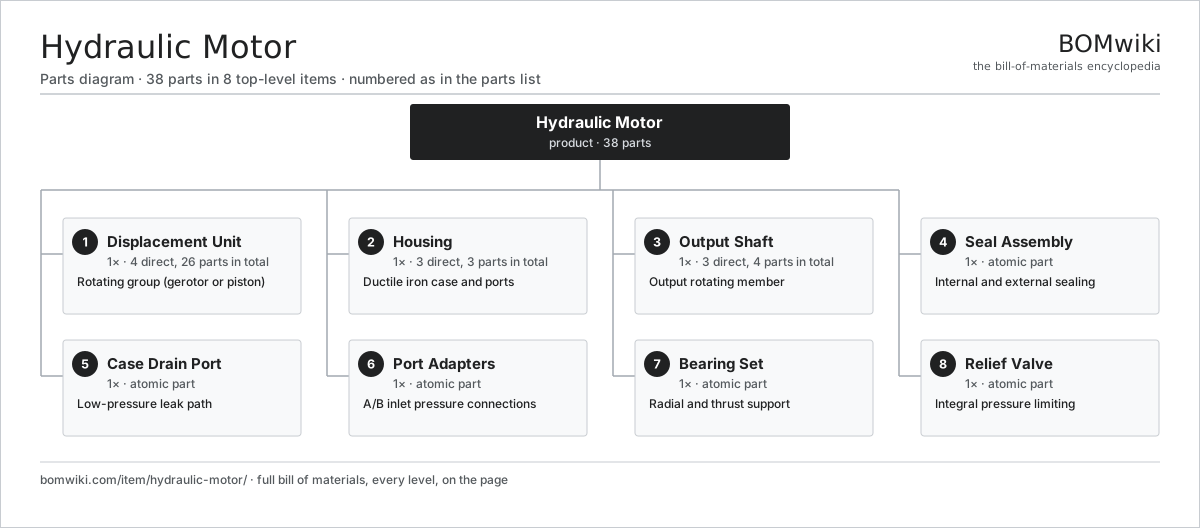
| # | Part | Qty | What it does |
|---|---|---|---|
| 1 | Displacement Unit 4 parts | 1× | Rotating group (gerotor or piston) |
| 2 | Housing 3 parts | 1× | Ductile iron case and ports |
| 3 | Output Shaft 3 parts | 1× | Output rotating member |
| 4 | Seal Assembly | 1× | Internal and external sealing |
| 5 | Case Drain Port | 1× | Low-pressure leak path |
| 6 | Port Adapters | 1× | A/B inlet pressure connections |
| 7 | Bearing Set | 1× | Radial and thrust support |
| 8 | Relief Valve | 1× | Integral pressure limiting |
3D model
No 3D model yet. Have a CAD file of this? Add a 3D model. STL renders right on this page; STEP, FreeCAD, and OpenSCAD sources are welcome too (openly licensed, like all 3D models on BOMwiki).
Build & assembly graph
expand / collapse · shared sub-assemblies converge · links to related products · est. labourTap an assembly to expand/collapse · tap a part to open it · use “Open page” for any node · drag to pan, scroll to zoom.
Bill of materials for Hydraulic Motor
8 top-level lines · 25 rows shown · 38 parts total · indented to 3 levels| # | Item / sub-assembly | Part no. | Qty/assy | Ext. qty | Parts | Type |
|---|---|---|---|---|---|---|
| 1 | Displacement Unit 4 parts | hydraulic-motor-displacement | 1× | 1 | 26 | assembly |
| 1.1 | Rotor Assembly 4 parts | rotor-assembly | 1× | 1 | 19 | assembly |
| 1.1.1 | Rotor Shaft | rotor-shaft | 1× | 1 | · | part |
| 1.1.2 | Rotor Core | rotor-core | 1× | 1 | · | part |
| 1.1.3 | Neodymium Magnet | neodymium-magnet | 16× | 16 | · | part |
| 1.1.4 | Ball Bearing | ball-bearing | 1× | 1 | · | part |
| 1.2 | Stator Assembly 3 parts | stator-assembly | 1× | 1 | 3 | assembly |
| 1.2.1 | Stator Core (laminations) | stator-core | 1× | 1 | · | part |
| 1.2.2 | Copper Winding | copper-winding | 1× | 1 | · | part |
| 1.2.3 | Slot Insulation | stator-insulation | 1× | 1 | · | part |
| 1.3 | Port Plate | hydraulic-motor-port-plate | 1× | 1 | · | part |
| 1.4 | O-Ring Set | oring-set | 3× | 3 | · | part |
| 2 | Housing 3 parts | hydraulic-motor-housing | 1× | 1 | 3 | assembly |
| 2.1 | Housing Body | hydraulic-motor-housing-body | 1× | 1 | · | part |
| 2.2 | End Cap | hydraulic-motor-end-cap | 1× | 1 | · | part |
| 2.3 | Fastener Set | fastener-set | 1× | 1 | · | part |
| 3 | Output Shaft 3 parts | hydraulic-motor-shaft | 1× | 1 | 4 | assembly |
| 3.1 | Shaft Body | hydraulic-motor-shaft-body | 1× | 1 | · | part |
| 3.2 | Ball Bearing | ball-bearing | 2× | 2 | · | part |
| 3.3 | Fastener Set | fastener-set | 1× | 1 | · | part |
| 4 | Seal Assembly | hydraulic-motor-seals | 1× | 1 | · | part |
| 5 | Case Drain Port | hydraulic-motor-case-drain | 1× | 1 | · | part |
| 6 | Port Adapters | hydraulic-motor-ports | 1× | 1 | · | part |
| 7 | Bearing Set | hydraulic-motor-bearings | 1× | 1 | · | part |
| 8 | Relief Valve | hydraulic-motor-relief-valve | 1× | 1 | · | part |
Something wrong in this list? Report a problem with this BOM.
Sourcing: possible vendors
Browse the supplier directory → Prices, MOQ, and lead times are algorithmic estimates, not quotes, and not claims about these companies. Company mappings are curated by keyword; est. price band $50–$50k. How estimates work| Vendor | HQ | Specialty | MOQ | Lead time |
|---|---|---|---|---|
|
🇩🇰Grundfos
grundfos.com ↗
|
Bjerringbro, DK | Pumps | 200 units | 6–12 wks |
|
🇺🇸Xylem
xylem.com ↗
|
Washington, US | Water technology | 200 units | 6–12 wks |
| flowserve.com ↗ | Irving, US | Pumps & valves | 200 units | 6–12 wks |
|
🇩🇪KSB
ksb.com ↗
|
Frankenthal, DE | Pumps & valves | 200 units | 6–12 wks |
| parker.com ↗ | Cleveland, US | Motion & fluid control | 200 units | 6–12 wks |
506-word article