Hydronic Air Handler
ProductOverview
A hydronic air handler is a fan coil unit that heats or cools air by circulating it across a hot-water or chilled-water heat exchanger. Unlike central forced-air furnaces that heat all air at a single location, hydronic air handlers are mounted locally in each zone (bedroom, office, living room) and operate independently, allowing individual room temperature control via Control Board Module thermostats or zone dampers.
The system is called "hydronic" because it uses water (Greek "hydro-") as the heat transfer medium. Hot water from a boiler or chiller, rather than electric heating elements or combustion, passes through the Heat Exchanger Coil. The same loop of hot or cold water can serve multiple handlers in different zones, with each handler's Zone Valve Control Interface metering flow independently based on demand. This contrasts with traditional central systems, where a single furnace heats all air, and zone control is achieved through dampers in shared ductwork (which is less responsive and less efficient).
The Handler Cabinet is typically compact, 24–36 inches wide, and 12–18 inches tall. It mounts flush in ceilings (in suspended-ceiling grids common in commercial buildings) or wall-mounted in closets or mechanical rooms. The unit draws room return air through a filter, circulates it across the coil, and discharges warm or cool air back into the space.
How it works
Heating mode: A room thermostat or occupancy sensor detects that space temperature has fallen below setpoint. The Control Board Module receives this signal and sends a command to the Zone Valve Control Interface. If the valve is solenoid-operated (simple on/off), it opens fully, allowing hot boiler water to flow through the Heat Exchanger Coil. If the valve is proportional (modulating), the controller adjusts the valve opening incrementally, more valve opening → more hot water flow → higher output temperature.
Simultaneously, the Control Board Module energizes the Multi-Speed Blower Motor motor. The Blower Motor (EC or PSC type) ramps up speed, driving air through the Air Filter Rack and across the hot Heat Exchanger Coil. Aluminum fins on the coil tubes rapidly transfer heat from 70–80°C water to ~20°C room air, raising air temperature to 40–50°C as it traverses the core. This warm air is discharged back into the room through supply grilles.
As room temperature rises toward setpoint, the thermostat signal weakens. The Control Board Module gradually reduces either the valve opening (proportional) or cycles the blower speed down (if multi-speed). Once temperature reaches setpoint (±1–2°C), the valve closes or reduces to a dribble (maintaining piping temperature), and the blower stops or runs at low speed.
Cooling mode (if chilled water is available): The same sequence occurs, but with cold water (8–15°C) from a chiller or cooling circuit flowing through the coil. Room air exiting the coil is cooled to 18–22°C. Moisture in room air condenses on the cold fins and drains into the Drain Pan Assembly, which directs condensate through a P-trap and drain line to a sink or floor drain.
Zone valve control: The Zone Valve Control Interface is the critical differentiator from central systems. Rather than all zones sharing a single duct system and fighting over a limited total airflow, each handler can command its own water supply independently. If the bedroom handler calls for heat, its zone valve opens; if the living room handler also calls, its valve opens. Both receive hot water at full temperature and adjust heat output by controlling airflow (via blower speed) or valve opening (proportional).
This provides excellent load-balancing: a room that gains internal heat (from sun or equipment) naturally cools faster and reduces its demand; the zone valve throttles, and the blower slows, allowing other zones to receive more water and maintaining system balance without the complex zoning dampers and bypass ducts of traditional systems.
Proportional vs. on-off control: Simple on-off zone valves are cheaper ($100) but less responsive: the handler is either fully heated or fully off, causing temperature swings (overshoot/undershoot) of ±3–5°C. Proportional valves ($300–500) modulate water flow smoothly, maintaining ±1–2°C accuracy and improving comfort while reducing energy waste from overshooting setpoint.
Components and operation
The Heat Exchanger Coil: Typically a plate-frame design (stainless-steel plates separated by gaskets) or a compact tube-and-fin aluminum core. The tube-and-fin design is lighter and cheaper but more prone to fouling if water is dirty; the plate-frame design is more robust and easily disassembled for cleaning. Water connections are 1/2 or 3/4 inch NPT. Air-side pressure drop is low (0.05–0.15 inches W.C.) at rated flow, so a modest Blower Motor overcomes resistance.
The Multi-Speed Blower Motor: Usually a centrifugal fan driven by an AC PSC motor or modern EC (electronically commutated) motor. EC motors are more efficient and offer 0–100% proportional speed control via an analog or PWM signal from the Control Board Module. PSC motors are cheaper and typically offer multi-speed (low/medium/high) operation via tap selection or external relay switching.
The Air Filter Rack: Holds a standard 16×25 or 20×25 pleated filter (MERV 8–13). Filters should be replaced every 3 months in typical office or residential use, more frequently if the space is dusty or pets are present. A clogged filter can reduce airflow by 50%, degrading heat transfer and increasing blower noise.
The Control Board Module: A microcontroller with inputs from a room thermostat (or occupancy sensor) and outputs to the Zone Valve Control Interface actuator and blower motor. Advanced controllers include a LCD Display Panel showing current and setpoint temperatures, system status, and filter-change reminders. Some systems integrate with building automation systems (BACnet, Modbus) for centralized monitoring.
Installation and piping
Each Heat Exchanger Coil must be connected to a hot-water supply loop and a return loop. The supply is fed from the boiler through a main water line, and the Zone Valve Control Interface is installed in the supply line to the handler (or occasionally in the return). The return from all handlers typically merges into a common return line back to the boiler.
Proper hydronic-air-handler-drainage is essential: the Drain Pan Assembly must slope toward a drain point, and a P-trap must be installed to prevent siphoning of the drain. In climates without cooling, the drain pan can be smaller or even eliminated (though some standby capacity is prudent for humidity condensation).
Balancing: After installation, the piping must be balanced, water flows adjusted so that each handler receives approximately equal water pressure and flow. This is done by partially closing hydronic-air-handler-isolating-valves (ball valves in supply and return lines) to restrict flow to higher-pressure zones, equalizing pressure across all handlers.
Maintenance and troubleshooting
Annual service includes:
- Replacing the Filter Media (quarterly or as needed).
- Cleaning the Multi-Speed Blower Motor wheel and motor exterior of dust.
- Flushing the Heat Exchanger Coil with clean water to remove sediment and mineral deposits (if water is hard).
- Checking the Drain Pan Assembly P-trap for debris; ensuring drain line flows freely.
Common issues:
- Poor heating/cooling: Often due to a blocked Filter Media (reduces airflow) or the Zone Valve Control Interface stuck in the closed position (no water flow). Check differential pressure across the filter; replace if >0.3 inches W.C.
- Noisy blower: Dust accumulation on the Multi-Speed Blower Motor wheel, or a loose mounting bolt. Clean the wheel or tighten fasteners.
- Condensate backup: The Drain Pan Assembly outlet is blocked or the P-trap is missing. Water backs up into the coil, drips from ducts, and can damage ceilings or floors. Immediately clear the drain or add trap if missing.
- Temperature overshoot: The Control Board Module is oversizing demand. Reduce thermostat sensitivity or switch to proportional zone valve control.
Advantages and limitations
Advantages:
- Individual zone control; occupants set independent temperatures.
- Efficient; each zone heats/cools only when occupied, reducing central system cycling losses.
- Scalable; easy to add zones in retrofit by adding handlers and hot-water lines.
- Quiet; EC motors and proportional valves minimize on/off cycling noise.
Limitations:
- Requires a boiler/chiller and circulating pump; not suitable for all applications.
- Higher installed cost than central furnace + ductwork for small homes.
- Maintenance complexity; more individual units to service.
- Coil fouling in hard-water regions requires periodic cleaning.
- Dependent on boiler operation; if boiler fails, all zones lose heating.
Hydronic air handlers are most cost-effective in commercial buildings, multi-zone retrofits, or homes where superior zone control justifies the added complexity.
Hydronic Air Handler parts and their functions
8 top-level parts · 28 parts in total · full bill of materials below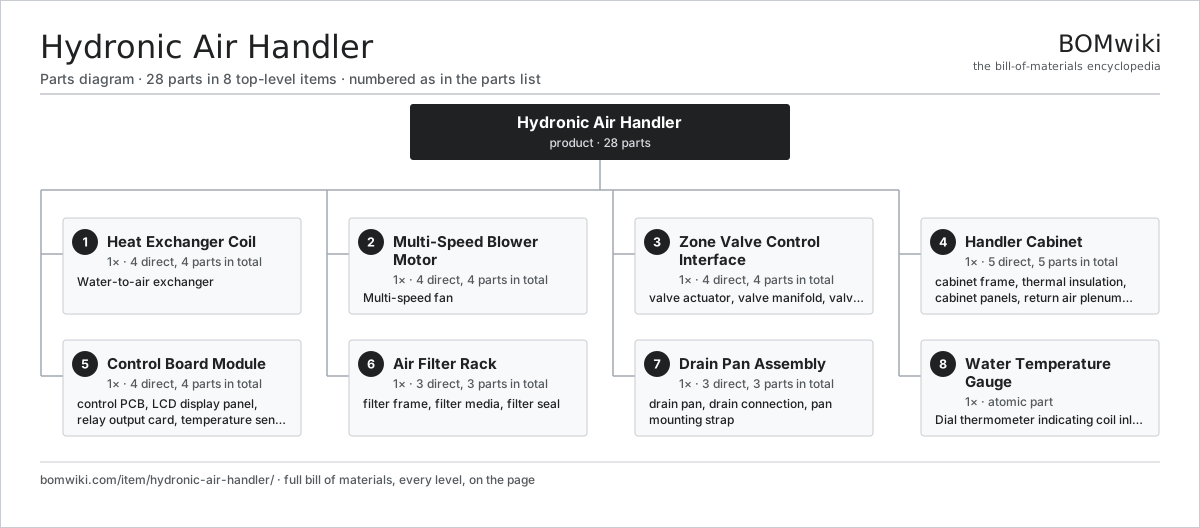
| # | Part | Qty | What it does |
|---|---|---|---|
| 1 | Heat Exchanger Coil 4 parts | 1× | Water-to-air exchanger |
| 2 | Multi-Speed Blower Motor 4 parts | 1× | Multi-speed fan |
| 3 | Zone Valve Control Interface 4 parts | 1× | Motorized or solenoid valve regulating hot water flow through coil based on room temperature demand. |
| 4 | Handler Cabinet 5 parts | 1× | Insulated steel or plastic enclosure housing all components and directing air flow. |
| 5 | Control Board Module 4 parts | 1× | Microcontroller managing blower speed, zone valve position, and thermostat interlocks. |
| 6 | Air Filter Rack 3 parts | 1× | Removable or disposable filter holder in return plenum catching airborne particles. |
| 7 | Drain Pan Assembly 3 parts | 1× | Stainless steel or aluminum tray under coil collecting condensation during cooling operation. |
| 8 | Water Temperature Gauge | 1× | Dial thermometer indicating coil inlet water temperature. |
3D model
No 3D model yet. Have a CAD file of this? Add a 3D model. STL renders right on this page; STEP, FreeCAD, and OpenSCAD sources are welcome too (openly licensed, like all 3D models on BOMwiki).
Build & assembly graph
expand / collapse · shared sub-assemblies converge · links to related products · est. labourTap an assembly to expand/collapse · tap a part to open it · use “Open page” for any node · drag to pan, scroll to zoom.
Bill of materials for Hydronic Air Handler
8 top-level lines · 35 rows shown · 28 parts total · indented to 3 levels| # | Item / sub-assembly | Part no. | Qty/assy | Ext. qty | Parts | Type |
|---|---|---|---|---|---|---|
| 1 | Heat Exchanger Coil 4 parts | hydronic-air-handler-heat-coil | 1× | 1 | 4 | assembly |
| 1.1 | Coil Tubes | hydronic-air-handler-coil-tubes | 1× | 1 | · | part |
| 1.2 | Coil Fins | hydronic-air-handler-coil-fins | 1× | 1 | · | part |
| 1.3 | Coil Header | hydronic-air-handler-coil-header | 1× | 1 | · | part |
| 1.4 | Coil Gasket | hydronic-air-handler-coil-gasket | 1× | 1 | · | part |
| 2 | Multi-Speed Blower Motor 4 parts | hydronic-air-handler-blower | 1× | 1 | 4 | assembly |
| 2.1 | Blower Motor | blower-motor | 1× | 1 | · | part |
| 2.2 | Blower Wheel | hydronic-air-handler-blower-wheel | 1× | 1 | · | part |
| 2.3 | Motor Isolation Mount | hydronic-air-handler-motor-mount | 1× | 1 | · | part |
| 2.4 | Motor Run Capacitor | hydronic-air-handler-capacitor | 1× | 1 | · | part |
| 3 | Zone Valve Control Interface 4 parts | hydronic-air-handler-zone-valve-interface | 1× | 1 | 4 | assembly |
| 3.1 | Valve Actuator | hydronic-air-handler-valve-actuator | 1× | 1 | · | part |
| 3.2 | Valve Manifold | hydronic-air-handler-valve-body | 1× | 1 | · | part |
| 3.3 | Valve Stem | hydronic-air-handler-valve-stem | 1× | 1 | · | part |
| 3.4 | Valve Seat | hydronic-air-handler-valve-seat | 1× | 1 | · | part |
| 4 | Handler Cabinet 5 parts | hydronic-air-handler-cabinet | 1× | 1 | 5 | assembly |
| 4.1 | Cabinet Frame | hydronic-air-handler-cabinet-frame | 1× | 1 | · | part |
| 4.2 | Thermal Insulation | hydronic-air-handler-cabinet-insulation | 1× | 1 | · | part |
| 4.3 | Cabinet Panels | hydronic-air-handler-cabinet-panels | 1× | 1 | · | part |
| 4.4 | Return Air Plenum | hydronic-air-handler-return-plenum | 1× | 1 | · | part |
| 4.5 | Supply Air Plenum | hydronic-air-handler-supply-plenum | 1× | 1 | · | part |
| 5 | Control Board Module 4 parts | hydronic-air-handler-control-board | 1× | 1 | 4 | assembly |
| 5.1 | Control PCB | hydronic-air-handler-pcb | 1× | 1 | · | part |
| 5.2 | LCD Display Panel | hydronic-air-handler-display | 1× | 1 | · | part |
| 5.3 | Relay Output Card | hydronic-air-handler-relay-module | 1× | 1 | · | part |
| 5.4 | Temperature Sensor | hydronic-air-handler-temperature-sensor | 1× | 1 | · | part |
| 6 | Air Filter Rack 3 parts | hydronic-air-handler-filter-rack | 1× | 1 | 3 | assembly |
| 6.1 | Filter Frame | hydronic-air-handler-filter-frame | 1× | 1 | · | part |
| 6.2 | Filter Media | hydronic-air-handler-filter-element | 1× | 1 | · | part |
| 6.3 | Filter Seal | hydronic-air-handler-filter-gasket | 1× | 1 | · | part |
| 7 | Drain Pan Assembly 3 parts | hydronic-air-handler-drain-pan | 1× | 1 | 3 | assembly |
| 7.1 | Drain Pan | hydronic-air-handler-pan-tray | 1× | 1 | · | part |
| 7.2 | Drain Connection | hydronic-air-handler-pan-drain-fitting | 1× | 1 | · | part |
| 7.3 | Pan Mounting Strap | hydronic-air-handler-pan-strap | 1× | 1 | · | part |
| 8 | Water Temperature Gauge | hydronic-air-handler-thermometer | 1× | 1 | · | part |
Something wrong in this list? Report a problem with this BOM.
Related products
same domain, ranked by shared parts Air Curtain
115 parts · shares 1 with this page
Air Curtain
115 parts · shares 1 with this page
 Ceiling Cassette AC
395 parts · shares 1 with this page
Ceiling Cassette AC
395 parts · shares 1 with this page
 Dehumidifier
217 parts · shares 1 with this page
Direct-Vent Wall Furnace
25 parts · shares 1 with this page
Dehumidifier
217 parts · shares 1 with this page
Direct-Vent Wall Furnace
25 parts · shares 1 with this page
 Electric Furnace
33 parts · shares 1 with this page
Electric Furnace
33 parts · shares 1 with this page
 Evaporative Cooler
101 parts · shares 1 with this page
Evaporative Cooler
101 parts · shares 1 with this page
Sourcing: possible vendors
Browse the supplier directory → Prices, MOQ, and lead times are algorithmic estimates, not quotes, and not claims about these companies. Company mappings are curated by keyword; est. price band $100–$20k. How estimates work| Vendor | HQ | Specialty | MOQ | Lead time |
|---|---|---|---|---|
|
🇺🇸Carrier
carrier.com ↗
|
Palm Beach Gardens, US | HVAC | 500 units | 8–14 wks |
| tranetechnologies.com ↗ | Davidson, US | HVAC | 500 units | 8–14 wks |
|
🇯🇵Daikin
daikin.com ↗
|
Osaka, JP | HVAC | 500 units | 8–14 wks |
|
🇺🇸Lennox
lennox.com ↗
|
Richardson, US | HVAC | 500 units | 8–14 wks |
| johnsoncontrols.com ↗ | Milwaukee, US | Building systems | 500 units | 8–14 wks |
1,506-word article