Hydronic Buffer Tank
ProductOverview
A hydronic buffer tank (or thermal storage tank) is a large insulated vessel that stores hot or cold water, decoupling the cycling operation of heating or cooling equipment from the variable demand of the building. In a heating system, a boiler fires intermittently to heat the tank; then the tank gradually releases its stored thermal energy to radiant floors, baseboard heaters, or other loads as needed. Without a buffer tank, the boiler would cycle on and off rapidly (short-cycling), wasting energy through losses during startup and shutdown, and creating temperature swings. The tank absorbs and buffers these cycles, allowing the boiler to run longer at full capacity, improving overall efficiency by 10–30%.
Buffer tanks are essential in renewable energy systems: a solar thermal array might store heat during the day for evening use, or a heat pump might charge a tank during off-peak hours. In commercial buildings, buffer tanks enable load-shifting strategies, allowing equipment to run at optimal setpoints rather than chasing instantaneous demand. Typical residential systems use 300–1000 L tanks; commercial systems might use 5000+ L tanks.
How it works
The tank vessel, typically 300–5000 L, is filled with treated water (inhibitors, pH buffers) and highly insulated to minimize standby losses. Water enters through the supply inlet (top or upper-middle) from a boiler, heat pump, or solar collector. As hot water enters, it naturally rises and stratifies: hotter water stays at the top, cooler water sinks to the bottom. The internal baffles enhance this stratification by preventing rapid mixing, maintaining a temperature gradient from top (hot, 70–85°C) to bottom (cool, 30–45°C).
Building heating circuits withdraw water from different elevations depending on their temperature requirements. A space heater circuit pulls water from the draw port (upper section, 60–70°C); a low-temperature radiant floor circuit pulls from a lower tap (45–55°C); a domestic hot water preheat circuit might pull from the top. A circulation pump at the base draws the coolest water and returns it to the boiler, completing the loop. This stratified design maximizes the usable energy extracted per cycle.
Temperature probes inserted into multiple wells (top, middle, bottom) provide real-time feedback to a heating control system, which decides whether to fire the boiler (if top temperature drops below setpoint) or to draw from the tank (if building load appears). Modern systems use advanced controls to optimize boiler runtime, tank charging, and demand response.
Pressure Management
The tank is connected to a separate expansion tank (25–75 L diaphragm tank) via a small diameter line. As water heats, it expands; the expansion tank accommodates this volume increase without pressurizing the system excessively. A pressure relief valve (set at 100–150 kPa) provides final overpressure protection, venting excess water if expansion is excessive.
The drain and fill system allows technicians to empty the tank for maintenance, cleaning, or system decommissioning. Over time, oxygen dissolved in water precipitates iron oxide (rust) and calcium deposits settle as sediment; periodic flushing extends tank life.
Baffling and Stratification
The baffle system is critical to performance. In a simple tank without baffles, any incoming flow rapidly mixes with the entire volume, destroying temperature stratification and reducing usable capacity. Baffles (vertical or horizontal dividers) split the tank into upper and lower zones: supply inlet water enters the upper zone and is isolated from the lower (return) zone until it has cooled sufficiently. This passive stratification is purely physical, no valves or controls required, and improves the effective capacity by 30–50% compared to an unbaffled tank.
Materials and Durability
Steel tanks (2.0–3.5 mm wall) are traditional, offering strength and long life (20–40 years) if protected from corrosion by inhibitor chemistry and cathodic protection (sacrificial anode). Modern plastic tanks (polyethylene or polypropylene) are lighter, immune to rust, and suitable for residential systems; they tolerate 85–95°C water and resist UV (if kept indoors or shaded).
The insulation jacket (50–100 mm polyurethane foam or fiberglass blanket with vapor barrier) is critical: standby losses should not exceed 2% per day. Poor insulation renders a buffer tank ineffective, the tank cools faster than building demand can extract useful heat.
Applications
Buffer tanks are universal in solar thermal systems (sun is intermittent; buildings need heat 24/7). They are increasingly common in heat pump installations, allowing the heat pump to charge the tank during off-peak hours when electricity rates are low, then supply building demand during peak hours without firing the expensive on-peak compressor. In biomass and wood-fired systems, buffer tanks eliminate the need for frequent reloading while maintaining comfortable indoor temperature. They are also used in district heating networks to buffer supply and demand fluctuations.
Maintenance and Commissioning
At installation, the system is filled and pressurized to 50 kPa cold static pressure (the expansion tank is pre-charged to this pressure to allow subsequent thermal expansion). Annual inspections include checking the relief valve setpoint, verifying the expansion tank precharge, and testing temperature stratification by comparing readings at top, middle, and bottom thermowells. If stratification is poor, baffles may need cleaning (mineral scale can block flow).
Water treatment is essential: inhibitor residual and pH should be monitored every 2–3 years. The drain plug at the tank base collects sediment; periodic flushing (once annually) is standard.
Sizing and Control Strategy
Tank volume is typically 50–100 L per kW of heating capacity; a 20 kW boiler would have a 1000–2000 L buffer tank. Control logic varies: some systems modulate boiler firing to match instantaneous load; others fire the boiler to a setpoint (e.g., 70°C) and then cease, allowing the tank to coast down. The latter "charge and coast" strategy is simpler and often more efficient because it reduces burner on-time cycling.
Hydronic Buffer Tank parts and their functions
8 top-level parts · 21 parts in total · full bill of materials below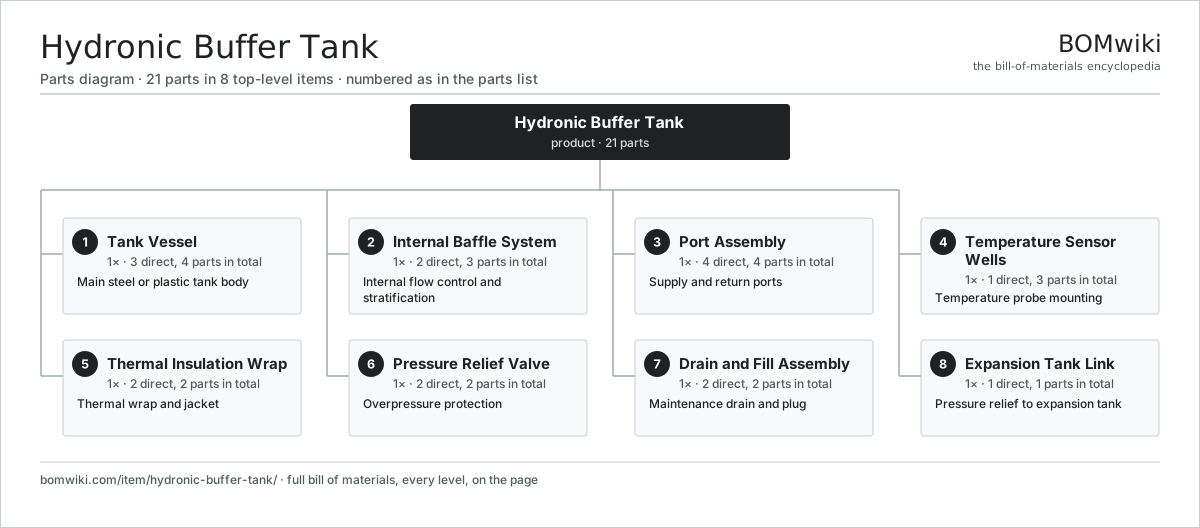
| # | Part | Qty | What it does |
|---|---|---|---|
| 1 | Tank Vessel 3 parts | 1× | Main steel or plastic tank body |
| 2 | Internal Baffle System 2 parts | 1× | Internal flow control and stratification |
| 3 | Port Assembly 4 parts | 1× | Supply and return ports |
| 4 | Temperature Sensor Wells 1 parts | 1× | Temperature probe mounting |
| 5 | Thermal Insulation Wrap 2 parts | 1× | Thermal wrap and jacket |
| 6 | Pressure Relief Valve 2 parts | 1× | Overpressure protection |
| 7 | Drain and Fill Assembly 2 parts | 1× | Maintenance drain and plug |
| 8 | Expansion Tank Link 1 parts | 1× | Pressure relief to expansion tank |
3D model
No 3D model yet. Have a CAD file of this? Add a 3D model. STL renders right on this page; STEP, FreeCAD, and OpenSCAD sources are welcome too (openly licensed, like all 3D models on BOMwiki).
Build & assembly graph
expand / collapse · shared sub-assemblies converge · links to related products · est. labourTap an assembly to expand/collapse · tap a part to open it · use “Open page” for any node · drag to pan, scroll to zoom.
Bill of materials for Hydronic Buffer Tank
8 top-level lines · 25 rows shown · 21 parts total · indented to 3 levels| # | Item / sub-assembly | Part no. | Qty/assy | Ext. qty | Parts | Type |
|---|---|---|---|---|---|---|
| 1 | Tank Vessel 3 parts | hydronic-buffer-tank-vessel | 1× | 1 | 4 | assembly |
| 1.1 | Cylindrical Tank Body | hydronic-buffer-tank-vessel-body | 1× | 1 | · | part |
| 1.2 | Tank End Cap | hydronic-buffer-tank-vessel-head | 2× | 2 | · | part |
| 1.3 | Pipe Nozzles | hydronic-buffer-tank-vessel-nozzles | 1× | 1 | · | part |
| 2 | Internal Baffle System 2 parts | hydronic-buffer-tank-baffles | 1× | 1 | 3 | assembly |
| 2.1 | Divider Plate | hydronic-buffer-tank-baffle-divider | 2× | 2 | · | part |
| 2.2 | Baffle Support Bracket | hydronic-buffer-tank-baffle-support | 1× | 1 | · | part |
| 3 | Port Assembly 4 parts | hydronic-buffer-tank-connections | 1× | 1 | 4 | assembly |
| 3.1 | Supply Inlet | hydronic-buffer-tank-connection-supply | 1× | 1 | · | part |
| 3.2 | Return Outlet | hydronic-buffer-tank-connection-return | 1× | 1 | · | part |
| 3.3 | Hot Water Outlet | hydronic-buffer-tank-connection-draw | 1× | 1 | · | part |
| 3.4 | Pump Connection | hydronic-buffer-tank-connection-pump | 1× | 1 | · | part |
| 4 | Temperature Sensor Wells 1 parts | hydronic-buffer-tank-sensor-wells | 1× | 1 | 3 | assembly |
| 4.1 | Thermowell Pocket | hydronic-buffer-tank-sensor-well-pocket | 3× | 3 | · | part |
| 5 | Thermal Insulation Wrap 2 parts | hydronic-buffer-tank-insulation | 1× | 1 | 2 | assembly |
| 5.1 | Foam Insulation | hydronic-buffer-tank-insulation-foam | 1× | 1 | · | part |
| 5.2 | Protective Jacket | hydronic-buffer-tank-insulation-jacket | 1× | 1 | · | part |
| 6 | Pressure Relief Valve 2 parts | hydronic-buffer-tank-relief-valve | 1× | 1 | 2 | assembly |
| 6.1 | Relief Valve Body | hydronic-buffer-tank-relief-valve-body | 1× | 1 | · | part |
| 6.2 | Pressure Spring | hydronic-buffer-tank-relief-valve-spring | 1× | 1 | · | part |
| 7 | Drain and Fill Assembly 2 parts | hydronic-buffer-tank-drain | 1× | 1 | 2 | assembly |
| 7.1 | Drain Ball Valve | hydronic-buffer-tank-drain-valve | 1× | 1 | · | part |
| 7.2 | Drain Plug Assembly | hydronic-buffer-tank-drain-plug | 1× | 1 | · | part |
| 8 | Expansion Tank Link 1 parts | hydronic-buffer-tank-expansion-connection | 1× | 1 | 1 | assembly |
| 8.1 | Expansion Line | hydronic-buffer-tank-expansion-line | 1× | 1 | · | part |
Something wrong in this list? Report a problem with this BOM.
Sourcing: possible vendors
Browse the supplier directory → Prices, MOQ, and lead times are algorithmic estimates, not quotes, and not claims about these companies. Company mappings are curated by keyword; est. price band $100–$20k. How estimates work| Vendor | HQ | Specialty | MOQ | Lead time |
|---|---|---|---|---|
|
🇺🇸Carrier
carrier.com ↗
|
Palm Beach Gardens, US | HVAC | 500 units | 8–14 wks |
| tranetechnologies.com ↗ | Davidson, US | HVAC | 500 units | 8–14 wks |
|
🇯🇵Daikin
daikin.com ↗
|
Osaka, JP | HVAC | 500 units | 8–14 wks |
|
🇺🇸Lennox
lennox.com ↗
|
Richardson, US | HVAC | 500 units | 8–14 wks |
| johnsoncontrols.com ↗ | Milwaukee, US | Building systems | 500 units | 8–14 wks |
1,029-word article