Hydroseeder
ProductOverview
A hydroseeder is a truck-mounted spray system for large-scale vegetation establishment and erosion control on slopes, embankments, and disturbed land. It combines water, seed, mulch (erosion control fiber), fertilizer, and tackifier (adhesive) in a single slurry tank, then sprays the mixture uniformly over the target area. A single tank can cover 1000–2000 m² depending on slope, vegetation density, and mulch rate.
Hydroseeders dominate highway revegetation, mine reclamation, and post-wildfire slope stabilization where rapid vegetation cover (< 30 days to visible green) is essential for erosion and sediment control. A Hydroseeder costs €60,000–120,000; rental is €300–500/day, justifying ownership for contractors operating regularly (> 20 jobs/year).
The equipment is simple and forgiving: seed loss due to poor contact, weather damage, or animal predation is acceptable (50–70 % germination is typical); the primary goal is preventing erosion while vegetation establishes over 6–12 months. Hydraulic systems tolerate sand and silt ingestion better than mechanical seeders.
How it works
The operator fills the slurry tank with water first (to 50 % capacity), then adds seed (per specification, typically 20–50 kg/1000 m²), mulch fiber (50–100 kg/1000 m²), fertilizer (20–50 kg/1000 m²), and tackifier/adhesive (10–20 L/1000 m²). The tank paddle agitator rotates at 100 rpm, continuously mixing to prevent settling. Tackifier and mulch adhere to seed, creating a slurry that bonds to soil.
The operator drives to the site and parks with clear line-of-sight to the target slope. The centrifugal spray pump is started; the boom arm (or handheld hose if a reel is deployed) is aimed at the slope base and the nozzles are opened to low flow (starting spray). As the operator increases proportional flow control, the spray stream widens and the mist travels 20–40 m upslope depending on water pressure and wind conditions.
The slurry is atomized into a fine mist by the nozzles; gravity causes droplets to fall and adhere to soil. The tacky slurry binds to soil aggregates, seeds, and mulch fibers, creating an armored surface resisting erosion during the critical 30–60 day germination window.
Spray pattern width depends on nozzle size and pressure: a 20–30 bar setup creates a 15 m wide pattern; a higher-pressure setup (up to 50 bar with specialized nozzles) achieves 30–40 m coverage. The operator overlaps passes by 30–50 % to ensure uniform coverage. A 1000 m² slope is typically completed in 1–2 hours depending on access and slope complexity.
Slurry formulation and additives
The slurry is specifically engineered for the target vegetation and soil type:
Seed species: Mixed native grass for highways (perennial ryegrass, tall fescue, native clover). Mine reclamation uses nitrogen-fixing legumes (annual lespedeza, cowpeas) to rapidly improve soil fertility. Slope angles > 60° require fiber-binding species (crown vetch, slope-geranium) with fibrous root systems preventing slippage.
Mulch: Hydroseed fiber is shredded wood or paper; it holds moisture and protects seed from UV and bird predation. Synthetic fiber (polypropylene) is sometimes used in salt or acidic soils where biodegradable mulch decays prematurely. Typical rate: 50–100 kg/1000 m² (thickness: 5–10 mm when dry).
Fertilizer: Balanced NPK (nitrogen-phosphorus-potassium) such as 10-10-10, applied at 20–50 kg/1000 m² depending on soil test. High-nitrogen formulations accelerate greening but can cause lush growth vulnerable to summer drought.
Tackifier: Polymer adhesive (acrylic latex or starch-based) binds slurry to soil. Typical rate: 10–20 L/1000 m². Without tackifier, slurry dries and cracks, and seed is easily displaced by rain splash.
Water: Typically 95 % of slurry by weight. Some formulations include water-retention polymers (superabsorbent, cross-linked polyacrylic acid) to reduce drought stress on emerging seedlings, especially in arid climates.
Germination and establishment
Hydroseeding is successful when seed germinates within 7–14 days (depending on species and temperature). Soil moisture is the limiting factor in dry climates; tackified mulch retains moisture but irrigation (sprinklers, drip) may be necessary in low-rainfall regions. Post-seeding irrigation for 2–4 weeks (1 inch total per week) dramatically improves germination.
Grass emergence is visible at 14–21 days; full vegetative cover (sufficient to prevent erosion) requires 6–8 weeks. Wildflower species mature slower (8–12 weeks) but provide longer-term esthetics and pollinator habitat.
Erosion control is the interim goal. During the bare period (days 1–30), the tackified mulch layer provides physical protection: water doesn't freely flow across the surface, reducing sediment loss by 80–90 %. By day 60, emerging grass roots bind soil, achieving permanent erosion resistance.
Spray pattern and coverage optimization
Coverage uniformity depends on operator technique and nozzle selection. Common mistakes:
- Overlapping errors: Uneven overlaps create thick and thin patches. Best practice: 40–50 % overlap, marked with flags or GPS.
- Pressure variation: Starting at low pressure and increasing partway through a pass causes the spray pattern to narrow mid-way, creating streaks. Solution: establish constant pump speed before spraying.
- Wind drift: Wind > 10 mph carries mist off-target. Spraying in early morning (calm air, high moisture) is optimal.
- Slope geometry: Concave slopes (gullies) collect spray and become over-seeded; ridges are under-seeded. Adjusting nozzle positions and overlaps corrects this.
The flow meter display allows the operator to maintain constant application rate (e.g., 40 L/min). Consistency prevents waste and ensures germination.
Maintenance and troubleshooting
The centrifugal pump is robust but vulnerable to:
- Seed/debris clogging: Strained at the suction strainer, but oversized seeds or clods can block the pump volute. Regular strainer cleaning (weekly) prevents this.
- Slurry settling: Without continuous agitation, heavy fiber and fertilizer settle to the tank bottom. The pump then draws thin slurry initially and thick paste at the end, causing application variability. Continuous agitation at 100 rpm solves this.
- Seal wear: The mechanical pump seal wears from abrasive slurry; replacement every 1000 hours is typical. A failing seal causes slow drips at the pump shaft and eventual slurry loss.
The spray hose is subject to UV degradation (if stored in sun) and internal slurry clogging (if not flushed after each job). Hoses last 2–3 years; replacement cost is €2,000–3,000 for a 50 m section.
The paddle agitator may bend or break if oversized debris (rocks, wood) enters the tank. Screening the water fill and inspecting the tank before adding seed prevents this.
Hydroseeding vs. alternatives
Hand seeding: Laborers scatter seed by hand or broadcast spreader. Cost: €50–100/1000 m², takes 5–10 workers. Suitable for small areas (< 5000 m²). Germination is poor due to poor seed-soil contact.
Mechanical seeding: Grain drills or drop spreaders apply seed in rows. Cost: €100–200/1000 m², faster than hand seeding but limited to shallow slopes (< 45°). Poor for steep slopes and rocky ground.
Aerial seeding: Helicopter-dropped seed (typically on mountain slopes). Cost: €500–1500/1000 m², extremely fast (100+ hectares per day) but low germination (10–20 %) and unsuitable for steep slopes vulnerable to slipping.
Hydroseeder: Cost €150–300/1000 m² (including labor and slurry), fast (1000 m²/day), high germination (40–70 %) on all slope angles, integrates mulch and tackifier. Standard choice for revegetation.
Environmental impact and regulations
Hydroseeding is environmentally favorable:
- Native species: Preserves local plant communities, supports native fauna.
- Low chemical load: Fertilizer is balanced; no herbicides or insecticides typical in hydroseeding mixes (though available as additives).
- Erosion prevention: Rapid vegetation cover prevents downstream sedimentation.
Regulations in most jurisdictions require hydroseeding of exposed slopes > 5 % grade and > 2000 m² area following construction. Stormwater discharge must be <10 mm/km, achieved by tackling and vegetating slopes within 14 days.
Some sensitive areas (stream buffers, endangered species habitat) restrict seed mixes and timing; the contract documents specify details.
Standards and specifications
Hydroseeding is governed by:
- ASTM D6457: Hydroseed application equipment and methods.
- APWA Green Book: Standard Specifications for Public Works Construction (includes hydroseeding standards).
- Local erosion control ordinances: Specify minimum coverage timing and vegetation density.
Most contracts reference a regional "Recommended Plant List" detailing species for soil type, climate zone, and erosion class (light, medium, severe). Contractor selects the seed mix from approved list, often coordinating with a soil scientist.
Hydroseeder parts and their functions
7 top-level parts · 37 parts in total · full bill of materials below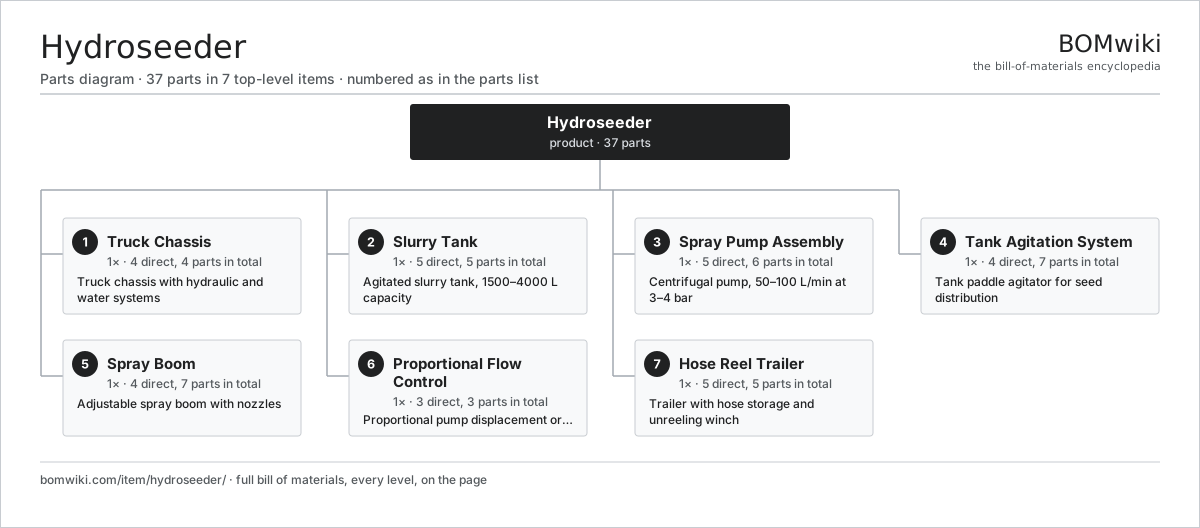
| # | Part | Qty | What it does |
|---|---|---|---|
| 1 | Truck Chassis 4 parts | 1× | Truck chassis with hydraulic and water systems |
| 2 | Slurry Tank 5 parts | 1× | Agitated slurry tank, 1500–4000 L capacity |
| 3 | Spray Pump Assembly 5 parts | 1× | Centrifugal pump, 50–100 L/min at 3–4 bar |
| 4 | Tank Agitation System 4 parts | 1× | Tank paddle agitator for seed distribution |
| 5 | Spray Boom 4 parts | 1× | Adjustable spray boom with nozzles |
| 6 | Proportional Flow Control 3 parts | 1× | Proportional pump displacement or nozzle valve |
| 7 | Hose Reel Trailer 5 parts | 1× | Trailer with hose storage and unreeling winch |
3D model
No 3D model yet. Have a CAD file of this? Add a 3D model. STL renders right on this page; STEP, FreeCAD, and OpenSCAD sources are welcome too (openly licensed, like all 3D models on BOMwiki).
Build & assembly graph
expand / collapse · shared sub-assemblies converge · links to related products · est. labourTap an assembly to expand/collapse · tap a part to open it · use “Open page” for any node · drag to pan, scroll to zoom.
Bill of materials for Hydroseeder
7 top-level lines · 37 rows shown · 37 parts total · indented to 3 levels| # | Item / sub-assembly | Part no. | Qty/assy | Ext. qty | Parts | Type |
|---|---|---|---|---|---|---|
| 1 | Truck Chassis 4 parts | hydroseeder-chassis | 1× | 1 | 4 | assembly |
| 1.1 | Truck Frame | hydroseeder-truck-body | 1× | 1 | · | part |
| 1.2 | Engine | hydroseeder-engine | 1× | 1 | · | part |
| 1.3 | Hydraulic Pump | hydroseeder-hydraulic-pump | 1× | 1 | · | part |
| 1.4 | Power Transmission | hydroseeder-transmission | 1× | 1 | · | part |
| 2 | Slurry Tank 5 parts | hydroseeder-tank | 1× | 1 | 5 | assembly |
| 2.1 | Tank Shell | hydroseeder-tank-shell | 1× | 1 | · | part |
| 2.2 | Manway Cover | hydroseeder-tank-manway | 1× | 1 | · | part |
| 2.3 | Tank Baffles | hydroseeder-tank-baffles | 1× | 1 | · | part |
| 2.4 | Suction Strainer | hydroseeder-tank-strainer | 1× | 1 | · | part |
| 2.5 | Water Inlet | hydroseeder-water-fill | 1× | 1 | · | part |
| 3 | Spray Pump Assembly 5 parts | hydroseeder-pump | 1× | 1 | 6 | assembly |
| 3.1 | Pump Impeller | hydroseeder-pump-impeller | 1× | 1 | · | part |
| 3.2 | Pump Housing | hydroseeder-pump-housing | 1× | 1 | · | part |
| 3.3 | Pump Bearing | hydroseeder-pump-shaft-bearing | 2× | 2 | · | part |
| 3.4 | Pump Seal | hydroseeder-pump-seal | 1× | 1 | · | part |
| 3.5 | Discharge Check Valve | hydroseeder-pump-discharge-valve | 1× | 1 | · | part |
| 4 | Tank Agitation System 4 parts | hydroseeder-agitation | 1× | 1 | 7 | assembly |
| 4.1 | Agitator Motor | hydroseeder-agitator-motor | 1× | 1 | · | part |
| 4.2 | Agitator Shaft | hydroseeder-agitator-shaft | 1× | 1 | · | part |
| 4.3 | Agitator Paddle | hydroseeder-agitator-paddles | 4× | 4 | · | part |
| 4.4 | Agitator Bearing | hydroseeder-agitator-bearing | 1× | 1 | · | part |
| 5 | Spray Boom 4 parts | hydroseeder-spray-boom | 1× | 1 | 7 | assembly |
| 5.1 | Boom Arm | hydroseeder-boom-arm | 1× | 1 | · | part |
| 5.2 | Spray Nozzle | hydroseeder-spray-nozzles | 4× | 4 | · | part |
| 5.3 | Boom Hose | hydroseeder-boom-hose | 1× | 1 | · | part |
| 5.4 | Nozzle Holder | hydroseeder-nozzle-holder | 1× | 1 | · | part |
| 6 | Proportional Flow Control 3 parts | hydroseeder-proportional-control | 1× | 1 | 3 | assembly |
| 6.1 | Proportional Valve | hydroseeder-proportional-valve | 1× | 1 | · | part |
| 6.2 | Flow Meter | hydroseeder-flow-meter | 1× | 1 | · | part |
| 6.3 | Proportional Amplifier | hydroseeder-proportional-amplifier | 1× | 1 | · | part |
| 7 | Hose Reel Trailer 5 parts | hydroseeder-hose-reel | 1× | 1 | 5 | assembly |
| 7.1 | Reel Frame | hydroseeder-reel-frame | 1× | 1 | · | part |
| 7.2 | Reel Motor | hydroseeder-reel-motor | 1× | 1 | · | part |
| 7.3 | Reel Drum | hydroseeder-reel-drum | 1× | 1 | · | part |
| 7.4 | Quick-Disconnect Coupling | hydroseeder-reel-coupling | 1× | 1 | · | part |
| 7.5 | Reel Brake | hydroseeder-reel-brakes | 1× | 1 | · | part |
Something wrong in this list? Report a problem with this BOM.
Sourcing: possible vendors
Browse the supplier directory → Prices, MOQ, and lead times are algorithmic estimates, not quotes, and not claims about these companies. Company mappings are curated by keyword; est. price band $15k–$2M. How estimates work| Vendor | HQ | Specialty | MOQ | Lead time |
|---|---|---|---|---|
| caterpillar.com ↗ | Irving, US | Construction & mining equipment | made to order | 16–28 wks |
|
🇯🇵Komatsu
komatsu.com ↗
|
Tokyo, JP | Construction & mining equipment | made to order | 16–28 wks |
|
🇸🇪Volvo CE
volvoce.com ↗
|
Gothenburg, SE | Construction equipment | made to order | 16–28 wks |
|
🇨🇭Liebherr
liebherr.com ↗
|
Bulle, CH | Cranes & heavy equipment | made to order | 16–28 wks |
|
🇨🇳XCMG
xcmg.com ↗
|
Xuzhou, CN | Construction machinery | made to order | 16–28 wks |
1,394-word article